
Search
The Rare & Early Newspapers Hobby

Receive the Newsletter

Buy Historic Newspapers

April Newsletter (2026) – Timothy Hughes Rare & Early Newspapers…
April 17, 2026 by GuyHeilenman · Leave a Comment  Email This Post
|
Email This Post
|  Print This Post
|
|
If you liked this post, you may also enjoy...
- March, 2024 Newsletter from Timothy Hughes Rare & Early Newspapers…
- The April (2023) Newsletter from Rare & Early Newspapers…
- The October (2019) Newsletter from Rare & Early Newspapers…
- The January (2023) Newsletter from Rare & Early Newspapers…
- The July, 2025 Newsletter from Timothy Hughes Rare & Early Newspapers…
Who’s Who in Newspapers? Father Thomas edition…
April 13, 2026 by Phineas Q. Wryte · 1 Comment Email This Post
| Print This Post
The 13th installment of Who’s Who in Newspapers
Many visitors to the History’s Newsstand Blog are familiar with the Damascus Affair of 1840 — one of the most consequential antisemitic episodes of the 19th century. Far fewer, however, know the name at the center of the storm: Father Thomas. It is his disappearance that lit the fuse, and it is his name that echoed through the newspapers of the day — including the remarkable report shown below, from our original issue of The Times (London), dated May 8, 1840.
Father Thomas: The Disappearance That Shook the World
Father Thomas of Tuscany (c. 1768–1840) was a Franciscan friar and physician serving in Damascus, Syria, then under the control of Egyptian ruler Mehemet Ali. On February 5, 1840, Father Thomas and his servant Ibrahim Amara vanished without a trace. What followed was not merely a criminal investigation — it was a catastrophe for the Jewish community of Damascus and, ultimately, for Jewish communities across the globe.
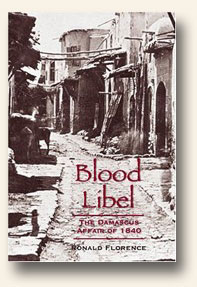
French Consul Ulysse de Ratti-Menton seized upon the disappearance to level charges against prominent local Jews, alleging that Father Thomas had been murdered as part of a ritualistic killing — the ancient and thoroughly debunked “Blood Libel” accusation, which falsely claimed that Jews used the blood of Christians in religious rites. Under torture, confessions were extracted. Several Jewish men died in captivity. Others faced execution. The affair sent shockwaves from Damascus to London, Paris, and beyond.
What makes the Damascus Affair historically significant — beyond its immediate horror — is the response it provoked. Jewish leaders in Europe, including Sir Moses Montefiore of England and Adolphe Crémieux of France, organized an international campaign on behalf of the accused, traveling to Egypt to appeal directly to Mehemet Ali. Their efforts represent one of the earliest instances of organized, international Jewish advocacy — a precursor, in many ways, to the modern human rights movement.
The report shown in full below offers a remarkable window into how the affair was unfolding in real time. Sourced from private letters arriving via Malta, the account describes how the Jews of Alexandria petitioned Mehemet Ali on April 9th, asking that those accused of Father Thomas’s murder be judged by the Viceroy himself. Seven leading men were received at the Palace, where Mehemet Ali acknowledged he had never encountered such a charge against the Jewish nation in all his years of rule. Crucially, he forbade the use of torture against the prisoners — a directive sent by dromedary to Commander-General Scheriff Pasha in Damascus. The report concludes with a notable observation: “This spirit of liberality and justice on the part of Mehemet Ali is a striking symptom of the progress of civilization in the East.”
As for Father Thomas himself — his fate was never definitively established. The accusations against the Damascus Jews were never formally dropped, though the imprisoned survivors were eventually released following the international intervention of Montefiore and Crémieux later that summer.
History has long since judged the Damascus Affair as a grotesque miscarriage of justice, fueled by antisemitism and political opportunism. The Blood Libel charge had no basis in fact — then or ever. Yet it is the name of Father Thomas that remains permanently linked to one of the 19th century’s darkest chapters: not because he caused it, but because his disappearance became the pretext for it.
This original Times of London report offers readers of today an unmediated glimpse into the unfolding events of 1840 — and is precisely what makes collecting historic newspapers so endlessly rewarding. The news, as they say, never gets old.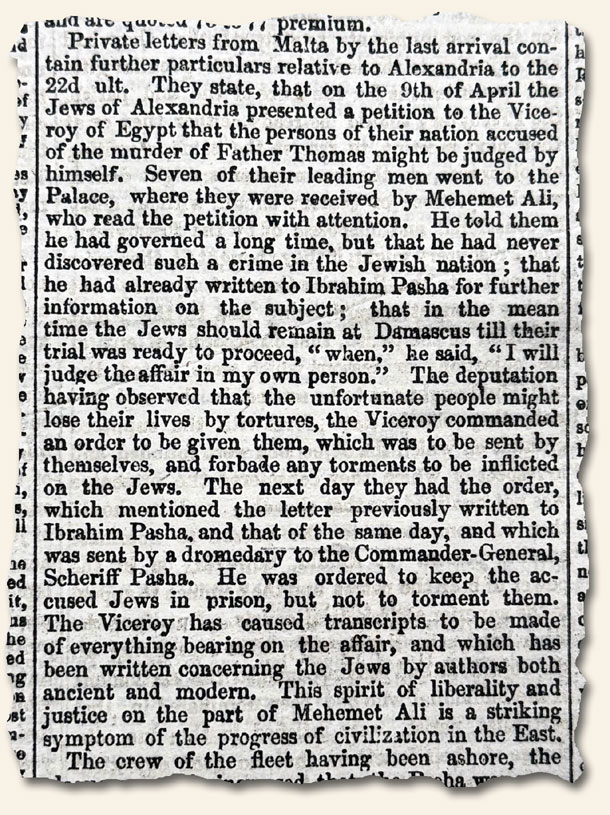
If you liked this post, you may also enjoy...
- The Haggadah (during Passover) – 1st mention in a New York Times…
- April Newsletter (2026) – Timothy Hughes Rare & Early Newspapers…
- Early Jewish America through the eyes of historic newspapers…
- Who’s Who in Newspapers? Citizen Genêt edition…
- Equal rights – a long and arduous path…
What’s in a Masthead – An 1800s Boston Investigator…
April 10, 2026 by Phineas Q. Wryte · 1 Comment Email This Post
| Print This Post
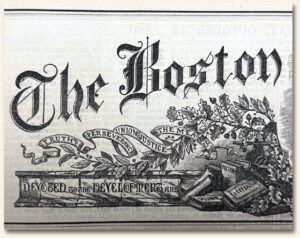 At first glance, the bold Gothic lettering of The Boston Investigator seems simply to announce a title—but linger a moment, and it reveals a creed. Founded in 1831, the paper became one of America’s longest-running freethought journals, devoted to skepticism, reform, and intellectual independence. By the 1880s, its identity was not merely stated but artistically embedded. The masthead itself functioned as a declaration of purpose, inviting readers into a publication that questioned orthodoxy and encouraged inquiry.
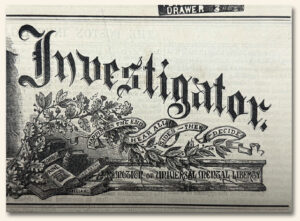
The imagery is deliberate and richly layered. Laurel and oak branches evoke endurance and strength, while flowing banners proclaim ideals such as “Truth,” “Perseverance,” and “Justice.” A cluster of books—bearing names like Paine, Voltaire, and Jefferson—anchors the paper firmly in Enlightenment tradition. And perhaps most striking is the phrase arcing confidently across the design: “Hear All Sides — Then Decide.” In an era often caricatured as rigid or dogmatic, here is a publication quite literally engraving open-minded debate into its identity. The Investigator was not merely tolerating dissent—it was institutionalizing it.
That makes the masthead feel remarkably modern—and, in some ways, quietly defiant even now. Its rebellious spirit from the 19th century champions a principle that can feel increasingly fragile today: the willingness to entertain opposing views before forming conclusions. Where much of the present climate tends to narrow discourse and reward certainty over curiosity, this 19th-century newspaper boldly carved intellectual openness into its very banner. So, what’s in a masthead? In this case, everything: a philosophy of inquiry, a commitment to dialogue, and a timeless challenge to think freely.
PS The Boston Investigator is considered to be the first American newspaper dedicated to the cause of freethought.
If you own an authentic newspaper with a “special” masthead and you would like to share it with the collectible community, please send a clear photo of the masthead and the description you would like included to me at pqwryte@rarenewspapers.com.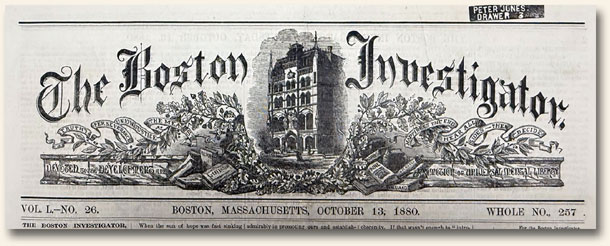
If you liked this post, you may also enjoy...
- Period printing… Did you ever notice…?
- Are Presidential proclamations for thanksgiving and prayer unconstitutional?
- The reason I collected it: The Spy…
- What’s the title?
- More than just another anti-slavery newspaper… A recent find…
Lead-up to a Nation… as reported in the newspapers of the day (reflecting back on March, 1776)…
April 3, 2026 by GuyHeilenman · Leave a Comment Email This Post
| Print This Post
-
Colonies in Flux – The Influence of Common Sense (Lead-up to a Nation – E31)
-
General William Howe – The Pennsylvania Ledger (Lead-up to a Nation – E32)
-
The Siege of Boston – Debate at the House of Commons (Lead-up to a Nation – E33)
-
Diverse Voices – Divisions of the Era (Lead-up to a Nation – E34)
We hope you are enjoying this year-long trek to the 250th anniversary of The United States through the eyes of those who were fully engaged, first hand. As mentioned previously, all accounts are rooted in what they read in the newspapers of the day.
“History is never more fascinating than when read from the day it was first reported.” (Timothy Hughes, 1975)
If you liked this post, you may also enjoy...
- Lead-up to a Nation… as reported in the newspapers of the day (Intro & Sept., 1775)…
- Lead-up to a Nation… as reported in the newspapers of the day (October, 1775)…
- Lead-up to a Nation… as reported in the newspapers of the day (January, 1776)…
- Lead-up to a Nation… as reported in the newspapers of the day (November, 1775)…
- Lead-up to a Nation… as reported in the newspapers of the day (February, 1776)…
Who’s Who in Newspapers? Jack Johnson edition (1910)…
March 30, 2026 by GuyHeilenman · Leave a Comment Email This Post
| Print This Post
The 12th installment of: Who’s Who in Newspapers
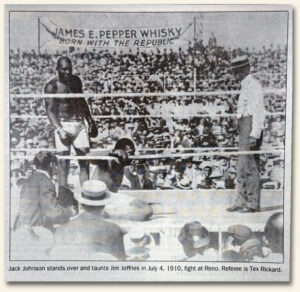 If you’re a boxing enthusiast, you may know the turn-of-the-century “Galveston Giant,” John (Jack) Johnson. Yet far fewer people know the depth of his struggle against bigotry, open hatred, and injustice.
Born in Galveston, Texas in 1878 to formerly enslaved parents, Johnson rose from the rough world of late-19th-century prizefighting to become the first Black heavyweight champion of the world in 1908. In the ring he was brilliant—defensively skilled, confident, and often playful as he dismantled opponents. Outside it, he lived defiantly in an era that demanded Black men show deference. His wealth, fame, and refusal to conform—especially his relationships with white women—made him a lightning rod for racial hostility across America. Authorities eventually targeted him using the Mann Act, widely viewed by historians as a politically motivated prosecution.
His story came back to my attention recently when a collecting friend asked if we had a Los Angeles Times dated July 8, 1990. To be honest, while he often seeks newspapers with Black-American content, I would never have guessed Jack Johnson was at the heart of his quest.
If you are concerned about racism—and are not afraid to confront the warts of the past—spending a little time researching Johnson’s life can be sobering. At the same time, it can also serve as a reminder of how far our society has progressed in confronting bigotry.
Below is a photo of the introduction to the article our friend was seeking. While the lengthy piece may still be available in its original context through the link above, at least for now the Los Angeles Times provides open access to the article’s text at: “80 Years Ago, the Truth Hurt.”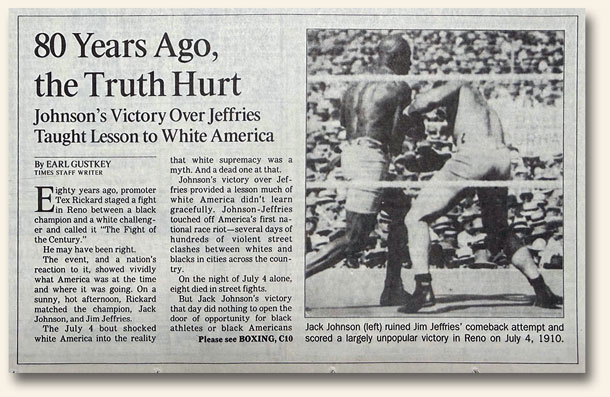
If you liked this post, you may also enjoy...
- The Traveler… Jack Johnson bombs…
- Who’s Who in Newspapers? Lewis H. Latimer edition…
- Calendar Section of the Los Angeles Times … Mini-Time Capsules of Our Lives…
- The Traveler… Too Much Pain and Suffraging…
- Jack the Ripper… on Pinterest
Announcing: Catalog 365 – Released (early) for April, 2026 – Rare & Early Newspapers…
March 27, 2026 by Phineas Q. Wryte · Leave a Comment Email This Post
| Print This Post
|
|
If you liked this post, you may also enjoy...
- Announcing: Catalog #329 for April, 2023 – Rare & Early Newspapers…
- Announcing: Catalog #327 for February, 2023 – Rare & Early Newspapers for collectors…
- Announcing: Catalog #321 (for August, 2022) – Rare & Early Newspapers for collectors…
- Announcing: Catalog #322 for September, 2022 – Rare & Early Newspapers for collectors…
- Announcing: Catalog #341 for April, 2024 – Rare & Early Newspapers…
Mystery Solved … The Ancestry of Abraham Lincoln Clarified…
March 23, 2026 by Laura Heilenman · 1 Comment Email This Post
| Print This Post
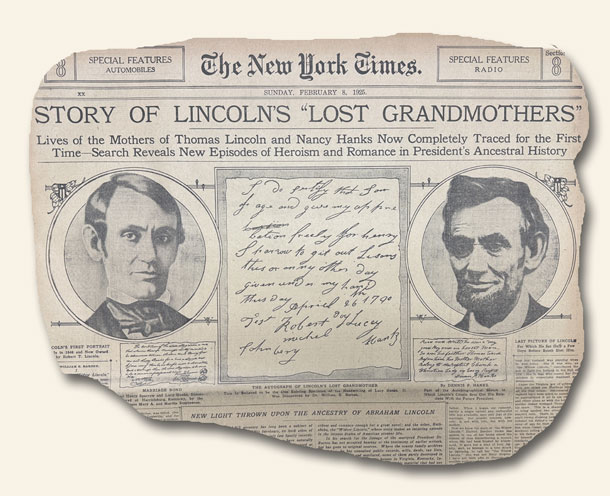
We often discuss the legacy of our founding fathers and American heroes… highlights of their lives which leave an indelible impression on us as individuals or on the country we cherish. With all this focus, it is a shame we often miss the stories of their ancestry… the people and events that molded them into the larger-than-life figures we admire. Such is the case with Abraham Lincoln. Although we have all learned of his self-education in a one room log cabin and the deep loses he suffered as a young man, it wasn’t until 1925 that we were able to get a clearer picture of family members who came before and how their stories might have impacted the Lincoln. On February 8, 1925 The New York Times had substantial coverage of Abraham Lincoln’s grandmothers who had, until this point, not been confirmed. The paper goes on to say the stories of these ladies reveal. “Episodes of Heroism and Romance in the president’s Ancestral History”. Not unlike today, apparently, people at the turn of the century longed for a good paparazzi story as well.
If you liked this post, you may also enjoy...
- Lincoln & Whitman … it’s all in the perspective…
- Will the real Abraham Lincoln please stand up?
- My collecting story… M.M. in Freeport, NY…
- America – pulling a nation back together…
- The Assassination of Abraham Lincoln… one the the very best…
Vanguard to Revolution…
March 20, 2026 by Laura Heilenman · Leave a Comment Email This Post
| Print This Post
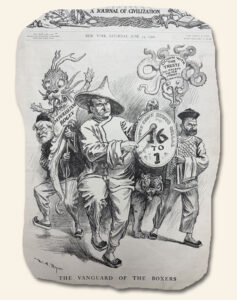 One of the fascinating areas of historic newspaper collecting is the ability to see patterns over time. Last week, I found a Harper’s Weekly for a collector with a fascinating front page print that caught my attention and the caption triggered a deeper search. The Boxer Rebellion of the 1900’s included a group called “Vanguards”. Although familiar with this term, I was curious as to other times this concept had popped up throughout history. The following is an overview of my discovery…
If you liked this post, you may also enjoy...
- They put it in print… George Washington called a quack…
- The Traveler… boxed himself into a corner…
- They put it in print… Forget the boxer: don’t mess with his wife…
- Additional kudos for, “Reporting the Revolutionary War”…
- Weaponry in the 17th century… distant cousin of the modern hand grenade…
March Newsletter (2026) – Timothy Hughes Rare & Early Newspapers…
March 16, 2026 by GuyHeilenman · Leave a Comment Email This Post
| Print This Post
|
|
If you liked this post, you may also enjoy...
- April Newsletter (2026) – Timothy Hughes Rare & Early Newspapers…
- February Newsletter (2026) – Timothy Hughes Rare & Early Newspapers…
- March, 2024 Newsletter from Timothy Hughes Rare & Early Newspapers…
- Holiday Newsletter (2025) – Timothy Hughes Rare & Early Newspapers…
- The October (2019) Newsletter from Rare & Early Newspapers…
St. Patrick’s Day…
March 14, 2026 by Laura Heilenman · Leave a Comment Email This Post
| Print This Post
St. Patrick’s Day is right around the corner and with it comes a festive feel and a great reason to celebrate. Whether you are planning on a great meal at your local Irish Pub or some homemade Corned beef & Cabbage, there is something about St. Patrick’s Day that highlight’s Springs fast approach. So, enjoy your pint and grub, a good Irish movie (The Quiet Man is my favorite) and a walk down memory lane as you scan coverage of the oldest continuously running St. Patrick’s day parade in the world highlighted in the Mid-Week Pictorial & The New York Herald. Whatever your mode of celebration… May the Luck of the Irish be with you!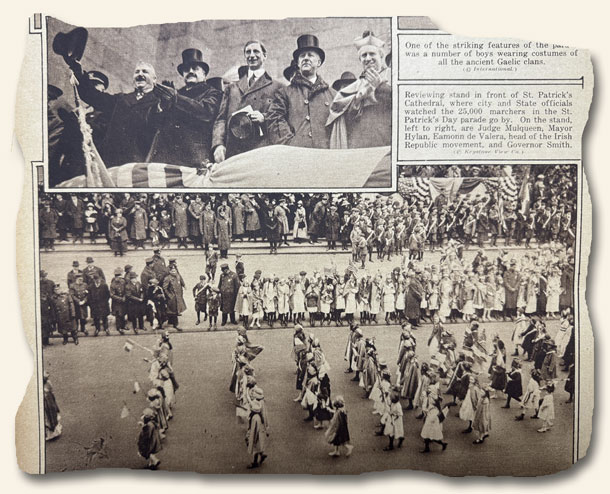
If you liked this post, you may also enjoy...