

Search
History of Newspapers Video (see more)
Email Subscription
Sign up to receive our latest blog updates!Buy Historic Newspapers

Genuine or reprint?
March 26, 2009 by TimHughes  Email This Post
|
Email This Post
|  Print This Post
A great fear of any novice collector is knowing whether an item purchased is genuine or not. It’s a valid concern, as the other collectibles have been infested by reproduction,s reprints, or deceivingly fake material from furniture to coins to baseball collectibles.
The world of rare newspapers is not immune but it is not a serious problem either. With a few helpful hints almost every collector can avoid the pitfalls of having non-genuine newspapers end up in their collection.
Fake material of any collectible seems to become an problem when popularity and values grow. Since rare newspaper collecting remains a relatively unknown hobby with relatively low prices there is little incentive to create fake editions. And the requirements to recreate a 200 year old newspaper to have it look like a genuine edition can be complex and expensive.
With but one exception, I am not aware of any reprinted newspapers which were created to deceive. Virtually all facsimile issues on the market were created as souvenirs of historic events (Honolulu issues on Pearl Harbor can still be purchased at the memorial), on anniversaries of the first issue printed (many volume one, number one issues are reprints), as curious give-aways or “premiums” (major events such as the Boston Massacre, Declaration of Independence, etc. were reprinted), or as teaching tools in an educational environment (Harper’s Weekly issues from the Civil War were reprinted on their 100th anniversary: look for “a reissue of” above the “H” in “Harper’s Weekly” on page 1).
The lone exception is a collection of the “Pennsylvania Gazette” from the 1730’s – 1787 with issues turning up in small auction halls throughout the East some 20 years ago. The issues were aged to look 200 years old and the paper was very close to genuine newsprint from the era. Beware of this title if it contains a “Tontine Coffee House” inked stamp on the front page & if it looks a bit washed out.
The number of reprint newspapers on the market is exceedingly small so collectors have little to worry about. But keep these points in mind:
1) The most common reprint newspapers are on the Library of Congress check-list. Go here to keep the list handy. It also includes helpful tips on how to tell if genuine or a reprint.
2) Be aware of what 200 year old and 100 year old newsprint should look like. Almost all reprints were done on paper which is not reflective of the era.
3) Be suspicious of exceedingly historic newspaper turning up in illogical places. The likelihood of a genuine Declaration of Independence report being in flea market or amongst of group of papers from a non-collecting family is very remote. In other words if the find seems too good to be true, it likely is.
4) Be careful with volume one, number one newspapers. Such first editions were commonly reprinted by the publisher on the 50th or 100th anniversary.
5) Above all, buy from reputable dealers whose expertise, experience and reputation stand behind all they sell.
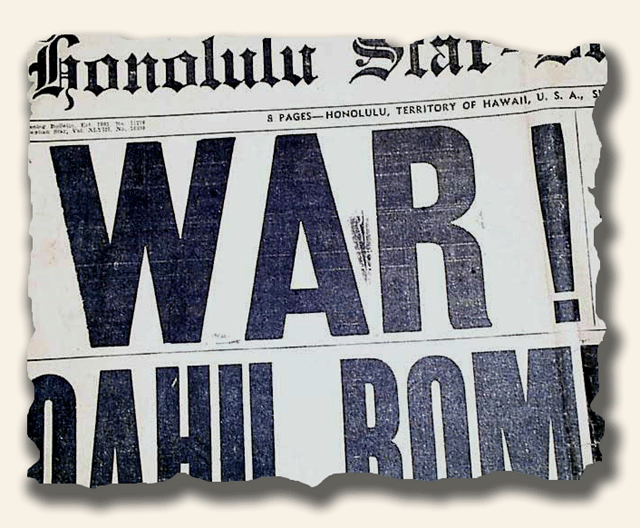 The “Honolulu Star-Bulletin” of Dec. 7, 1941 mentioned above is not on the Library of Congress check-list, however it’s easy to spot a reprint. The genuine issue has an ink smear between the “A” and “R” in the huge word “WAR!” on the front page (see photo). They cleaned it up on the reprint so it won’t be present.
And a news flash–I just learned that the “Dallas Morning News” issue of Nov. 23, 1963 reporting Kennedy’s assassination has been reprinted. Look for the word “Reprint” in the dateline just after the four stars. Do note those we have on our website & have sold for over 20 years are all genuine!
Common sense can be the best guide. The requirements to reprint an 8 page Civil War newspaper with a minor battle report could cost hundreds of dollars while the genuine issue might sell for $20, so chances are good such finds are genuine. For this reason our hobby is a fascinating one not prone to the pitfalls of other collectibles.
Our community of collectors is quite small which has worked in our favor. All of us are in an enviable position of being able to assemble great collections of historic material before the world at large “discovers” our hobby and changes the environment in years to come.
Enjoy!
If you liked this post, you may also enjoy...
- Your help would be appreciated…
- The reprint issues of the “Honolulu Star-Bulletin” Pearl Harbor issue…
- Collecting Historic and Rare Newspapers Basics – Part One
- Extensive list of reprinted newspapers…
- Documenting an early reprint of the Ulster County Gazette…
Comments
30 Responses to “Genuine or reprint?”
Feel free to leave a comment...
and oh, if you want a pic to show with your comment, go get a gravatar!
The best source of information I have seen is “An Annotated Index of American Newspaper Editions Known to Have Been Reprinted” which Rick Brown, now of historybuff.com, published in 1992. I think it is now out of print, but I got another copy of it on eBay recently. I have been the unwitting recipient of a couple of reprints on eBay. I think I am getting better at spotting them in the photos on eBay before bidding.
Yes, ” An Annotated Index of American Newspaper Editions Known to Have Been Reprinted” is long out of print. In fact, I only have 2 copies myself. I am in the process of putting this work on a CD with the reprints being searchable. Since published, I have documented over 100 reprints that were not in the original publication. Included with the CD will be actual swatches of hand-made rag linen, machine-made rag linen, and Old woodpulp (Used primarily between 1878 – 1920.) Production of this work has been quite slow due to lack of funds. I have been unemployed for the last 59 weeks so I don’t have any “discretionary” income to put towards the cost.
Although I certainly agree that the original publishers of reprints had no intention of deceiving the general public I cannot say that is true of people today who knowingly try to sell reprints as originals.
Granted, there are some today who honestly believe the reprint paper they have is an original and promote it as an original. Never the less, to the buyer of such reprints it is no consolation to know that the seller had no intent to deceive you. The seller’s innocence of conscious deception does not make your fake newspaper any easier to accept.
I recently wrote to a seller to inform him, with substantial evidence, that the paper he was claiming to be an original was, in fact, a reprint. His response to me was, “You know that, and I know that, but they do not know that.”
One of the most informative books on newspaper reprints is one entitled: An Annotated Index of American Newspaper Editions Known to Have Been Reprinted. This book was compiled by Rick Brown and published in 1992.
To the best of my knowledge this book is no longer being printed, but it would be worth your while to try and find this book, especially if you are new to collecting newspapers.
The book provides excellent tips on detecting reprints and also lists about 400 newspapers, from 1689 to 1974, that have been reprinted. I always keep this book by my side when browsing newspapers on Ebay.
Morris
Morris – You are quite correct in that many reprint issues on ebay are being offered as genuine. In some cases I believe the seller truly is not aware (I’ve been thanked many times when I was in touch and the sellers removed the items from ebay) but there are also times when I believe the seller conveniently does not address the situation. My comment in my post was that with one exception reprints were not created to deceive. The after-market is a completely different situation.
[…] The rest is here: Genuine or reprint? : History’s Newsstand Blog […]
Hi Tim an all above thank you for your posts I have found this very helpful, however I am still no closer to finding out if the first edition of the UKs News of the world in 1843 is a reprint or a genuine print as it has been hidden away in a cupboard for years an years. Is there a tell tale mark or stamp to look for? Is there a professional who woul be able to help? All comments will be much appreciated! Thanks Kayleigh.
Hello,After reading up on re-print newspapers I am still left wondering if my newspaper is an original and how to know for sure. It was found in the basement of an Antique store in Massachusetts that has been around for many , many years. I purchased the entire contents at auction. The newspaper I have is a Daily Evening transcript. Volume 1, No1. It is in an old frame behind glass on both sides so you can see all 4 pages. The paper is old and it had been repaired at one time along the folds with tape in some spots that has now yellowed a bit. it was displayed at one time and the reverse side is a lot whiter than the front page side. I realize that Volume 1, no 1 is a common reprint but the other art that I found with this paper is from around the same time period and was buried under layers and layers of dust. The page size is approx. 15 tall by 10.75″ tall . That is most likely not an exact measurement because some of the margin is behind the frame and I don’t want to remove it from the frame. Any help you can offer me is greatly appreciated.
Thank you,
Dean
My 91 year old aunt has a collection of papers she is curious about. She found them at the bottom of an old trunk at her aunt’s house in Connecticut many years ago, and thinks they are the real deal. They are NYT’s-there are about 150 of them, all from the time leading up to Lincoln’s assassination. The last hundred days of Lincoln, so to speak. She says they are on very white paper, and thinks it is because they are printed on linen, instead of cotton because of the war shortages.
Could these be reprints? She’s not very tech savvy, so I don’t know if she could manage a picture. What’s the best way to handle them? She says they are about 22″ x 34″.
Thank you,
Marlene
I have a 1991 reprint of the December 8, 1941 NYTimes paper. It looks genuine, as it should. But eventually I want the real deal. Are there any signs to look for that are different between the reprint and the real deal?
Thanks.
We have several posts through the following link which may help in terms of comparison. We are always happy to verify if you find one.
Link: http://blog.rarenewspapers.com/index.php?s=pearl+Harbor
I have an original newspaper from
Milwaukee Journal, Aug 15, 1945.
I Know it’s original as my parents were married in June, 1945 and they saved the paper in an acid free-padded envelope & gave it to me when I opened my antique shop.
I couldn’t part with it then, but I have
incurable Leukemia . Medicare has decided I no longer need Chemotherapy & denied payments.
Can anyone tell me how/where I can sell this newspaper now as I really need the money & don’t know how to form a “fund me ” account. Thankyou
Title: War Over!!! Truman says
Sorry for your bad news. eBay could potentially be your best option.
Sorry for your bad news. eBay could potentially be your best option.
Hello I am here trying to figure out if the newspaper clipping i own is real or not its a san Francisco Examiner with germany surrenders printed on the front page and when i open it shows the titanic sinking idk if the paper is real or not
Hello Daryna – What you have is not an original. Sorry.
I have a New York Herald, Saturday April 15 1865. This paper has been pieced together with what looks to be old scotch tape. It is a 1 page piece in a frame, so I have not looked at the backside. It is yellowed, and is part of that edition that dealt with Lincoln assassination. The page starts out with GRANT on the left upper side at the top. How do I know if this is a reprint? It looks to be very frail, but legible reading. I have no idea what page it is. Thanks I hope it is not fake.
Hello Richard – Please contact me (Guy) by e-mail (guy@rarenewspapers.com), and include a couple of close-up photos, and I’ll tell you want I think.
Hello. I recently bought a Massachusetts Gazette I feel pretty confident its genuine, but I was wondering whether you would be willing to take a glance and see what you think. It has the right look and feel, but an expert opinion would be great. Thank you for all the great information in this blog.
Hello Aaron – Sorry, but we do not monitor such questions from here. Please send us information regarding what you have to us at info@rarenewspapers.com. Thanks for your understanding. We’ll certainly take a look at it and give you our thoughts.
I have a nov 23 Rd Dallas morning news that says Kennedy Dallas slain and I’m trying to figure out if it’s a reprint or original
I have a newspaper. may 1927 Brooklyn Daily Eagle Lindbergh Flight. Very good shape. Have listed on ebay. Was asked if it was a reprint. Never thought about it and i do not know. Carefully looked at it and can not find any obvious notes that it is or is not.
Regardless am declutering, I want to sell it but am always honest in my transactions.
Any advice or interest
Sorry, but we do not monitor such questions from here. Please send us information regarding what you have to us at info@rarenewspapers.com. Thanks for your understanding.
Sorry, but we do not monitor such questions from here. Please send us information regarding what you have to us at info@rarenewspapers.com. Thanks for your understanding.
i have just come into some old papers ,some i know are real not sure about one , i have the times dated march 1809 .the sun queen victorias corination, news of the world 1st edition , not sure how to tell if original.daily mirror october 11 1930. queen mary suppliment 1936.news chronicledecember 10th 1936.the birmingham post claerwen dam supplement,2 editions of our home dated 1889 and 3 editions of womens weekly dated 1932
Hello John,
It is best to send me (Guy) details (exact title and date) along with a photo of the front pages to guy@rarenewspapers.com. Once received I’ll let you know what I think.
How can I tell if my Titanic sinks newspaper is real
Send a few closeup pictures and the title and exact date of the newspaper to me at guy@rarenewspapers.com, and I’ll let you know what I think.
Guy,
I have been cleaning out a friend’s house and we came across a New York Times, April 16, 1912 newspaper of the Titanic. Can you tell us if it’s an original? It is the full newspaper. I have read your previous comments/replies so I am going to email you some pictures. If you have time could you look at them and let us know.
Thank you,
Janelle
If you have not done so already, send this information with a few photos to info@rarenewspapers.com, and we will let you know what we think.