

Search
The Rare & Early Newspapers Hobby

Receive the Newsletter

Buy Historic Newspapers

Who’s Who in Newspapers? Jack Johnson edition (1910)…
March 30, 2026 by GuyHeilenman · Leave a Comment
The 12th installment of: Who’s Who in Newspapers
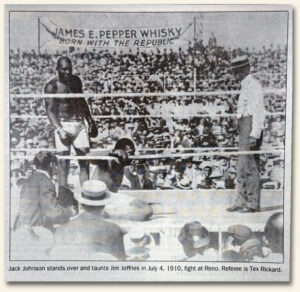 If you’re a boxing enthusiast, you may know the turn-of-the-century “Galveston Giant,” John (Jack) Johnson. Yet far fewer people know the depth of his struggle against bigotry, open hatred, and injustice.
Born in Galveston, Texas in 1878 to formerly enslaved parents, Johnson rose from the rough world of late-19th-century prizefighting to become the first Black heavyweight champion of the world in 1908. In the ring he was brilliant—defensively skilled, confident, and often playful as he dismantled opponents. Outside it, he lived defiantly in an era that demanded Black men show deference. His wealth, fame, and refusal to conform—especially his relationships with white women—made him a lightning rod for racial hostility across America. Authorities eventually targeted him using the Mann Act, widely viewed by historians as a politically motivated prosecution.
His story came back to my attention recently when a collecting friend asked if we had a Los Angeles Times dated July 8, 1990. To be honest, while he often seeks newspapers with Black-American content, I would never have guessed Jack Johnson was at the heart of his quest.
If you are concerned about racism—and are not afraid to confront the warts of the past—spending a little time researching Johnson’s life can be sobering. At the same time, it can also serve as a reminder of how far our society has progressed in confronting bigotry.
Below is a photo of the introduction to the article our friend was seeking. While the lengthy piece may still be available in its original context through the link above, at least for now the Los Angeles Times provides open access to the article’s text at: “80 Years Ago, the Truth Hurt.”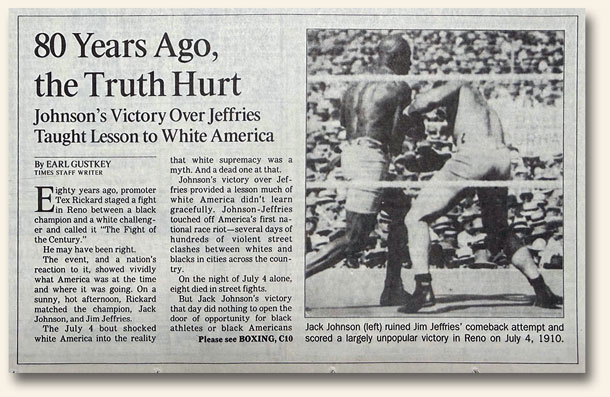
Significant Discovery: Horace Greeley’s “views” of Freedmen (1865)…
March 9, 2026 by GuyHeilenman · Leave a Comment
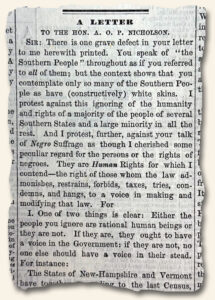
After being heavily engrossed in the rare & early newspapers collectible for over 50 years, encountering “new” discoveries within our own archives has not abated. Case in point: We recently identified a significant letter in the August 26, 1865, issue of the New York Daily Tribune that had previously gone unnoticed. Located on page 4 and signed simply “H. G.” (Horace Greeley), this letter addressed to the Hon. A. O. P. Nicholson offers a profound look into the intellectual climate of the immediate post-Civil War era. Perhaps it was the inconspicuous single column heading, “A Letter”, which was complicit in our oversight. Such “discoveries” are one of the reasons why we love this hobby.
As far as the letter itself is concerned… The exchange occurred during a pivotal window of Reconstruction. With the war concluded and the Thirteenth Amendment in the process of ratification, the nation was gripped by a debate over the “physical, intellectual, and emotional condition” of newly emancipated African Americans. While many, including Nicholson, sought to categorize or question the capabilities of the formerly enslaved through a lens of racial “fitness,” Greeley used his editorial platform to push back against these prejudices.
In this letter, Greeley argues that any perceived deficiencies in the Black population were not inherent traits, but the direct result of the “degradations” of the institution of slavery. By advocating for education and the rights of “Free Labor,” Greeley was effectively laying the groundwork for the so-called “Radical Republican” agenda that would eventually lead to the 14th and 15th Amendments.
For collectors of Civil War, Reconstruction-era, and Black-Americana ephemera, this issue serves as a primary source document and captures the exact moment the country transitioned from a military conflict to a philosophical battle over the true meaning of citizenship – a powerful step towards realizing the founding charge that all (people) are created equal.
Two Discoveries, One Powerful Reminder – It Started with the Pony Express…
January 26, 2026 by GuyHeilenman · Leave a Comment
From the very beginning, a recurring theme on the History’s Newsstand blog has been the joy of finding hidden gems—those golden nuggets tucked within historic newspapers. Collectors of rare and early papers know this thrill well: you acquire an issue for one reason, only to uncover something unexpected that proves equally—if not more—captivating.
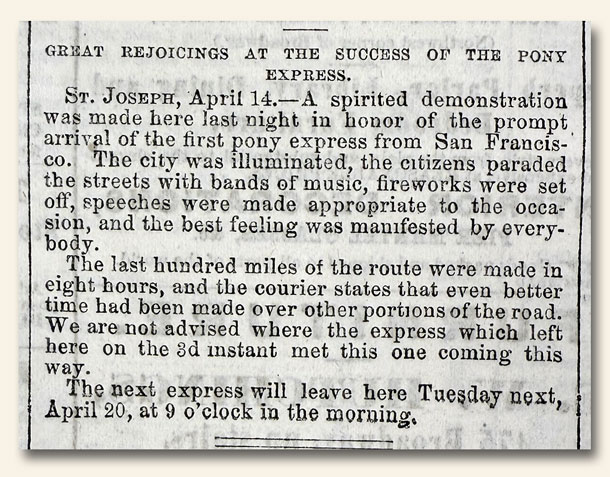
That’s exactly what happened to me recently while examining the April 16, 1860 issue of The Evening Post (New York). My original goal was to locate coverage of the completion of the first run of the Pony Express, and to my delight, I found not one but two front-page reports. Front-page coverage of such events is rare enough—but two related pieces? A true collector’s treat.
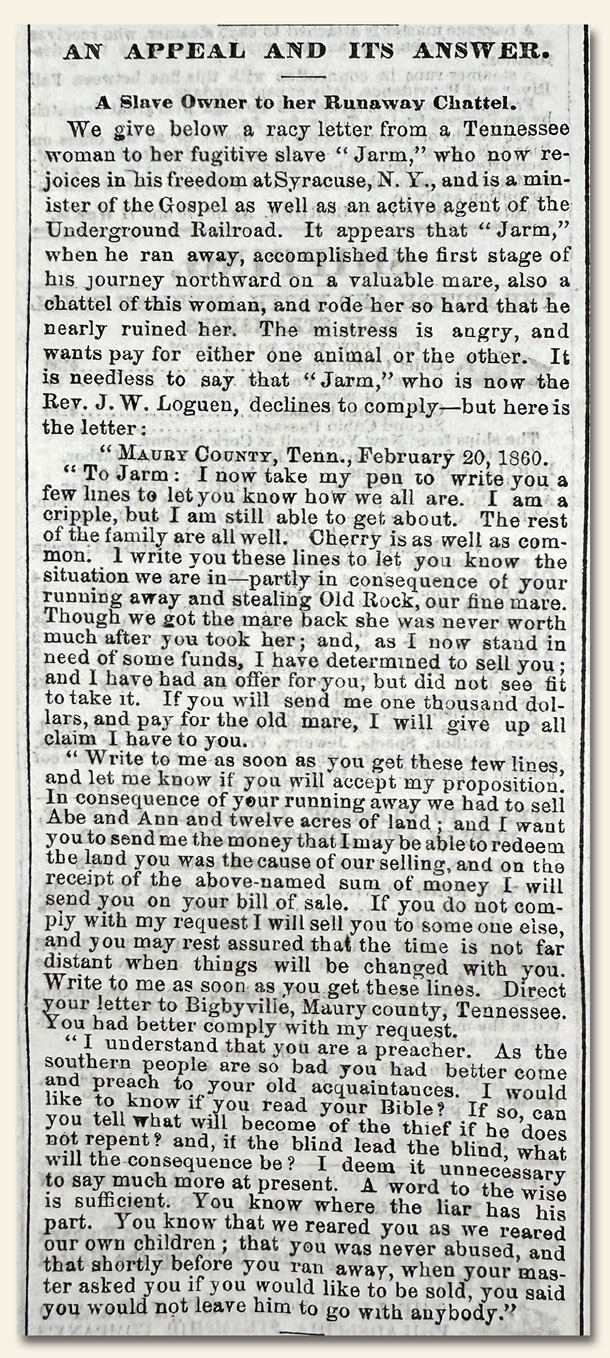
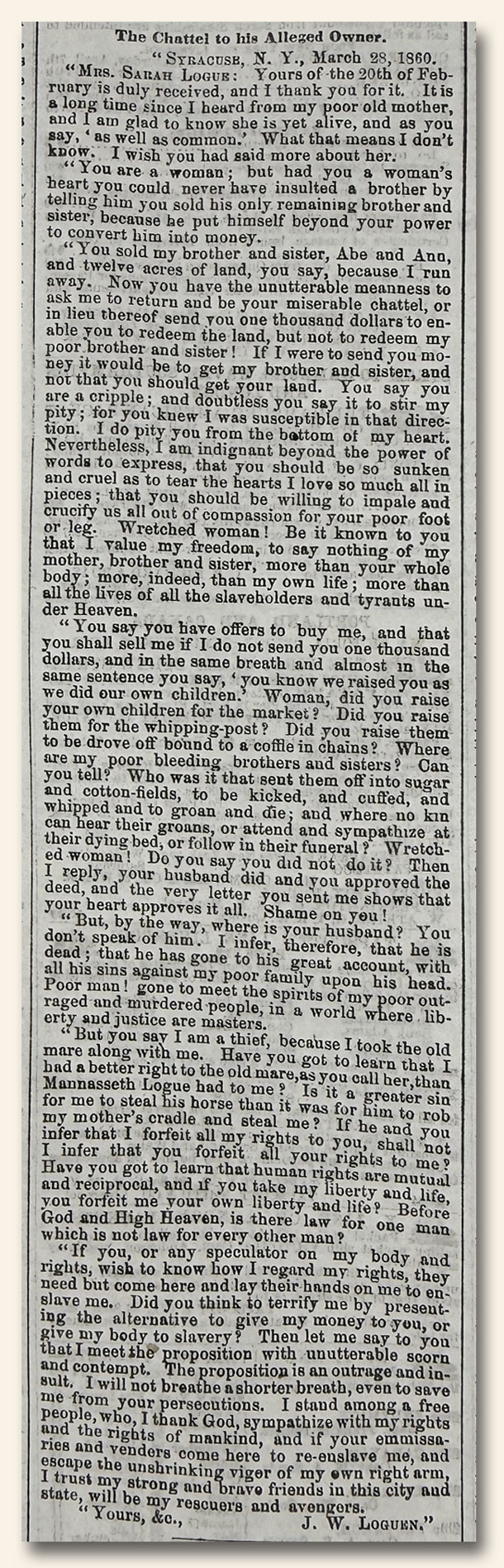
As I continued browsing for additional Pony Express material within the issue, I stumbled upon one of those unforgettable “hidden gems”: a printed exchange between a runaway slave and his former master. While not an account of a major historical event, few subjects evoke as much emotion as slavery, and reading such raw, personal correspondence in a period newspaper was deeply moving.
While the issue’s collectible value is likely anchored by its Pony Express reports, it’s this second discovery that continues to resonate with me. It serves as a poignant reminder—to me, my family, and my friends—of the immeasurable worth of every human being. Each of us, created in God’s image, carries equal and sacred value. Red and yellow, black and white—we are all precious in His sight.
All right, I’ll step down from my soapbox now. The photos below provide context for the discoveries mentioned above. Thanks for reading—and for sharing in the joy of finding history’s hidden treasures.
One of the Two Reports regarding the Pony Express
Correspondence Between the Runaway Slave and his former “Master”
Who’s Who in Newspapers? Lewis H. Latimer edition…
January 16, 2026 by GuyHeilenman · 1 Comment
The 11th installment of: Who’s Who in Newspapers
Lewis who? A collecting-friend recently asked us if we had the death report of Lewis H. Latimer. He sends us similar requests quite frequently, but it rare that I have never heard of the person who’s obit he is seeking. Lewis Latimer is one of the exceptions, and the time spent bringing myself up to speed was worth the effort. Such explorations are one of the attributes of collecting historic newspapers so fascinating. Shown below, absent of any editorializing, is what was found in The New York Times for December 13, 1928, followed by a bit of background. I hope you enjoy.
Our Listing on www.RareNewspapers.com:
Black Americana: Lewis H. Latimer’s death report – member of the Edison Pioneers…
THE NEW YORK TIMES, Dec. 13, 1928
* Death report of Lewis H. Latimer
* Member of the Edison Pioneers
* Credited for drawing plans for Alexander Graham Bell’s telephone
Page 29 has a 2-paragraph obituary headed: “LEWIS H. LATIMER DEAD”, which tells of the death of Black-American Lewis Latimer, a member of the Edison Pioneers. See background details below.
Other news of the day is found throughout.
Complete in 60 pages, slightly irregular along the left spine, in very good condition.
Background (Lewis Latimer): Lewis Howard Latimer (1848–1928) was a groundbreaking African American inventor, engineer, and draftsman whose work significantly shaped modern technology. Born in Massachusetts to parents who had escaped slavery, Latimer faced racial barriers throughout his life but persevered through self-education and determination. After serving in the U.S. Navy during the Civil War, he taught himself mechanical drafting and was hired by a Boston patent law firm.
Latimer played a key role in drafting the patent drawings for Alexander Graham Bell’s telephone in 1876. He later worked with Hiram Maxim and Thomas Edison, where he improved the carbon filament for incandescent light bulbs, making them longer-lasting, more affordable, and suitable for widespread use. He also authored Incandescent Electric Lighting (1890), the first technical book on the subject.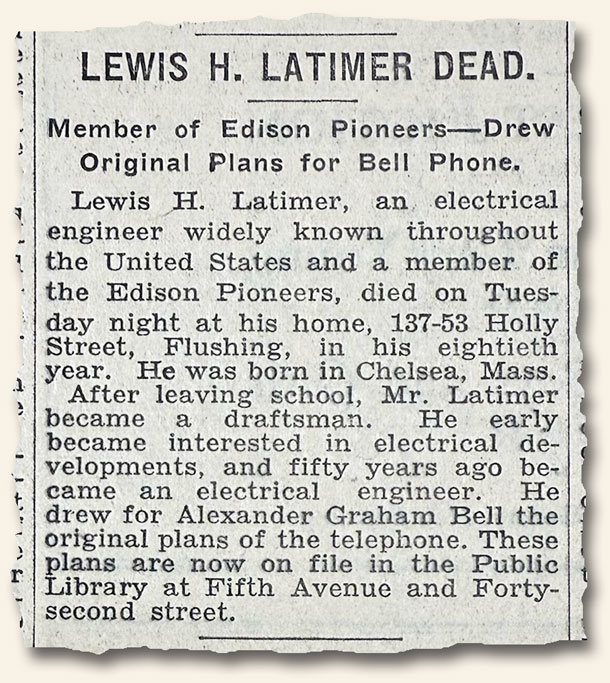
Who’s Who in Newspapers – Robert Smalls edition…
March 3, 2025 by GuyHeilenman · Leave a Comment
The 9th installment of Who’s Who in Newspapers
Let’s explore for a moment. Would you leave your small child alone in your car with the engine running? Might you ask your best friend, who happens to be a recovering alcoholic, to watch your house – and especially your liquor cabinet, while your family is on vacation? Would you have your dog guard the steaks you’re grilling so you can take a bathroom break? Continuing in the food category (yes, I’m hungry), would you leave a tray of fresh-baked cookies out in the open during your 5-year-old’s birthday celebration and leave for 30 minutes expecting all would still be present upon your return? I’m guessing the answer to all of the above would be a resounding “NO, of course not.” In fact, “What were you thinking?” would be any observer’s reasonable response.
How about this one? If you were the captain of a confederate vessel holding a number of “quite capable” slaves, would you and a large portion of the crew leave them unshackled and largely unguarded so you could enjoy a bit of shore-leave? Before you say, “No capta07in would be so foolish”, it would be worth your time to read about Robert Smalls‘ and his enslaved companions’ escape from the Charleston Harbor on the USS Planter during the Civil War. An article printed in the New-York Tribune date May 24, 1862 is shown below. However, after (hopefully) enjoying the article, it might be worth your time to read more about the event and this fascinating man. Two possibilities are the brief summary found on Wikipedia and/or author Cate Lineberry’s, “Be Free or Die: The Amazing Story of Robert Smalls’ Escape from Slavery to Union Hero“. Once again, I am grateful much about him was chronicled in the newspapers of his day – making him an easy edition to “Who’s Who in Newspapers”.

Who’s Who in Newspapers? Denmark Vesey edition…
December 16, 2024 by GuyHeilenman · Leave a Comment
The 8th installment of Who’s Who in Newspapers
Denmark Vesey… Certainly not a household name, but how about Frederick Douglass, John Brown, and Nat Turner? These and more credit the Denmark Vesey incident (a planned slave revolt) as a key cog in their inspiration to risk their lives in order to help free the Southern slaves. The Niles’ Register dated July 13, 1822 contains the following is a brief article regarding the fate of those involved:
Douglass used Vesey, a free black man, as a rallying cry to recruit Black men to fight in the Union Army during the Civil War by declaring, “Remember Denmark Vesey of Charleston”. Vesey’s plot to arm enslaved people against their enslavers and temporarily liberate Charleston inspired abolitionists and fueled anti-slavery activity throughout the United States – many viewing him as a hero and martyr for freedom.
Note: In total, the courts convicted 67 men of conspiracy and hanged 35, including Vesey, in July 1822. Thirty-one men were deported, 27 were reviewed and acquitted, and 38 were questioned and released. You can read more about the incident itself at: The Denmark Vesey Incident.
Who’s Who in Newspapers? Pamela Sparhawk edition…
March 22, 2024 by GuyHeilenman · Leave a Comment
The 7th installment of Who’s Who in Newspapers:
Thanks to Swann Auction Galleries, we discovered another fascinating but unheralded name which appeared in three 1817 issues of the Columbian Centinel (see a photo of the notice below). Swann staff provided the following background:
Pamela Sparhawk was born circa 1761 in Africa, was captured as a young girl and brought to Boston in slavery and was granted her freedom during the American Revolution. She had been separated from her brother by her original owner, but miraculously reconnected with him in Boston, where he owned property and was living under the name Samuel Bean. When Samuel died in 1816, Pamela petitioned the court to be recognized as his heir. Her petition ran three times in the Columbian Centinel newspaper, telling the story of her life: “Pamela Sparhawk of Boston . . . is a native of Africa, and was brought from thence to the West-Indies by a slave trader . . . and was a slave in the family of Rev. Mr. Merriam, of Newton, until the American Revolution. . . Samuel Bean acknowledged her to be his sister and was satisfied of the fact, but it would be difficult if not impossible for her in a court of law to establish her claim . . . in consequence of the unhappy circumstance, which will be easily perceived.” The notices were signed in type with her mark, a sideways capital “X.” The statement was witnessed by Congressman Timothy Fuller (father of the important feminist author Margaret Fuller), but it apparently went unheeded by the General Court.
Pamela Sparhawk’s life has recently been reconstructed and celebrated by the Historic Newton organization in an online exhibition, “Finding Pamela: Writing a New History,” and was described in the Boston Globe on 30 June 2021.
The link to the auction (which at the time of this post was still in the future) is:
SWANN Auction #2663 – The petition of formerly enslaved woman Pamela Sparhawk
Thankfully we had an issue with this coverage as well, but the greatest gain was the research which Swann’s offering inspired. In less than 15 minutes we were able to locate *background information on Pamela which we found qui te interesting.
If you’re curiosity has been piqued to the point where you decide to discover more about her through the following link, please note the additional related information shown below the heading: “Who was Pamela Sparhawk?” Enjoy.
FINDING PAMELA
Dramatic Headlines Speak for Themselves… Martin Luther King Jr Assassinated!
March 11, 2024 by GuyHeilenman · Leave a Comment
The best headlines need no commentary. Such is the case with The (Cleveland) Plain Dealer, April 5, 1968, which featured a report on the assassination of Reverend Dr. Martin Luther King Jr:
“DR. KING IS SHOT TO DEATH”

The impact of Newspapers on the abolition of slavery…
August 4, 2023 by GuyHeilenman · Leave a Comment
 The impact print media in general, and newspapers in particular had on attitudes towards slavery cannot be overstated. The abolitionist press was in full-force during the early-to-mid 1800’s with publications such as The Anti-Slavery Bugle, The Emancipator, the National Anti-Slavery Standard, the National Era (which had the honor of being the first to print Harriet Beecher Stowe’s “Uncle Tom’s Cabin”), among those who carried the torch. While some publishers became household names during this critical period in American history (William Lloyd Garrison – publisher of The Liberator), Frederick Douglass – publisher of the North Star [later, the Frederick Douglass’ Paper], and Horace Greeley – publisher of the New York Tribune), a slew of others, while highly influential, have largely been forgotten. One such unheralded publisher was Hezekiah Niles’, the publisher of the Niles’ Register from Baltimore, Maryland. While Niles’ Register would not be placed under the umbrella of The Abolitionist Press, not wearing this label coupled with its heavy focus on political issues may have played to his advantage when Hezekiah wrote and published his “Mitigation of Slavery” in serialized form over a span of 8 issues in 1819. It may not have had an Uncle-Tom’s-Cabin-level impact among the masses, there is little doubt the minds of many in-and-around Washington D.C. were challenged to keep the abolishment of slavery at the forefront of both political and public discourse. The full text of his essay can be read on-line, however, photo-snippets of portions of an original as well as a brief description may be viewed on the Rare Newspapers website: Hezekiah Niles’ “Mitigation of Slavery“. His final thoughts are shown below.
Horrace Greeley, Fred Douglass, Harriet Beecher Stowe… Hezekiah Niles…
Snapshot 1960… From Small Beginnings…
May 25, 2023 by GuyHeilenman · Leave a Comment
What happened? On July 16, 1960, a group of eight African American students – seven in high school and one in college, entered the “whites only” wing of the public library in Greenville, South Carolina to protest the library’s policy of segregation (the library had separate wings for blacks and whites).
Peaceful or violent? They entered the “whites only” wing quietly, selected books from the shelves, and sat down to read in silent protest.
Effective? While only lasting 40 minutes (at which point they were arrested), their actions led to the eventual desegregation of the library a mere 2 months later.
Public response? According to Wikipedia, although the library put up a fuss, and even initially closed stating, “the efforts made by a few Negroes to use the White library will now deprive White and Negro citizens of the benefit of a library”, they eventually reopened due to pressure from the black and white residents of the community.
“Red and yellow, black and white; they are precious…”
Legacy? While it is hard to measure the spidering impact of such “small” efforts, one of the “Greenville 8” is now a household name: Reverend Jesse Jackson.
The small report found on page 19 of The New York Times dated July 17, 1960 is symbolically shown in large format below.