

Search
The Rare & Early Newspapers Hobby

Receive the Newsletter

Buy Historic Newspapers

Pricing newspapers back in the 1970’s…
May 18, 2026 by TimHughes · 22 Comments
 In conversations with people about how I started this business, a common question is, “How did you know how to prices newspapers back then?” Well, the short answer is, I didn’t.
This venture started as a hobby with no thought of it turning into a business. But when I started getting too many of a similar title or date, selling off the “unwanteds” became a more common occurrence. My simple thought was, if I had $3 for it, try to sell it for $5. If I did, the price stuck for future issues; if it didn’t, the price dropped to $4.
But this became trickier years later when I was buying for resale but didn’t have enough experience to know what to pay, nor what to price them at. Nor did anyone for that matter, as there were no price guides, nor sufficient auction records to offer a clue.
I was flying by the seat of my pants. If I thought an event was historic, say a major Civil War battle, I would pay the $5 price and increase it by 50% or so. If it sold, then the next time I inched it up a bit more. If it didn’t, I reduced the price a bit. Never knowing how high customers might go for an event, I might have “inched up” the price of an event 15 times over the coarse of 4 or 5 years until there was some resistance. I was careful to keep records of sales through the years–even in the pre-computer days–which was a tremendous assistance in assigning values to the myriad of historical events covering 300 years of history.
 Did I sell some great material too cheaply in the early years? I sure did. Looking at some of my earlier catalogs I gladly pay five times the selling price of many items I sold. But it was part of the process. I remember once having a volume of a Las Vegas, New Mexico newspaper from 1881. There must have been 30 or 40 issues with a small “Reward” ad for the capture of Billy the Kid. I think I sold those issues for less than $20 each. After all, if I had 40 of them how rare could they be? Certainly I’ve learned through the years, and became smarter as well.
But we still encounter items which challenged us today. As we continue to find truly rare, almost unique issues it becomes difficult to assign values with no history or prior sales. But these are the fun challenges. As much as you may enjoy finding interesting items in our catalogs, I enjoy finding the unusual to offer.
“I have always gotten more joy from buying newspapers than selling them.”, Tim Hughes (2009).
PS from Guy: Between the internet and the surge of AI, it has never been easier to find “hidden” content and comparable pricing. For collectors who live for the thrill of discovery and have an old newspaper in hand, try using this prompt: “What noteworthy historical coverage is featured in [Newspaper Title] published on [Date]?” You might be amazed by what you find. If you turn up something unique, please share your discovery with the Rare & Early Newspapers community!
“Printing In The Americas” – A reference book for your shelves…
March 2, 2026 by TimHughes · Leave a Comment
 There are very few reference books which are exclusive to newspapers, so some of the better ones are about printing in general, peppered with historical accounts of newspaper publishing as well.
One of my favorites is such a book, titled “Printing In The Americas” by John Clyde Oswald. Done by the Gregg Publishing Company in 1937 it unfortunately is out of print, however copies can be found on book dealer shelves across the country. With the broad scope of internet sites abebooks.com and alibris.com I suspect it would not be difficult to find a copy.
There are 91 chapters totaling over 560 pages but it can essentially be considered to have three parts. first: a general history of printing in colonial America which includes much on early newspapers; second: a state by state review of the their first printing efforts, most of which were newspapers rather than books or pamphlets; and third: printing history in other countries of the Western hemisphere including Canada, Central America, South America and the West Indies, typically not dealt with in most printing history efforts.
I find the Midwest and Western states to have the most intriguing histories, filled with stories of tragedy & hardship in trying to operate a printing establishment in the wilds of America. There were far more failures than successes. Early printers must certainly have come from hearty and optimistic stock.
While we do not have one to offer, this is a title I would suggest you pursue. Given its format it doesn’t have to be read cover to cover, but rather chapters of interest stand alone as little histories in just a few pages.
Displaying newspapers – Frame to see all four pages…
February 23, 2026 by TimHughes · 4 Comments
 Many newspapers lend themselves nicely to framing and display, certainly those with either graphic appeal or a very historic report on the front page. Even better if an issue has both. But display can be problematic when the significant report is on the inside or back page.
 The photos show one inventive display option for four page newspapers, which includes almost all from before the 1830’s. This “Pennsylvania Gazette” printed by Ben Franklin has his imprint at the bottom of page 4, and by opening the newspaper and matting both sides, all 4 pages are visible. The matted portion of the display is in the frame trim and hinged to the portion of which hangs on the wall, so by opening the frame all four pages are visible. A magnetic clasp keeps the frame closed while on the wall.
Give this a try for that special issue in your collection which otherwise would be difficult to display.
From the Vault: The top ten: “20th century”…
November 21, 2025 by TimHughes · 9 Comments
From this period in newspaper publishing history, displayability has much to do with the desirability of a newspaper, perhaps more so than historical significance. Since I come to this task of listing the “top ten” from the perspective of a rare newspaper dealer and knowing the requests we receive for certain events, the following list may not be the same as my most “historic” but they are my thoughts for the most “desirable” based on customer demand. Certainly FDR’s New Deal is more historically significant than the death of Bonnie & Clyde, but not more desirable from a collector standpoint. I’d be curious to hear of your thoughts.
 Here they are, beginning with number ten:
10) St. Valentine’s Day Massacre, Feb. 14, 1929 An issue with a dramatic banner headline, & ideally dated the 14th. Morning papers would be dated the 15th.
9) Death of Bonnie & Clyde, May 23, 1934 The gangster era remains much in demand, & perhaps due to the movie this event beats out Dillinger, Capone & the others from the era. A dramatic headline drives desirability–ideally with a photo–even if not in a Louisiana newspaper.
8.) Charles Lindbergh flies the Atlantic, May 22, 1927 The New York Times had a nice headline account with a map of the route, and the prestige of the newspaper always keeps it in high demand.
 7) Call-Chronicle-Examiner, San Francisco, April 19, 1906 I note a specific title & date for this event, as these 3 newspapers combined to produce one 4 page newspaper filled with banner heads & the latest news. No advertisements.
6) Crash of the Hindenberg, May 6, 1937 The more dramatic the headline the better, & ideally with the Pulitizer Prize winning photo of the airship in flames.
5) Wright brothers fly, Dec. 17, 1903 Here’s where the significance of the event drives desirability over dramatic appeal. Few can argue the impact of manned flight on the world. Reports were typically brief & buried on an inside page with a small headline, so a lengthy front page report would be in top demand.
4) Stock market crash, October, 1929 Demand is driven by the dramatic headline and its wording. Too many newspapers tried to put an optimistic spin on the tragedy. Collectors want “collapse, disaster, crash” & similarly tragic words in the headline (how about Variety magazine’s: “Wall Street Lays On Egg”?)
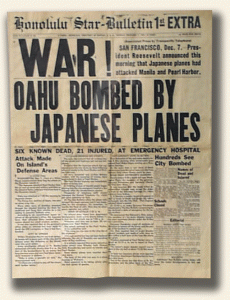 3) Honolulu Star-Bulletin, Dec. 7, 1941 “1st Extra” The defining issue from World War II but be careful of reprints as most issues on the market are not genuine.
2) Chicago Daily Tribune, Nov. 3, 1948 “Dewey Defeats Truman”. What more need be said?
1) Titanic sinking, April 14, 1912 Certainly low on the historically significant list, but off the charts on the desirability scale, much due to the block-busting movie. The more dramatic the headline the better, and hopefully with a nice illustration of the ship going down.
My “honorable mention” list might include baseball’s “Black Sox” scandal of 1919, sinking of the Lusitania, end of World War II, D-Day, JFK’s election, the New Deal, a great Babe Ruth issue, etc. Maybe they would rank higher on your list. Feel free to share your top choices.
From the Vault: Headlines drive interest in World War II…
October 24, 2025 by TimHughes · Leave a Comment
For likely a multitude of reasons, interest in World War II newspapers ranks far higher than in the Korean War, World War I, or the Spanish-American War. It may be a generational thing, as most collectors today are children of World War II veterans and likely heard stories of the war first-hand, or found 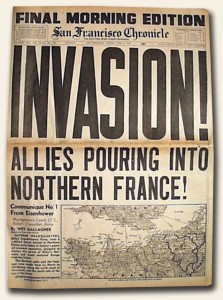 newspapers in their parents attics which sparked an interest. One could debate a number of other possible reasons why other wars lack the intrigue found in that fought by the “greatest generation”.
Headline collecting has always been a focus for this hobby, and as any collector knows, bold, banner headlines did not become commonplace until late in the 19th century. With the increasing competitiveness of daily newspapers across the country–Hearst, Pulitzer & others rising to prominence–flashier front pages were needed to draw attention at the corner news stand. It’s a shame there is not more interest in the Spanish-American War and World War I as both events resulted in some huge, dramatic, & very displayable headlines.
Because there are a plethora of newspapers from the WWII era available, collectors have become very discriminating in what they collect. Only the “best of the best” will do, meaning just the major events and only those with huge and displayable headlines. If there is a “top 6” list of sought-after events, our experience is they would be: 1) attack on Pearl Harbor; 2) the D-Day invasion; 3) death of Hitler; 4) end of the war in Europe; 5) dropping of the atomic bomb; 6) end of the war in the Pacific. One could add any number of other battle reports such as Midway, battle of the Bulge, fall of Italy, Iwo Jima, battle for Berlin, and so much more. And we could step back before American involvement in the war and add Hitler’s invasion of Poland and the battle of Britain.
The bigger the headline the better. With some newspapers the entire front page was taken up with a headline and a related graphic. The U.S. flag was a common patriotic device. Tabloid-size newspapers commonly had the front page entirely taken up with a singular headline and tend to be better for display given their smaller size.
 And not just American newspapers draw interest. German newspapers hold a special intrigue, but the language barrier is a problem for many. But the British Channel Islands, located in the English Channel between England & France, were occupied by the Nazi during the war so their reports were very pro-Nazi while printed in the English language (ex., Guernsey Island). And the military newspaper “Stars and Stripes“, while certainly being American, was published at various locations in Europe and the Pacific. Collectors have a special interest in finding World War II events in the official newspapers of the American military forces. Plus there were a multitude of “camp” newspapers, amateur-looking newspapers printed on a mimeograph machine for consumption limited to a military base, and typically printed is very small quantities. Their rarity is not truly appreciated by many.
For obvious reasons, there is also a high degree of collectible interest from those wishing to make sure certain aspects of history are not forgotten. The Holocaust, and the Nazi propaganda used to provide a rationale for eliminating the Jewish people, is well documented in newspapers from the era. In addition to the Holocaust and its atrocities, issues providing context through reporting other pre-war events such as the Great Depression, fascism, and increased militarism, are also desirable.
True to any collectable field, newspaper collectors are always on the lookout for an issue better than what they have, and collection upgrades are constant. Finding that special, rare, unusual or fascinating headline is what makes the hobby fun. Will interest in the Korean War and the Vietnam War gain more interest in future years? Perhaps so. With interest currently low and availability and prices very attractive, it might be a good time to explore.
From the Vault: Creating Harper’s Weekly engravings: a fascinating process…
July 21, 2025 by TimHughes · 15 Comments
 Harper’s Weekly issues of the 19th century remain among the more popular in our inventory, as the multiple engravings found in each issue document much of American history from 1857 through the end of the century. We have over 60,000 issues in inventory but still some dates are sold out as soon as they arrive. I suspect most of you have seen this title, but few may be aware of the interesting process of creating the prints in a timely manner.
 The story of how Harper’s delivered this amazing product during the Civil War is a fascinating one, and I must give credit to www.sonofthesouth.net for much of detail.
The process started by the deployment of not only reporters but also artists to the battlefield. Some of the most renowned artists of the 1800’s got their start as illustrators for Harper’s Weekly, including Winslow Homer and Thomas Nast. These artists would sketch scenes of the battles that they witnessed and the sketches would then be dispatched back to Harper’s for publication in the upcoming papers.
In order to publish the artwork, the images first had to be carved onto a block of wood. But it would take too much time for a single engraver to carve an entire print, particularly given the timeliness of each issue. To provide the illustrations as quickly as possible, a very clever idea was developed. The illustration would be cut into 2 inch squares and each square would be engraved onto a different small block of wood by an assigned carver.
 By dividing the illustration up, each artist assigned to just a portion, a team of workers could carve a full page illustration in a short period of time. After the small blocks were completed they were then screwed together to form the overall illustration and a finishing engraver would provide final touches to be sure the pieces were perfectly aligned. This completed wood block was then used as a “master” to stamp the illustration onto all the newspapers being printed. If you look at a Harper’s engraving carefully you can often see where the blocks of wood were joined together.
It wasn’t until the 1890’s that the technology of printing caused the end of hand-done engravings for the pages of Harper’s and other illustrated periodicals. With the demise of this labor-intensive trade also came the end of some of the more beautiful works of art to be found on paper. They remain treasures today and hearken back to an era when artistry and long hours of work were an important part in providing the news.
(This post was originally published on March 23, 2009.)
From the Vault: American history in British newspapers…
July 7, 2025 by TimHughes · Leave a Comment
 After 50 years in the hobby I can honestly say today as I said then: collecting early newspapers is an inexpensive hobby when compared to other collectibles of like vintage. And the reason is basic economics: supply and demand. Although the collecting fraternity has increased through the years, and the supply of early newspapers has dwindled some, prices still remain a relative bargain for material over 100—and over 200—years old.
Exceptions exist. American newspapers of the 18th century are few and far between today. When I began in the hobby in the mid-1970’s, finding the occasional 18th century bound volume of American newspapers was rather common. I even purchased a number of volumes of colonial and Revolutionary War newspapers printed in the colonies. Such purchases are very rare today, and consequently prices for American titles before the1790’s can be exorbitant for many collectors.
Which brings me to this topic. We are fortunate in this hobby to have a terrific alternative to American newspapers of the colonial era: British newspapers. Keeping in mind that the American colonies were British possessions at the time, considerable American reporting was not uncommon (and I can attest that American newspapers of the same period had considerable European reports!). In fact most British newspapers took their accounts directly from American newspapers so the reporting was identical. And the added bonus of British newspaper reports is commentary with a British bias, offering an interesting perspective to what we remember from history class.
Hobbyists of 25 – 50 years ago eschewed British titles because American titles were so common. But today the collecting market is much different. In many respects I see today’s availability & pricing of British titles much like the situation with American titles 50 years ago. We can find major American events of the colonial era at prices still under $1000 (higher for the “best of the best”) in the London Chronicle or like titles, and under $300 for second tier events. We find there is typically a 5 fold price difference between reports in American versus British newspapers. We’ve sold the Boston Tea Party for $1150 in the London Chronicle. In an American newspaper a like account would exceed $10,000. We’ve sold the Boston Massacre in the London Chronicle for the same price. And yet again, it would easily exceed $10,000 in an American title. One of the most significant documents of the Revolutionary War, “The Causes & Necessity For Taking Up Arms”, we sell as a $540 item in the Gentleman’s Magazine, yet we sold it for $5550 in the New England Chronicle a number of years ago – and today it would go for $8,000-$12,000+. Same complete document, both from 1775, one within the budget of most collectors, the other not.
But prices are rising for British imprints as more collectors are becoming aware that if they want their collection to contain all the significant events of the 18th century, British newspapers and magazines are their only alternative. The Declaration of Independence remains the most desired event for American collectors. An American newspaper printing is beyond the budgets of almost all collectors, if available at all. An auction price of $50,000 – $75,000 would be expected, while we recently sold the same document in the London Chronicle for $8775. But I will also note it was not long ago that we sold it for $4450. Our current price for a front page account of the Battle of Lexington & Concord in the London Chronicle is $985. Our previous sale of the identical dated issue was $440.
Where will the hobby be with such events in another 25-50 years? Will all 18th century newspapers–American and British–be considered museum pieces? Much will determine where prices go and I will not hazard a guess. But I am pleased that as the hobby enters a crossroad in availability versus pricing, we currently have a reasonable path to follow for the foreseeable future. These are interesting times for the collecting fraternity.
Collecting Newspapers – The Basics (Part II) – What to Expect…
March 24, 2025 by GuyHeilenman · Leave a Comment

The 2nd installment of “Collecting Newspapers – The Basics” continues with a focus on the answers to handful of common questions: “Why does my newspaper look like it came from a bound volume, and what are the small holes along the spine?”, “Considering their age, what their condition?”, “Why is my issue so small?”, “How many pages do they have?, “Will it be brittle?” “What is ‘foxing’?”, “What does ‘chipping’ mean?, “Why is the old newspaper I just received so white – is it a reprint?”, and similar. Whereas many of these questions are answered in detail through dedicate posts, a quick primer is provided the page shown below which comes from the brochure we send out to new collectors.

Additional information about the hobby can be found through this Blog and on the Rare Newspapers’ website.
Collecting Newspapers – The Basics (Part I) – Eras, Topics, and Titles…
February 24, 2025 by GuyHeilenman · Leave a Comment
We, (Timothy Hughes Rare & Early Newspapers), have been offering old and historic newspapers to the collecting community since 1976, with Tim’s first acquisition for his own personal collection taking place in 1975. For those who are either unfamiliar with or new to this amazing hobby, today we are kicking off a revisit of a series of posts, “Collecting Newspapers – The Basics”, to serve en masse as a Primer for those interested in learning more about the collectible. The first installment (below) may appear to be a bit self-serving, but the heart behind it is simply to let seekers know the span of topics and types of newspapers which can be found.
So, what can be found on the pages of Rare & Early Newspapers? While the possibilities are nearly endless, a sampling includes:
Eras: Colonial, Early 1800’s Americana, Reconstruction, Industrial Revolution, Old West, Victorian, Roaring 20’s, “The 60’s”, and similar, plus an abundance of war-eras (French and Indian War, Revolutionary War, War of 1812, Texas-Mexican War, Civil War, Spanish-American War, WWI, WWII, Korean War, Vietnam War, etc.). Some prefer to collect by centuries (1600’s, 1700’s, 1800’s, 1900’s, and now, even the 2000’s).
Topics: Black Americana, Mormon, Gangsters & Outlaws, Judaica, Sports & Entertainment, Inventors & Inventions, Gunfights, Deaths of the Famous, Politics, Presidents, Proclamations, Amendments, Historic SCOTUS Decisions, Trials & Tragedies, Slavery, Famous 1sts & Records, Movie Premiers, Famous Illustrators, and more.
Titles: Oxford/London Gazette, Harper’s Weekly, Frank Leslie’s, Scientific American, Gentleman’s Magazine, London Gazette, Village Voice, Sporting News, and nearly 1,000 other newspaper titles from throughout the United States, along with dozens specifically from the Old West and Colonial eras. Rare & unusual titles are also desirable.
People: Pick any famous person from the 1600’s through 20th century, regardless of the genre or genres for which they are known, newspapers will have undoubtedly recorded what brought their name into public awareness.
Historical Events: Without making a feeble attempt to list examples, if an event has an historical bent, not only will newspapers have recorded it, but they will have done so within the context of the period in which it happened. This is one of the reasons why many writers of both non-fiction and historical fiction seek newspapers from the time and (if possible) location of when and where an event took place. Newspapers make wonderful source material.
These and additional collecting themes can be found on the homepage of RareNewspapers.com. Also take note of the “View All Categories” tab on the right side towards the bottom of the page. If you don’t see what you are looking for, let us know. Our effort to add links to the collecting interests of those who appreciate old newspapers is ongoing.


Additional collecting themes/ideas can also be found throughout this Blog.
“Collecting Newspapers – The Basics” (Part V) – Reprints…
April 5, 2024 by GuyHeilenman · Leave a Comment
While “fakes” in collectibles, depending upon the item being sought (stamps, coins, Hummels, etc.), can be common, thankfully such is not the case with Rare and Early Newspapers. Furthermore, the common “fakes” (called “reprints”) are well documented and were rarely done with nefarious motives. Part of the reason for the rarity of reprints is likely the price-point of most collectible newspapers (still quite low) in comparison to the cost of creating a fake which would be good enough to pass as authentic to someone who is familiar with the collectible. Printing methods, ink, paper, era-specific (“tell-tale”) environmental impact, and more have varied so significantly over time, the cost and effort it would take to create profitable forgeries cost/effort prohibitive. Still, there are exceptions – and being “in the know” can save one from being duped out of their hard-earned savings.
The issue-specific attributes which help to distinguish a reprint from an authentic issue would fill a book to rival Tolstoy’s War and Peace – making an attempt to do so within a single post absurd. However, over the past decade we have created over a dozen posts in an effort to cover as much as possible – specifically targeting the most common. Hopefully you will find them helpful:
POSTS REGARDING COMMON REPRINTS
