

Search
The Rare & Early Newspapers Hobby

Receive the Newsletter

Buy Historic Newspapers

“Collecting Newspapers – The Basics” (Part IV) – Setting Values…
March 25, 2024 by TimHughes · 535 Comments
We are often asked “What’s my newspaper worth?” in phone calls and email messages. As one might suspect, there are many factors which determine value and much like a jeweler cannot give a value of a diamond by an email or telephone inquiry, our ethics do not permit us to place values on newspapers without seeing the issues in hand.
Many factors determine value. The more important include condition, desirability among collectors, extent of coverage, completeness of the issue, proximity of the city of publication to where the event happened, time lag between the event date and the reporting date, dramatic appeal (more so with 20th century issues), and location of the report within the issue (front page? page 3?). Other factors come into play with more significant events but those noted are the prime determinants of value.
From a personal perspective setting values has been an interesting process, as no guide book of values existed 30+ years ago when I started the business. I priced an item in my catalog for $10 and if I had twenty orders for it I knew the price was too low. If no one ordered it the price was too high. Through the years, and by data basing sold prices (on index cards prior to the computer!), I’ve honed my own “price guide” based on actual sales, and it is this now-sophisticated database which we use to set values for new inventory as it arrives.
Do values continue to rise? In general, yes, but we are careful to never recommend the purchase of early newspapers for investment purposes. As is true of most collectibles, rarity and desirability determine where prices will be for the future.
But providing an historical perspective from our own files, back in October of 1981 we sold in our catalog #26 the NEW YORK HERALD of March 5, 1865 reporting the inauguration of Abraham Lincoln, very nice condition, for $70. In 2018 we sold another issue of the NEW YORK HERALD of March 5, 1865, also in very nice condition, for $745. If we had a similar issue today, it would likely go for around $1,000 – and even more if offered through a prominent auction house.
So, what do you do if you have a newspaper and would like to know its approximate value? One resource is this Blog – not for posting questions, but for exploring. We have many posts which provide specific examples of issues and their prices. Perhaps a better resource is the Rare & Early Newspapers website which provides 10,000+ examples (best to search by date and look for a comparable – see image below). Once you’ve explored these avenues, you are always welcome to contact us directly by email (guy@rarenewspapers.com). We would need the exact title and exact date of each issue to get started. Sending only photos does not work for us.
What two resources are not helpful?
1) Ebay. Why? Just because someone is asking for an amazing price doesn’t mean they’ll ever sell it at that price. “Previous Sales” are what matters.
2) Posting a question on this Blog. Why? We rarely monitor it.
Feel free to send any additional questions concerning the valuation of newspaper to us at the same email shown above. We’ll do our best to answer any that come our way… and who knows, perhaps they show up in a future post. 🙂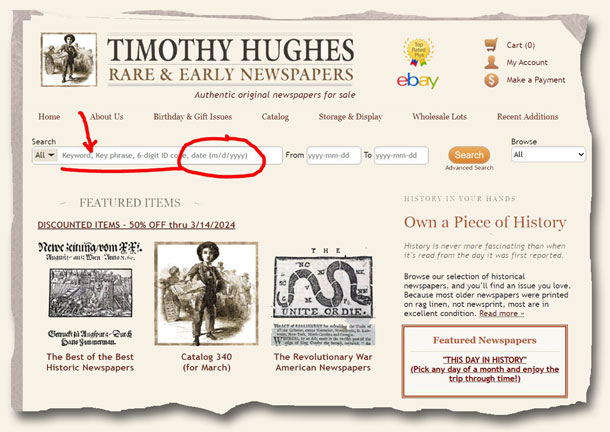
Condition and pricing…
October 10, 2011 by TimHughes · 3 Comments
 Many collectors may wonder what the relationship is between the condition of a newspaper and its price. Obviously the condition of a newspaper is subjective, and some problems bother some collectors more than others. But for issues offered through our company here are my thoughts as to how I price our newspapers:
* “Natural” faults are less of a problem than human-created. By this I mean problems with foxing (a darkening of portions due to the natural aging of the chemicals in the paper or the environment in which the newspaper was stored), folds, and minor edge tears. Such disfigurements are to be expected with newspapers of a certain age, and if considerable do affect the price but less so than other disfigurements. Even water staining I would consider a natural fault and can be excused as something to be expected and a minor problem if not causing loss of readability.
* Human-created disfigurements would include old tape mends & stains, trimming at the margins such that letters or words are partially shaved (caused when the bindery cuts too close to the text), lengthy tears into text, holes, portions clipped, etc. Such problems are annoying & could have been avoided with better care and I tend to discount the price of a newspaper more liberally than newspapers with natural faults. How much? It depends on the degree of the problem, so subjectivity is very important. If a newspaper has a noteworthy report which is not affected by the damage, it would be discounted less than had the notable report been affected. A small 2 by 1 inch piece clipped from the back leaf would be discounted less than a 2 by 10 inch clipped issue. A disfigurement to an inside page might result in a minimal price adjustment if the issue is offered for the displayability of the front page.
* Irregular margins, caused when a newspaper is improperly removed from a bound volume, will result in lowered values if the irregularity causes loss of type. Most irregular margins involve only the blank spine & the price adjustment would be minimal.
* Some damaged issues are relegated to our damaged pile to be sold in lots of 100 or more at a discounted price. But rare or historic issues are offered individually & priced according to the damage. Many collectors are attracted to damaged, discounted newspapers as they provide an opportunity for rare or historic reports at a much lower cost.
* Particularly bothersome to me are issues which are close-trimmed. Had the worker doing the trimming at the bindery been more carefully such faults could easily be avoided.
* Less bothersome are wear problems with “never bound” newspapers. Such issues are in their natural state as provided to the subscriber or sold on the newsstand, and logically tend to be more worn than issues taken from bound volumes. Such natural wear, when minimal, adds a certain patina to the item and would not detract from its value. For serious collectors, never-bound issues are preferable to issues from bound volume, but tend to be considerably less common.
* Guillotined issues, which are mechanically cut cleanly at the spine to facilitate microfilming, is a minor disfigurement if ample spine margin remains. Depending on the issue we might rejoin the issue at the spine with glue, rejoin using archival tape, or simply keep the issue loose.
* Repairing issues can be controversial. Some believe in repairing tears and others prefer they be left as is. In general I tend to repair rather than not repair. My primary reason is to prevent further tearing which can occur when a leaf is turned, as a tear is a weak spot which often gets worse when handling. We use a very thin strip of archival tape which does not stain and is almost invisible if properly used. When an issue is extensively repaired mention is made in the description. A newspaper’s price may be affected when archivally repaired, depending on the extensiveness of such repairs.
An early attempt at preserving newspapers…
July 6, 2009 by TimHughes · 2 Comments
 You may have noted many of our descriptions of the New York Times from the 1927-1953 period are described as the “rag edition”.
Fellow collector Paul Sarna passed along the following information taken from “News-Week” magazine of Oct. 28, 1933. It’s an interesting report from 76 years ago of the creation of the “rag edition” as a means of preserving newspapers for posterity, which remain a concern for present-day institutions as well.
A brief piece from this 1933 magazine tells of its beginning:
“To preserve valuable newspapers, libraries from time to time have resorted to sprays, rejuvenators, and glassine covers. But none has been to successful. With an eye on this problem the New York times, in 1927, began printing an edition on enduring rag paper. the idea had two disadvantages: the subscription price of the rag edition was $170 annually, and it filled about 870 ft. of new shelf space each year.”
The rag edition was produced on a very high quality newsprint, with a high percentage of cotton & linen content allowing the issues to remain very white & sturdy many years into the future. Given the subscription cost it is not surprising that libraries rather than individuals were the primarily subscribers. We have never seen a never-bound rag edition of the Times although they might exist.
The Times discontinued the rag edition in 1953. A few other newspapers also produced a rag edition during the early part of the 20th century as we’ve encountered a run of Detroit News in rag edition. Is anyone aware of other titles?