
Search
The Rare & Early Newspapers Hobby

Receive the Newsletter

Buy Historic Newspapers

Who’s Who in Newspapers? Moses G. Farmer edition (1879)…
June 8, 2026 by GuyHeilenman · Leave a Comment
The 15th installment of: Who’s Who in Newspapers
 When it comes to “man on the street” interviews, the lack of knowledgeable responses often received never fails to confound. We enjoy watching these—which is a bit troubling in itself—but if an interviewer asked, “Who invented the light bulb?”, I’d bet 75% would answer correctly, especially with a few “Thom… Thomas… Thomas Ed…” clues.
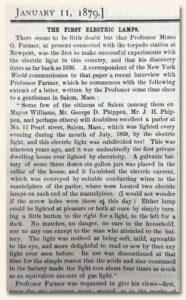
However, and to be fair, few of us (myself included) could name the pioneers who paved the way. Enter Moses G. Farmer. Thanks to a January 11, 1879, issue of Scientific American titled “THE FIRST ELECTRIC LAMPS,” I discovered this fascinating inventor who lit his Salem, MA, home in 1859—two decades before Edison’s breakthrough.
Using platinum filaments and batteries he had mounted for the purpose in his cellar, Farmer proved electricity could replace gas. Though the cost of platinum and the lack of a vacuum prevented commercial success, his “parlor lights” were the first to move electric light from the lab into a domestic reality – often enlightening dinner guests with his invention.
Farmer provided the “blueprint of failures” Edison needed. He proved electricity could light a home; Edison simply figured out how to make it last longer than a dinner party.
A modern sketch comparing Farmer’s and Edison’s work is shown below.
I love this collectible – and how it fuels the engine of life-long learning.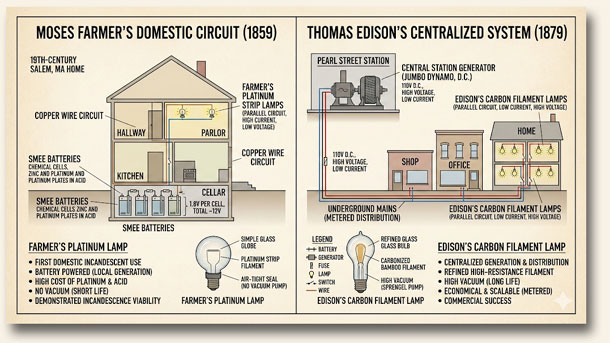
Lead-up to a Nation… as reported in the newspapers of the day (reflecting back on May, 1776)…
June 5, 2026 by GuyHeilenman · Leave a Comment
-
Hope and Defiance – French Sympathy (E39)
-
The New-England Chronicle – A Rare Voice (E40)
-
Powerful Resolves – Battlefield Successes (E41)
-
Addressing Military Overreach – Precedent for Restraint (E42)
- Common Sense – Condemnation of Monarchy (E43)
We hope you are enjoying this year-long trek to the 250th anniversary of The United States through the eyes of those who were fully engaged, first hand. As mentioned previously, all accounts are rooted in what they read in the newspapers of the day.
“History is never more fascinating than when read from the day it was first reported.” (Timothy Hughes, 1975)
Announcing: Catalog 367 – Released (early) for June, 2026 – Rare & Early Newspapers…
May 29, 2026 by GuyHeilenman · Leave a Comment
|
|
Who’s Who in Newspapers? Stephen Crane edition (1891)…
May 11, 2026 by GuyHeilenman · 1 Comment
The 14th installment of: Who’s Who in Newspapers
This series typically highlights lesser-known figures who have left intriguing marks in the world of historic newspapers—individuals often overlooked by the general public. However, today’s spotlight falls on a truly famous name: Stephen Crane (1871–1900), the acclaimed American author best known for his iconic Civil War novel *The Red Badge of Courage* (1895), a groundbreaking work of literary realism and naturalism that vividly captures the psychological turmoil of battle.
So why feature such a well-known literary giant in this series? Crane exemplifies a distinguished tradition of celebrated writers who launched their careers (or sharpened their skills) as newspaper journalists—often starting remarkably young. This roster includes luminaries such as:
– Mark Twain (Samuel Clemens), who began as a printer’s apprentice and reporter in his teens and early 20s.
– Charles Dickens, whose early work included vivid sketches and reporting for London newspapers.
– Ernest Hemingway, who honed his concise, punchy style as a cub reporter.
– George Orwell, who drew on journalistic experience for his essays and novels.
– Karl Marx, whose writings appeared in newspapers like the New-York Daily Tribune.
Many of these authors were in their teens or early 20s when they first contributed to newspapers, using the medium to observe society up close, develop their voices, and earn a living while building toward greater literary achievements.
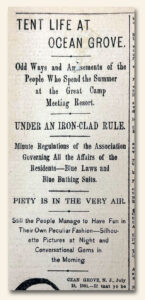
The featured newspaper clip below and to the right are from one of Crane’s earliest published pieces: a sketch titled “Tent Life at Ocean Grove”, written and illustrated by Crane at the age of just 19, which we recently unearthed in the New York Herald dated July 19, 1891.
Ocean Grove, New Jersey—often called “God’s Square Mile”—was (and remains) a unique seaside community founded in 1869 by Methodist ministers as a camp meeting site. Part of the broader 19th-century Methodist camp meeting movement, it combined intense religious revivalism with summer respite: families lived in tents or simple cottages during annual gatherings, emphasizing piety, prayer meetings, lectures, and moral recreation—while alcohol and other “worldly” amusements were strictly prohibited. At its cultural peak in the late 19th century, Ocean Grove represented Victorian-era piety at its most earnest, contrasting sharply with the lively, secular beach resorts nearby (like Asbury Park).
Crane’s article offers a sharp, observational glimpse into this world. He describes the “somber-hued” atmosphere of the tent colony, where devout “tenters” engaged in serious religious devotion amid the summer heat. With characteristic irony and wit, he contrasts this restrained, spiritual environment with the more carefree, bustling vacation spots just beyond its borders—highlighting class differences, social norms, and the peculiar blend of holiness and holiday.
For collectors and scholars of historic newspapers, the 1891 *Herald* piece stands out as an early “warning shot” of Crane’s emerging literary genius. It foreshadows the keen social observation, subtle irony, and class consciousness that would later define masterpieces like *The Red Badge of Courage*, *Maggie: A Girl of the Streets* (1893), and his war reporting. While a later 1892 article for the *New York Tribune* (on a Labor Day parade) sparked controversy and effectively ended his newspaper career in that city due to its critical tone, this Ocean Grove sketch remains a more polished, evocative example of his talent for elevating a routine travelogue or feature story into incisive social commentary.
Talk about precocious talent—Crane was already displaying the distinctive voice that would make him one of America’s most innovative writers before he even turned 20!
Who else would you add to the list?
Personal Note: I have a personal connection to this world Crane described. During our early teens in the 1960s and 1970s, my sister and I attended Chester Heights Camp Meeting in Delaware County, PA—a historic Methodist camp meeting grounds established in 1872, not long after Ocean Grove’s founding. Though more than 90 years had passed since Crane’s visit to Ocean Grove, much of the atmosphere felt strikingly similar to what he captured: the rows of simple cottages (most without running water), the focused religious services, the sense of stepping away from everyday bustle into a place of earnest devotion and quiet summer fellowship. While the world around it had changed dramatically over the decades—and Chester Heights itself has evolved in many ways—the core spirit of sincere personal faith buoyed by sold Biblical teaching and powerful worship in a communal setting endured remarkably intact during those years. Reading Crane’s sharp, ironic sketch today brings those childhood summers vividly back to life.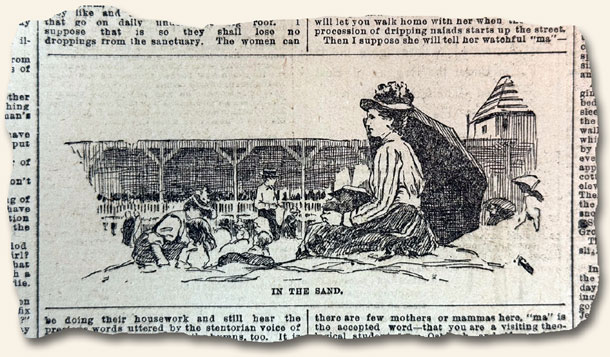
PS Confession: We had to take a bus to our camp meeting’s “beach” – a small public pool about 10 miles from our location.
Lead-up to a Nation… as reported in the newspapers of the day (reflecting back on April, 1776)…
May 8, 2026 by GuyHeilenman · Leave a Comment
-
The King’s own Regulars & Their Triumph over the Irregulars – Propaganda (E35)
-
Voices of a Young Nation – Reports: Grim and Grateful (E36)
-
Stirring Reports – Elected Delegates & New Postal System (E37)
-
Independence was Destiny – The Case for Independence (E38)
We hope you are enjoying this year-long trek to the 250th anniversary of The United States through the eyes of those who were fully engaged, first hand. As mentioned previously, all accounts are rooted in what they read in the newspapers of the day.
“History is never more fascinating than when read from the day it was first reported.” (Timothy Hughes, 1975)
This famous Confederate issue, with a contemporary explanation…
May 4, 2026 by TimHughes · Leave a Comment
Over the last 50 years we have sold many genuine issues of the famous “Vicksburg Daily Citizen” issue of July 2 (4), 1863. Its desirability is in the curious background of its creation. If you have received our catalogs through the years, you have likely read of at least one of our offerings, with the details as to how the July 2 issue was left on the press when the Confederates left town when the Yankee forces moved in. As the story goes, Yankee printers found the July 2 issue still on the press, changed the last paragraph to reflect the historic changes that had happened over the previous two days, and printed the paper.
We were not aware until recently that a contemporary issue of the “New York Times” told the story quite well. Page 2 of the August 5, 1863 issue has over a column headed: “The Fall of Vicksburgh” “Last Words of the Vicksburgh Citizen” “A Curious Relic of the Siege”.
The report begins: “When Grant took possession of Vicksburgh, a detachment of the Fifteenth Illinois cavalry visited the office of the ‘Daily Citizen”. They found the number intended for July 2 in type, and the paper all ready for printing, but circumstances had prevented its issue…the paper was very poor wall-paper. The matter was wholly editorial, with the exception of a column and a half of: “Yankee News from all Points” copied from the Memphis Bulletin, a paper which the Citizen says is ‘edited by a pink-nosed, slab-sided, toad-eating Yankee, who is a lineal descendant of Judas Iscariot…” with much more.
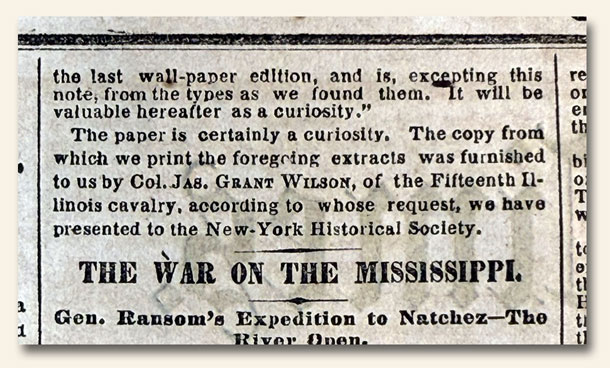
Further on, it explains how the last paragraph of the Vicksburg issue came to be: “The Illinois men who visited the office of the ‘Citizen’ thought that this admirable number ought not to be withheld from the subscribers. They set to work at once to print it off, but as it was now the Fourth of July and some changes had taken place since the original editor made up his sheets for the 2d, they brought up the news to date in the following postscript…” , which is the famous paragraph at the bottom of the page that begins: “Two days bring about great changes…”.
The Times article notes in conclusion: “…The copy from which we print the foregoing extracts was furnished to us by Col. Jas. Grant Wilson, of the Fifteenth Illinois cavalry, according to whose request, we have presented to the New York Historical Society.”
Although there are many issues in the realm of rare newspapers that are curious, unusual, or perhaps exceedingly historic in a very unusual way, rarely are collectors treated to a contemporary account of how they came to be. This is one.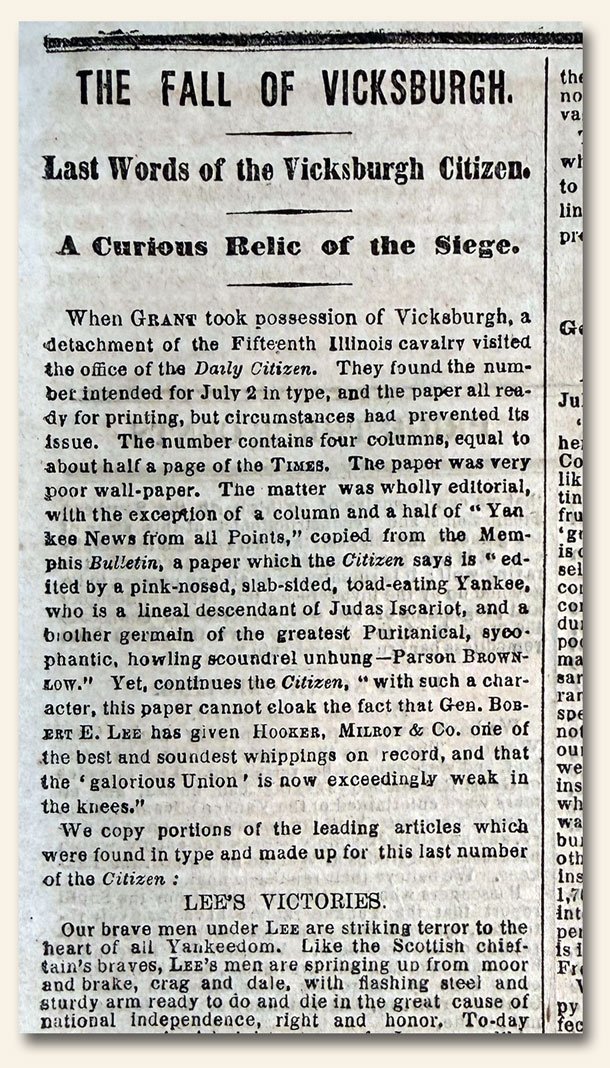
Announcing: Catalog 366 – Released (early) for May, 2026 – Rare & Early Newspapers…
May 1, 2026 by GuyHeilenman · Leave a Comment
|
|
April Newsletter (2026) – Timothy Hughes Rare & Early Newspapers…
April 17, 2026 by GuyHeilenman · Leave a Comment
|
|
What’s in a Masthead – An 1800s Boston Investigator…
April 10, 2026 by Phineas Q. Wryte · 1 Comment
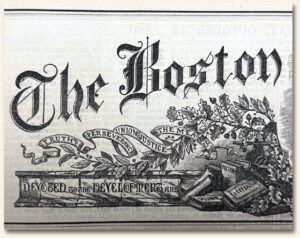 At first glance, the bold Gothic lettering of The Boston Investigator seems simply to announce a title—but linger a moment, and it reveals a creed. Founded in 1831, the paper became one of America’s longest-running freethought journals, devoted to skepticism, reform, and intellectual independence. By the 1880s, its identity was not merely stated but artistically embedded. The masthead itself functioned as a declaration of purpose, inviting readers into a publication that questioned orthodoxy and encouraged inquiry.
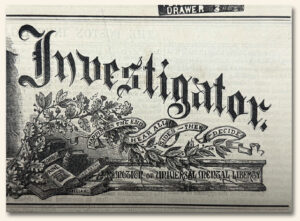
The imagery is deliberate and richly layered. Laurel and oak branches evoke endurance and strength, while flowing banners proclaim ideals such as “Truth,” “Perseverance,” and “Justice.” A cluster of books—bearing names like Paine, Voltaire, and Jefferson—anchors the paper firmly in Enlightenment tradition. And perhaps most striking is the phrase arcing confidently across the design: “Hear All Sides — Then Decide.” In an era often caricatured as rigid or dogmatic, here is a publication quite literally engraving open-minded debate into its identity. The Investigator was not merely tolerating dissent—it was institutionalizing it.
That makes the masthead feel remarkably modern—and, in some ways, quietly defiant even now. Its rebellious spirit from the 19th century champions a principle that can feel increasingly fragile today: the willingness to entertain opposing views before forming conclusions. Where much of the present climate tends to narrow discourse and reward certainty over curiosity, this 19th-century newspaper boldly carved intellectual openness into its very banner. So, what’s in a masthead? In this case, everything: a philosophy of inquiry, a commitment to dialogue, and a timeless challenge to think freely.
PS The Boston Investigator is considered to be the first American newspaper dedicated to the cause of freethought.
If you own an authentic newspaper with a “special” masthead and you would like to share it with the collectible community, please send a clear photo of the masthead and the description you would like included to me at pqwryte@rarenewspapers.com.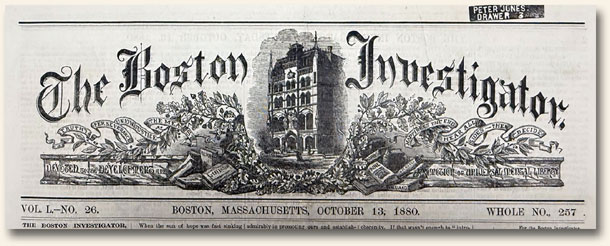
Lead-up to a Nation… as reported in the newspapers of the day (reflecting back on March, 1776)…
April 3, 2026 by GuyHeilenman · Leave a Comment
-
Colonies in Flux – The Influence of Common Sense (Lead-up to a Nation – E31)
-
General William Howe – The Pennsylvania Ledger (Lead-up to a Nation – E32)
-
The Siege of Boston – Debate at the House of Commons (Lead-up to a Nation – E33)
-
Diverse Voices – Divisions of the Era (Lead-up to a Nation – E34)
We hope you are enjoying this year-long trek to the 250th anniversary of The United States through the eyes of those who were fully engaged, first hand. As mentioned previously, all accounts are rooted in what they read in the newspapers of the day.
“History is never more fascinating than when read from the day it was first reported.” (Timothy Hughes, 1975)