
Search
The Rare & Early Newspapers Hobby

Receive the Newsletter

Buy Historic Newspapers

Nothing New Under the Sun… Thomas Nast Calls Out Government Fraud…
April 20, 2026 by Laura Heilenman · Leave a Comment
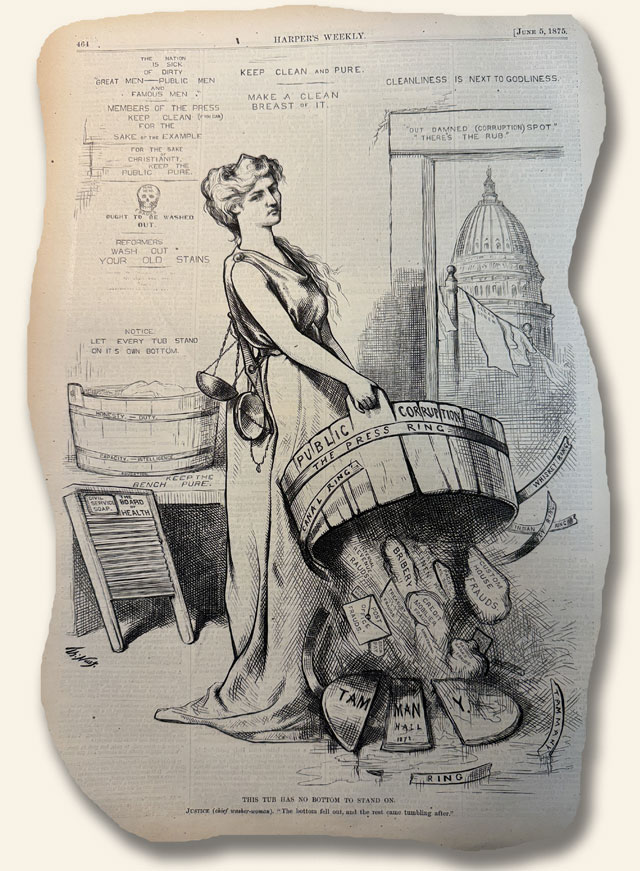 Thomas Nast’s 1875 wood engraving “This Tub Has No Bottom to Stand On,” published in Harper’s Weekly, stands as a searing indictment of Gilded Age graft. In the cartoon, blindfolded Justice hoists a washtub labeled “Public Corruption” by its handles. The metal rings binding it—each stamped with the names of notorious syndicates such as the Tammany Ring, Whiskey Ring, Canal Ring, Indian Ring, and City Ring—snap apart under the strain. The tub’s false bottom, emblazoned “Tammany Hall 1872,” plummets to the floor, spilling a cascade of documented crimes: bribery, internal-revenue frauds, Custom House swindles, Crédit Mobilier scandals, Treasury embezzlement, and Post Office graft. Nast, fresh from dismantling Boss Tweed’s machine, used the image to declare that these interlocking networks of political and corporate plunder possessed no legitimate foundation; once challenged by law or public scrutiny, the entire edifice collapsed, emptying its ill-gotten contents for all to see.
Nearly 150 years later, the United States still contends with systemic corruption that echoes those same structural weaknesses. Transparency International’s 2025 Corruption Perceptions Index gave the country a score of 64 out of 100—its lowest mark on record—ranking it 29th globally and marking a continued slide amid partisan polarization and regulatory capture.
The parallel between Nast’s era and our own is therefore not merely stylistic but substantive. Both periods feature explosive economic growth, technological upheaval, and extreme inequality that lubricate the machinery of graft; historians routinely describe the present as a “second Gilded Age” precisely because corporate-political fusion and fee-based governance have reemerged in updated forms. Yet important differences exist: today’s watchdogs, independent prosecutors, and digital transparency tools act as faster-acting surrogates for Nast’s allegorical Justice, rapidly exposing and clawing back billions that once vanished into obscurity. The enduring lesson of the cartoon therefore persists undiminished: corruption’s tub still has no bottom to stand on. When accountability is applied—whether by cartoonist’s pen or federal indictment—the contents inevitably spill, reminding every generation that vigilance and impartial justice remain the only forces capable of dismantling rings that otherwise appear impregnable.
Who’s Who in Newspapers? Father Thomas edition…
April 13, 2026 by Phineas Q. Wryte · 1 Comment
The 13th installment of Who’s Who in Newspapers
Many visitors to the History’s Newsstand Blog are familiar with the Damascus Affair of 1840 — one of the most consequential antisemitic episodes of the 19th century. Far fewer, however, know the name at the center of the storm: Father Thomas. It is his disappearance that lit the fuse, and it is his name that echoed through the newspapers of the day — including the remarkable report shown below, from our original issue of The Times (London), dated May 8, 1840.
Father Thomas: The Disappearance That Shook the World
Father Thomas of Tuscany (c. 1768–1840) was a Franciscan friar and physician serving in Damascus, Syria, then under the control of Egyptian ruler Mehemet Ali. On February 5, 1840, Father Thomas and his servant Ibrahim Amara vanished without a trace. What followed was not merely a criminal investigation — it was a catastrophe for the Jewish community of Damascus and, ultimately, for Jewish communities across the globe.
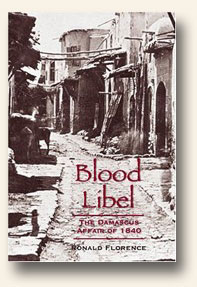
French Consul Ulysse de Ratti-Menton seized upon the disappearance to level charges against prominent local Jews, alleging that Father Thomas had been murdered as part of a ritualistic killing — the ancient and thoroughly debunked “Blood Libel” accusation, which falsely claimed that Jews used the blood of Christians in religious rites. Under torture, confessions were extracted. Several Jewish men died in captivity. Others faced execution. The affair sent shockwaves from Damascus to London, Paris, and beyond.
What makes the Damascus Affair historically significant — beyond its immediate horror — is the response it provoked. Jewish leaders in Europe, including Sir Moses Montefiore of England and Adolphe Crémieux of France, organized an international campaign on behalf of the accused, traveling to Egypt to appeal directly to Mehemet Ali. Their efforts represent one of the earliest instances of organized, international Jewish advocacy — a precursor, in many ways, to the modern human rights movement.
The report shown in full below offers a remarkable window into how the affair was unfolding in real time. Sourced from private letters arriving via Malta, the account describes how the Jews of Alexandria petitioned Mehemet Ali on April 9th, asking that those accused of Father Thomas’s murder be judged by the Viceroy himself. Seven leading men were received at the Palace, where Mehemet Ali acknowledged he had never encountered such a charge against the Jewish nation in all his years of rule. Crucially, he forbade the use of torture against the prisoners — a directive sent by dromedary to Commander-General Scheriff Pasha in Damascus. The report concludes with a notable observation: “This spirit of liberality and justice on the part of Mehemet Ali is a striking symptom of the progress of civilization in the East.”
As for Father Thomas himself — his fate was never definitively established. The accusations against the Damascus Jews were never formally dropped, though the imprisoned survivors were eventually released following the international intervention of Montefiore and Crémieux later that summer.
History has long since judged the Damascus Affair as a grotesque miscarriage of justice, fueled by antisemitism and political opportunism. The Blood Libel charge had no basis in fact — then or ever. Yet it is the name of Father Thomas that remains permanently linked to one of the 19th century’s darkest chapters: not because he caused it, but because his disappearance became the pretext for it.
This original Times of London report offers readers of today an unmediated glimpse into the unfolding events of 1840 — and is precisely what makes collecting historic newspapers so endlessly rewarding. The news, as they say, never gets old.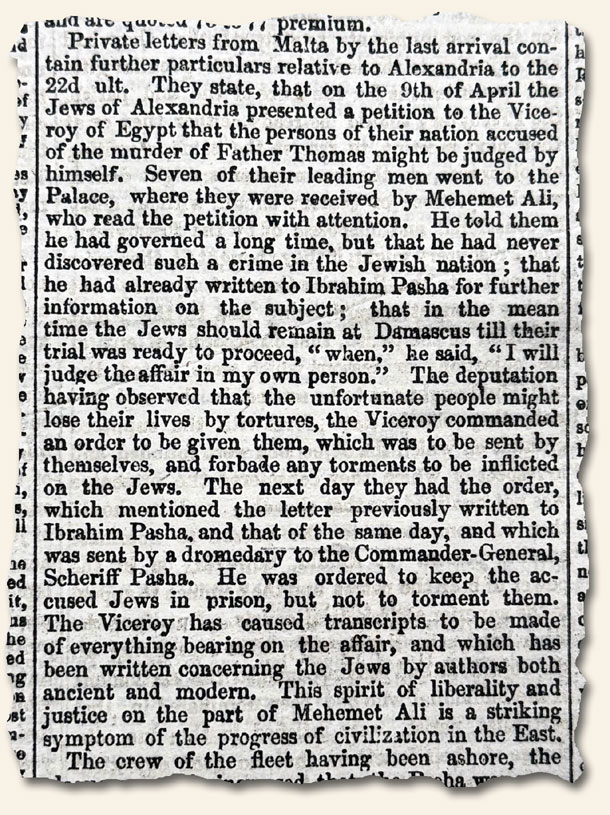
What’s in a Masthead – An 1800s Boston Investigator…
April 10, 2026 by Phineas Q. Wryte · 1 Comment
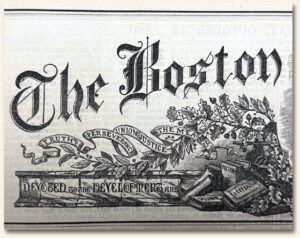 At first glance, the bold Gothic lettering of The Boston Investigator seems simply to announce a title—but linger a moment, and it reveals a creed. Founded in 1831, the paper became one of America’s longest-running freethought journals, devoted to skepticism, reform, and intellectual independence. By the 1880s, its identity was not merely stated but artistically embedded. The masthead itself functioned as a declaration of purpose, inviting readers into a publication that questioned orthodoxy and encouraged inquiry.
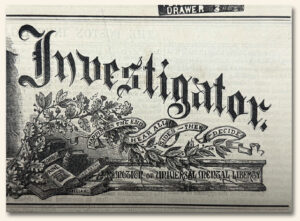
The imagery is deliberate and richly layered. Laurel and oak branches evoke endurance and strength, while flowing banners proclaim ideals such as “Truth,” “Perseverance,” and “Justice.” A cluster of books—bearing names like Paine, Voltaire, and Jefferson—anchors the paper firmly in Enlightenment tradition. And perhaps most striking is the phrase arcing confidently across the design: “Hear All Sides — Then Decide.” In an era often caricatured as rigid or dogmatic, here is a publication quite literally engraving open-minded debate into its identity. The Investigator was not merely tolerating dissent—it was institutionalizing it.
That makes the masthead feel remarkably modern—and, in some ways, quietly defiant even now. Its rebellious spirit from the 19th century champions a principle that can feel increasingly fragile today: the willingness to entertain opposing views before forming conclusions. Where much of the present climate tends to narrow discourse and reward certainty over curiosity, this 19th-century newspaper boldly carved intellectual openness into its very banner. So, what’s in a masthead? In this case, everything: a philosophy of inquiry, a commitment to dialogue, and a timeless challenge to think freely.
PS The Boston Investigator is considered to be the first American newspaper dedicated to the cause of freethought.
If you own an authentic newspaper with a “special” masthead and you would like to share it with the collectible community, please send a clear photo of the masthead and the description you would like included to me at pqwryte@rarenewspapers.com.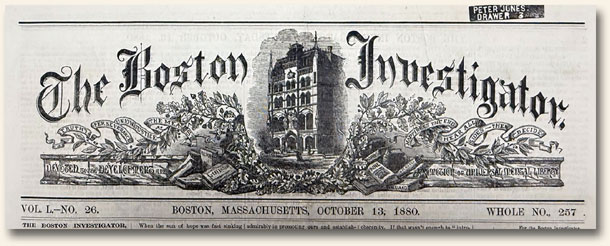
Announcing: Catalog 365 – Released (early) for April, 2026 – Rare & Early Newspapers…
March 27, 2026 by Phineas Q. Wryte · Leave a Comment
|
|
Mystery Solved … The Ancestry of Abraham Lincoln Clarified…
March 23, 2026 by Laura Heilenman · 1 Comment
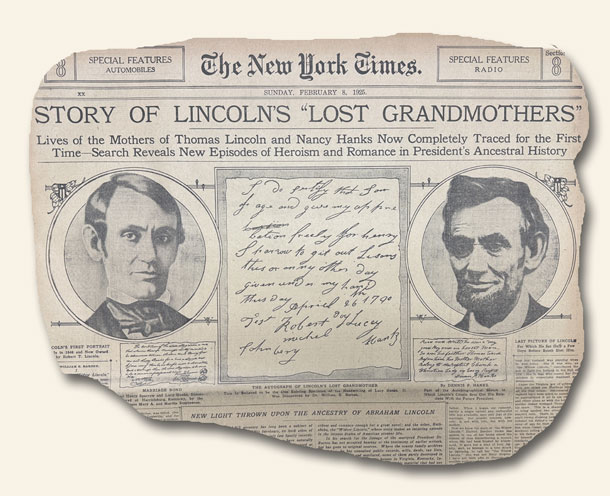
We often discuss the legacy of our founding fathers and American heroes… highlights of their lives which leave an indelible impression on us as individuals or on the country we cherish. With all this focus, it is a shame we often miss the stories of their ancestry… the people and events that molded them into the larger-than-life figures we admire. Such is the case with Abraham Lincoln. Although we have all learned of his self-education in a one room log cabin and the deep loses he suffered as a young man, it wasn’t until 1925 that we were able to get a clearer picture of family members who came before and how their stories might have impacted the Lincoln. On February 8, 1925 The New York Times had substantial coverage of Abraham Lincoln’s grandmothers who had, until this point, not been confirmed. The paper goes on to say the stories of these ladies reveal. “Episodes of Heroism and Romance in the president’s Ancestral History”. Not unlike today, apparently, people at the turn of the century longed for a good paparazzi story as well.
This Day Through History (as reported in authentic newspapers)…
March 12, 2026 by GuyHeilenman · 1 Comment
A birthday newspaper is a wonderful gift. But what if you could choose from dozens of newsworthy dates — all sharing that same special day of any month? NOW YOU CAN!
Pick any month and day below and we’ll instantly show you every historic newspaper we have from that exact date — regardless of the year.
Example 1:
Example 2: Newspapers Published on July 4th
Significant Discovery: Horace Greeley’s “views” of Freedmen (1865)…
March 9, 2026 by GuyHeilenman · Leave a Comment
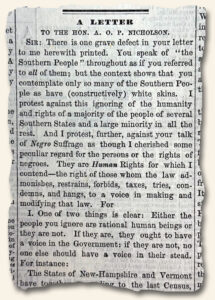
After being heavily engrossed in the rare & early newspapers collectible for over 50 years, encountering “new” discoveries within our own archives has not abated. Case in point: We recently identified a significant letter in the August 26, 1865, issue of the New York Daily Tribune that had previously gone unnoticed. Located on page 4 and signed simply “H. G.” (Horace Greeley), this letter addressed to the Hon. A. O. P. Nicholson offers a profound look into the intellectual climate of the immediate post-Civil War era. Perhaps it was the inconspicuous single column heading, “A Letter”, which was complicit in our oversight. Such “discoveries” are one of the reasons why we love this hobby.
As far as the letter itself is concerned… The exchange occurred during a pivotal window of Reconstruction. With the war concluded and the Thirteenth Amendment in the process of ratification, the nation was gripped by a debate over the “physical, intellectual, and emotional condition” of newly emancipated African Americans. While many, including Nicholson, sought to categorize or question the capabilities of the formerly enslaved through a lens of racial “fitness,” Greeley used his editorial platform to push back against these prejudices.
In this letter, Greeley argues that any perceived deficiencies in the Black population were not inherent traits, but the direct result of the “degradations” of the institution of slavery. By advocating for education and the rights of “Free Labor,” Greeley was effectively laying the groundwork for the so-called “Radical Republican” agenda that would eventually lead to the 14th and 15th Amendments.
For collectors of Civil War, Reconstruction-era, and Black-Americana ephemera, this issue serves as a primary source document and captures the exact moment the country transitioned from a military conflict to a philosophical battle over the true meaning of citizenship – a powerful step towards realizing the founding charge that all (people) are created equal.
Announcing: Catalog 364 – Released for March, 2026 – Rare & Early Newspapers…
February 27, 2026 by GuyHeilenman · Leave a Comment
Catalog 364 (for March): This latest offering of authentic newspapers is comprised of over 300 new items, a selection which includes the following noteworthy issues: an issue re: the Olive Branch Petition, Hawaii’s first English language newspaper, “The Crisis” essay #9 by Thomas Paine, a first report of Lincoln’s assassination, a Civil War prison camp newspaper, an early newsbook from 1643, the historic “Funding Act”, and more.
The following links are designed to help you explore all available items from this latest edition of our catalog:
Abridged Catalog (EXCLUDES wholesale lots & titles sold only by year (not by a specific date)
A PDF Version of the Catalog (printable)
Entire Catalog grouped by Era:
1500-1799 (full view OR quick-scan/compact view)
1800-1899 (full view OR quick-scan/compact” view)
1900-Present (full view OR quick-scan/compact” view)
The following links focus on both this month’s and last months catalogs:
- Combined Catalogs (entirety of both)
Become a Premium Member to receive hard copy versions of our catalogs (U.S. residents only).
Announcing: Catalog 363 – Released for February, 2026 – Rare & Early Newspapers…
January 30, 2026 by GuyHeilenman · Leave a Comment
Catalog 363 (for February): This latest offering of authentic newspapers is comprised of over 300 new items, a selection which includes the following noteworthy issues: a Massachusetts Spy with the desired “Join or Die” snake engraving, a Pennsylvania Ledger with the Olive Branch Petition, one of the rarest of early American magazines, The Jew Bill: striving for equal rights for Jews, a handsome colonial New York newspaper from 1745, a fine report on the death of George Washington, and more.
The following links are designed to help you explore all available items from this latest edition of our catalog:
- Abridged Catalog (EXCLUDES wholesale lots & titles sold only by year (not by a specific date)
- A PDF Version of the Catalog (printable)
- Entire Catalog grouped by Era:
1500-1799 (full view OR quick-scan/compact view)
1800-1899 (full view OR quick-scan/compact” view)
1900-Present (full view OR quick-scan/compact” view)
The following links focus on both this month’s and last months catalogs:
- Combined Catalogs (entirety of both)
Become a Premium Member to receive hard copy versions of our catalogs (U.S. residents only).
Two Discoveries, One Powerful Reminder – It Started with the Pony Express…
January 26, 2026 by GuyHeilenman · Leave a Comment
From the very beginning, a recurring theme on the History’s Newsstand blog has been the joy of finding hidden gems—those golden nuggets tucked within historic newspapers. Collectors of rare and early papers know this thrill well: you acquire an issue for one reason, only to uncover something unexpected that proves equally—if not more—captivating.
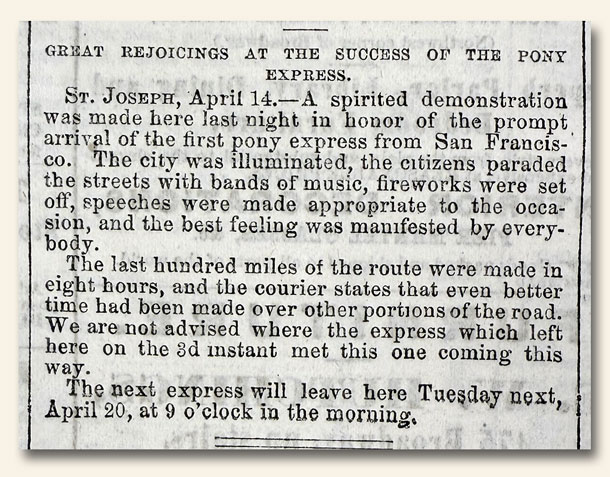
That’s exactly what happened to me recently while examining the April 16, 1860 issue of The Evening Post (New York). My original goal was to locate coverage of the completion of the first run of the Pony Express, and to my delight, I found not one but two front-page reports. Front-page coverage of such events is rare enough—but two related pieces? A true collector’s treat.
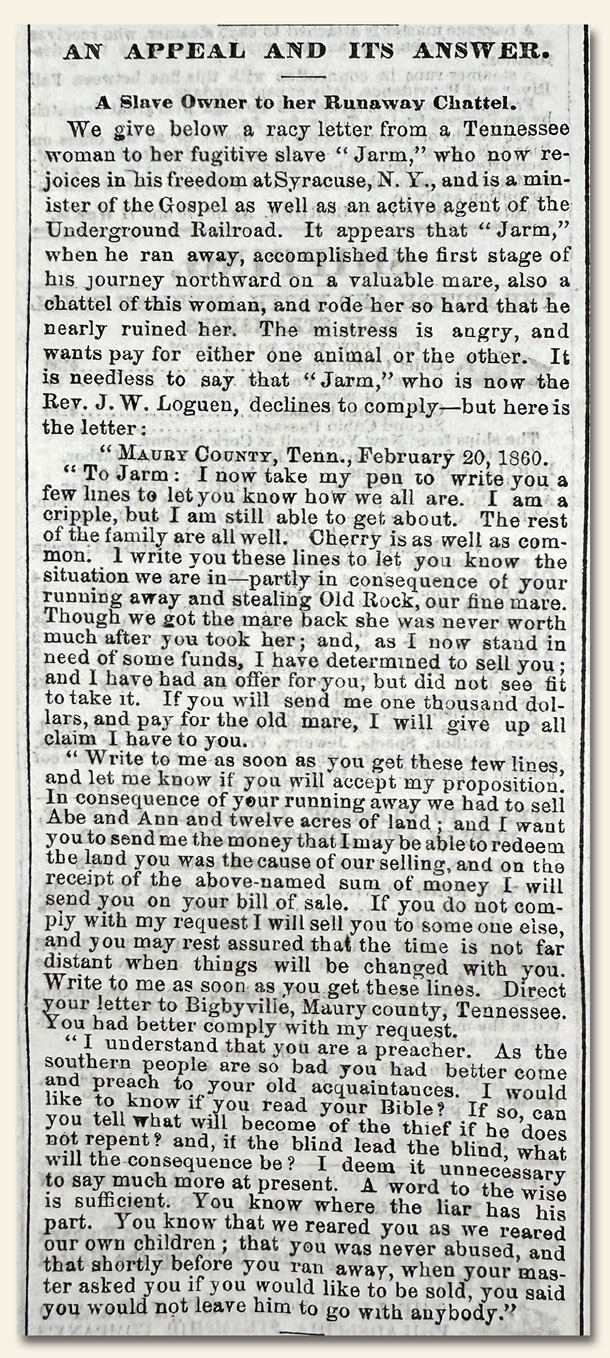
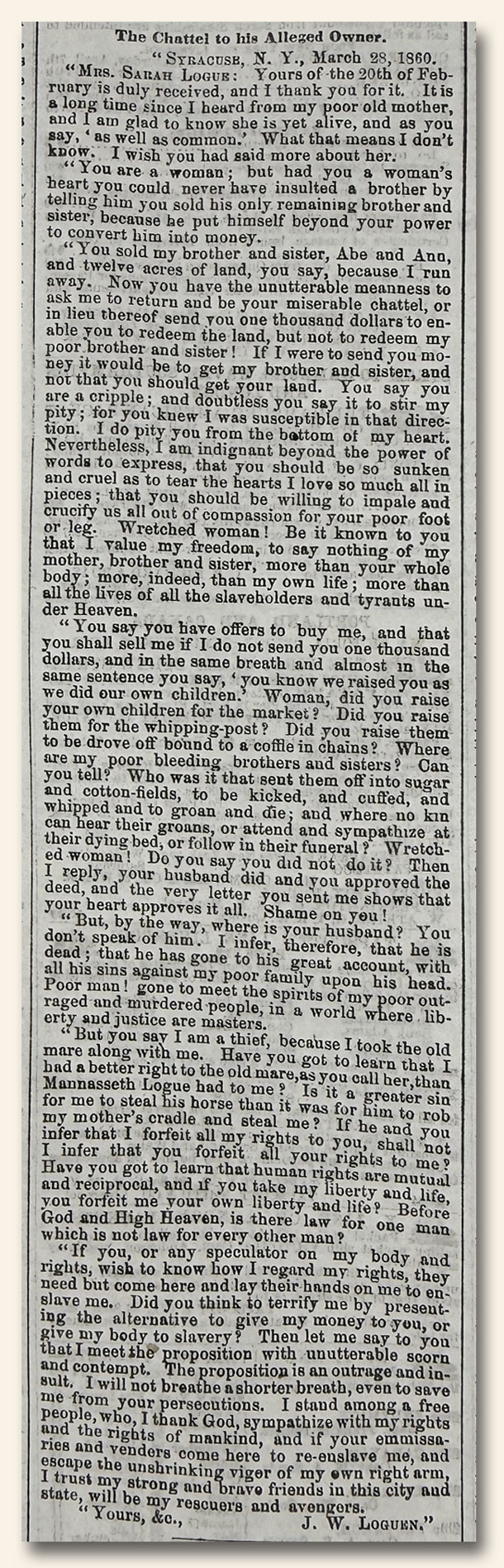
As I continued browsing for additional Pony Express material within the issue, I stumbled upon one of those unforgettable “hidden gems”: a printed exchange between a runaway slave and his former master. While not an account of a major historical event, few subjects evoke as much emotion as slavery, and reading such raw, personal correspondence in a period newspaper was deeply moving.
While the issue’s collectible value is likely anchored by its Pony Express reports, it’s this second discovery that continues to resonate with me. It serves as a poignant reminder—to me, my family, and my friends—of the immeasurable worth of every human being. Each of us, created in God’s image, carries equal and sacred value. Red and yellow, black and white—we are all precious in His sight.
All right, I’ll step down from my soapbox now. The photos below provide context for the discoveries mentioned above. Thanks for reading—and for sharing in the joy of finding history’s hidden treasures.
One of the Two Reports regarding the Pony Express
Correspondence Between the Runaway Slave and his former “Master”