
Search
The Rare & Early Newspapers Hobby

Receive the Newsletter

Buy Historic Newspapers

Lead-up to a Nation… as reported in the newspapers of the day (reflecting back on May, 1776)…
June 5, 2026 by GuyHeilenman · Leave a Comment
-
Hope and Defiance – French Sympathy (E39)
-
The New-England Chronicle – A Rare Voice (E40)
-
Powerful Resolves – Battlefield Successes (E41)
-
Addressing Military Overreach – Precedent for Restraint (E42)
- Common Sense – Condemnation of Monarchy (E43)
We hope you are enjoying this year-long trek to the 250th anniversary of The United States through the eyes of those who were fully engaged, first hand. As mentioned previously, all accounts are rooted in what they read in the newspapers of the day.
“History is never more fascinating than when read from the day it was first reported.” (Timothy Hughes, 1975)
An intriguing irony of American history, only to be found in a newspaper…
June 1, 2026 by TimHughes · Leave a Comment
There are times when we browse through a newspaper and, while looking for something else, come across an unexpected little gem of American history. And from what we are able to determine, this “little gem” has never been reported to this day.
The “Boston Daily Journal” of April 14, 1865 shares the date of the Lincoln assassination, he attending a performance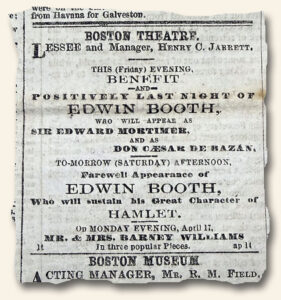 of “Our American Cousin” at Ford’s Theatre in Washington, D.C. Page 3 of this newspaper has an advertisement for the Boston Theatre, noting: “This (Friday) Evening Benefit and Positively Last Night of EDWIN BOOTH who will appear as Sir Edward Mortimer…To-Morrow (Saturday Afternoon, Farewell Appearance of EDWIN BOOTH, Who will sustain his Great Character of Hamlet…”.
So what did we find? The very evening that famed actor Edwin Booth was performing in a Boston theater, his younger brother was assassinating the President in a theater less than 400 miles away.
This advertisement, logically, would only be found in a Boston newspaper.
This is similar to another of our blog posts, concerning Lincoln attending a Washington, D.C. stage performance of John Wilkes Booth in 1863, the irony being Lincoln’s assumed applause at the conclusion of the performance for the person who would assassinate him less than 2 years later.
Such tidbits of history are fascinating finds, and could only be discovered in newspapers of the day. So look carefully at the issues you purchase. Will you discover a historical gem that the world knew nothing about?
Announcing: Catalog 367 – Released (early) for June, 2026 – Rare & Early Newspapers…
May 29, 2026 by GuyHeilenman · Leave a Comment
|
|
Lead-up to a Nation… as reported in the newspapers of the day (reflecting back on April, 1776)…
May 8, 2026 by GuyHeilenman · Leave a Comment
-
The King’s own Regulars & Their Triumph over the Irregulars – Propaganda (E35)
-
Voices of a Young Nation – Reports: Grim and Grateful (E36)
-
Stirring Reports – Elected Delegates & New Postal System (E37)
-
Independence was Destiny – The Case for Independence (E38)
We hope you are enjoying this year-long trek to the 250th anniversary of The United States through the eyes of those who were fully engaged, first hand. As mentioned previously, all accounts are rooted in what they read in the newspapers of the day.
“History is never more fascinating than when read from the day it was first reported.” (Timothy Hughes, 1975)
This famous Confederate issue, with a contemporary explanation…
May 4, 2026 by TimHughes · Leave a Comment
Over the last 50 years we have sold many genuine issues of the famous “Vicksburg Daily Citizen” issue of July 2 (4), 1863. Its desirability is in the curious background of its creation. If you have received our catalogs through the years, you have likely read of at least one of our offerings, with the details as to how the July 2 issue was left on the press when the Confederates left town when the Yankee forces moved in. As the story goes, Yankee printers found the July 2 issue still on the press, changed the last paragraph to reflect the historic changes that had happened over the previous two days, and printed the paper.
We were not aware until recently that a contemporary issue of the “New York Times” told the story quite well. Page 2 of the August 5, 1863 issue has over a column headed: “The Fall of Vicksburgh” “Last Words of the Vicksburgh Citizen” “A Curious Relic of the Siege”.
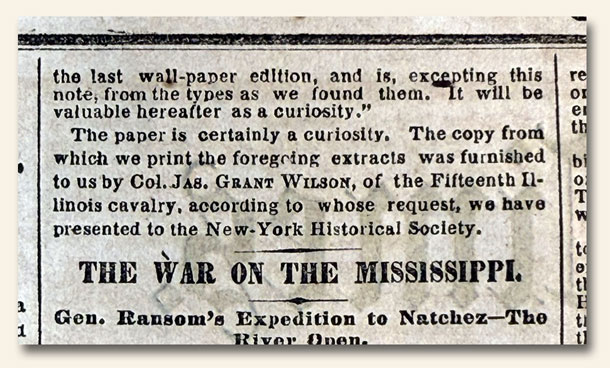
The report begins: “When Grant took possession of Vicksburgh, a detachment of the Fifteenth Illinois cavalry visited the office of the ‘Daily Citizen”. They found the number intended for July 2 in type, and the paper all ready for printing, but circumstances had prevented its issue…the paper was very poor wall-paper. The matter was wholly editorial, with the exception of a column and a half of: “Yankee News from all Points” copied from the Memphis Bulletin, a paper which the Citizen says is ‘edited by a pink-nosed, slab-sided, toad-eating Yankee, who is a lineal descendant of Judas Iscariot…” with much more.
Further on, it explains how the last paragraph of the Vicksburg issue came to be: “The Illinois men who visited the office of the ‘Citizen’ thought that this admirable number ought not to be withheld from the subscribers. They set to work at once to print it off, but as it was now the Fourth of July and some changes had taken place since the original editor made up his sheets for the 2d, they brought up the news to date in the following postscript…” , which is the famous paragraph at the bottom of the page that begins: “Two days bring about great changes…”.
The Times article notes in conclusion: “…The copy from which we print the foregoing extracts was furnished to us by Col. Jas. Grant Wilson, of the Fifteenth Illinois cavalry, according to whose request, we have presented to the New York Historical Society.”
Although there are many issues in the realm of rare newspapers that are curious, unusual, or perhaps exceedingly historic in a very unusual way, rarely are collectors treated to a contemporary account of how they came to be. This is one.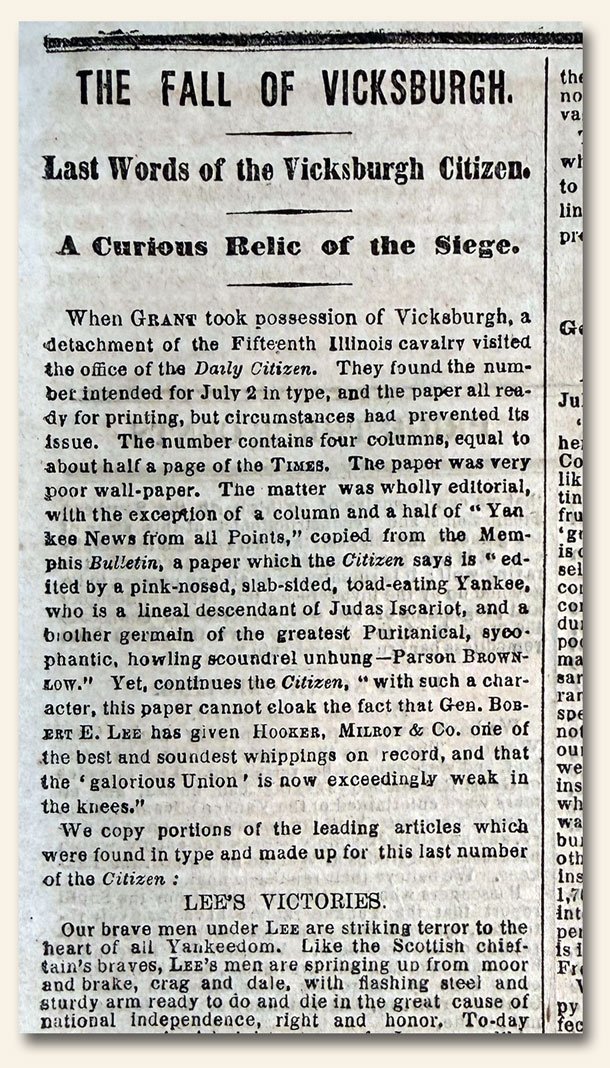
Announcing: Catalog 366 – Released (early) for May, 2026 – Rare & Early Newspapers…
May 1, 2026 by GuyHeilenman · Leave a Comment
|
|
Who’s Who in Newspapers? Father Thomas edition…
April 13, 2026 by Phineas Q. Wryte · 1 Comment
The 13th installment of Who’s Who in Newspapers
Many visitors to the History’s Newsstand Blog are familiar with the Damascus Affair of 1840 — one of the most consequential antisemitic episodes of the 19th century. Far fewer, however, know the name at the center of the storm: Father Thomas. It is his disappearance that lit the fuse, and it is his name that echoed through the newspapers of the day — including the remarkable report shown below, from our original issue of The Times (London), dated May 8, 1840.
Father Thomas: The Disappearance That Shook the World
Father Thomas of Tuscany (c. 1768–1840) was a Franciscan friar and physician serving in Damascus, Syria, then under the control of Egyptian ruler Mehemet Ali. On February 5, 1840, Father Thomas and his servant Ibrahim Amara vanished without a trace. What followed was not merely a criminal investigation — it was a catastrophe for the Jewish community of Damascus and, ultimately, for Jewish communities across the globe.
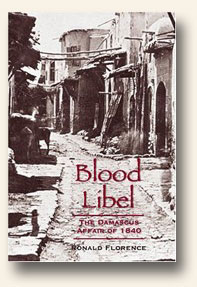
French Consul Ulysse de Ratti-Menton seized upon the disappearance to level charges against prominent local Jews, alleging that Father Thomas had been murdered as part of a ritualistic killing — the ancient and thoroughly debunked “Blood Libel” accusation, which falsely claimed that Jews used the blood of Christians in religious rites. Under torture, confessions were extracted. Several Jewish men died in captivity. Others faced execution. The affair sent shockwaves from Damascus to London, Paris, and beyond.
What makes the Damascus Affair historically significant — beyond its immediate horror — is the response it provoked. Jewish leaders in Europe, including Sir Moses Montefiore of England and Adolphe Crémieux of France, organized an international campaign on behalf of the accused, traveling to Egypt to appeal directly to Mehemet Ali. Their efforts represent one of the earliest instances of organized, international Jewish advocacy — a precursor, in many ways, to the modern human rights movement.
The report shown in full below offers a remarkable window into how the affair was unfolding in real time. Sourced from private letters arriving via Malta, the account describes how the Jews of Alexandria petitioned Mehemet Ali on April 9th, asking that those accused of Father Thomas’s murder be judged by the Viceroy himself. Seven leading men were received at the Palace, where Mehemet Ali acknowledged he had never encountered such a charge against the Jewish nation in all his years of rule. Crucially, he forbade the use of torture against the prisoners — a directive sent by dromedary to Commander-General Scheriff Pasha in Damascus. The report concludes with a notable observation: “This spirit of liberality and justice on the part of Mehemet Ali is a striking symptom of the progress of civilization in the East.”
As for Father Thomas himself — his fate was never definitively established. The accusations against the Damascus Jews were never formally dropped, though the imprisoned survivors were eventually released following the international intervention of Montefiore and Crémieux later that summer.
History has long since judged the Damascus Affair as a grotesque miscarriage of justice, fueled by antisemitism and political opportunism. The Blood Libel charge had no basis in fact — then or ever. Yet it is the name of Father Thomas that remains permanently linked to one of the 19th century’s darkest chapters: not because he caused it, but because his disappearance became the pretext for it.
This original Times of London report offers readers of today an unmediated glimpse into the unfolding events of 1840 — and is precisely what makes collecting historic newspapers so endlessly rewarding. The news, as they say, never gets old.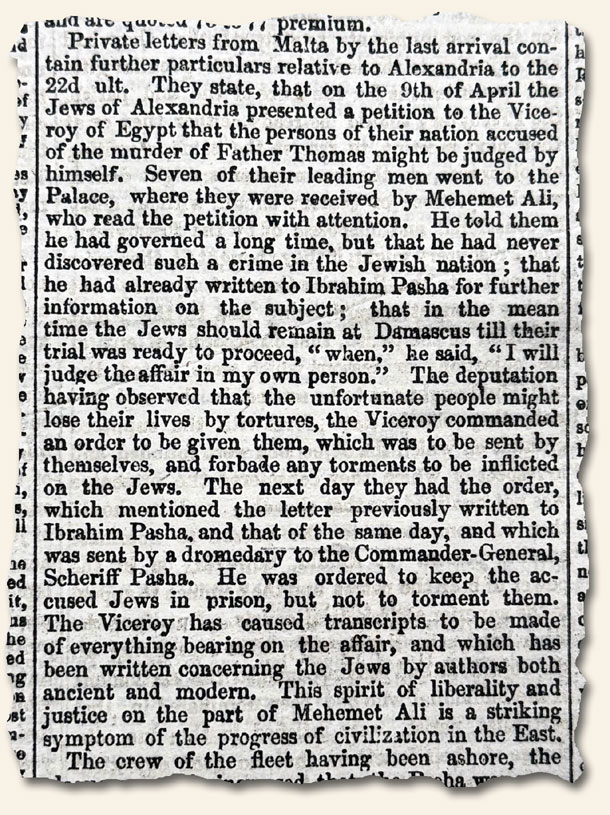
Lead-up to a Nation… as reported in the newspapers of the day (reflecting back on March, 1776)…
April 3, 2026 by GuyHeilenman · Leave a Comment
-
Colonies in Flux – The Influence of Common Sense (Lead-up to a Nation – E31)
-
General William Howe – The Pennsylvania Ledger (Lead-up to a Nation – E32)
-
The Siege of Boston – Debate at the House of Commons (Lead-up to a Nation – E33)
-
Diverse Voices – Divisions of the Era (Lead-up to a Nation – E34)
We hope you are enjoying this year-long trek to the 250th anniversary of The United States through the eyes of those who were fully engaged, first hand. As mentioned previously, all accounts are rooted in what they read in the newspapers of the day.
“History is never more fascinating than when read from the day it was first reported.” (Timothy Hughes, 1975)
Announcing: Catalog 365 – Released (early) for April, 2026 – Rare & Early Newspapers…
March 27, 2026 by Phineas Q. Wryte · Leave a Comment
|
|
Significant Discovery: Horace Greeley’s “views” of Freedmen (1865)…
March 9, 2026 by GuyHeilenman · Leave a Comment
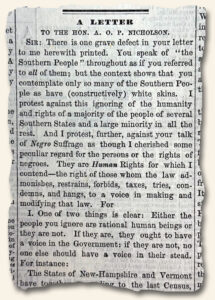
After being heavily engrossed in the rare & early newspapers collectible for over 50 years, encountering “new” discoveries within our own archives has not abated. Case in point: We recently identified a significant letter in the August 26, 1865, issue of the New York Daily Tribune that had previously gone unnoticed. Located on page 4 and signed simply “H. G.” (Horace Greeley), this letter addressed to the Hon. A. O. P. Nicholson offers a profound look into the intellectual climate of the immediate post-Civil War era. Perhaps it was the inconspicuous single column heading, “A Letter”, which was complicit in our oversight. Such “discoveries” are one of the reasons why we love this hobby.
As far as the letter itself is concerned… The exchange occurred during a pivotal window of Reconstruction. With the war concluded and the Thirteenth Amendment in the process of ratification, the nation was gripped by a debate over the “physical, intellectual, and emotional condition” of newly emancipated African Americans. While many, including Nicholson, sought to categorize or question the capabilities of the formerly enslaved through a lens of racial “fitness,” Greeley used his editorial platform to push back against these prejudices.
In this letter, Greeley argues that any perceived deficiencies in the Black population were not inherent traits, but the direct result of the “degradations” of the institution of slavery. By advocating for education and the rights of “Free Labor,” Greeley was effectively laying the groundwork for the so-called “Radical Republican” agenda that would eventually lead to the 14th and 15th Amendments.
For collectors of Civil War, Reconstruction-era, and Black-Americana ephemera, this issue serves as a primary source document and captures the exact moment the country transitioned from a military conflict to a philosophical battle over the true meaning of citizenship – a powerful step towards realizing the founding charge that all (people) are created equal.