
Search
The Rare & Early Newspapers Hobby

Receive the Newsletter

Buy Historic Newspapers

How a change in plans could change the course of history…
October 5, 2026 by TimHughes · Leave a Comment
One of the intriguing aspects of collecting early newspapers is the opportunity to learn–with hindsight–how some aspects of history, seeming mundane at the time, could change ever-so-slightly yet affect the course of history forever. Let me explain.
An inconspicuous report in the “Evening Bulletin” issue of Oct. 31, 1863 (shown below), from Providence, Rhode Is., is headed: “The Field of Gettysburg”. Remembering that the historic Battle of Gettysburg was fought nearly 4 months prior, it would have been no surprise that the cemetery at Gettysburg would be formally dedicated to the memory of the thousands who died in that struggle. The planning being of little consequence to anyone at the time, we are not surprised that this is the first such report we have seen in any newspaper.
The report has two points of curious interest. First, the dedication was originally planned for October 22, but it had to be postponed until November 19: “…by which time all the dead braves will be, probably, interred.” There is also mention that: “Edward Everett will deliver, probably, his finest oration…” plus more on the planned event. There was no mention of President Lincoln.
Lincoln was not formally invited to participate until November 2, just 17 days before the ceremony, and 11 days after the original date for the event. By contrast, Everett had been invited months prior. The committee did not expect Lincoln to give a major speech. David Wills’s official invitation letter specifically requested that the President provide just “a few appropriate remarks” to formally set aside the grounds after Everett’s grand oration.
Indeed, Everett gave a “grand oration”. He spoke for two hours (13,607 words), while Lincoln followed with his two-minute Gettysburg Address (272 words), which ultimately became one of the most famous speeches in human history.
What if Lincoln had not been invited at the last minute? The dedication of the Gettysburg Cemetery would still have been reported in most newspapers of the day, given Edward Everett’s speech, but over 16o years later, history would have had little memory of the event. It was Lincoln’s two-minute address that made the difference.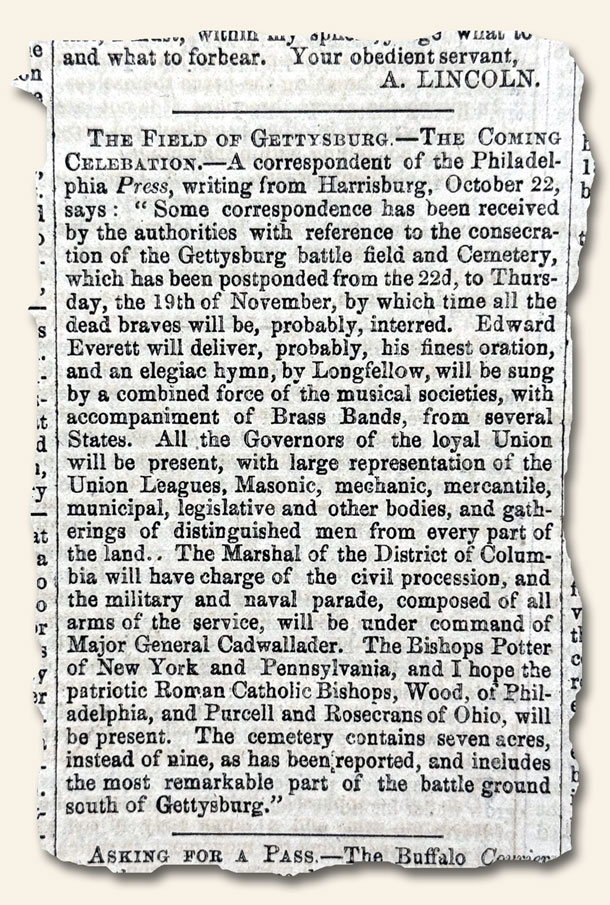
The Slow Death of a President… The Doctor Whose Name Became a Punchline…
September 21, 2026 by Laura Heilenman · Leave a Comment
On July 2, 1881, President James A. Garfield was shot twice at a Washington, D.C. train station by Charles Guiteau. One bullet grazed his arm; the other lodged in his back. Neither wound was immediately fatal, and the president would linger for 80 agonizing days. Ultimately, what killed him was not the assassin’s marksmanship, but the “care” that followed.
The man who seized control of the case was Dr. Doctor Willard Bliss (whose first name was act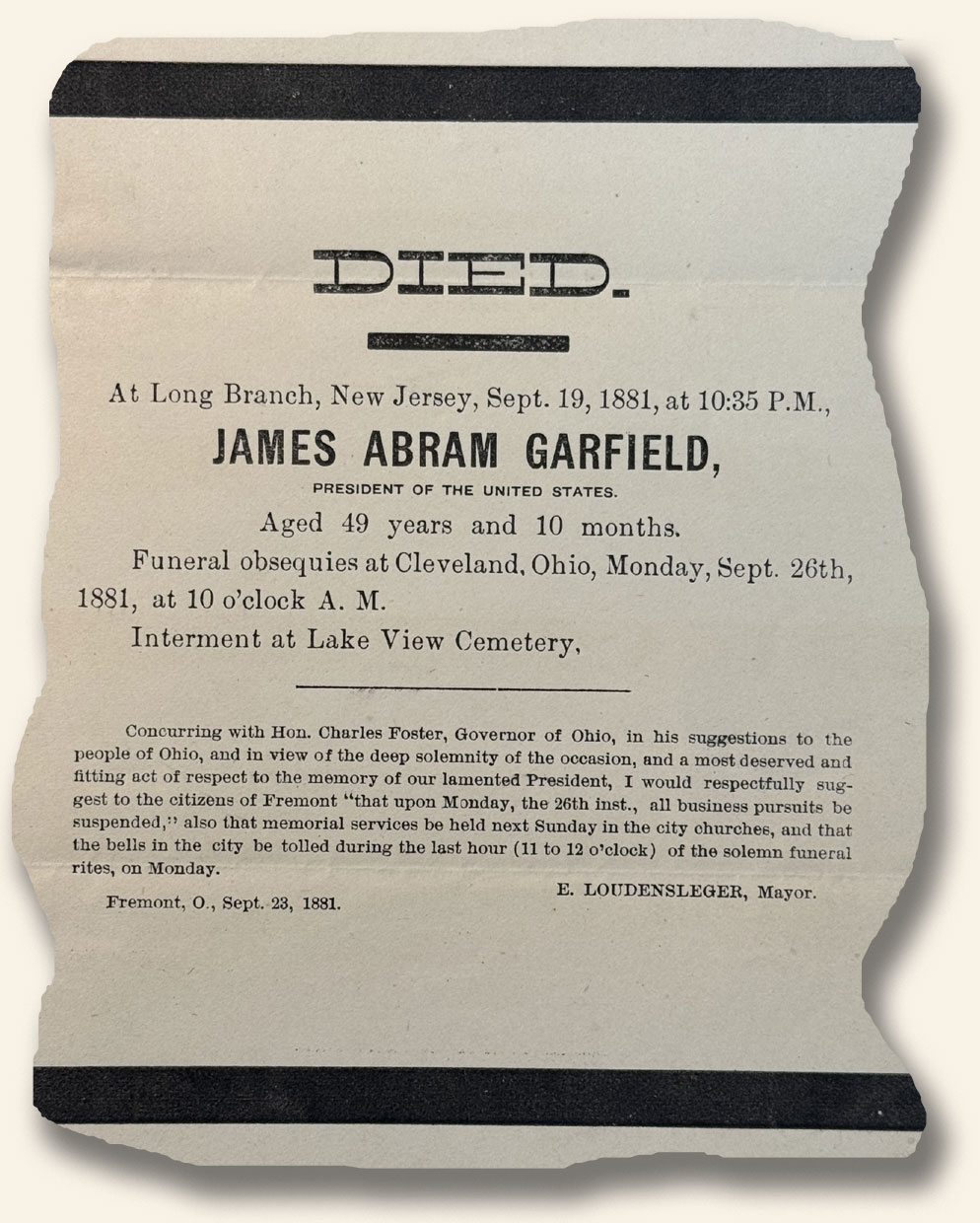 ually “Doctor”). Summoned to the scene, Bliss immediately took charge, sidelined other physicians, and restricted access to the president. He was convinced the bullet sat on the right side of Garfield’s body near the liver. It did not. A post-mortem examination revealed it lodged safely on the left side, embedded near the pancreas without harming any vital organs. Bliss, however, never accepted he was wrong.
Worse than his misdiagnosis was his method of treatment. Though Joseph Lister’s antiseptic techniques were gaining traction in Europe and among progressive American physicians, Bliss effectively rejected them. He repeatedly probed Garfield’s wound with unwashed fingers and unsterilized instruments, transforming a minor entry wound into a massive, pus-filled infection channel. He subjected the president to painful examinations without anesthesia, fed him rectally with concoctions of beef bouillon and egg yolks, and heavy-dosed him with quinine and morphine. Garfield lost nearly 100 pounds as his body broke out in systemic abscesses. On September 19, he succumbed to sepsis and a ruptured splenic artery.
At his trial, Guiteau famously—and with grim accuracy—claimed: “I deny the killing, if your Honor please. We admit the shooting.” He argued that while he had merely shot the president, the doctors had killed him. The public record increasingly backed that assertion.
Critics fiercely condemned Bliss’s arrogance and stubborn refusal to adopt modern medicine. A popular 19th-century jab soon circulated with particular sting: “Ignorance is Bliss.”
The phrase itself was far older, coined by English poet Thomas Gray in 1742 (“Where ignorance is bliss, ’tis folly to be wise”). But after Garfield’s death, the old line took on a bitter new life. Bliss’s name and vanity turned a classic poetic observation into a sharp medical epitaph. The pun stuck in popular retellings, granting an 18th-century idiom an extra layer of tragic dark humor no poet ever intended.
Garfield’s wound was easily survivable by modern standards—and likely survivable even by the best medical practices of 1881. Instead, he received confident ignorance dressed as expertise.
The reason I collect it: stunning graphics inside… Lincoln’s Funeral…
August 17, 2026 by TimHughes · Leave a Comment
We have handled many Lincoln assassination and funeral issues, and many can be graphic in terms of type size and drama of the column headlines. Most notably, the ‘Philadelphia Inquirer’ had several issues from April 17 to 25 with very nice graphic appeal.
But never have we seen inside pages so dramatically presented as with the ‘Cleveland Morning Leader’ issue of April 28, 1865. Although the front page is focused on the capture and death of John Wilkes Booth, as well as reports on the Lincoln funeral (all page 1 and 4 columns have wide, black mourning rules), pages 2 and 3 are consumed with broadside-like graphics, offering no text save for that found within the graphics. Page 2 appears much like a monument in memory of Lincoln, and page 3 has a black border surrounding short poems and portions of a “Speech of Abraham Lincoln” and a line from his “Emancipation Proclamation”.
When first encountered I noticed the ink bleed-through on page 1 and thought it was offsetting from the previous issue (not uncommon). But when I opened the newspaper I discovered something I had never seen the likes of before.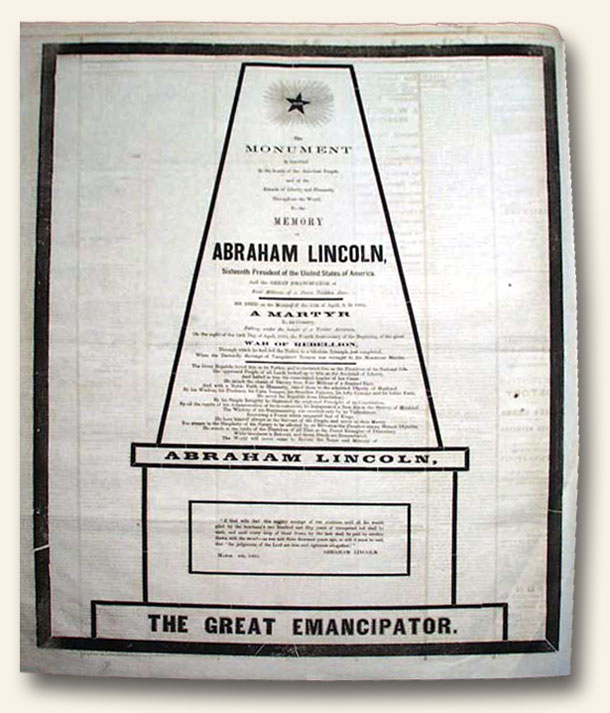
The Moment Before the World Changes… Lincoln’s Assassination Day…
July 27, 2026 by Laura Heilenman · Leave a Comment
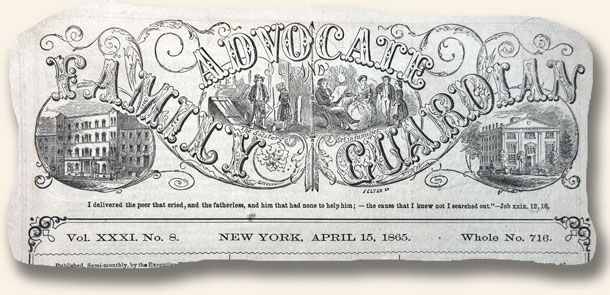
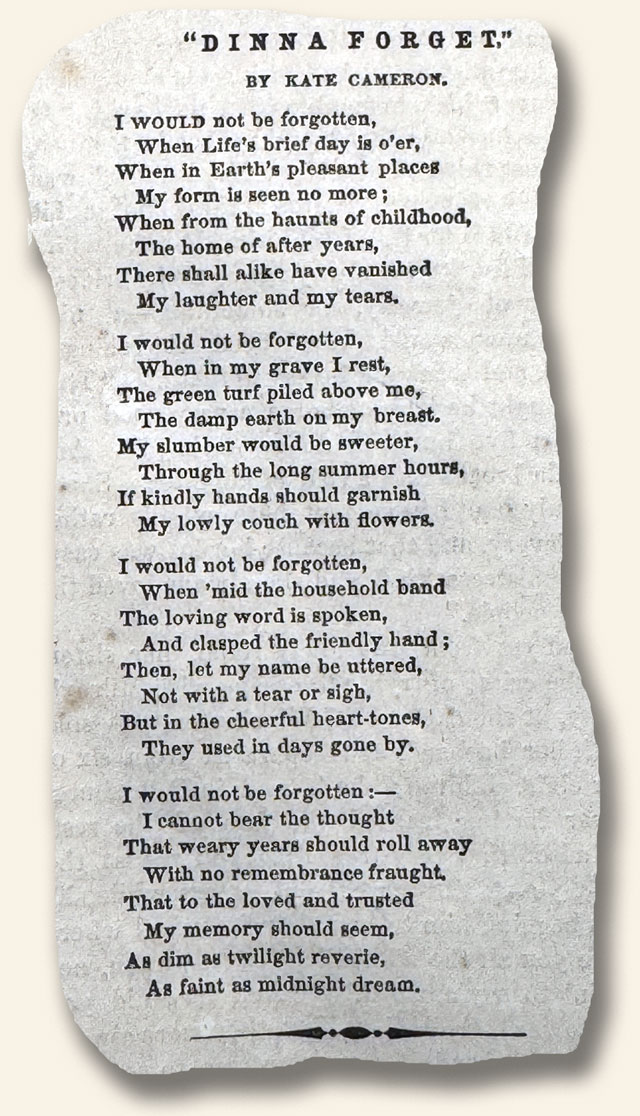
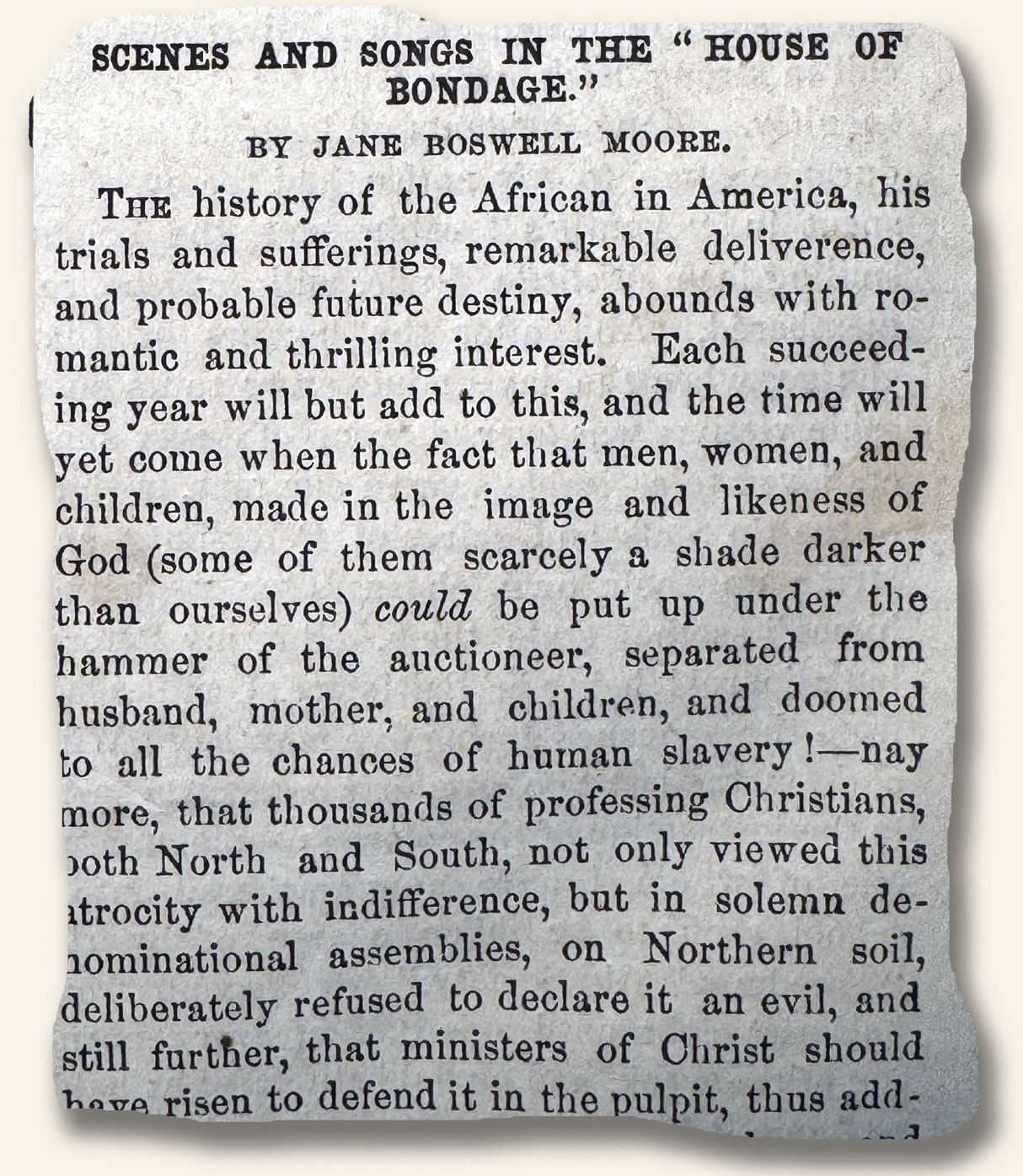
You can’t read historic newspapers for long before you are struck by how often people experience “the moment before”.
The April 15, 1865 issue of the ADVOCATE FAMILY GUARDIAN has a prime example with so much nuance that you can’t imagine it was not planned and yet, clearly it was not.
Hours before President Lincoln was Assassinated, the paper published their daily edition and the front page was framed by 2 articles. On the left side was a poem describing the death of someone and how they would never be forgotten. The right side had an article describing slavery and how God’s people should have risen to speak against it. What a beautiful, accidental tribute to the President who was about to be mourned and who did rise and stand against slavery. The irony of the frontpage coverage could not be lost on the reader… in hindsite.
Strong Foundation … Liberty Takes Continual Work …
July 6, 2026 by Laura Heilenman · Leave a Comment
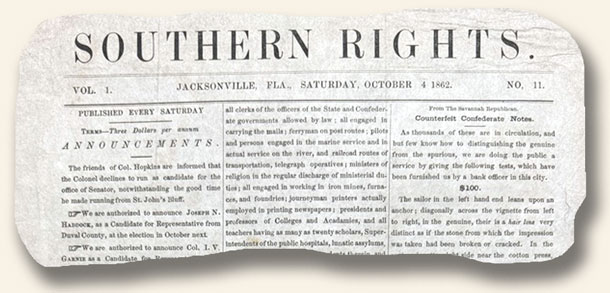
On October 4, 1862, the SOUTHERN RIGHTS out of Jacksonville, Florida had a fascinating issue with a story similar to that of the iconic Vicksburg Daily Citizen issue of July 4, 1863, when the Union troops found the newspaper still in the press, changed the final paragraph to report the Union takeover, and printed the issue.
The SOUTHERN RIGHTS newspaper’s story is found in a listing by the American Antiquarian Society and is as follows:
“Captain Valentine B. Chamberlain was in command of a company of the 7th Connecticut Volunteers who found the printing office and actually printed the issue for Oct. 4, 1862 from the standing type with Capt. Chamberlain’s addition in the first column on page 1 (see below). They then burnt the office and removed the press and types. The Oct. 4, 1862 issue was reissued in Hilton Head, South Carolina by Chamberlain, although retaining the Jacksonville imprint; and also reissued later in Jacksonville by the original printers once they had re-established their shop.
Printed at the bottom of this broadside issue is the following: Explanation–when the U.S. Forces under brigadier general J.M. Brannon visited Jacksonville, Fla., the form of the ‘Southern rights’ was found standing in this office just as it was left by the skedaddling rebels. The office was immediately ‘cleaned out,’ and–there being more ‘devils’ than printers present– the form was thrown into ‘pi’ in less time than it takes to write it. A proof sheet coming into our possession, we re-print the sheet as near like the original as possible, for the purpose of showing to our friends in the North, the ‘talent, vigor, heroism and military ardor’ that is not displayed in this trophy of Jacksonville.”–signed: Printers.
Captain Chamberlain’s addition mentioned above is headed: “Notice”, and reads, much tongue-in-cheek: “The Editor of this paper is absent from town for a few days on urgent business in the interior. It is therefore announced that the publication of this paper will hereafter be weekly suspended as it has been heretofore, weakly continued.
The taking of our battery after a loss of courage, but no blood, and the presence of the Yankee fleet, and the fearful proximity of Gen. Brannan and his forces, render the ‘Southern Rights’ precarious.”
“Broken hearts cannot be photographed”… Matthew Brady…
June 26, 2026 by TimHughes · Leave a Comment
War has always inflicted its pains and sorrows upon a nation. But the brutality and reality of war never fully struck home until the Civil War. It was different.
Many lives were lost in the French & Indian War, the Revolutionary War, and the 19th century events of the War of 1812 and Mexican War, but until the invention of photography, there was a certain amount of callousness to what war was really about.
The Civil War changed all that, and perhaps one person, Matthew Brady, did more to make that change than anyone.
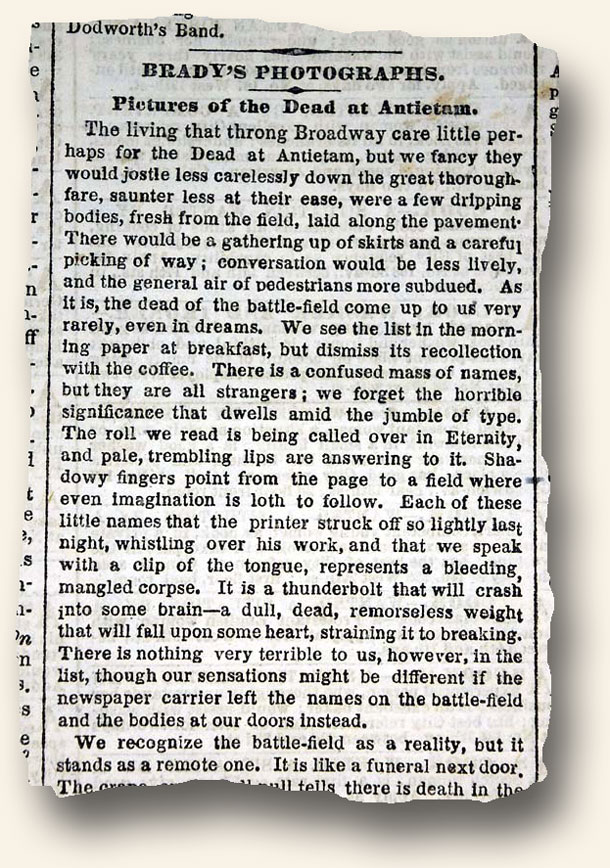
The Civil War was the first war to be photographed. In 1862, famed photographer Mathew Brady exhibited a series of pictures taken by protégés Alexander Gardner and James Gibson immediately after the Battle of Antietam. Gardner and Gibson, two of the many photographers Brady hired to document the war, produced at least 95 images at Antietam. Their images were the first to show dead bodies on the field.
The October 20, 1862 issue of the “New York Times” contains one of the more moving articles on the horrors of war, brought home to the residents of New York through an exhibition of “Pictures of the Dead at Antietam” in Matthew Brady’s Manhattan Gallery.
The article is headed: “‘Brady’s Photographs” and it reports on the exhibition by comparing the brutality & reality of war, to the callousness of New York’s residents who read the daily papers but did not relate to the horrors they reported.
The article is extremely well-written, taking most of a column. The full text can be seen in the attached photos, however a few bits are worthy of noting here: “The living that throng Broadway care little perhaps for the dead at Antietam, but…they would jostle less carelessly down the great thoroughfare, saunter less at their ease, were a few dripping bodies, fresh from the field, laid along the payment…We see the list in the morning papers…but dismiss its recollection with the coffee. There is a confused mass of names, but they are all strangers…We recognize the battle-field as a reality, but it stands as a remote one…” with more.
Then: “Mr. Brady has done something to bring home to us the terrible reality and earnestness of war. If he has not brought bodies and laid them in our dooryards and along the streets, he has done something very like it. At the door of his gallery hangs a little placard, ‘The Dead of Antietam’…There is one side of the picture that the sun did not catch…It is the background of widows and orphans, torn from the bosom of their natural protectors by the red remorseless hand of Battle, and thrown upon the fatherhood of God. Homes have been made desolate & the light of life in thousands of hearts has been quenched forever. All of this desolation imagination must paint–broken hearts cannot be photographed…” and much more.
In 50 years of selling early newspapers, this issue most powerfully brings home the grief, sorrows, tragedies, realities, and unanswered questions that war inflicts upon a nation. What a difference a photograph can make.
Juneteenth… The Nuances of Slavery’s End…
June 19, 2026 by Laura Heilenman · Leave a Comment
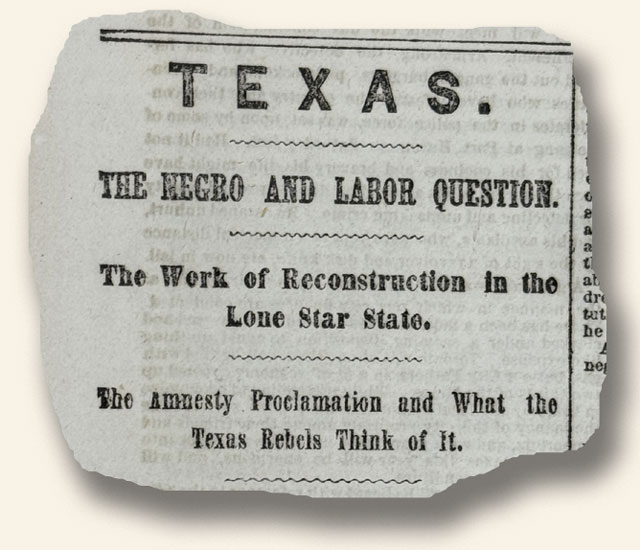 The saying, “History is a set of lies agreed upon,” often attributed to Napoleon, reminds us how easily we can simplify the past. A few days ago, I read about the story of General Granger’s landmark announcement in Galveston on June 19, 1865. Today, while digging deeper into the same moment, I came across Colonel G.W. Clark’s follow-up order issued in Houston just three days later. Reading both orders side by side offers a fascinating window into how emancipation actually unfolded on the ground in Texas.
General Granger’s General Order No. 3 was the pivotal statewide declaration that brought the Emancipation Proclamation to the last major Confederate holdout. Addressed to “the people of Texas,” it formally informed roughly 250,000 enslaved people that they were free, stressing “absolute equality of personal rights and rights of property” and transforming the old master-slave relationship into one of “employer and hired labor.” Its importance cannot be overstated: this was the public, official moment that ended legal slavery in Texas and gave birth to Juneteenth as a day of celebration and remembrance.
Colonel Clark’s General Orders No. 3, issued on June 22, 1865, for the Post of Houston, played a more localized but equally necessary role. It provided the practical instructions needed to prevent chaos in a major occupied city, directing freedmen to remain temporarily with former owners while reassuring them that doing so would “forfeit none of their rights of freedom.” Clark added details about upcoming labor contracts and consequences for idleness, showing the administrative work required to turn grand declarations into orderly reality.
Though both orders advanced the same goal of peaceful transition, their tones on freedom differed in telling ways. Granger’s language was bold and expansive, celebrating equality and a clean break with the past. Clark’s was more measured and reassuring, carefully balancing direction with the promise that freedom remained intact. Reading them together reveals how emancipation was not a single dramatic event but a layered process—announced with inspiring clarity in one breath and managed with cautious practicality in the next. In that sense, these two orders from 1865 still rhyme with the challenges of turning high ideals into lived experience.
Who’s Who in Newspapers? Moses G. Farmer edition (1879)…
June 8, 2026 by GuyHeilenman · Leave a Comment
The 15th installment of: Who’s Who in Newspapers
 When it comes to “man on the street” interviews, the lack of knowledgeable responses often received never fails to confound. We enjoy watching these—which is a bit troubling in itself—but if an interviewer asked, “Who invented the light bulb?”, I’d bet 75% would answer correctly, especially with a few “Thom… Thomas… Thomas Ed…” clues.
However, and to be fair, few of us (myself included) could name the pioneers who paved the way. Enter Moses G. Farmer. Thanks to a January 11, 1879, issue of Scientific American titled “THE FIRST ELECTRIC LAMPS,” I discovered this fascinating inventor who lit his Salem, MA, home in 1859—two decades before Edison’s breakthrough.
Using platinum filaments and batteries he had mounted for the purpose in his cellar, Farmer proved electricity could replace gas. Though the cost of platinum and the lack of a vacuum prevented commercial success, his “parlor lights” were the first to move electric light from the lab into a domestic reality – often enlightening dinner guests with his invention.
Farmer provided the “blueprint of failures” Edison needed. He proved electricity could light a home; Edison simply figured out how to make it last longer than a dinner party.
A modern sketch comparing Farmer’s and Edison’s work is shown below.
I love this collectible – and how it fuels the engine of life-long learning.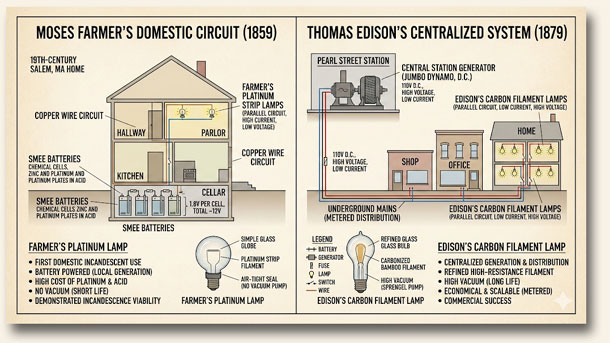
An intriguing irony of American history, only to be found in a newspaper…
June 1, 2026 by TimHughes · Leave a Comment
There are times when we browse through a newspaper and, while looking for something else, come across an unexpected little gem of American history. And from what we are able to determine, this “little gem” has never been reported to this day.
The “Boston Daily Journal” of April 14, 1865 shares the date of the Lincoln assassination, he attending a performance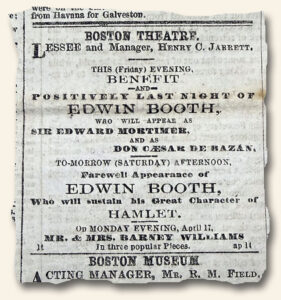 of “Our American Cousin” at Ford’s Theatre in Washington, D.C. Page 3 of this newspaper has an advertisement for the Boston Theatre, noting: “This (Friday) Evening Benefit and Positively Last Night of EDWIN BOOTH who will appear as Sir Edward Mortimer…To-Morrow (Saturday Afternoon, Farewell Appearance of EDWIN BOOTH, Who will sustain his Great Character of Hamlet…”.
So what did we find? The very evening that famed actor Edwin Booth was performing in a Boston theater, his younger brother was assassinating the President in a theater less than 400 miles away.
This advertisement, logically, would only be found in a Boston newspaper.
This is similar to another of our blog posts, concerning Lincoln attending a Washington, D.C. stage performance of John Wilkes Booth in 1863, the irony being Lincoln’s assumed applause at the conclusion of the performance for the person who would assassinate him less than 2 years later.
Such tidbits of history are fascinating finds, and could only be discovered in newspapers of the day. So look carefully at the issues you purchase. Will you discover a historical gem that the world knew nothing about?
Announcing: Catalog 367 – Released (early) for June, 2026 – Rare & Early Newspapers…
May 29, 2026 by GuyHeilenman · Leave a Comment
|
|