
Search
The Rare & Early Newspapers Hobby

Receive the Newsletter

Buy Historic Newspapers

Do You Believe in Ghosts? The OSS and World War II’s “Ghost Foxes”…
October 19, 2026 by GuyHeilenman · Leave a Comment
If you’re a rare & early newspaper enthusiast or a history buff who loves the strange and surreal, you might think you’ve heard every bizarre military scheme concocted during World War II. But few wartime projects can rival the sheer, eerie oddity of the Office of Strategic Services’ (OSS) top-secret psychological warfare plot: Operation Fantasia.
During the height of the Pacific War, intelligence strategists were looking for unconventional ways to demoralize the enemy and spark widespread panic. They turned to anthropologists, who pointed out a deeply ingrained piece of Japanese folklore regarding the Kitsune—supernatural fox spirits. According to tradition, sighting a glowing fox spirit at night, especially one running on its hind legs, was a sure omen of impending doom and disaster.
Taking the myth literally, the OSS sprang into action. They ordered the capture of dozens of wild foxes, secured a dedicated building guarded by covert agents, and tasked chemists with developing a special radium-based paint that would make the animals glow brightly in the dark. The grand vision? Release an army of radioactively glowing “ghost foxes” into the forests of Japan to strike psychological terror into the population.
The tale was brought to our attention when we came across an intriguing post-war issue of the Springfield Sunday Republican (Mass.) dated August 18, 1946. There, featured prominently on the front page, was the newly declassified report revealing just how far the military was willing to go in the name of psychological warfare.
Of course, as compelling as the supernatural scheme sounded on paper, reality had other plans. The early tests were a comedy of errors: the paint was difficult to formulate, the disoriented foxes tried furiously to lick off the glowing chemical, and in field runs, they ended up terrifying each other just as much as anyone else. Between the logistical absurdities of deploying live glowing animals overseas and the sudden end of the war following Japan’s surrender, the “Ghost Foxes” were ultimately retired before ever setting foot on enemy soil.
Below is a photo from the front page featuring the wonderful headline: “Ghostly Foxes That Ran Upright Nearly Haunted Japan’s Forests”. It serves as a hilarious, astonishing reminder of the desperate ingenuity and bizarre tactics birthed in the shadows of wartime intelligence.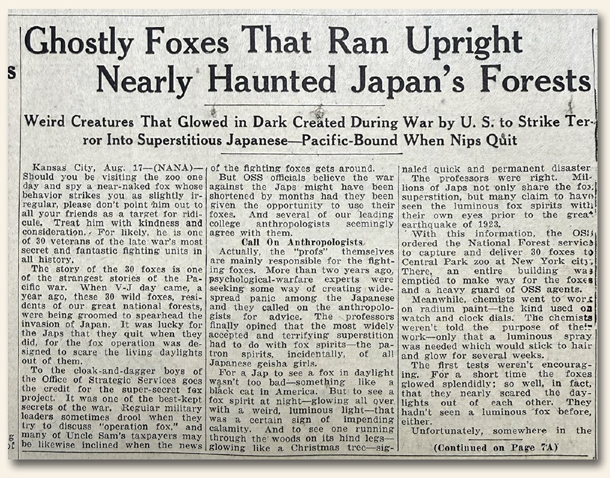
1st Man in Space… No Controversy Here…
September 25, 2026 by Laura Heilenman · Leave a Comment
Astronauts in space may be controversial in the USA, however, even conspiracy theorists don’t argue about Yuri Gagarin. On April 13, 1961, the Soviet newspaper Komsomolskaya Pravda captured that undeniable triumph on its front page. A large, heroic photograph of the 27-year-old cosmonaut dominated the layout, his confident smile and flight suit projecting the image of a new Soviet hero. The previous day, April 12, Gagarin had become the first human to travel into outer space, completing a single orbit aboard Vostok 1 in just 108 minutes. The paper’s bold headlin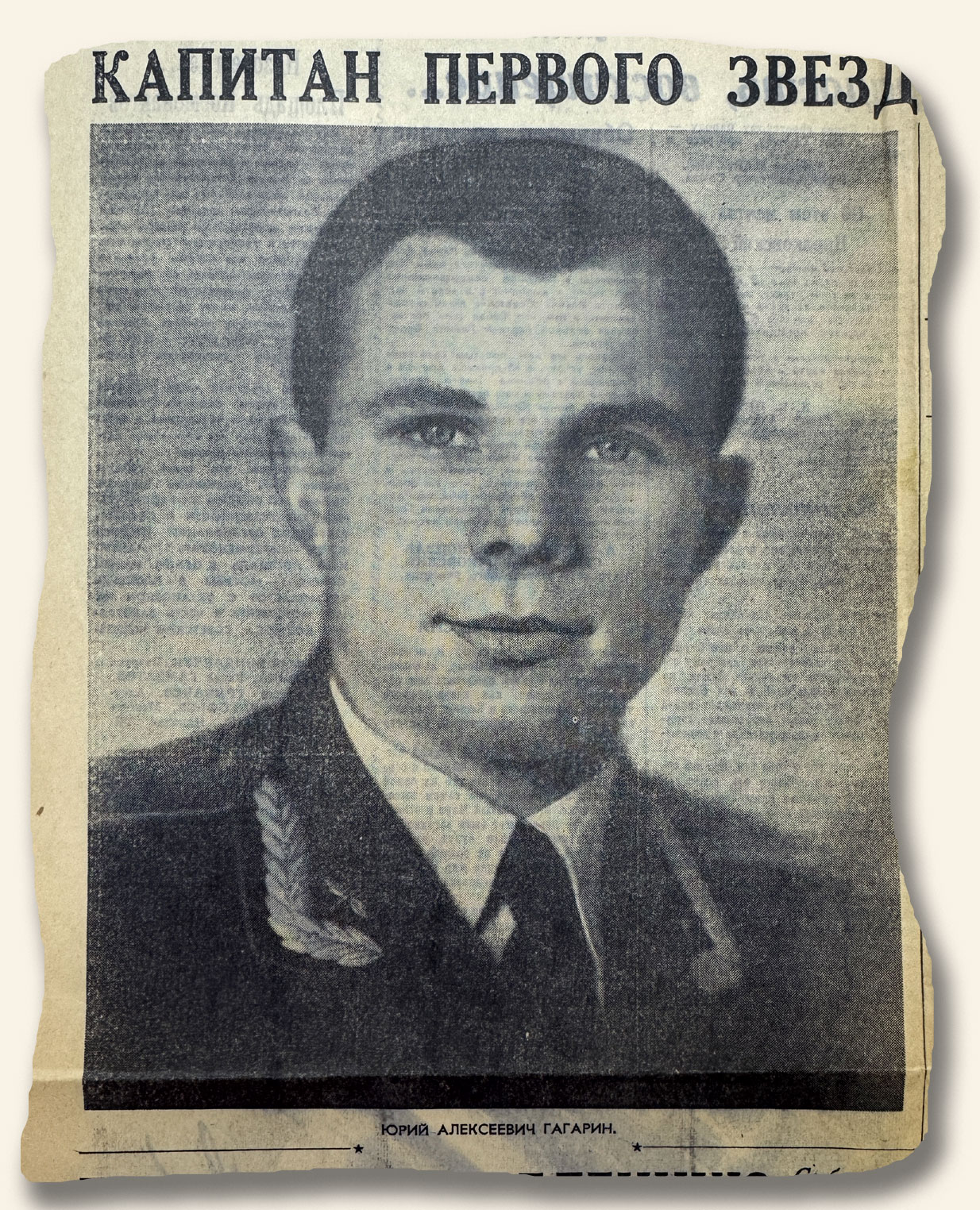 es and celebratory tone reflected pure national pride. Gagarin’s flight was presented not merely as a scientific milestone but as definitive proof of socialist superiority in the unfolding Space Race. While American efforts still lagged—Alan Shepard’s suborbital hop would not occur until May 5… the Soviet press framed the achievement as an irreversible lead. Readers saw Gagarin’s face as the face of progress, youth, and the future. Komsomolskaya Pravda, the official organ of the Communist Youth League, specialized in reaching a younger audience. Its coverage blended technical details of the mission with accessible, uplifting language designed to inspire. The large portrait on the front page served a dual purpose: it humanized the extraordinary feat and turned Gagarin into an instant icon. Ordinary citizens could look at that image and feel connected to the cosmos. This April 13 edition remains a vivid historical artifact. It shows how the Soviet Union communicated victory in real time, using bold photography and confident prose to shape public memory. Gagarin’s flight marked a genuine first for humanity, and this issue of Komsomolskaya Pravda preserved the excitement of that moment for its readers… and for history.
Did it All Start with a Laugh?… Political Cartoons Across Time…
September 14, 2026 by Laura Heilenman · 1 Comment
Which of us doesn’t love a good laugh, especially when we need a healthy way to relieve a bit of the built-up pressure? The presence of political cartoons can sometimes take the sting out of the craziness of reality. While still popular today in print and digital form, political cartoons have been with us for centuries. Originally, they were not printed in newspapers but sold as individual prints, such as William Hogarth’s “An Emblematical Print on the South Sea Scheme” (1721), a satirical engraving which critiques the financial speculation, corruption, and public credulity that fueled the South Sea Bubble of 1720–21. Eventually, these satirical statements on society made their way into the newspapers of the day and across the ocean to the New World. Benjamin Franklin’s famous “Join, or Die,” appearing in the Pennsylvania Gazette, helped spur the colonies toward Revolution. Decades later, Thomas Nast’s work in Frank Leslie’s Illustrated Newspaper and Harper’s Weekly aided Lincoln’s reelection and helped define the modern two-party system by popularizing both the Republican elephant and the Democratic donkey. Eventually, these artistic gems ventured into color, impacting audiences at a whole new level. Today we are inundated with political satire, some of which is comparable to the talent of the 1700s and 1800s and much of which falls well short. Regardless, our culture would be less rich without this creative way to help us laugh our way through more stressful times.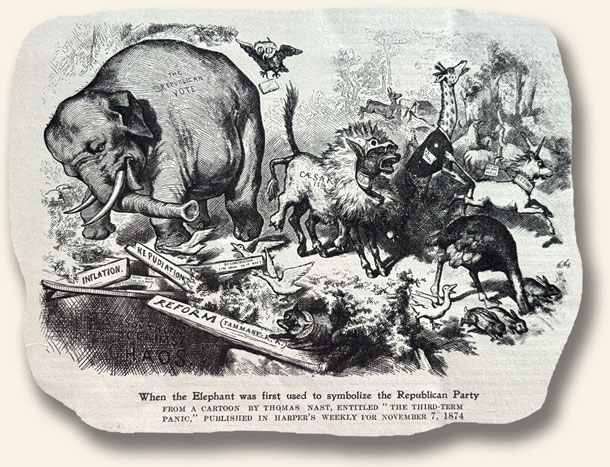
Labor Day. . . End of Summer, Hurricanes Ramp Up…
September 7, 2026 by Laura Heilenman · Leave a Comment
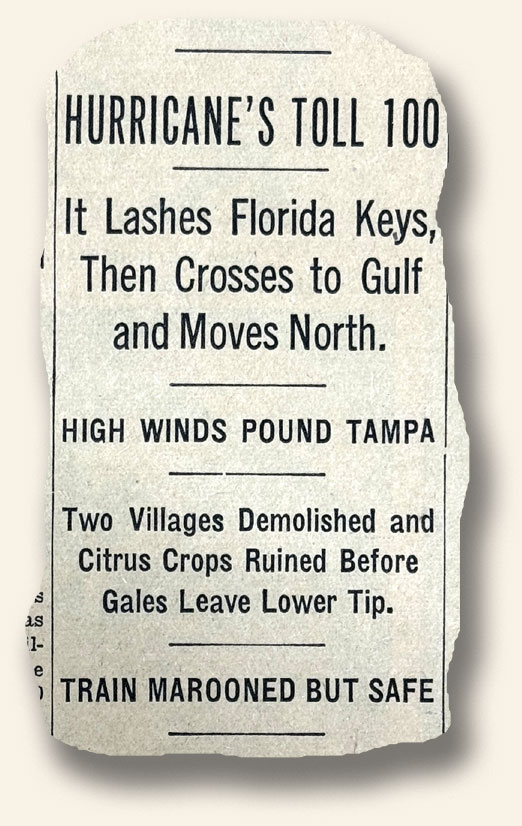 Labor Day once marked the final lazy days of summer. . . the last stretch before school began. These days, many kids head back weeks earlier and while family picnics and yard games still happen, the holiday loses a little of its shine when it no longer feels like summer’s true close. September’s arrival often brings more than just last of those firefly filled evenings. Although Atlantic hurricane season officially begins on June 1, my family never bothered with travel insurance for our Outer Banks vacations unless our trip began in September. Risky? Maybe. . . especially given how destructive East Coast storms can be. Those hoping for a relaxed Labor Day in 1935 faced far worse. The powerful Labor Day Hurricane devastated the Florida Keys, killing hundreds (many of them World War I veterans working on a highway project). On its front page, the September 4, 1935, New York Times reported the Morgan liner Dixie stranded on a reef with more than 350 people aboard, rescue ships blocked by heavy seas, while the captain radioed that all remained well. We can only speculate that family picnics were put on hold; it was truly, all hands-on deck.
Who’s Who in Newspapers? Larry Walters edition (1982)…
September 4, 2026 by GuyHeilenman · Leave a Comment
If you’re a fan of quirky American folklore, you might recognize the name “Lawn Chair Larry.” Yet few realize the sheer audacity – and immediate, nationwide intrigue that surrounded the moment 33-year-old Larry Walters actually took off into the Southern California sky.
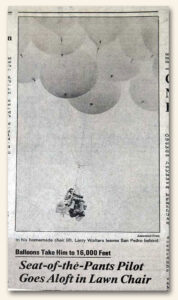 On July 2, 1982, Walters tied 42 helium-filled weather balloons to an ordinary aluminum lawn chair in the backyard of his girlfriend, Carol Van Deusen, in San Pedro. Armed with a pellet gun, a CB radio, a camera, and a parachute, his plan was simple: float lazily across San Pedro toward the Mojave Desert. Instead, when his tether line unexpectedly snapped, Walters shot skyward like a rocket, losing his glasses in the process and soaring to an astonishing 16,000 feet! Freezing in the high-altitude air, he startled commercial airliner pilots who radioed in shock to report a man sitting in a lawn chair in controlled airspace. To descend, Walters systematically popped several balloons with his pellet gun, eventually landing tangled in power lines in a Long Beach neighborhood – unharmed, but briefly causing a local blackout.
His story came to light quite by accident during a search through our archives for something completely unrelated. Our gaze was immediately drawn to the front page of the Los Angeles Times from July 3, 1982, which featured a remarkable photograph of a man taking flight from the comfort of a lawn chair.
If you are fascinated by eccentric dreamers who take “seat-of-the-pants” ambition to literal new heights, spending a little time reading contemporary accounts of Larry Walters’ flight is pure joy. It serves as an amusing, incredible reminder of human ingenuity, boundless determination, and the unpredictable nature of backyard aviation.
To the right is a photo from the front page of the Los Angeles Times our friend was seeking, complete with the bold headlines “Seat-of-the-Pants Pilot Goes Aloft in Lawn Chair” and the iconic snapshot showing Walters airborne over San Pedro.
Who’s Who in Newspapers? George Ray Tweed edition (1944)…
August 10, 2026 by GuyHeilenman · 1 Comment
If you’re a World War II history enthusiast, you might recognize the name George Ray Tweed — a U.S. Navy radioman known to the world as the “Ghost of Guam.” Yet few realize the sheer grit, luck, and quiet resistance required to pull off one of the most remarkable survival stories in American military history.
When Japanese forces invaded Guam in December 1941, Tweed refused to surrender alongside his comrades. Instead, he slipped into the island’s rugged jungle with little more than a rifle, a radio, and an unwavering determination to stay free. For over two and a half years, Tweed evaded intense enemy patrols, relying on the immense courage of local Chamorro families who risked torture and execution to keep him hidden, fed, and supplied. Using his background as a technician, he even built a crude radio receiver to gather Allied news, transforming himself into a symbol of hope for the occupied islanders.
If you are fascinated by human resilience—and the incredible bravery of civilians who risked everything in wartime—spending a little time researching Tweed’s survival on Guam is deeply inspiring. It serves as a powerful reminder of how ingenuity, faith, and the loyalty of brave allies can overcome seemingly impossible odds.
We discovered him quite by accident as we were searching for a client’s request for a “birthday newspaper“ from the same week. Thankfully, while extracting the date he wanted, we noticed this headline and corresponding photo (in the Minneapolis Morning Tribune, Aug. 11, 1944) which motivated us to see what we could learn about him.
Below is a photo featuring the bold front-page headline: “Dodges Japs 2 1/2 Years on Guam”.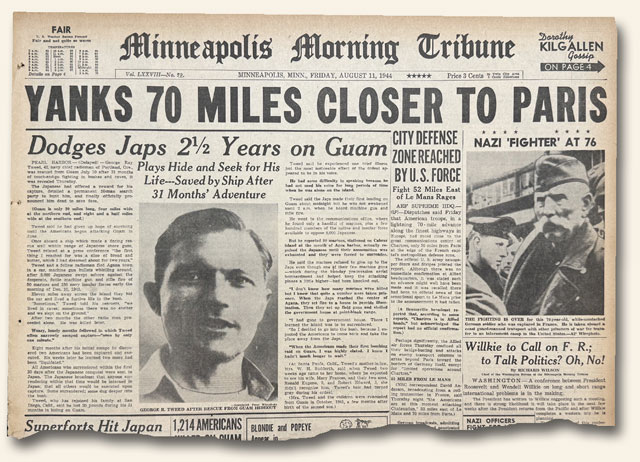
Ballot Box Standoff…Veterans Bring Justice…
August 7, 2026 by Laura Heilenman · Leave a Comment
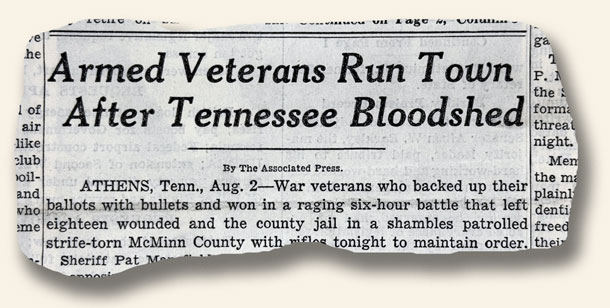 On August 2, 1946, as reports from the previous night’s violence in McMinn County began reaching national newsrooms, The New York Times carried early accounts of the Ballot Box Standoff in Athens, Tennessee. Initial wire dispatches described a chaotic election-day confrontation in which returning World War II veterans, alleging that a corrupt local machine was preparing to steal the vote. Clashes ensued with heavily armed deputies, and one early headline erroneously claimed a sheriff had been slain, reflecting the confusion of overnight bulletins as the story was still unfolding. By the next morning’s August 3 edition, the Times gave the story prominent front-page treatment with an Associated Press report headlined “Armed Veterans Run Town After Tennessee Bloodshed.” Datelined Athens, August 2, the article detailed how GI-backed citizens had besieged the county jail after deputies seized ballot boxes, exchanged gunfire for hours, used dynamite, and ultimately forced the surrender of roughly fifty deputies. Eighteen people were wounded; the veterans then patrolled the streets with rifles to maintain order while the ballots were recovered and counted. An editorial on page 10, titled “Election in Tennessee,” weighed the deeper meaning of the events. It acknowledged the veterans’ conviction that a dictatorial political machine had long falsified results and that peaceful avenues of reform seemed closed. Yet the editorial also cautioned that taking the law into one’s own hands—however understandable the grievances—threatened the orderly processes essential to democracy, leaving readers with a sober reflection on both the courage and the risks of the armed stand for honest elections.
California’s Workaround… a Prohibition loophole…
August 3, 2026 by Laura Heilenman · Leave a Comment
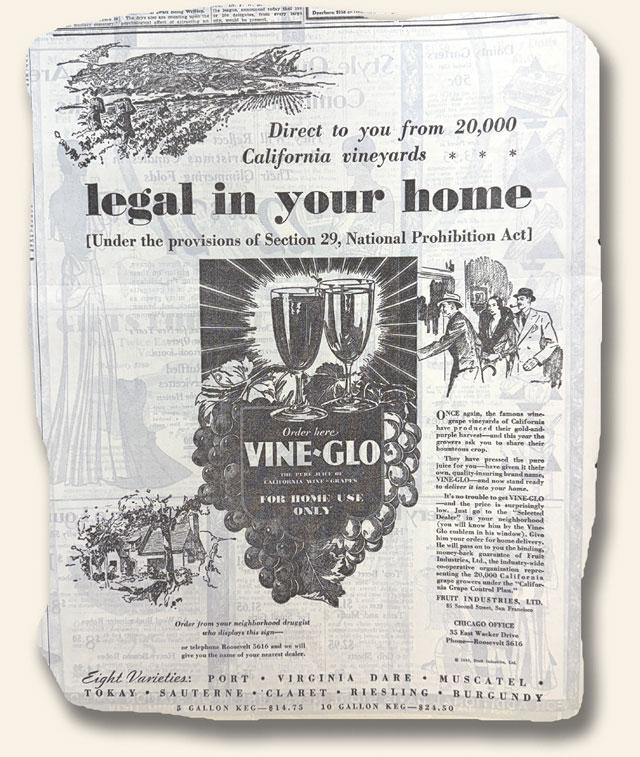 When Prohibition took effect on January 17, 1920, under the 18th Amendment and the Volstead Act, American grape growers and winemakers faced a philosophical crisis. Commercial production, sale, and transportation of alcoholic beverages were suddenly illegal, threatening to wipe out California’s thriving vineyards. Many growers considered ripping out their vines and planting other crops. Yet a crucial loophole in Section 29 of the Volstead Act offered a lifeline: households could legally produce up to 200 gallons of non-intoxicating fruit juices or cider each year strictly for personal home consumption. Demand for wine grapes soared almost overnight as people began crushing and fermenting them themselves, and prices climbed dramatically.
Enterprising producers soon refined this workaround into a convenient product known as grape bricks (or wine bricks). Companies such as Vino Sano (appearing around 1921) and later Vine-Glo compressed concentrated grape juice into solid, shelf-stable blocks that could be shipped anywhere and stored for months. Customers simply dissolved a brick in a gallon of water to create grape juice. The bricks came in flavors that conveniently matched popular wines—port, sherry, burgundy, claret, muscatel, and others—making the intended use obvious to anyone paying attention. An ad for these grape bricks, by the company Vine-Glo, is found in THE CHICAGO DAILY TRIBUNE for December 8, 1930.
This innovation kept many vineyards alive and even made some growers wealthy during the dry years. The most memorable feature of these bricks was the carefully worded “warning” printed on the packaging. Labels instructed buyers on how to reconstitute the juice and then solemnly cautioned them not to leave the mixture in a cool cupboard for twenty or twenty-one days, not to add sugar in certain amounts, and not to fail to add benzoate of soda—because otherwise the liquid would ferment into wine. These reverse instructions served as a thinly veiled recipe while allowing the sellers to claim they were only providing a legal non-alcoholic product. The wink-and-nod approach worked for years, turning grape bricks into one of Prohibition’s most ingenious (and widely enjoyed) workarounds until court challenges and the eventual repeal of the ban in 1933.
Announcing: Catalog 367 – Released (early) for June, 2026 – Rare & Early Newspapers…
May 29, 2026 by GuyHeilenman · Leave a Comment
|
|
Stranger than fiction – Bobby Leach edition…
May 22, 2026 by GuyHeilenman · Leave a Comment
The Irony of Fate: The Bizarre Death of Daredevil Bobby Leach
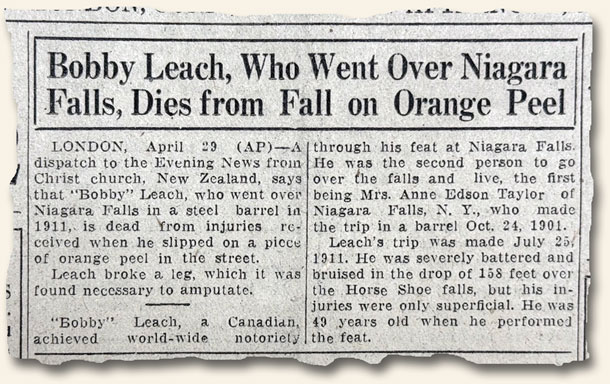
History is often written in the grandest of strokes, but sometimes it is defined by the cruelest of ironies. Such was the case for Bobby Leach, the legendary English daredevil who spent his life dancing on the edge of catastrophe, only to be brought down by a stray piece of fruit. In April 1926, the man who had famously conquered the roaring cataracts of Niagara Falls met a quiet, tragic end in a hospital bed in Auckland, New Zealand.
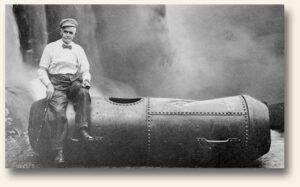
Source: Library of Congress
Leach’s claim to immortality was cemented on July 25, 1911, when he became the first man to survive a plunge over Niagara’s Horseshoe Falls in a custom-built steel barrel. The 170-foot drop was a violent ordeal that left him with a shattered jaw and two broken kneecaps, yet he emerged alive—a feat that many at the time considered a miracle. He spent the following years touring the globe, a living testament to human grit and the pursuit of the “impossible,” sharing his tales of survival with captivated audiences.
However, the luck that sustained him through death-defying stunts ran out during a lecture tour in New Zealand. While walking down Princes Street in Auckland, Leach slipped on an orange peel. The fall, seemingly minor compared to the crushing forces of the Niagara River, resulted in a severely broken leg. In the 1920s, medical limitations turned a simple fracture into a death sentence; the wound became infected, and gangrene soon followed.
Despite an emergency amputation intended to save his life, Leach succumbed to complications on April 26, 1926. He was buried in Auckland’s Hillsborough Cemetery, far from the waterfalls that made him famous. Today, his story serves as a poignant reminder for history enthusiasts: a man can survive the world’s most dangerous forces of nature, only to be defeated by the most mundane of accidents. It is a legacy defined not just by the height of his fall, but by the quiet irony of his final stumble.
What brought this to our attention was the following front page article from THE DAY, New London, CT, dated April 29, 1926.