
Search
The Rare & Early Newspapers Hobby

Receive the Newsletter

Buy Historic Newspapers

Fight for a Nation – Introduction…
October 9, 2026 by GuyHeilenman · Leave a Comment
During the lead-up to July 4, 2026 – as our country celebrated its 250th anniversary – we brought you Lead-Up to a Nation, a weekly video series using authentic, period newspapers to chronicle the fateful year heading into July 4, 1776.
Now that the Declaration has been made, the real struggle begins.
Starting this month, we’re launching our a monthly video series: Fight for a Nation. Join us over the coming years as we relive the American Revolution through the very pages, ink, and first-hand reporting of those who lived through this incredible period in American and world history.
Check out the first three installments below—we hope you enjoy journeying back in time with us!
Installment from July, 2026
The Declaration Proclaimed – Military Challenges + Growing Confidence (Fight for a Nation – E1)
Installment from August, 2026
A Nation at its Birth – Shaping the Future (Fight for a Nation – E2)
Installment from September, 2026
The Treaty of Jamestown – 1st Permanent English Settlement in America (Fight for a Nation – E3)
A truth… a story… a myth… a discovery – What to do with a 1666 London Gazette?
September 28, 2026 by GuyHeilenman · Leave a Comment
 Collectors seek out “rare & early” newspapers for a host of reasons. Some use them as primary source material for research. Others collect them to grasp the contemporary response to an historical event, while others use them to chronical a non-revisionist view of an era. Framing them for display is quite common – whether it be to set a mood, or, as is quite common with museums, to aid in telling the story regarding a display of unique items. Yet another group loves to obtain them to enhance their primary collectible (ex. those who collect early sewing machines finding newspapers with matching advertisements, patents, or early commentary on various stages of development). The possibilities are almost endless.
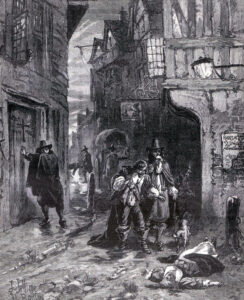
The topic at hand was recently revived when a collector, who had just purchased a London Gazette dated August 9, 1666 containing a brief report on the week’s mortality bill from the Great Plague (shown below), informed us of his purpose in collecting the newspaper – which we found fascinating… and which eventually led to a discovery.
A Purpose – He purchased to use as inspiration for an event-tethered short story (historical fiction?). If you have a little time, I’m sure he would not mind if you took a gander: THE KING’S BAKER
A Discovery – After reading his story I decided to dig a little deeper into the 1665-6 London Plague and was drawn in by an article posted by the London Museum titled: THREE MYTHS ABOUT THE GREAT FIRE OF LONDON
A MYTH – I don’t want to give anything away, but suffice to say, I need to go back to a lot of people and correct what I once thought was true. Yikes!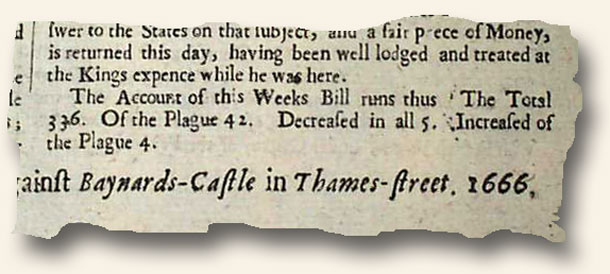
A Truth – For those who like to pine for the past, during the week prior to the above newspaper’s distribution in 1666, 42 people in London alone were known to have died from the bubonic plague. Life was not easy; but death often was.
Reasons for the Declaration of Independence. . . Step by Step Logic…
August 28, 2026 by Laura Heilenman · Leave a Comment
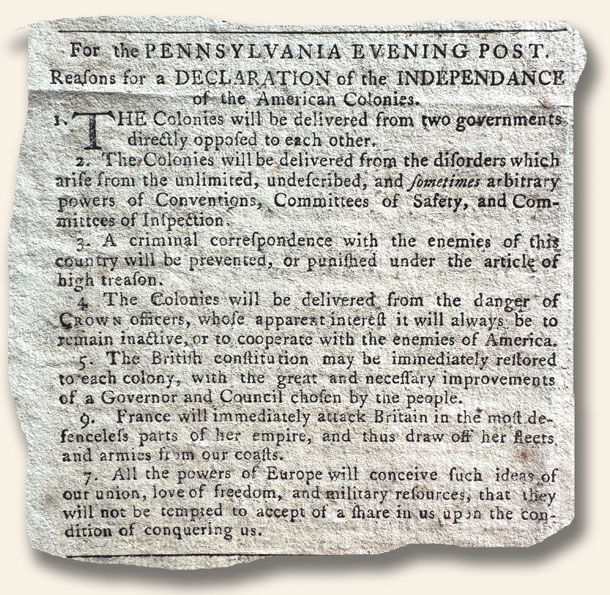 Often as we have big decisions ahead of us, wise council around us may prompt us to ask ourselves the question. . . why? Knowing the whys can often help point us to answer the more logistical question of how. In April of 1776, the Pennsylvania Evening Post attempted to lay out the why of the enormous decision facing the colonies. Below, read the text and reasoning laid before the citizenry.
Reasons for a DECLARATION of the INDEPENDANCE of the American Colonies.
- THE Colonies will be delivered from two governments directly opposed to each other.
- The Colonies will be delivered from the disorders which arise from the unlimited, undescribed, and sometimes arbitrary powers of Conventions, Committees of Safety, and Committees of Inspection.
- A criminal correspondence with the enemies of this country will be prevented or punished under the article of high treason.
- The Colonies will be delivered from the danger of Crown officers, whose apparent interest it will always be to remain inactive, or to cooperate with the enemies of America.
- The British constitution may be immediately restored to each colony, with the great and necessary improvements of a Governor and Council chosen by the people.
- France will immediately attack Britain in the most defenseless parts of her empire and thus draw off her fleets and armies from our coasts.
- All the powers of Europe will conceive such ideas of our union, love of freedom, and military resources, that they will not be tempted to accept of a share in us upon the condition of conquering us.
If only we could all present our logical arguments in such a concise and impactful manner.
A recently released video related to this post is available at: Independence was Destiny – The Case for Independence
When crises happen, publishers can be creative… Ben Franklin & the Stamp Act…
August 24, 2026 by TimHughes · Leave a Comment
Occasionally, a newspaper just doesn’t look like a newspaper. When crises happen, some newspaper publishers can be creative and angry, resulting in “newspapers” that are quite unusual. Here is one.
Looking very much like a broadside (although it is four pages), an issue we purchased many years ago is simply headed: “REMARKABLE OCCURRENCES”, having no date, no city of publication, and no issue number.
 With some investigation, we learned that this is actually the November 14, 1765 issue of the famous “Pennsylvania Gazette” printed by Ben Franklin and David Hall. The hated Stamp Act took effect on Nov. 1, 1765. Therefore the paper was suspended and in its place a broadside entitled “No Stamped Paper to be had” was printed for Nov. 7, and this four page issue titled: “Remarkable Occurrences” was created for Nov. 14. The regular title and numbering were resumed with the Nov. 21 issue but without the imprint. No name of publisher appeared until the Feb. 6, 1766 issue printed by David Hall, as the partnership with Franklin had been dissolved.
Never, previously, have we ever handled either of these two issues.
The entire front page is taken up with Stamp Act content. Page 2 has content from Europe, and pages 3 and 4 have content with datelines from Boston, Newport, Philadelphia, and New York with again, much of the content related to the Stamp Act.
This is treasured as one of the more intriguing newspapers in our inventory, and is even more notable with its connection to the Stamp Act.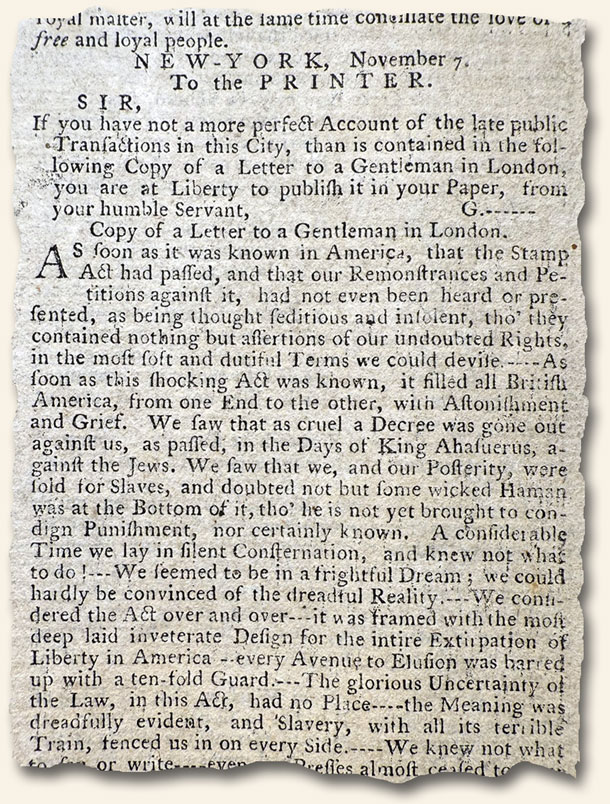
The reason I collect it: stunning graphics inside… Lincoln’s Funeral…
August 17, 2026 by TimHughes · Leave a Comment
We have handled many Lincoln assassination and funeral issues, and many can be graphic in terms of type size and drama of the column headlines. Most notably, the ‘Philadelphia Inquirer’ had several issues from April 17 to 25 with very nice graphic appeal.
But never have we seen inside pages so dramatically presented as with the ‘Cleveland Morning Leader’ issue of April 28, 1865. Although the front page is focused on the capture and death of John Wilkes Booth, as well as reports on the Lincoln funeral (all page 1 and 4 columns have wide, black mourning rules), pages 2 and 3 are consumed with broadside-like graphics, offering no text save for that found within the graphics. Page 2 appears much like a monument in memory of Lincoln, and page 3 has a black border surrounding short poems and portions of a “Speech of Abraham Lincoln” and a line from his “Emancipation Proclamation”.
When first encountered I noticed the ink bleed-through on page 1 and thought it was offsetting from the previous issue (not uncommon). But when I opened the newspaper I discovered something I had never seen the likes of before.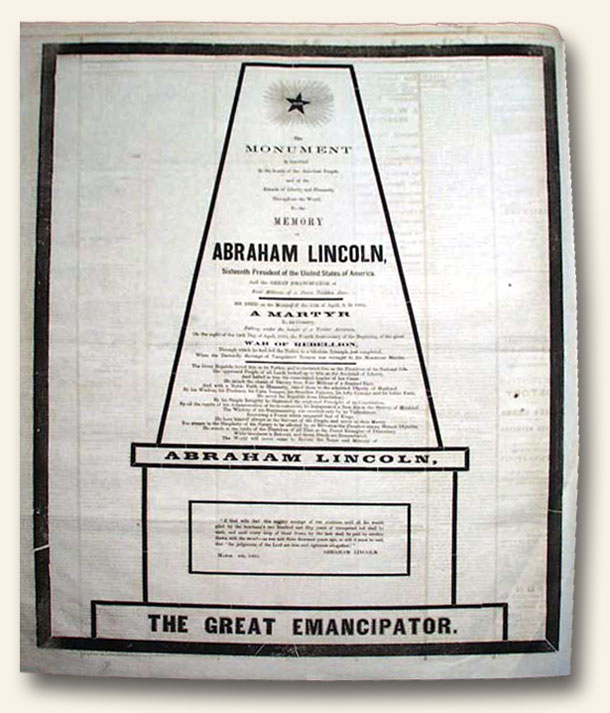
Lead-up to a Nation… as reported in the newspapers of the day (reflecting back on June/July, 1776)…
July 15, 2026 by GuyHeilenman · 1 Comment
- Revolution Gaining Momentum – Building on Resistance (Lead-up to a Nation – E44)
- Irreconcilable Actions of England – Royal Authority Suppressed (Lead-up to a Nation – E45)
- The Brink of Independence – England Clings to Hope of Peace (Lead-up to a Nation – E46)
- The Virginia Convention – Colonies urged toward Independence (Lead-up to a Nation – E47)
- Centuries of Struggle – One Declaration that Changed the World (Lead-up to a Nation – E48)
We hope you’ve are enjoyed this year-long trek to the 250th anniversary of The United States through the eyes of those who were fully engaged, first hand. As we continue with the next phase of the journey, as mentioned previously, all accounts will be rooted in what they read in the newspapers of the day.
“History is never more fascinating than when read from the day it was first reported.” (Timothy Hughes, 1975)
Strong Foundation … Liberty Takes Continual Work …
July 6, 2026 by Laura Heilenman · Leave a Comment
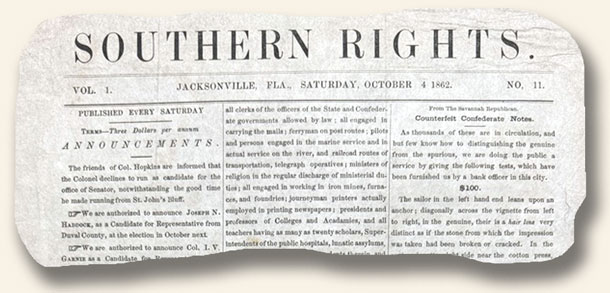
On October 4, 1862, the SOUTHERN RIGHTS out of Jacksonville, Florida had a fascinating issue with a story similar to that of the iconic Vicksburg Daily Citizen issue of July 4, 1863, when the Union troops found the newspaper still in the press, changed the final paragraph to report the Union takeover, and printed the issue.
The SOUTHERN RIGHTS newspaper’s story is found in a listing by the American Antiquarian Society and is as follows:
“Captain Valentine B. Chamberlain was in command of a company of the 7th Connecticut Volunteers who found the printing office and actually printed the issue for Oct. 4, 1862 from the standing type with Capt. Chamberlain’s addition in the first column on page 1 (see below). They then burnt the office and removed the press and types. The Oct. 4, 1862 issue was reissued in Hilton Head, South Carolina by Chamberlain, although retaining the Jacksonville imprint; and also reissued later in Jacksonville by the original printers once they had re-established their shop.
Printed at the bottom of this broadside issue is the following: Explanation–when the U.S. Forces under brigadier general J.M. Brannon visited Jacksonville, Fla., the form of the ‘Southern rights’ was found standing in this office just as it was left by the skedaddling rebels. The office was immediately ‘cleaned out,’ and–there being more ‘devils’ than printers present– the form was thrown into ‘pi’ in less time than it takes to write it. A proof sheet coming into our possession, we re-print the sheet as near like the original as possible, for the purpose of showing to our friends in the North, the ‘talent, vigor, heroism and military ardor’ that is not displayed in this trophy of Jacksonville.”–signed: Printers.
Captain Chamberlain’s addition mentioned above is headed: “Notice”, and reads, much tongue-in-cheek: “The Editor of this paper is absent from town for a few days on urgent business in the interior. It is therefore announced that the publication of this paper will hereafter be weekly suspended as it has been heretofore, weakly continued.
The taking of our battery after a loss of courage, but no blood, and the presence of the Yankee fleet, and the fearful proximity of Gen. Brannan and his forces, render the ‘Southern Rights’ precarious.”
Lead-up to a Nation… as reported in the newspapers of the day (reflecting back on May, 1776)…
June 5, 2026 by GuyHeilenman · Leave a Comment
-
Hope and Defiance – French Sympathy (E39)
-
The New-England Chronicle – A Rare Voice (E40)
-
Powerful Resolves – Battlefield Successes (E41)
-
Addressing Military Overreach – Precedent for Restraint (E42)
- Common Sense – Condemnation of Monarchy (E43)
We hope you are enjoying this year-long trek to the 250th anniversary of The United States through the eyes of those who were fully engaged, first hand. As mentioned previously, all accounts are rooted in what they read in the newspapers of the day.
“History is never more fascinating than when read from the day it was first reported.” (Timothy Hughes, 1975)
An intriguing irony of American history, only to be found in a newspaper…
June 1, 2026 by TimHughes · Leave a Comment
There are times when we browse through a newspaper and, while looking for something else, come across an unexpected little gem of American history. And from what we are able to determine, this “little gem” has never been reported to this day.
The “Boston Daily Journal” of April 14, 1865 shares the date of the Lincoln assassination, he attending a performance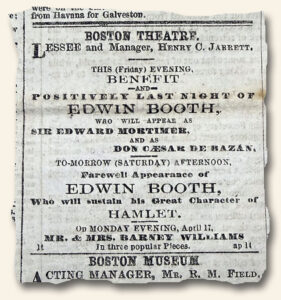 of “Our American Cousin” at Ford’s Theatre in Washington, D.C. Page 3 of this newspaper has an advertisement for the Boston Theatre, noting: “This (Friday) Evening Benefit and Positively Last Night of EDWIN BOOTH who will appear as Sir Edward Mortimer…To-Morrow (Saturday Afternoon, Farewell Appearance of EDWIN BOOTH, Who will sustain his Great Character of Hamlet…”.
So what did we find? The very evening that famed actor Edwin Booth was performing in a Boston theater, his younger brother was assassinating the President in a theater less than 400 miles away.
This advertisement, logically, would only be found in a Boston newspaper.
This is similar to another of our blog posts, concerning Lincoln attending a Washington, D.C. stage performance of John Wilkes Booth in 1863, the irony being Lincoln’s assumed applause at the conclusion of the performance for the person who would assassinate him less than 2 years later.
Such tidbits of history are fascinating finds, and could only be discovered in newspapers of the day. So look carefully at the issues you purchase. Will you discover a historical gem that the world knew nothing about?
Announcing: Catalog 367 – Released (early) for June, 2026 – Rare & Early Newspapers…
May 29, 2026 by GuyHeilenman · Leave a Comment
|
|