
Search
The Rare & Early Newspapers Hobby

Receive the Newsletter

Buy Historic Newspapers

19th century Stacked Headlines vs. 20th century Banner Headlines – both served their eras well…
October 26, 2026 by GuyHeilenman · Leave a Comment
 If you’re a collector of historic newspapers, you know that front-page design underwent a seismic shift between the 19th and 20th centuries. Nowhere is this evolution more dramatic than in how publishers announced history-defining news.
In the 19th century, newspapers relied on stacked headlines – a vertical sequence of bold, short phrases and illustrations packed into a single column. Without the technology to print massive type across the page, editors built suspense line by line. Take the April 10, 1865 issue of the Daily Evening Traveller (Boston) reporting Lee’s surrender at Appomattox. The column reads like a drumbeat: woodcut eagles, exclamatory “HURRAH!” banners, and stacked subheads detailing the terms of surrender. It was a typographic ladder, guiding readers down through the overwhelming joy of the Civil War’s end.
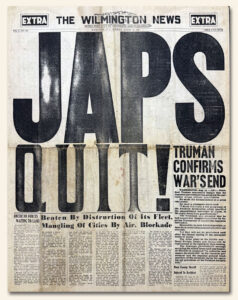
By the mid-20th century, layout technology and competition from radio transformed front pages into visual megaphones. Enter banner headlines – giant, full-width typography designed to scream from newsstands. Look at the August 14, 1945 Wilmington News-Extra announcing the end of WWII. The towering headline “JAPS QUIT” spans nearly the entire page, dwarfing every other element. It didn’t ask you to read down a column; it delivered an immediate, visceral emotional punch from across the street.
Both styles are masterclasses in drama. The 19th-century stacked headline invites you into a story with rhythmic anticipation, while the 20th-century banner stops you dead in your tracks.
Below are photos from our collection showing these two distinct eras of historic news design side-by-side!
Note: The stacked headlines from the April 10, 1865 Boston Evening Traveller may very well be the best we have ever seen for this historic event:
Are these the top 10 History’s Newsstand posts? AI thinks so…
October 23, 2026 by GuyHeilenman · Leave a Comment
 Let’s face it, while AI can be helpful, by its own admission, it isn’t always right. I’m sure we’ve all experienced responses which were head-scratchers. So, just for fun I used AI (GROK in this case) to obtain a top ten list of the most desirable posts on our History’s Newsstand blog – based on the number of views, comments, posting, and post-backs. Do you agree with the results? As of 2026, the (so -stated) top 10 are:
– Do Old and Antique Newspapers Have Any Collectible Value?
– “Collecting Newspapers – The Basics” (Part IV) – Setting Values...
– Framing and Storing Newspapers… the ongoing story…
– The 1600’s and 1700’s on a budget…
– More on printing newspapers in the 1700’s…
– The reprint issues of the “Honolulu Star-Bulletin” Pearl Harbor issue… and the reprint set…
– WW2 Era Newspapers Found In The Attic… Are They Worth Anything?
– Journalists at Their Gritty Best…
If you have a favorite or two of your own, please let the collectible community know by commenting to this post.
Do You Believe in Ghosts? The OSS and World War II’s “Ghost Foxes”…
October 19, 2026 by GuyHeilenman · Leave a Comment
If you’re a rare & early newspaper enthusiast or a history buff who loves the strange and surreal, you might think you’ve heard every bizarre military scheme concocted during World War II. But few wartime projects can rival the sheer, eerie oddity of the Office of Strategic Services’ (OSS) top-secret psychological warfare plot: Operation Fantasia.
During the height of the Pacific War, intelligence strategists were looking for unconventional ways to demoralize the enemy and spark widespread panic. They turned to anthropologists, who pointed out a deeply ingrained piece of Japanese folklore regarding the Kitsune—supernatural fox spirits. According to tradition, sighting a glowing fox spirit at night, especially one running on its hind legs, was a sure omen of impending doom and disaster.
Taking the myth literally, the OSS sprang into action. They ordered the capture of dozens of wild foxes, secured a dedicated building guarded by covert agents, and tasked chemists with developing a special radium-based paint that would make the animals glow brightly in the dark. The grand vision? Release an army of radioactively glowing “ghost foxes” into the forests of Japan to strike psychological terror into the population.
The tale was brought to our attention when we came across an intriguing post-war issue of the Springfield Sunday Republican (Mass.) dated August 18, 1946. There, featured prominently on the front page, was the newly declassified report revealing just how far the military was willing to go in the name of psychological warfare.
Of course, as compelling as the supernatural scheme sounded on paper, reality had other plans. The early tests were a comedy of errors: the paint was difficult to formulate, the disoriented foxes tried furiously to lick off the glowing chemical, and in field runs, they ended up terrifying each other just as much as anyone else. Between the logistical absurdities of deploying live glowing animals overseas and the sudden end of the war following Japan’s surrender, the “Ghost Foxes” were ultimately retired before ever setting foot on enemy soil.
Below is a photo from the front page featuring the wonderful headline: “Ghostly Foxes That Ran Upright Nearly Haunted Japan’s Forests”. It serves as a hilarious, astonishing reminder of the desperate ingenuity and bizarre tactics birthed in the shadows of wartime intelligence.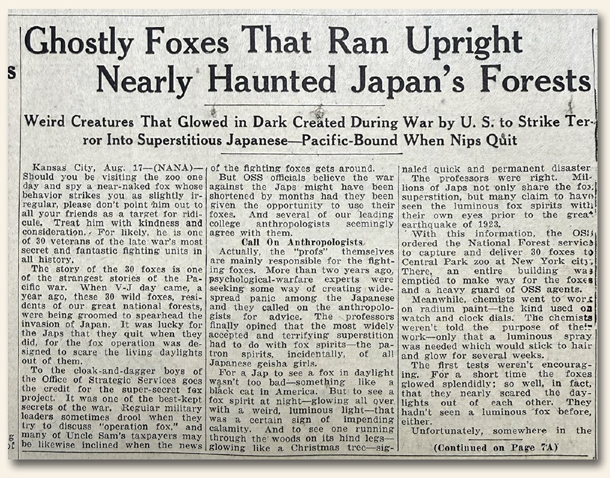
Fight for a Nation – Introduction…
October 9, 2026 by GuyHeilenman · Leave a Comment
During the lead-up to July 4, 2026 – as our country celebrated its 250th anniversary – we brought you Lead-Up to a Nation, a weekly video series using authentic, period newspapers to chronicle the fateful year heading into July 4, 1776.
Now that the Declaration has been made, the real struggle begins.
Starting this month, we’re launching our a monthly video series: Fight for a Nation. Join us over the coming years as we relive the American Revolution through the very pages, ink, and first-hand reporting of those who lived through this incredible period in American and world history.
Check out the first three installments below—we hope you enjoy journeying back in time with us!
Installment from July, 2026
The Declaration Proclaimed – Military Challenges + Growing Confidence (Fight for a Nation – E1)
Installment from August, 2026
A Nation at its Birth – Shaping the Future (Fight for a Nation – E2)
Installment from September, 2026
The Treaty of Jamestown – 1st Permanent English Settlement in America (Fight for a Nation – E3)
How a change in plans could change the course of history…
October 5, 2026 by TimHughes · Leave a Comment
One of the intriguing aspects of collecting early newspapers is the opportunity to learn–with hindsight–how some aspects of history, seeming mundane at the time, could change ever-so-slightly yet affect the course of history forever. Let me explain.
An inconspicuous report in the “Evening Bulletin” issue of Oct. 31, 1863 (shown below), from Providence, Rhode Is., is headed: “The Field of Gettysburg”. Remembering that the historic Battle of Gettysburg was fought nearly 4 months prior, it would have been no surprise that the cemetery at Gettysburg would be formally dedicated to the memory of the thousands who died in that struggle. The planning being of little consequence to anyone at the time, we are not surprised that this is the first such report we have seen in any newspaper.
The report has two points of curious interest. First, the dedication was originally planned for October 22, but it had to be postponed until November 19: “…by which time all the dead braves will be, probably, interred.” There is also mention that: “Edward Everett will deliver, probably, his finest oration…” plus more on the planned event. There was no mention of President Lincoln.
Lincoln was not formally invited to participate until November 2, just 17 days before the ceremony, and 11 days after the original date for the event. By contrast, Everett had been invited months prior. The committee did not expect Lincoln to give a major speech. David Wills’s official invitation letter specifically requested that the President provide just “a few appropriate remarks” to formally set aside the grounds after Everett’s grand oration.
Indeed, Everett gave a “grand oration”. He spoke for two hours (13,607 words), while Lincoln followed with his two-minute Gettysburg Address (272 words), which ultimately became one of the most famous speeches in human history.
What if Lincoln had not been invited at the last minute? The dedication of the Gettysburg Cemetery would still have been reported in most newspapers of the day, given Edward Everett’s speech, but over 16o years later, history would have had little memory of the event. It was Lincoln’s two-minute address that made the difference.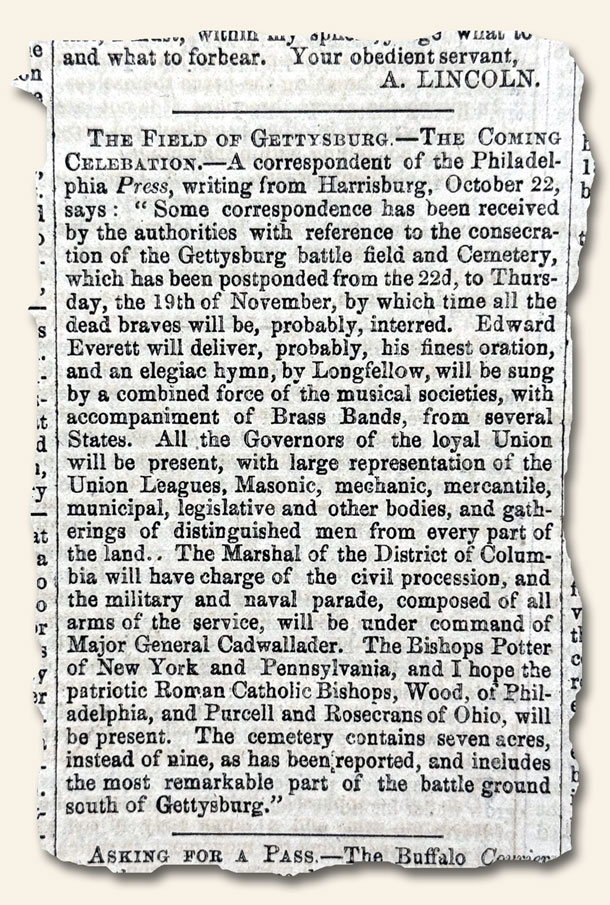
A truth… a story… a myth… a discovery – What to do with a 1666 London Gazette?
September 28, 2026 by GuyHeilenman · Leave a Comment
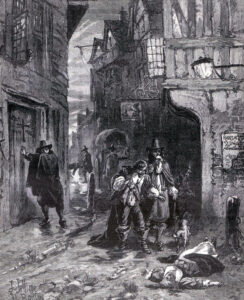 Collectors seek out “rare & early” newspapers for a host of reasons. Some use them as primary source material for research. Others collect them to grasp the contemporary response to an historical event, while others use them to chronical a non-revisionist view of an era. Framing them for display is quite common – whether it be to set a mood, or, as is quite common with museums, to aid in telling the story regarding a display of unique items. Yet another group loves to obtain them to enhance their primary collectible (ex. those who collect early sewing machines finding newspapers with matching advertisements, patents, or early commentary on various stages of development). The possibilities are almost endless.
The topic at hand was recently revived when a collector, who had just purchased a London Gazette dated August 9, 1666 containing a brief report on the week’s mortality bill from the Great Plague (shown below), informed us of his purpose in collecting the newspaper – which we found fascinating… and which eventually led to a discovery.
A Purpose – He purchased to use as inspiration for an event-tethered short story (historical fiction?). If you have a little time, I’m sure he would not mind if you took a gander: THE KING’S BAKER
A Discovery – After reading his story I decided to dig a little deeper into the 1665-6 London Plague and was drawn in by an article posted by the London Museum titled: THREE MYTHS ABOUT THE GREAT FIRE OF LONDON
A MYTH – I don’t want to give anything away, but suffice to say, I need to go back to a lot of people and correct what I once thought was true. Yikes!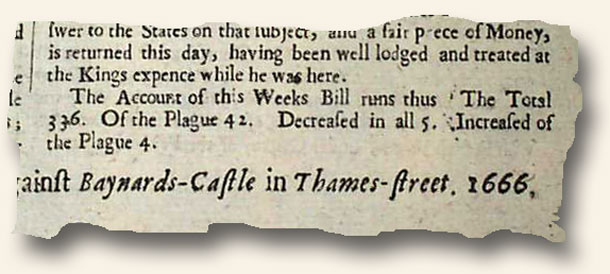
A Truth – For those who like to pine for the past, during the week prior to the above newspaper’s distribution in 1666, 42 people in London alone were known to have died from the bubonic plague. Life was not easy; but death often was.
Who’s Who in Newspapers? Larry Walters edition (1982)…
September 4, 2026 by GuyHeilenman · Leave a Comment
If you’re a fan of quirky American folklore, you might recognize the name “Lawn Chair Larry.” Yet few realize the sheer audacity – and immediate, nationwide intrigue that surrounded the moment 33-year-old Larry Walters actually took off into the Southern California sky.
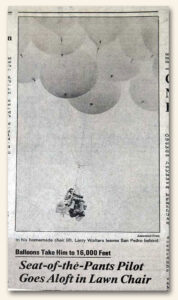 On July 2, 1982, Walters tied 42 helium-filled weather balloons to an ordinary aluminum lawn chair in the backyard of his girlfriend, Carol Van Deusen, in San Pedro. Armed with a pellet gun, a CB radio, a camera, and a parachute, his plan was simple: float lazily across San Pedro toward the Mojave Desert. Instead, when his tether line unexpectedly snapped, Walters shot skyward like a rocket, losing his glasses in the process and soaring to an astonishing 16,000 feet! Freezing in the high-altitude air, he startled commercial airliner pilots who radioed in shock to report a man sitting in a lawn chair in controlled airspace. To descend, Walters systematically popped several balloons with his pellet gun, eventually landing tangled in power lines in a Long Beach neighborhood – unharmed, but briefly causing a local blackout.
His story came to light quite by accident during a search through our archives for something completely unrelated. Our gaze was immediately drawn to the front page of the Los Angeles Times from July 3, 1982, which featured a remarkable photograph of a man taking flight from the comfort of a lawn chair.
If you are fascinated by eccentric dreamers who take “seat-of-the-pants” ambition to literal new heights, spending a little time reading contemporary accounts of Larry Walters’ flight is pure joy. It serves as an amusing, incredible reminder of human ingenuity, boundless determination, and the unpredictable nature of backyard aviation.
To the right is a photo from the front page of the Los Angeles Times our friend was seeking, complete with the bold headlines “Seat-of-the-Pants Pilot Goes Aloft in Lawn Chair” and the iconic snapshot showing Walters airborne over San Pedro.
Reasons for the Declaration of Independence. . . Step by Step Logic…
August 28, 2026 by Laura Heilenman · Leave a Comment
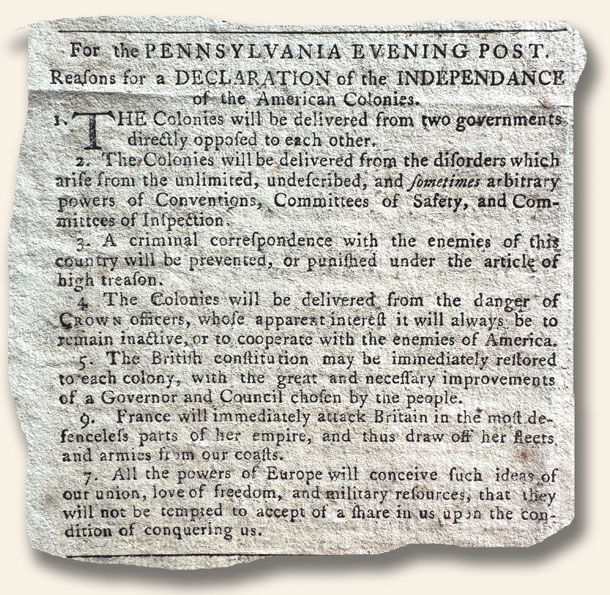 Often as we have big decisions ahead of us, wise council around us may prompt us to ask ourselves the question. . . why? Knowing the whys can often help point us to answer the more logistical question of how. In April of 1776, the Pennsylvania Evening Post attempted to lay out the why of the enormous decision facing the colonies. Below, read the text and reasoning laid before the citizenry.
Reasons for a DECLARATION of the INDEPENDANCE of the American Colonies.
- THE Colonies will be delivered from two governments directly opposed to each other.
- The Colonies will be delivered from the disorders which arise from the unlimited, undescribed, and sometimes arbitrary powers of Conventions, Committees of Safety, and Committees of Inspection.
- A criminal correspondence with the enemies of this country will be prevented or punished under the article of high treason.
- The Colonies will be delivered from the danger of Crown officers, whose apparent interest it will always be to remain inactive, or to cooperate with the enemies of America.
- The British constitution may be immediately restored to each colony, with the great and necessary improvements of a Governor and Council chosen by the people.
- France will immediately attack Britain in the most defenseless parts of her empire and thus draw off her fleets and armies from our coasts.
- All the powers of Europe will conceive such ideas of our union, love of freedom, and military resources, that they will not be tempted to accept of a share in us upon the condition of conquering us.
If only we could all present our logical arguments in such a concise and impactful manner.
A recently released video related to this post is available at: Independence was Destiny – The Case for Independence
When crises happen, publishers can be creative… Ben Franklin & the Stamp Act…
August 24, 2026 by TimHughes · Leave a Comment
Occasionally, a newspaper just doesn’t look like a newspaper. When crises happen, some newspaper publishers can be creative and angry, resulting in “newspapers” that are quite unusual. Here is one.
Looking very much like a broadside (although it is four pages), an issue we purchased many years ago is simply headed: “REMARKABLE OCCURRENCES”, having no date, no city of publication, and no issue number.
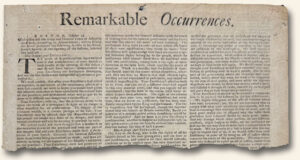 With some investigation, we learned that this is actually the November 14, 1765 issue of the famous “Pennsylvania Gazette” printed by Ben Franklin and David Hall. The hated Stamp Act took effect on Nov. 1, 1765. Therefore the paper was suspended and in its place a broadside entitled “No Stamped Paper to be had” was printed for Nov. 7, and this four page issue titled: “Remarkable Occurrences” was created for Nov. 14. The regular title and numbering were resumed with the Nov. 21 issue but without the imprint. No name of publisher appeared until the Feb. 6, 1766 issue printed by David Hall, as the partnership with Franklin had been dissolved.
Never, previously, have we ever handled either of these two issues.
The entire front page is taken up with Stamp Act content. Page 2 has content from Europe, and pages 3 and 4 have content with datelines from Boston, Newport, Philadelphia, and New York with again, much of the content related to the Stamp Act.
This is treasured as one of the more intriguing newspapers in our inventory, and is even more notable with its connection to the Stamp Act.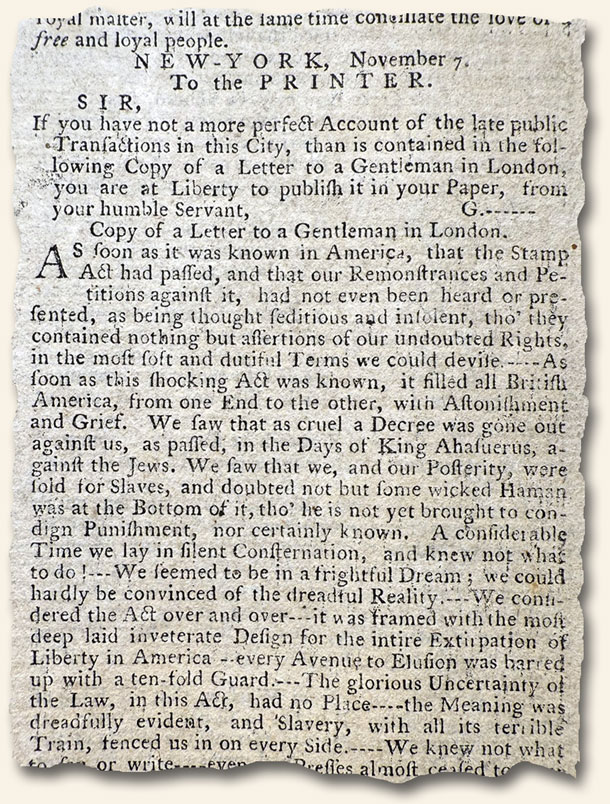
The reason I collect it: stunning graphics inside… Lincoln’s Funeral…
August 17, 2026 by TimHughes · Leave a Comment
We have handled many Lincoln assassination and funeral issues, and many can be graphic in terms of type size and drama of the column headlines. Most notably, the ‘Philadelphia Inquirer’ had several issues from April 17 to 25 with very nice graphic appeal.
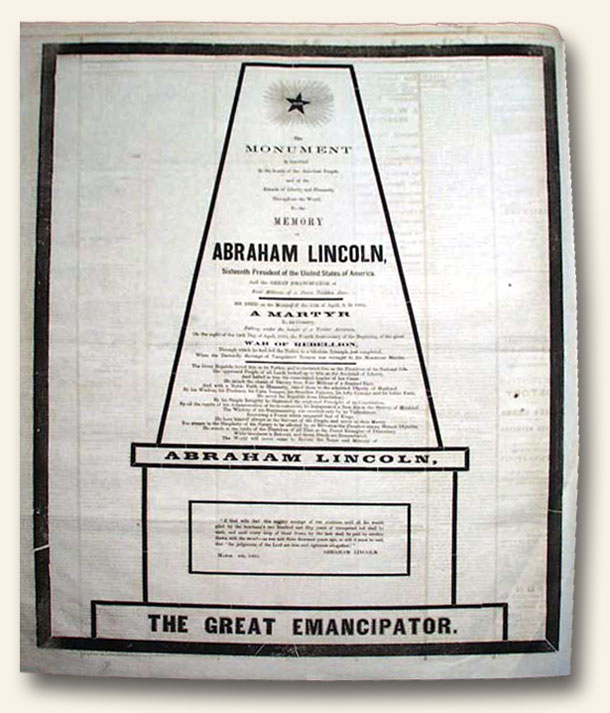
But never have we seen inside pages so dramatically presented as with the ‘Cleveland Morning Leader’ issue of April 28, 1865. Although the front page is focused on the capture and death of John Wilkes Booth, as well as reports on the Lincoln funeral (all page 1 and 4 columns have wide, black mourning rules), pages 2 and 3 are consumed with broadside-like graphics, offering no text save for that found within the graphics. Page 2 appears much like a monument in memory of Lincoln, and page 3 has a black border surrounding short poems and portions of a “Speech of Abraham Lincoln” and a line from his “Emancipation Proclamation”.
When first encountered I noticed the ink bleed-through on page 1 and thought it was offsetting from the previous issue (not uncommon). But when I opened the newspaper I discovered something I had never seen the likes of before.