

Search
The Rare & Early Newspapers Hobby

Receive the Newsletter

Buy Historic Newspapers

Who’s Who in Newspapers? Stephen Crane edition (1891)…
May 11, 2026 by GuyHeilenman · 1 Comment
The 14th installment of: Who’s Who in Newspapers
This series typically highlights lesser-known figures who have left intriguing marks in the world of historic newspapers—individuals often overlooked by the general public. However, today’s spotlight falls on a truly famous name: Stephen Crane (1871–1900), the acclaimed American author best known for his iconic Civil War novel *The Red Badge of Courage* (1895), a groundbreaking work of literary realism and naturalism that vividly captures the psychological turmoil of battle.
So why feature such a well-known literary giant in this series? Crane exemplifies a distinguished tradition of celebrated writers who launched their careers (or sharpened their skills) as newspaper journalists—often starting remarkably young. This roster includes luminaries such as:
– Mark Twain (Samuel Clemens), who began as a printer’s apprentice and reporter in his teens and early 20s.
– Charles Dickens, whose early work included vivid sketches and reporting for London newspapers.
– Ernest Hemingway, who honed his concise, punchy style as a cub reporter.
– George Orwell, who drew on journalistic experience for his essays and novels.
– Karl Marx, whose writings appeared in newspapers like the New-York Daily Tribune.
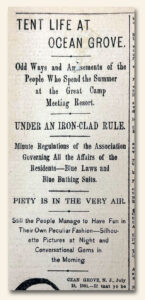
Many of these authors were in their teens or early 20s when they first contributed to newspapers, using the medium to observe society up close, develop their voices, and earn a living while building toward greater literary achievements.
The featured newspaper clip below and to the right are from one of Crane’s earliest published pieces: a sketch titled “Tent Life at Ocean Grove”, written and illustrated by Crane at the age of just 19, which we recently unearthed in the New York Herald dated July 19, 1891.
Ocean Grove, New Jersey—often called “God’s Square Mile”—was (and remains) a unique seaside community founded in 1869 by Methodist ministers as a camp meeting site. Part of the broader 19th-century Methodist camp meeting movement, it combined intense religious revivalism with summer respite: families lived in tents or simple cottages during annual gatherings, emphasizing piety, prayer meetings, lectures, and moral recreation—while alcohol and other “worldly” amusements were strictly prohibited. At its cultural peak in the late 19th century, Ocean Grove represented Victorian-era piety at its most earnest, contrasting sharply with the lively, secular beach resorts nearby (like Asbury Park).
Crane’s article offers a sharp, observational glimpse into this world. He describes the “somber-hued” atmosphere of the tent colony, where devout “tenters” engaged in serious religious devotion amid the summer heat. With characteristic irony and wit, he contrasts this restrained, spiritual environment with the more carefree, bustling vacation spots just beyond its borders—highlighting class differences, social norms, and the peculiar blend of holiness and holiday.
For collectors and scholars of historic newspapers, the 1891 *Herald* piece stands out as an early “warning shot” of Crane’s emerging literary genius. It foreshadows the keen social observation, subtle irony, and class consciousness that would later define masterpieces like *The Red Badge of Courage*, *Maggie: A Girl of the Streets* (1893), and his war reporting. While a later 1892 article for the *New York Tribune* (on a Labor Day parade) sparked controversy and effectively ended his newspaper career in that city due to its critical tone, this Ocean Grove sketch remains a more polished, evocative example of his talent for elevating a routine travelogue or feature story into incisive social commentary.
Talk about precocious talent—Crane was already displaying the distinctive voice that would make him one of America’s most innovative writers before he even turned 20!
Who else would you add to the list?
Personal Note: I have a personal connection to this world Crane described. During our early teens in the 1960s and 1970s, my sister and I attended Chester Heights Camp Meeting in Delaware County, PA—a historic Methodist camp meeting grounds established in 1872, not long after Ocean Grove’s founding. Though more than 90 years had passed since Crane’s visit to Ocean Grove, much of the atmosphere felt strikingly similar to what he captured: the rows of simple cottages (most without running water), the focused religious services, the sense of stepping away from everyday bustle into a place of earnest devotion and quiet summer fellowship. While the world around it had changed dramatically over the decades—and Chester Heights itself has evolved in many ways—the core spirit of sincere personal faith buoyed by sold Biblical teaching and powerful worship in a communal setting endured remarkably intact during those years. Reading Crane’s sharp, ironic sketch today brings those childhood summers vividly back to life.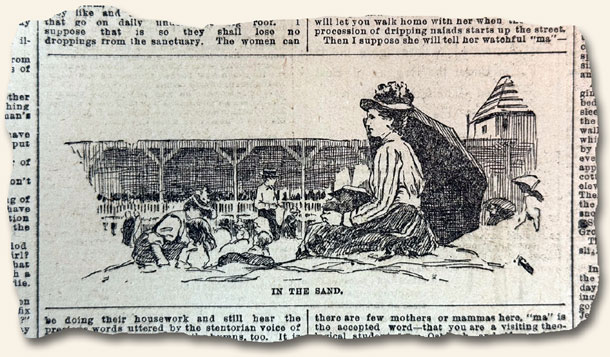
PS Confession: We had to take a bus to our camp meeting’s “beach” – a small public pool about 10 miles from our location.
I’m New Here: Week Twenty-Eight…
August 29, 2019 by Stephanie Williams · Leave a Comment
 It’s probably obvious by now that histories of people are the most intriguing aspect of life to me and it helps me when I enter into the customer service aspect of this job. Each longtime collector, or birthday dabbler, or train-of-thought/rabbit trail follower (I made that term up) is led or driven by his or her own tale. And I am privileged to hear about the whys and wherefores of the quests.
This week I worked with an Earth Science teacher who has been collecting early records of hurricanes, tidal surges and solar eclipses with an intensity I can’t help but appreciate, even though I could barely follow his pontificating. It makes me happy that he is teaching, and I hope his enthusiasm is contagious to at least one of the jaded high schoolers trudging through the eleventh grade of our system of education. A writer in Manhattan checked in five times this week, and added titles that were absolutely vital to the history she is compiling and I have a mental image of scraps of paper covered in scribbles from which she cross checks and matches our latest catalog offerings. Her exclamations of delight are always tinged with the “I really shouldn’t…” tone that most dieters adopt.
Preferences aside, details really matter in this job. Enthusiasm over stories within a volume cannot excuse my neglect to mark the proper location for return. With thirty-one rows of interior shelving that is fifteen feet high and thirty feet long, a misfiled collection may never be found again, however valuable the issues or concentrated the search. Similarly, folks who ordered a hundred times don’t appreciate a letter that welcomes them as a new collector, and our six-digit item codes can’t have a single transposition without becoming wrong. By this error, I did not locate a New York Tribune from the Civil War period but a Scientific American from January 24, 1891. Tracing my mistake to the original point at which I veered from the straight and narrow path of accuracy, I ended up sitting down to a cup of tea and a technical description of the “Electrical Base Ball Bulletin.” It caught my eye because we are located in “The Birthplace of Little League” and host the annual World Series every August. As with the Science instructor, the technical jargon jumbles me a bit so I cannot begin to comprehend how the contraption worked. However, the description is clearly an invention of Mr. S. D. Mott of Passaic, New Jersey from 129 years ago, that was possibly the precursor to the system for the modern scoreboard display.
So, there you have it.
In the world of Rare and Early Newspapers, even a wrong turn (in a timely fashion) can land me in a place I learn something new.