

Search
The Rare & Early Newspapers Hobby

Receive the Newsletter

Buy Historic Newspapers

The reason I collect it: stunning graphics inside… Lincoln’s Funeral…
August 17, 2026 by TimHughes · Leave a Comment
We have handled many Lincoln assassination and funeral issues, and many can be graphic in terms of type size and drama of the column headlines. Most notably, the ‘Philadelphia Inquirer’ had several issues from April 17 to 25 with very nice graphic appeal.
But never have we seen inside pages so dramatically presented as with the ‘Cleveland Morning Leader’ issue of April 28, 1865. Although the front page is focused on the capture and death of John Wilkes Booth, as well as reports on the Lincoln funeral (all page 1 and 4 columns have wide, black mourning rules), pages 2 and 3 are consumed with broadside-like graphics, offering no text save for that found within the graphics. Page 2 appears much like a monument in memory of Lincoln, and page 3 has a black border surrounding short poems and portions of a “Speech of Abraham Lincoln” and a line from his “Emancipation Proclamation”.
When first encountered I noticed the ink bleed-through on page 1 and thought it was offsetting from the previous issue (not uncommon). But when I opened the newspaper I discovered something I had never seen the likes of before.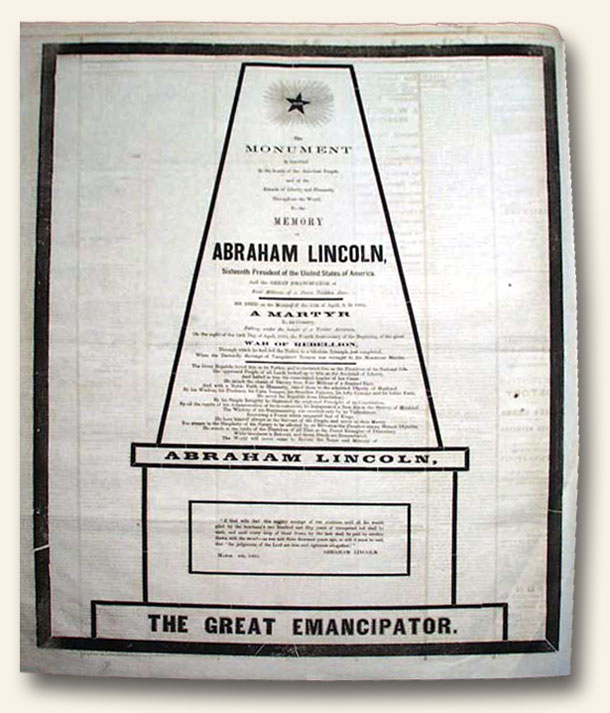
The Moment Before the World Changes… Lincoln’s Assassination Day…
July 27, 2026 by Laura Heilenman · Leave a Comment
You can’t read historic newspapers for long before you are struck by how often people experience “the moment before”.
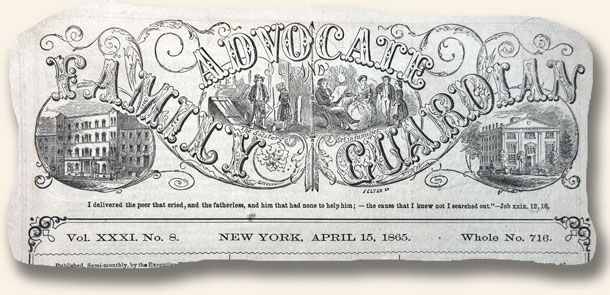
The April 15, 1865 issue of the ADVOCATE FAMILY GUARDIAN has a prime example with so much nuance that you can’t imagine it was not planned and yet, clearly it was not.
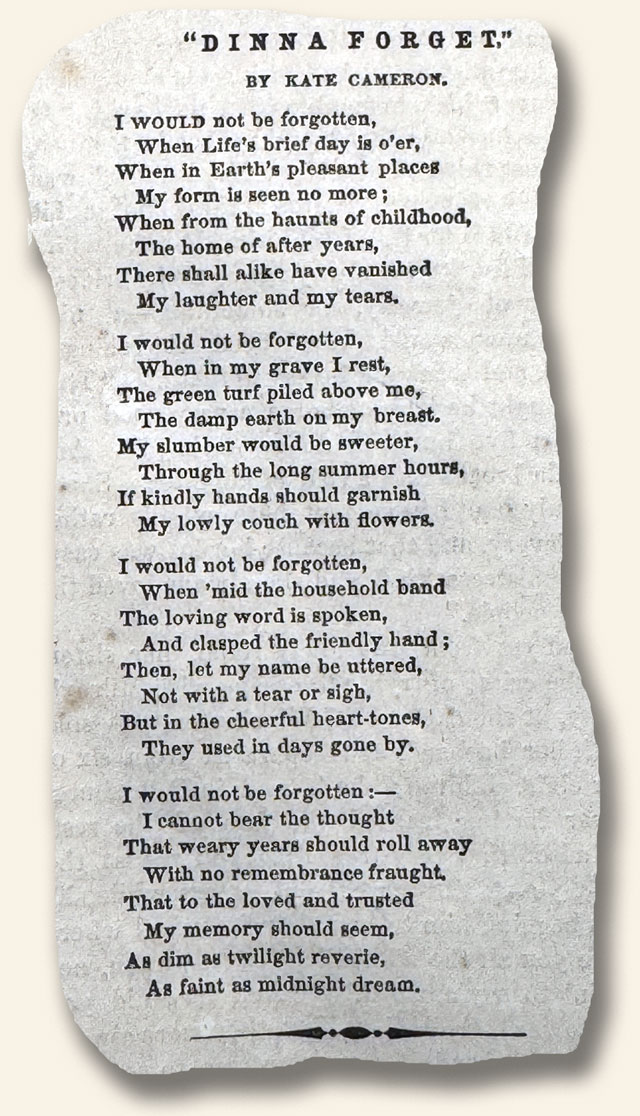
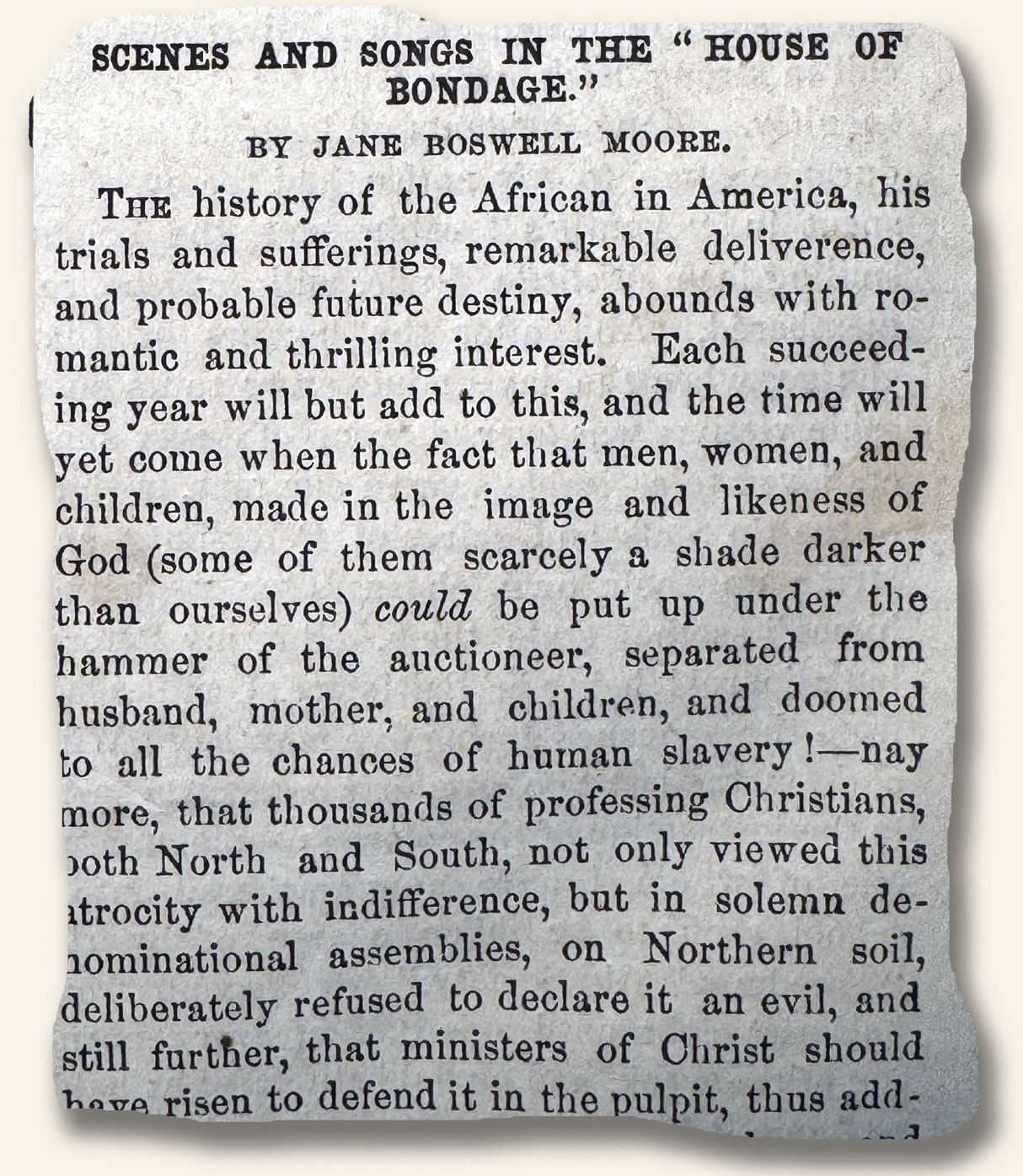
Hours before President Lincoln was Assassinated, the paper published their daily edition and the front page was framed by 2 articles. On the left side was a poem describing the death of someone and how they would never be forgotten. The right side had an article describing slavery and how God’s people should have risen to speak against it. What a beautiful, accidental tribute to the President who was about to be mourned and who did rise and stand against slavery. The irony of the frontpage coverage could not be lost on the reader… in hindsite.
Juneteenth… The Nuances of Slavery’s End…
June 19, 2026 by Laura Heilenman · Leave a Comment
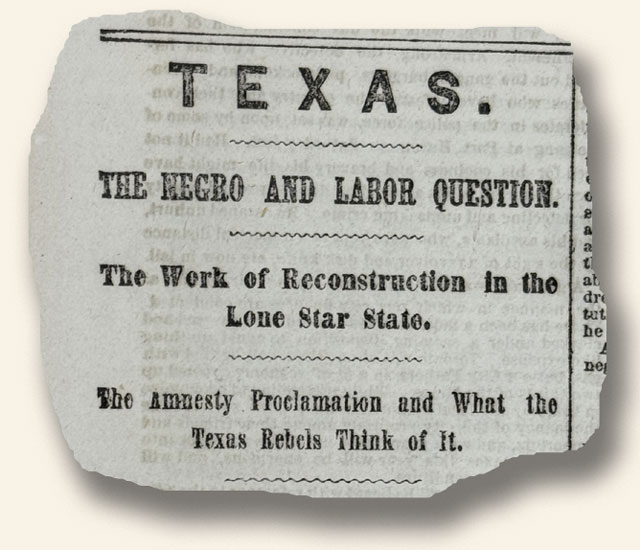 The saying, “History is a set of lies agreed upon,” often attributed to Napoleon, reminds us how easily we can simplify the past. A few days ago, I read about the story of General Granger’s landmark announcement in Galveston on June 19, 1865. Today, while digging deeper into the same moment, I came across Colonel G.W. Clark’s follow-up order issued in Houston just three days later. Reading both orders side by side offers a fascinating window into how emancipation actually unfolded on the ground in Texas.
General Granger’s General Order No. 3 was the pivotal statewide declaration that brought the Emancipation Proclamation to the last major Confederate holdout. Addressed to “the people of Texas,” it formally informed roughly 250,000 enslaved people that they were free, stressing “absolute equality of personal rights and rights of property” and transforming the old master-slave relationship into one of “employer and hired labor.” Its importance cannot be overstated: this was the public, official moment that ended legal slavery in Texas and gave birth to Juneteenth as a day of celebration and remembrance.
Colonel Clark’s General Orders No. 3, issued on June 22, 1865, for the Post of Houston, played a more localized but equally necessary role. It provided the practical instructions needed to prevent chaos in a major occupied city, directing freedmen to remain temporarily with former owners while reassuring them that doing so would “forfeit none of their rights of freedom.” Clark added details about upcoming labor contracts and consequences for idleness, showing the administrative work required to turn grand declarations into orderly reality.
Though both orders advanced the same goal of peaceful transition, their tones on freedom differed in telling ways. Granger’s language was bold and expansive, celebrating equality and a clean break with the past. Clark’s was more measured and reassuring, carefully balancing direction with the promise that freedom remained intact. Reading them together reveals how emancipation was not a single dramatic event but a layered process—announced with inspiring clarity in one breath and managed with cautious practicality in the next. In that sense, these two orders from 1865 still rhyme with the challenges of turning high ideals into lived experience.
Who’s Who in Newspapers? Moses G. Farmer edition (1879)…
June 8, 2026 by GuyHeilenman · Leave a Comment
The 15th installment of: Who’s Who in Newspapers
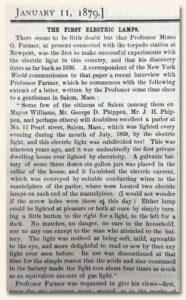 When it comes to “man on the street” interviews, the lack of knowledgeable responses often received never fails to confound. We enjoy watching these—which is a bit troubling in itself—but if an interviewer asked, “Who invented the light bulb?”, I’d bet 75% would answer correctly, especially with a few “Thom… Thomas… Thomas Ed…” clues.
However, and to be fair, few of us (myself included) could name the pioneers who paved the way. Enter Moses G. Farmer. Thanks to a January 11, 1879, issue of Scientific American titled “THE FIRST ELECTRIC LAMPS,” I discovered this fascinating inventor who lit his Salem, MA, home in 1859—two decades before Edison’s breakthrough.
Using platinum filaments and batteries he had mounted for the purpose in his cellar, Farmer proved electricity could replace gas. Though the cost of platinum and the lack of a vacuum prevented commercial success, his “parlor lights” were the first to move electric light from the lab into a domestic reality – often enlightening dinner guests with his invention.
Farmer provided the “blueprint of failures” Edison needed. He proved electricity could light a home; Edison simply figured out how to make it last longer than a dinner party.
A modern sketch comparing Farmer’s and Edison’s work is shown below.
I love this collectible – and how it fuels the engine of life-long learning.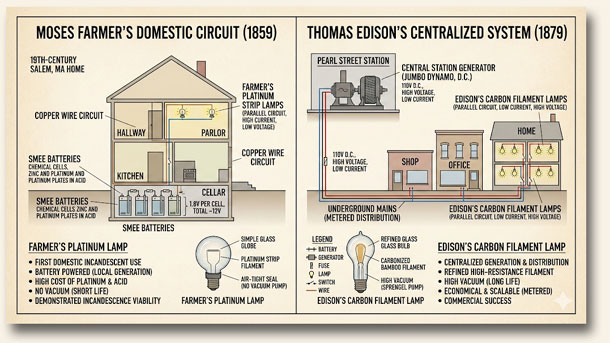
Announcing: Catalog 367 – Released (early) for June, 2026 – Rare & Early Newspapers…
May 29, 2026 by GuyHeilenman · Leave a Comment
|
|
Who’s Who in Newspapers? Stephen Crane edition (1891)…
May 11, 2026 by GuyHeilenman · 1 Comment
The 14th installment of: Who’s Who in Newspapers
This series typically highlights lesser-known figures who have left intriguing marks in the world of historic newspapers—individuals often overlooked by the general public. However, today’s spotlight falls on a truly famous name: Stephen Crane (1871–1900), the acclaimed American author best known for his iconic Civil War novel *The Red Badge of Courage* (1895), a groundbreaking work of literary realism and naturalism that vividly captures the psychological turmoil of battle.
So why feature such a well-known literary giant in this series? Crane exemplifies a distinguished tradition of celebrated writers who launched their careers (or sharpened their skills) as newspaper journalists—often starting remarkably young. This roster includes luminaries such as:
– Mark Twain (Samuel Clemens), who began as a printer’s apprentice and reporter in his teens and early 20s.
– Charles Dickens, whose early work included vivid sketches and reporting for London newspapers.
– Ernest Hemingway, who honed his concise, punchy style as a cub reporter.
– George Orwell, who drew on journalistic experience for his essays and novels.
– Karl Marx, whose writings appeared in newspapers like the New-York Daily Tribune.
Many of these authors were in their teens or early 20s when they first contributed to newspapers, using the medium to observe society up close, develop their voices, and earn a living while building toward greater literary achievements.
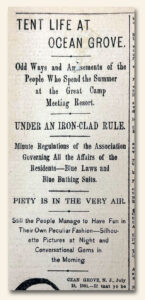
The featured newspaper clip below and to the right are from one of Crane’s earliest published pieces: a sketch titled “Tent Life at Ocean Grove”, written and illustrated by Crane at the age of just 19, which we recently unearthed in the New York Herald dated July 19, 1891.
Ocean Grove, New Jersey—often called “God’s Square Mile”—was (and remains) a unique seaside community founded in 1869 by Methodist ministers as a camp meeting site. Part of the broader 19th-century Methodist camp meeting movement, it combined intense religious revivalism with summer respite: families lived in tents or simple cottages during annual gatherings, emphasizing piety, prayer meetings, lectures, and moral recreation—while alcohol and other “worldly” amusements were strictly prohibited. At its cultural peak in the late 19th century, Ocean Grove represented Victorian-era piety at its most earnest, contrasting sharply with the lively, secular beach resorts nearby (like Asbury Park).
Crane’s article offers a sharp, observational glimpse into this world. He describes the “somber-hued” atmosphere of the tent colony, where devout “tenters” engaged in serious religious devotion amid the summer heat. With characteristic irony and wit, he contrasts this restrained, spiritual environment with the more carefree, bustling vacation spots just beyond its borders—highlighting class differences, social norms, and the peculiar blend of holiness and holiday.
For collectors and scholars of historic newspapers, the 1891 *Herald* piece stands out as an early “warning shot” of Crane’s emerging literary genius. It foreshadows the keen social observation, subtle irony, and class consciousness that would later define masterpieces like *The Red Badge of Courage*, *Maggie: A Girl of the Streets* (1893), and his war reporting. While a later 1892 article for the *New York Tribune* (on a Labor Day parade) sparked controversy and effectively ended his newspaper career in that city due to its critical tone, this Ocean Grove sketch remains a more polished, evocative example of his talent for elevating a routine travelogue or feature story into incisive social commentary.
Talk about precocious talent—Crane was already displaying the distinctive voice that would make him one of America’s most innovative writers before he even turned 20!
Who else would you add to the list?
Personal Note: I have a personal connection to this world Crane described. During our early teens in the 1960s and 1970s, my sister and I attended Chester Heights Camp Meeting in Delaware County, PA—a historic Methodist camp meeting grounds established in 1872, not long after Ocean Grove’s founding. Though more than 90 years had passed since Crane’s visit to Ocean Grove, much of the atmosphere felt strikingly similar to what he captured: the rows of simple cottages (most without running water), the focused religious services, the sense of stepping away from everyday bustle into a place of earnest devotion and quiet summer fellowship. While the world around it had changed dramatically over the decades—and Chester Heights itself has evolved in many ways—the core spirit of sincere personal faith buoyed by sold Biblical teaching and powerful worship in a communal setting endured remarkably intact during those years. Reading Crane’s sharp, ironic sketch today brings those childhood summers vividly back to life.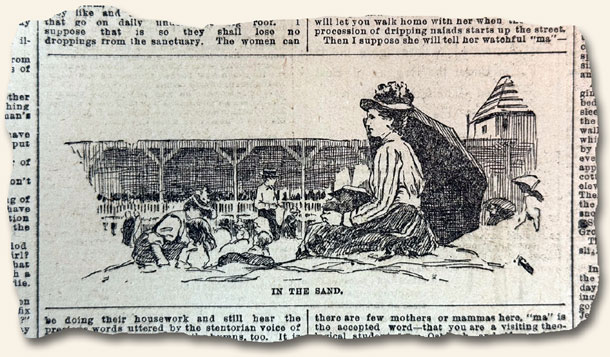
PS Confession: We had to take a bus to our camp meeting’s “beach” – a small public pool about 10 miles from our location.
Announcing: Catalog 366 – Released (early) for May, 2026 – Rare & Early Newspapers…
May 1, 2026 by GuyHeilenman · Leave a Comment
|
|
Announcing: Catalog 365 – Released (early) for April, 2026 – Rare & Early Newspapers…
March 27, 2026 by Phineas Q. Wryte · Leave a Comment
|
|
Mystery Solved … The Ancestry of Abraham Lincoln Clarified…
March 23, 2026 by Laura Heilenman · 1 Comment
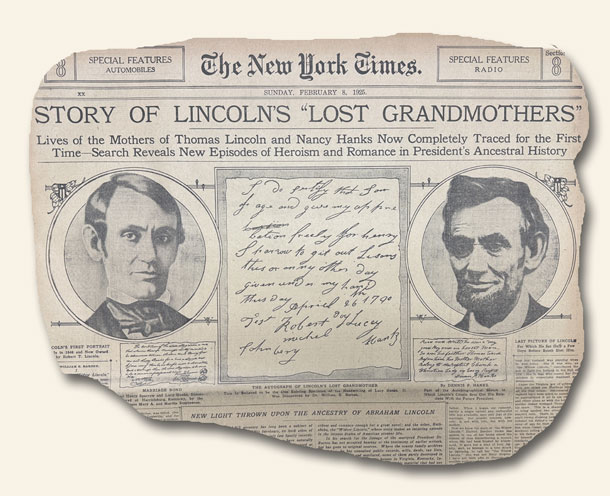
We often discuss the legacy of our founding fathers and American heroes… highlights of their lives which leave an indelible impression on us as individuals or on the country we cherish. With all this focus, it is a shame we often miss the stories of their ancestry… the people and events that molded them into the larger-than-life figures we admire. Such is the case with Abraham Lincoln. Although we have all learned of his self-education in a one room log cabin and the deep loses he suffered as a young man, it wasn’t until 1925 that we were able to get a clearer picture of family members who came before and how their stories might have impacted the Lincoln. On February 8, 1925 The New York Times had substantial coverage of Abraham Lincoln’s grandmothers who had, until this point, not been confirmed. The paper goes on to say the stories of these ladies reveal. “Episodes of Heroism and Romance in the president’s Ancestral History”. Not unlike today, apparently, people at the turn of the century longed for a good paparazzi story as well.
Significant Discovery: Horace Greeley’s “views” of Freedmen (1865)…
March 9, 2026 by GuyHeilenman · Leave a Comment
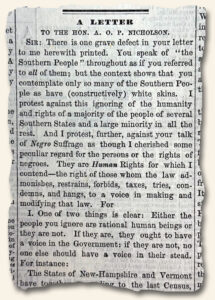
After being heavily engrossed in the rare & early newspapers collectible for over 50 years, encountering “new” discoveries within our own archives has not abated. Case in point: We recently identified a significant letter in the August 26, 1865, issue of the New York Daily Tribune that had previously gone unnoticed. Located on page 4 and signed simply “H. G.” (Horace Greeley), this letter addressed to the Hon. A. O. P. Nicholson offers a profound look into the intellectual climate of the immediate post-Civil War era. Perhaps it was the inconspicuous single column heading, “A Letter”, which was complicit in our oversight. Such “discoveries” are one of the reasons why we love this hobby.
As far as the letter itself is concerned… The exchange occurred during a pivotal window of Reconstruction. With the war concluded and the Thirteenth Amendment in the process of ratification, the nation was gripped by a debate over the “physical, intellectual, and emotional condition” of newly emancipated African Americans. While many, including Nicholson, sought to categorize or question the capabilities of the formerly enslaved through a lens of racial “fitness,” Greeley used his editorial platform to push back against these prejudices.
In this letter, Greeley argues that any perceived deficiencies in the Black population were not inherent traits, but the direct result of the “degradations” of the institution of slavery. By advocating for education and the rights of “Free Labor,” Greeley was effectively laying the groundwork for the so-called “Radical Republican” agenda that would eventually lead to the 14th and 15th Amendments.
For collectors of Civil War, Reconstruction-era, and Black-Americana ephemera, this issue serves as a primary source document and captures the exact moment the country transitioned from a military conflict to a philosophical battle over the true meaning of citizenship – a powerful step towards realizing the founding charge that all (people) are created equal.