

Search
The Rare & Early Newspapers Hobby

Receive the Newsletter

Buy Historic Newspapers

“Broken hearts cannot be photographed”… Matthew Brady…
June 26, 2026 by TimHughes · Leave a Comment
War has always inflicted its pains and sorrows upon a nation. But the brutality and reality of war never fully struck home until the Civil War. It was different.
Many lives were lost in the French & Indian War, the Revolutionary War, and the 19th century events of the War of 1812 and Mexican War, but until the invention of photography, there was a certain amount of callousness to what war was really about.
The Civil War changed all that, and perhaps one person, Matthew Brady, did more to make that change than anyone.
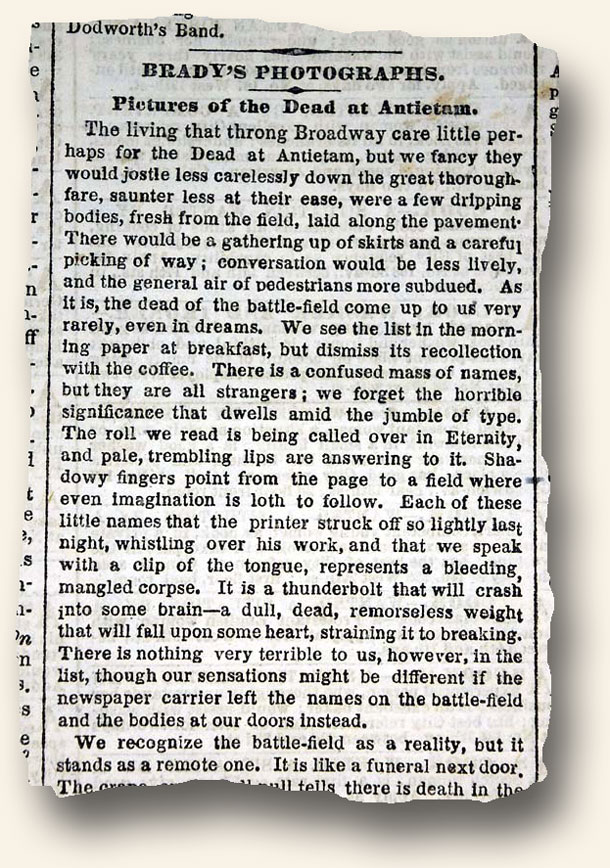
The Civil War was the first war to be photographed. In 1862, famed photographer Mathew Brady exhibited a series of pictures taken by protégés Alexander Gardner and James Gibson immediately after the Battle of Antietam. Gardner and Gibson, two of the many photographers Brady hired to document the war, produced at least 95 images at Antietam. Their images were the first to show dead bodies on the field.
The October 20, 1862 issue of the “New York Times” contains one of the more moving articles on the horrors of war, brought home to the residents of New York through an exhibition of “Pictures of the Dead at Antietam” in Matthew Brady’s Manhattan Gallery.
The article is headed: “‘Brady’s Photographs” and it reports on the exhibition by comparing the brutality & reality of war, to the callousness of New York’s residents who read the daily papers but did not relate to the horrors they reported.
The article is extremely well-written, taking most of a column. The full text can be seen in the attached photos, however a few bits are worthy of noting here: “The living that throng Broadway care little perhaps for the dead at Antietam, but…they would jostle less carelessly down the great thoroughfare, saunter less at their ease, were a few dripping bodies, fresh from the field, laid along the payment…We see the list in the morning papers…but dismiss its recollection with the coffee. There is a confused mass of names, but they are all strangers…We recognize the battle-field as a reality, but it stands as a remote one…” with more.
Then: “Mr. Brady has done something to bring home to us the terrible reality and earnestness of war. If he has not brought bodies and laid them in our dooryards and along the streets, he has done something very like it. At the door of his gallery hangs a little placard, ‘The Dead of Antietam’…There is one side of the picture that the sun did not catch…It is the background of widows and orphans, torn from the bosom of their natural protectors by the red remorseless hand of Battle, and thrown upon the fatherhood of God. Homes have been made desolate & the light of life in thousands of hearts has been quenched forever. All of this desolation imagination must paint–broken hearts cannot be photographed…” and much more.
In 50 years of selling early newspapers, this issue most powerfully brings home the grief, sorrows, tragedies, realities, and unanswered questions that war inflicts upon a nation. What a difference a photograph can make.
Does anyone know about this obscure Thomas Nast print from 1877?
June 6, 2025 by TimHughes · 3 Comments
Amongst our holdings is an obscure newspaper called “The People” from New York City, dated November 3, 1877. A closer look notes this is the volume 1, number 1 issue, and more curiously, we can find nothing about this newspaper online. This may be the only issue published, and with no mention of it in Gregory’s “Union List of American Newspapers” one wonders whether any institution is aware it even exists.
Compounding this obscurity is the large comic illustration (shown below) of John Morrissey, done by the famed artist Thomas Nast, verified by a small front page article headed: “Our Cartoon”. It verifies: “The accompanying admirable portrait of Our Great Municipal Reformer is one of the earliest made by Nast, and cost $100. It was engraved by a peculiar process which reversed the artist’s signature; but by holding it before the glass the Nast’s familiar handwriting will be recognized.”
Nothing can be found online of the existence of a Thomas Nast print captioned as noted above, let alone being in a newspaper titled: “The People”. With as much academic research that has been on this famed political artist, I find it interesting that nothing seems to be known of it.
So I reach out to all the Thomas Nast scholars, collectors, and admirers. Is anything out there that we are missing as to the existence of this print? Photos accompany this post. It exists; we just want to know more, and hopefully someone can be of help.
Leading up to the Political Season… Late 1800’s Edition…
August 26, 2024 by Laura Heilenman · Leave a Comment
 Here it comes – at about this same time on a 4-year rotating basis… the autumn media ramp-up to our presidential election. Although it can seem a bit overwhelming at times – like a tsunami of ads and interviews, I thought it might be fun to look to the past at a more humorous version of political culture and embrace the comedy and satire that accompanied the mid-to-late 1800’s press. So, feel free to join me as I peruse Puck and Judge Magazines – not to mention the endless stream of Harper’s Weekly Nast Cartoons. We could all use a chuckle right about now.
The Illustrated London News… Beautiful imagery…
September 16, 2022 by LauraH · Leave a Comment
 Today, as I was searching for an issue for a collector, I was paging through an 1857 issue of The Illustrated London News. In the midst of all of the intricate black and white sketches I happened upon two full-color double page portraits of what I believed to be women’s fashion of the day… one titled “Town” and the other titled “Country”. Of course, my immediate thought went to the popular American magazine which began in the 1800’s. However, upon a bit of investigating, I found that the current Town and Country Magazine had a predecessor two hundred years prior to its inception (some of which we have sold). This English version which began in the 1760’s is described as follows by Wikipedia:
“Town and Country Magazine was an 18th-century London-based publication that featured tales of scandals and affairs between members of London’s upper classes. Town and Country Magazine was founded by Archibald Hamilton in 1769. It gained the name ‘Town and Country’ because Hamilton had two offices, one in urban Clerkenwell and one in a rural area near Highgate. In the 1770s there was a dramatic increase in suits brought by men and their wives’ lovers in England. Many people became eager to read transcripts of adultery trials…”.
Yikes! After reading this, I am no longer sure what I found was describing women’s fashion.
Take a Closer Look … The Delicate Details of Woodcut Prints…
April 14, 2022 by LauraH · 1 Comment
I have had some fascinating conversations this past year with one of our collecting friends who is an expert in woodcut prints. I won’t be a name dropper, however, if he is reading this, he will have no doubt as to who I am referencing. I greatly appreciate the time he took to share his knowledge which has motivated me to pause and look more carefully at every print I encounter in the RareNewspapers archives. My proficiency in this area is sparse and not terribly reliable but I did want to share a few takeaways.
Some artists of woodcut prints would draw on paper and send the illustration to a publisher who would cut the paper into tiny square blocks and have each one sketched onto a square block of wood. These wooden squares would be handed out to different craftsmen who would carve their block and then the blocks would be rejoined for printing. Sometimes, when time was of the essence, each craftsman would use carving tools which could create many tiny lines at once. If you look closely at many such illustrations, you can tell these prints have hundreds of parallel lines – indicating the use of these tools. Occasionally, when more time was available, each line was formed individually – a painstaking process, but one which produced an almost unimaginable degree of detail!
Some artists preferred to draw their own prints directly onto the wood and so they were sent a group of one-inch square pieces bound together with twine. When the artist had finished their drawing, the publisher would untie the pieces and distribute the blocks to the woodcarvers.
Regardless of how each print was created, the detail, craftsmanship and artistic skill needed to produce one illustration is mind blowing. So, the next time you glance through a Harper’s Weekly, Leslie’s Illustrated , Illustrated London News, or handful of other illustrated titles of the “woodcut era”, perhaps you will join me in pausing and giving a bit of deference to these creators of beauty. Thanks Bill for sharing this delightful insight with me.
Frederic Remington Prints on Pinterest…
May 25, 2012 by GuyHeilenman · Leave a Comment
 Frederic Remington is known for his work depicting the American Wild West. Many of his prints made their way onto the pages of Harper’s Weekly, the premier illustrated newspaper of the 19th and early 20th centuries, along with a handful of other publications of the period. Timothy Hughes Rare & Early Newspapers has posted several of these on Pinterest for everyone to enjoy. They may be found at: Frederic Remington Prints – Harper’s Weekly
Another cure for baldness…
September 3, 2011 by TimHughes · Leave a Comment
This advertisement for “Graham’s Glass Vacuum Cap” appeared in the Oct. 7, 1905 issue of “Scientific American“. It proclaims: “See Your Hair Grow”. The instructions say that: “…when you have caused a good, healthy, red glow in the scalp…” it will cause hair to grow. I would think a red, glowing scalp would be a sign of other problems…