

Search
The Rare & Early Newspapers Hobby

Receive the Newsletter

Buy Historic Newspapers

Snapshot 1852… Uncle Tom’s Cabin…
July 29, 2019 by GuyHeilenman · Leave a Comment  Email This Post
|
Email This Post
|  Print This Post
The following snapshot comes from the National Intelligencer dated December 28, 1852. Most are aware of the impact Harriet Beecher Stowe’s Uncle Tom’s Cabin had on the fabric of The United States, but not everyone saw eye-to-eye. The image below shows a blurb of a politically incorrect view from the northern region of the country.
If you liked this post, you may also enjoy...
- “Uncle Tom’s Cabin” – impacting The Senate and The South (1853)…
- The impact of Newspapers on the abolition of slavery…
- The Fight Against Slavery… 1822…
- The meanderings of those who collect Rare & Early Newspapers…
- Mike Drop from 1886… Frederick Douglass Leaves Us All Stunned…
I’m New Here: Weeks Twenty-Two and Twenty-Three…
July 26, 2019 by Stephanie Williams · Leave a Comment Email This Post
| Print This Post
 Time seems to be advancing at an ever-increasing pace. Each day is crammed with more tasks than can possibly be accomplished; I think this means I am beginning to get the hang of things. But Monday brought me up short a bit as I searched titles tracing a particular story which initially diverted to the Freedom Ride. As intriguing as the tone in those accumulating reports of bus rides through the South was, the heading on a neighboring column wrested my eyes and my thoughts. I had to know the reason that divorcees (such a fancy and outmoded term) spent a night in jail. At least that’s what I believed at the time. However, since it has been four days since I read the report and I am still ready to sound forth at a moment’s reflection, it might have been better if I stuck to the familiar angst over bus seats allocated by color of skin.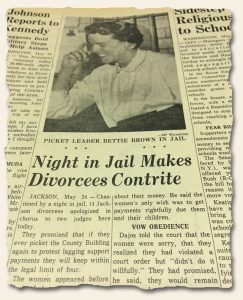
In case accompanying photographs do not tell enough story, women went to jail because deadbeat dads (such a crass and modern term) did not pay court-ordered child support. Just that. The year was 1963, and I suppose I am not meant to expect much else from the era — particularly that the freedom to assemble could possibly, legally, be constrained to a total of four persons.
Because, that was the crux of the charges — the reason for the headline: Night in Jail Makes Divorcees Contrite. “They promised that if they ever picket the County Building again to protest lagging support payments they will keep within the legal limit of four.” Fifty-six years ago a woman who was not receiving justice promised by the legal system had to promise to forego rights granted in 1791 by the First Amendment, even as she attempted to bring pressure to bear on the powers that be. Of course, I’m not foolish enough to think that this tiny fragment that sparks my ire is as important than any of the other Civil Rights /liberties that seem to have too limited of a citizenry to whom they are applied. And I am fiercely glad that the group of four swelled to an angry mob of twelve, bringing so much havoc upon the town that these single mothers had to be jailed in order to preserve the peace. Perhaps they were granddaughters of those who marched for Suffrage . It may be that they were inspired by other heroes that brought about change. Because things are not the same today. Here it helps me to take in the 1963 newspaper as a whole, reading again of the laws that were eventually impacted by two different groups. In 2019, wearied with seemingly insurmountable conflict, offense, discrimination and outright hatred, the neighboring headline, “11 Riders Quietly Leave for Mississippi Test Run” provides some perspective. Multiple barriers to equality remain, but many have been knocked down. Many barriers have been knocked down, but perhaps some have been worn away through the centuries by those whose stories are woven through old newspaper pages, those who find their own, quiet, persistent way to push back.
If you liked this post, you may also enjoy...
- I’m New Here: Weeks Twenty & Twenty-One…
- Popcorn, Principle, and the Presidency: JFK’s Quiet Stand for Artistic Courage…
- The Woman’s Journal & Education, Law and Depression…
- I’m New Here: Week Twenty-Four…
- The 1st Amendment – from 1789 to 1961 to…?
The July (2019) Newsletter from Rare & Early Newspapers…
July 22, 2019 by GuyHeilenman · Leave a Comment Email This Post
| Print This Post
Each month the staff of Timothy Hughes Rare & Early Newspapers sends out a newsletter to our members which includes special offers, discounts, alerts to new inventory, and information related to the rare newspaper collectible.
The July, 2019 newsletter:
|
 Welcome to the July 2019 edition of our monthly
|
If you liked this post, you may also enjoy...
- The October (2019) Newsletter from Rare & Early Newspapers…
- The July (2018) Newsletter from Rare & Early Newspapers…
- The July (2020) Newsletter from Rare & Early Newspapers…
- November/Thanksgiving Newsletter – Timothy Hughes Rare & Early Newspapers…
- The September (2018) Newsletter from Rare & Early Newspapers…
The Village Voice… Greenwich Village, New York…
July 19, 2019 by GuyHeilenman · Leave a Comment Email This Post
| Print This Post
 Bob Dylan, Andy Warhol, Nat Hentoff, John Wilcock, Norman Mailer, Ezra Pound, Lynda Barry, Robert Christgau, Andrew Sarris, J. Hoberman, James Baldwin, E.E. Cummings, Ted Hoagland… Broadway and Off-Broadway theater reviews, the annual Obie Awards, upstart musicians and actors, progressive and left-leaning journalism… the beatnik, hippie , and Bohemian cultures…
Although we rarely use this space to announce new inventory, we’ve recently taken in a collection which is unique enough to warrant an exception. As many know, The Village Voice, the iconic newspaper from Greenwich Village, recently stopped printing new issues. However, over the years they had saved samples of a majority of their issues for the purpose of eventually creating a digital archive, and once done, we were able to procure the lion’s-share of their own collection. What a treat! Although I personally am unable to endorse portions of their content, their impact on culture as far as newspapers are concerned may very well be second to none. Over the next year or so collectors will begin to see listings appear through our website and our eBay store. In the meantime, if there are specific issues you would like to add to your collection, and can appreciate their provenance, please be in touch at guy@rarenewspapers.com. Our holdings include most issues from 1956 through close to the final publication.
If you liked this post, you may also enjoy...
- The Village Voice… The Heart of the 60’s-70’s Anti-Establishment Youth Culture…
- A West Coast collector amasses a large collection…
- Were you there – 1974? Bob Dylan returns from a nearly 8-year absence…
- Finding the Unexpected… Village Voice edition…
- A great rarity comes into our inventory…
The Traveler… death comes to Teddy…
July 15, 2019 by The Traveler · Leave a Comment Email This Post
| Print This Post
 Back in January I traveled to Norwich, New York via the Chenango Telegraph of January 7, 1919, where I found a three line headline “Col. Theodore Roosevelt Is Dead At His Home at Sagamore Hill.” “The news that Col. Theodore Roosevelt is dead was received at this office at 5:30 o’clock Monday morning… The ex-president died at his home at Sagamore Hill at 4 o’clock this morning…”
Besides his presidency, Teddy is probably most known for his Rough-Riders in the Spanish-American War while serving in Cuba.
~The Traveler
If you liked this post, you may also enjoy...
- The Traveler… a great man laid to rest…
- The Traveler… Presidential election day 1912… the first in New Mexico…
- The Traveler… the surrender… presidential nomination…
- The Traveler… peace…
- The Traveler… Battle of Tippecanoe…
Great Headlines Speak For Themselves… Black Dahlia found…
July 11, 2019 by The Traveler · Leave a Comment Email This Post
| Print This Post
The best headlines need no commentary. Such is the case with THE BOSTON POST, Massachusetts, January 17, 1947: “FORMER MEDFORD GIRL FOUND SLAIN“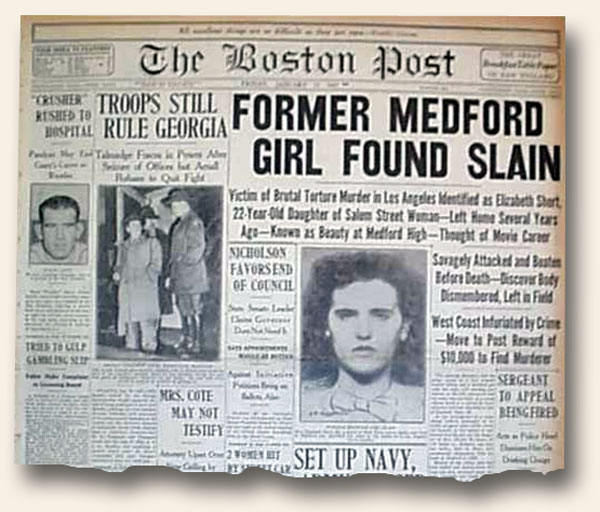
If you liked this post, you may also enjoy...
- Great Headlines Speak For Themselves… Watts riots in Los Angeles…
- Great Headlines Speak For Themselves… Martin Luther King, Jr. slain…
- Great Headlines Speak For Themselves… death of Gandhi…
- Bloody Sunday, Selma, Alabama… Great Headlines Speak For Themselves…
- Great Headlines Speak For Themselves… death of Carole Lombard…
The Traveler… new wheels to get around…
July 9, 2019 by The Traveler · Leave a Comment Email This Post
| Print This Post
 Nearly a year ago I journeyed to New York City by the means of the Scientific American, dated August 19, 1868, where I found the “Hanlon’s Patent Improved Velocipede”. “Within a few months the vehicle known as the velocipede has received an unusual degree of attention, especially in Paris, it having become in that city a very fashionable and favorite means of locomotion. To be sure the rider ‘works his passage,’ but the labor is less than that of walking, the time required to traverse a certain distance is not so much, while the exercise of the muscles is an healthful and invigorating. A few years ago, these vehicles were used merely as playthings for children, and it is only lately that their capabilities have been understood and acknowledged. Practice with these machines have been carried so far that offers of competitive trials of speed between them and horses on the race course have been made…”
I’m glad that they don’t make them that way any longer!
~The Traveler
If you liked this post, you may also enjoy...
- Before there was the Chunnel…
- Before heading out to Your New Year’s Eve Party…
- Snapshot 1881: Is it a car, a bike, a train or a trike?
- And I thought we were the lazy generation…
- The Traveler… the strike is over… looking to the future…
I’m New Here: Weeks Twenty & Twenty-One…
July 4, 2019 by Stephanie Williams · Leave a Comment Email This Post
| Print This Post
It’s hard to put into words all I learned last week, other than conclude (again) I work in an amazing place. Distinct events blurred together as we completed the regular tasks of a pre-catalog release week, simultaneous with the receipt of eleven pallets of a new title.
As I know the least, I am the least helpful in this bulk intake process. Everyone else has done it before – making space where none seems apparent. So I stayed out of the way, fielding phone, email and web orders to the best of my ability.
 This week, however, marks the Fourth of the July, and I took the opportunity to look at some surrounding details of 1776 through the real time lens of reported news.
The Sons of Liberty met under the Liberty Tree. It’s not an American fable; I read the notice calling for attendance and providing an alternate location in case of overflowing turnout. People staked fortune and life to sign the Declaration of Independence, and Philadelphia papers published their names alongside that document. Paul Revere was a working man who bought advertisements in The Massachusetts Centinel to draw more customers into his silver shop. Somehow, the risk of this bid for colonial freedom becomes more meaningful as I consider the sacrificial participation required from everyday people who had plenty to occupy them in their own private lives. Regular folks became significant because they stepped up when there was every reason to keep their heads down.
Today I am thinking about the farmers and shopkeepers, the printers and the writers who looked beyond immediate concerns to take a stand for the implications on centuries to come. Surely these are some for whom the words resounded, “When in the course of human events it becomes necessary…” I won’t pontificate aloud, but there are so many contrasts to the perspective I readily adopt within my plush and easy American life.
Fresh perspective on the human story feeds the impulse: the more I find out, the more I want to know. But the disconcerting truth is that the more I search, the more versions I find. The best course of action just might be to head back into the annals and read it for myself…
If you liked this post, you may also enjoy...
- The Declaration of Independence – Jefferson’s Original Draft…
- I’m New Here: Week Twenty-Seven…
- I’m New Here…Week Two
- Lead-up to a Nation… as reported in the newspapers of the day (November, 1775)…
- Living in the moment…
Announcing: Catalog #284 (for July, 2019) is now available…
July 2, 2019 by GuyHeilenman · Leave a Comment Email This Post
| Print This Post
- Catalog 284 (in its entirety)
- Noteworthy Catalog 284 ($250+)
- Combined Catalogs (current, w/ remnants of previous)
Don’t forget about this month’s DISCOUNTED ISSUES.
(The links above will redirect to the latest catalog in approx. 30 days, upon which time it will update to the most recent catalog.)
If you liked this post, you may also enjoy...
- Announcing: Catalog #314 (for January, 2022) is now available…
- Announcing: Catalog #313 (for December, 2021) is now available…
- Announcing: Catalog #280 (for March, 2019) is now available…
- Announcing: Catalog #298 (for September, 2020) is now available…
- Announcing: Catalog #292 (for March, 2020) is now available…
Two hours before disaster… Food for thought!
July 1, 2019 by GuyHeilenman · Leave a Comment Email This Post
| Print This Post
What were you doing when President John F. Kennedy was shot, when the space shuttle Columbia exploded, or when the World Trade Center’s twin towers were struck by planes? Remembering what one was doing at the exact moment such disasters strike is common. But what about two hours earlier? Disasters rarely come with warnings, and in most cases, those within their physical or emotional path are simply going about yet another day – washing dishes, changing diapers, walking dogs, daydreaming at school, arguing with a friend – going through the motions of life. AND THEN…
Such was the case on May 6, 1937 as depicted in an issue of the New York World Telegram. We’ll let the image shown below do the talking. Every moment of every day is precious. What were you doing two hours before you lost a child… a friend… a spouse… a parent? “Two Hours Earlier!” Just something to think about.
If you liked this post, you may also enjoy...