

Search
The Rare & Early Newspapers Hobby

Receive the Newsletter

Buy Historic Newspapers

Featured website: www.earlyamerica.com
August 5, 2010 by GuyHeilenman · 2 Comments  Email This Post
|
Email This Post
|  Print This Post
 As collectors of historic newspapers, we are always on the lookout for websites which blend history with early newspaper reporting. One such site is Archiving Early America. It describes itself as follows:
Archiving Early America
Your Window To Early America
Here at Archiving Early America, you will discover a wealth of resources — a unique array of primary source material from 18th Century America. Scenes and portraits from original newspapers, maps, writings come to life on your screen just as they appeared to this country’s forebears more than two centuries ago.
As you browse through these pages, you will find it easier to understand the people, places and events of this significant time in the American experience.
We particularly appreciate Pages From The Past, which provides examples of various historic newspapers. Although not directly related to newspapers, their digit library is also worthy of mention. Enjoy.
If you liked this post, you may also enjoy...
- Rick Brown & HistoryBuff.com – Featured Website!
- First use of the term “Columbia”…
- Eighteenth century featured newspaper…
- 19th century newspapers… revisited…
- Today’s Front Pages… a nice newspaper app…
Interesting cure for a multitude of ills…
July 31, 2010 by TimHughes · Leave a Comment Email This Post
| Print This Post
This advertisement in the August 22, 1885 issue of “Harper’s Weekly” gives evidence as to how much times have changed. And I find it interesting that cocaine–a known stimulant–would be a cure for “sleeplessness” and “nervousness”.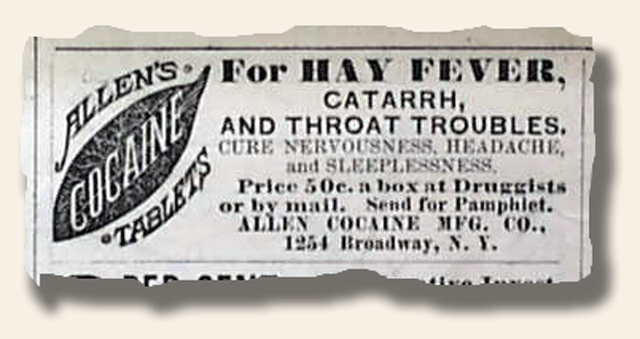
If you liked this post, you may also enjoy...
- Practice makes perfect???
- The prisoner left with them…
- Walmart sells them too…
- Stating the obvious…
- From the publisher of the Harper’s reprints…
The Traveler… Preferred seating…
July 29, 2010 by The Traveler · Leave a Comment Email This Post
| Print This Post
Today’s travel is taking us back 200 years. However, I was not able to find a publication for the exact date of July 29, 1810, therefore, I selected a Columbian Centinel dated July 25, 1810 (the closest I could find). On the second page of the issue I found a header “Unfortunate Ship Margaret” which immediate intrigued me as to why it was unfortunate. This is a lengthy report of the Margaret, which we discover that while on voyage from Naples, had upset and part of the crew were saved on the long-boat while 31 others were left adrift on the ship. The article proceeds to give details of what they endured during the 23 days at sea until they were rescued by a passing ship, it being the fourth ship they had seen (ouch).
 I also enjoy looking at advertisements, especially within 18th and 19th century issues, as they are often quite interesting… and at times, unique. Some also contain woodblock illustrations – and this issue is no exception . However, I found two advertisements that were a bit different. The first was a “Stop a Runaway“, which was a notification of a runaway apprentice boy. The other was quite intriguing as it was “Pews in the First Church — For Sale”, not to take home for use but for use during the worship services! Now — we joke at our church about “my pew” or “their pew”, but this takes preferred seating to a whole new level!! 🙂
~The Traveler
If you liked this post, you may also enjoy...
- A well dressed runaway…
- The first newspaper printed in Hawaii…
- Snapshot 1886… Mark Twain – yet another hidden gem…
- The Traveler… promise to pay…
- The Traveler… a woman “controlling” the way…
The allure of the Old West…
July 26, 2010 by TimHughes · Leave a Comment Email This Post
| Print This Post
While few of us will have the opportunity to visit some of the fascinating old mining towns of the Old West, holding a newspaper from a ghost town’s hey day can be the next best thing. And with a little knowledge about the town, a newspaper from the neighborhood press takes on added appeal and intrigue.
 With this in mind I will, from time to time, offer some background information on the towns from which some of our Old West newspapers came. And I’ll start with an issue with an interesting title, the “Owyhee Avalanche” of Silver City, Idaho.
Silver City is one of the few old mining towns that did not burn down or become commercialized into a modern city. Visiting Silver City is like going back into history. The Idaho Hotel is as it was 100 years ago with a few modern amenities. Rugged and picturesque, the 8,000 feet-high Owyhee Mountains surround Silver City, elevation 6,200 ft. The history-filled town contains about seventy-five structures that date from the 1860’s to the early 1900’s.
During its “heydays”, Silver City had about a dozen streets, seventy-five businesses, three hundred homes, a population of around 2,500, twelve ore-processing mills, and was the Owyhee County seat from 1866 to 1934. Some of the largest stage lines in the West operated in the area, and Silver City had the first telegraph and the first daily newspaper in the territory in 1874.
More that two dozen camps provided shelter, supplies and amusement for the thousands of people who came to the mountains seeking their fortunes in one way or another. The ruins of some of these can still be found though nature is reclaiming most of them at an accelerated rate. Almost a dozen cemeteries and many more remote burial sites attest to the hard and sometimes dangerous and violent lives led by many. Hundreds of mines pock-mark and honeycomb the mountains; one had upwards of seventy miles of tunnels laboriously hand-dug through it. Between 1863 and 1865, more than two hundred and fifty mines were in operation and hundreds more were developed thereafter. At least sixty million dollars worth of precious metals were taken from the area. (credit: historicsilvercityidaho.com)
Click HERE for some photos of present-day Silver City.
If you liked this post, you may also enjoy...
- Mining town of Gunnison, Colorado…
- Collecting the Old West…
- Punning in 1873.
- First newspaper in Idaho…
- “Just a Moment Before”… The Wild West is Romanticized…
Non-compassionate approach to advertising…
July 24, 2010 by TimHughes · Leave a Comment Email This Post
| Print This Post
This ad is from the “Daily Delta” of New Orleans, March 29, 1861. The advertiser chose a hard-line approach to selling his product, claiming one is: “…laying the foundation stone for an early grave by your obstinacy and stupidity.”
If you liked this post, you may also enjoy...
- Desperate spy tactics…
- First newspapers in Louisiana…
- Some back-handed compliments for Abe Lincoln…
- Words of wisdom…
- The July, 2025 Newsletter from Timothy Hughes Rare & Early Newspapers…
Collecting “bookend” newspapers…
July 22, 2010 by TimHughes · Leave a Comment Email This Post
| Print This Post
When writing up an newspaper on the beginning days of the Berlin Wall–when it was nothing more than barbed wire–it came to mind that we also have issues from Germany on the fall of the Berlin Wall. What a nice pair of issues to have together in a collection; the beginning and end of the Berlin Wall.
 This caused me to think of other “beginnings & endings” which would be nice to keep as pairs within a collection. Let me mention a few:
* wars, from proclamations declaring “war” to “peace” reports at their end
* the first and last games of Joe DiMaggio’s 56 game hitting streak
* the first and last games of Cal Ripken’s 2,130 consecutive game streak
* on a more somber note the first election of Abraham Lincoln and his death report, spanning the scope of his national prominence
* the Wright brothers’ first flight and man landing on the moon (actually not and “end”, but certainly a nice “bookend” issue)
* beginning and end of Prohibition
* beginning and end of the Stamp Act
* arrival of delegates to the Constitutional Convention, and the submission of the final Constitution for ratification
* The stock market at its high point on Sept. 3, 1929, and at it’s Depression low point on July 8, 1932
There must be many more. Offer your suggestions to add to the list!
If you liked this post, you may also enjoy...
- Twenty years later: revisiting an international event…
- One of the best we have seen…
- Announcing: Catalog #297 (for August, 2020) is now available…
- Some Legacies Change the World…
- Best of the 20th century?
First newspapers in Missouri…
July 19, 2010 by TimHughes · 3 Comments Email This Post
| Print This Post
 It was in 1808 when the first printing press arrived in what is now the state of Missouri, which was the Territory of Louisiana at the time. That was in St. Louis, which had about 1000 inhabitants at the time. Previous to moving to St. Louis, Joseph Charless, the printer, worked on a newspaper in Lexington, Kentucky in 1803, and then 4 years later was involved in the “Gazette” of Louisville. And it was on July 12, 1808 when Charless printed the first edition of the “Missouri Gazette“, the first newspaper in Missouri. He had 170 subscribers at the time, many of whom paid in flour, corn, beef or pork to the value of the $3 annual subscription. He changed the title to the “Louisiana Gazette” in 1809, but then when Congress created the Missouri Territory in 1812, the paper again became the “Missouri Gazette“.
Not uncommon to early printers, Charless had made many enemies through his newspaper, prompting opponents to head a movement to bring another printer into town. It was in 1815 when Joshua Norvell arrived in town, and in May of that year printed his first issue of the “Western Journal“. He sold it within two years, when the new printer changed the name on May 17, 1817 to the “Western Emigrant“. It again changed hands & title again in another two years, to the “St. Louis Enquirer“.
If you liked this post, you may also enjoy...
- The first newspapers in Iowa…
- First newspapers in Illinois…
- First newspapers in Michigan…
- First newspapers in Ohio…
- First newspapers printed in Oregon…
Just following the doctor’s orders…
July 17, 2010 by TimHughes · Leave a Comment Email This Post
| Print This Post
The following piece appeared in the “Bethlehem Daily Times” issue of November 22, 1869.
If you liked this post, you may also enjoy...
- ‘Twas the Night Before Christmas in 1923…
- Not written by the California Tourism bureau…
- John Wilkes Booth appears at Ford’s Theater, in 1863…
- Lincoln establishes a national Thanksgiving Day…
- Baseball game won by 2 1/2 to 2…
The Traveler… possibilities in Alaska??
July 15, 2010 by The Traveler · Leave a Comment Email This Post
| Print This Post
 While reading through The Christian Science Monitor dated July 15, 1910, I came across a report from Jacob H. Schiff. The report states that he and a party of friends were inspecting part of Alaska and as a result, are convinced it will become as populous and as productive as parts of Norway, Siberia and Russia. He (Jacob) states the greatest need of the far north to be transportation (access) and goes on further to identify the regions he believes would best be served by access by rail (train). At the time, did they really think that this would become possible??
Note (Google exploration): Through a little fun internet searching I discovered that Mr. Schiff was a well known banker and philanthropist with a descendant married to Al Gore’s daughter.
Looking further through the issue, a name of a city quickly caught my eye – Williamsport, PA! It seems that our hometown, the Lumber Capital of the World, was honoring the lumbermen with the hosting of a convention. Very cool!!
The final small article that just made me look twice had a heading of “Japanese Envoy Coming”, followed with the dateline “Honolulu”. Just knowing what occurred only three decades later…
~The Traveler
If you liked this post, you may also enjoy...
- The Traveler… spreading the word… named director…
- This is why collectors love broadsides…
- The Traveler… coffins… do they really have an expiration?
- Collector Historic Newspapers – A discussion with Tim Hughes…
- From Waco to Brooklyn…
Value for an “Ulster County Gazette”…
July 12, 2010 by TimHughes · 31 Comments Email This Post
| Print This Post
 If there is any one newspaper about which we receive the most calls as to value, it would have to be the “Ulster County Gazette” issue of January 4, 1800. This Kingston, New York, newspaper documents the death of George Washington, hence the appeal.
Anyone who has been collecting newspapers for more than a few years has likely encountered at least one of the more than 60 varieties of reprints which have been documented and which exist by the hundreds of thousands. The Library of Congress has an informative sheet which will allow one to distinguish a reprint edition from the original.
As of this date, only two genuine issues have been discovered, now in the hands of the American Antiquarian Society and the Library of Congress. Although the history of the reprints, going back to 1825, is an interesting subject in itself, my thoughts with this blog post are on the value of a genuine issue should a third one surface.
Keeping in mind that historical significance is perhaps the single most important determinant for value, The report of Washington’s death does not rank–in my opinion–on the “top shelf”. The “Ulster County Gazette” issue is a relatively late report with a Jan. 4, 1800 date (he died Dec. 14, 1799), and there is no particular significance to the city in regard to Washington; he wasn’t born there, didn’t die there, perhaps never even visited there (although during the Revolutionary War he was in that vicinity). The Declaration of Independence & Constitution rank high on the “top shelf”, and these documents in Philadelphia newspapers would be premier issues for such reports commanding values well above $100,000 each. As such, the “Ulster County Gazette” issue is famous for being a reprint and not much more.
So, the question is, should a third genuine issue surface, how much should it be worth? Yes, it is a rare newspaper as only two are known to exist, but I’m sure there are other small town newspapers from the era which are equally as rare. In our catalog 177 we will be offering a Providence, R.I. issue of January 1 for less than $2000, it being a first report also with front page mention and much inside page text regarding Washington’s death. But six institutions have this issue with perhaps a few more in private hands. I think some collectors believe the U.C.G. would be worth $100,000 or more, but I would disagree. Yes, it is “famous” as a reprint, and finding a 3rd issue would be neat, but how does this affect value? It’s a late report of Washington’s death in a small town, upstate New York newspaper which has no significance to the life of Washington. Perhaps add some premium for the notoriety of the issue, but I’m not sure I’d want to pay more than $3000 or $4000 for the issue. Step beyond the small circle of serious newspaper collectors and attempts to legitimize a hefty value would fall on deaf ears. Better reports, closer to Virginia, with earlier dates can be purchased for less.
So what are your thoughts? Feel free to share.
If you liked this post, you may also enjoy...