

Search
The Rare & Early Newspapers Hobby

Receive the Newsletter

Buy Historic Newspapers

The Slow Death of a President… The Doctor Whose Name Became a Punchline…
September 21, 2026 by Laura Heilenman  Email This Post
|
Email This Post
|  Print This Post
On July 2, 1881, President James A. Garfield was shot twice at a Washington, D.C. train station by Charles Guiteau. One bullet grazed his arm; the other lodged in his back. Neither wound was immediately fatal, and the president would linger for 80 agonizing days. Ultimately, what killed him was not the assassin’s marksmanship, but the “care” that followed.
The man who seized control of the case was Dr. Doctor Willard Bliss (whose first name was act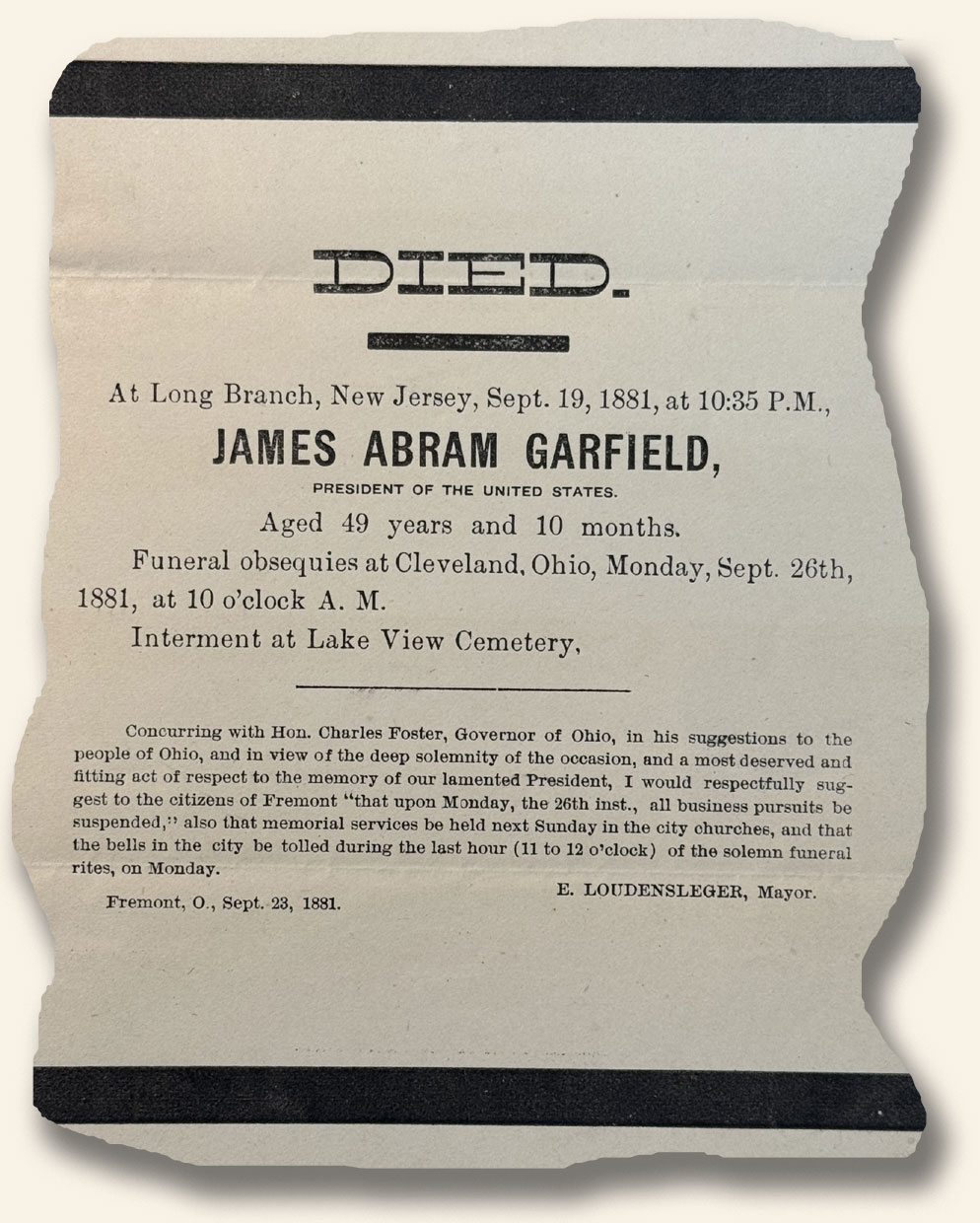 ually “Doctor”). Summoned to the scene, Bliss immediately took charge, sidelined other physicians, and restricted access to the president. He was convinced the bullet sat on the right side of Garfield’s body near the liver. It did not. A post-mortem examination revealed it lodged safely on the left side, embedded near the pancreas without harming any vital organs. Bliss, however, never accepted he was wrong.
Worse than his misdiagnosis was his method of treatment. Though Joseph Lister’s antiseptic techniques were gaining traction in Europe and among progressive American physicians, Bliss effectively rejected them. He repeatedly probed Garfield’s wound with unwashed fingers and unsterilized instruments, transforming a minor entry wound into a massive, pus-filled infection channel. He subjected the president to painful examinations without anesthesia, fed him rectally with concoctions of beef bouillon and egg yolks, and heavy-dosed him with quinine and morphine. Garfield lost nearly 100 pounds as his body broke out in systemic abscesses. On September 19, he succumbed to sepsis and a ruptured splenic artery.
At his trial, Guiteau famously—and with grim accuracy—claimed: “I deny the killing, if your Honor please. We admit the shooting.” He argued that while he had merely shot the president, the doctors had killed him. The public record increasingly backed that assertion.
Critics fiercely condemned Bliss’s arrogance and stubborn refusal to adopt modern medicine. A popular 19th-century jab soon circulated with particular sting: “Ignorance is Bliss.”
The phrase itself was far older, coined by English poet Thomas Gray in 1742 (“Where ignorance is bliss, ’tis folly to be wise”). But after Garfield’s death, the old line took on a bitter new life. Bliss’s name and vanity turned a classic poetic observation into a sharp medical epitaph. The pun stuck in popular retellings, granting an 18th-century idiom an extra layer of tragic dark humor no poet ever intended.
Garfield’s wound was easily survivable by modern standards—and likely survivable even by the best medical practices of 1881. Instead, he received confident ignorance dressed as expertise.
If you liked this post, you may also enjoy...
- Second time killed was the charm…
- They put it in print… when ghost stories were mainstream…
- The Gentleman’s Magazine & Poetry… Still learning…
- The Traveler… deaths of General Pike and Major Stoddard… recruiting…
- Medical marijuana! How about a prescription for beer?
Comments
Feel free to leave a comment...
and oh, if you want a pic to show with your comment, go get a gravatar!