

Search
The Rare & Early Newspapers Hobby

Receive the Newsletter

Buy Historic Newspapers

Who’s Who in Newspapers – John Wanamaker edition
November 10, 2025 by GuyHeilenman · 1 Comment  Email This Post
|
Email This Post
|  Print This Post
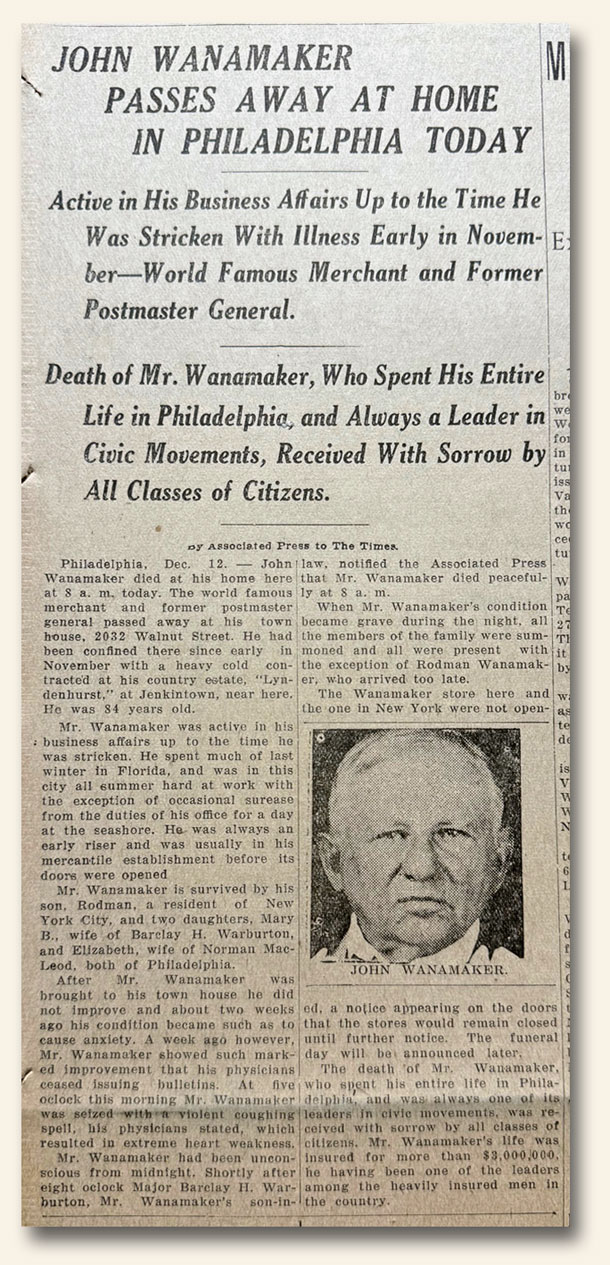
Typically, our “Who’s Who in Newspapers” series highlights individuals who were unfamiliar to me before I delved into the world of Rare & Early Newspapers. Today’s post is a departure from that norm. While reviewing the December 12, 1922, issue of The Bethlehem Times, I came across a front-page report of John Wanamaker’s passing. The article stirred a flood of childhood memories tied to this remarkable man whose legacy left a lasting impression on me. Eager to share his story, I hope the following introduction sheds light on his extraordinary contributions.
John Wanamaker: The Merchant Who Made Shopping an Experience
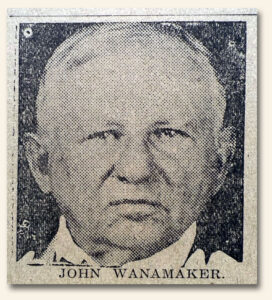 From personal memories to retail innovation, Wanamaker’s left a legacy that reshaped both commerce and tradition. Every December starting in the mid-1950s, my parents bundled up my siblings and me for a trip into Philadelphia to see the Christmas light and music show at Wanamaker’s (currently being converted into a mixed-use facility). To us, it was pure magic — thousands of twinkling lights, the sound of the great pipe organ, and crowds of families gathered in awe. With my grandmother working in the store during those years, Wanamaker’s always felt like more than a department store — it felt like part of our family’s story.
That sense of wonder was no accident. John Wanamaker (1838–1922), the man behind the store, believed shopping could be more than a transaction — it could be an experience. When he opened his Philadelphia department store in 1876, it quickly became a model for modern retail. Wanamaker pioneered the one-price system (no haggling), introduced the money-back guarantee, and used newspaper advertising on a scale few had seen before.
He also reshaped how Americans paid for what they bought. Realizing that many working families couldn’t afford to pay cash for larger purchases, Wanamaker offered installment plans and charge accounts. This bold move laid the foundation for consumer credit, opening the door for more households to access quality goods.
Beyond retail, Wanamaker served as U.S. Postmaster General under President Benjamin Harrison, introducing commemorative stamps and expanding rural mail delivery. Yet it was his Philadelphia store — both marketplace and civic landmark — that became his greatest legacy.
Even today, the memory of standing with my siblings beneath the glow of the light show while the Wanamaker organ thundered through the Grand Court remains a vivid reminder of how one man’s vision reshaped not just shopping, but tradition itself.
Wanamaker’s Firsts – Innovations that reshaped retail
- One-Price System – Ended the practice of haggling; everyone paid the same fair price.
- Money-Back Guarantee – Built customer trust and loyalty.
- Large-Scale Advertising – One of the first to use newspapers to reach wide audiences.
- Department Store Experience – Turned shopping into a cultural outing with art, music, and public events.
- Consumer Credit – Introduced installment plans and charge accounts, paving the way for modern credit.
If you liked this post, you may also enjoy...
- Snapshot 1922… John who?
- The Birth of a Holiday… Mother’s Day Becomes Official!
- My Collecting Story… Richard Sloan…
- MyAuctionFinds’ Interview of Tim…
- Some Legacies Change the World…
Lead-up to a Nation… as reported in the newspapers of the day (October, 1775)…
November 6, 2025 by GuyHeilenman · Leave a Comment Email This Post
| Print This Post
England Misses the Temper of the Times (Lead-up to a Nation – E9)
George Washington – Religious Freedom (Lead-up to a Nation – E10)
Ethan Allen and his Green Mountain Boys (Lead-up to a Nation – E11)
The Liberty Tree (Lead-up to a Nation – E12)
George Washington – Integrity, Leadership & Humility (Lead-up to a Nation – E13)
We hope you are enjoying this year-long trek to the 250th anniversary of The United States through the eyes of those who were fully engaged, first hand. As mentioned previously, all accounts are rooted in what they read in the newspapers of the day.
“History is never more fascinating than when read from the day it was first reported.” (Timothy Hughes, 1975)
If you liked this post, you may also enjoy...
- Lead-up to a Nation… as reported in the newspapers of the day (Intro & Sept., 1775)…
- Lead-up to a Nation… as reported in the newspapers of the day (January, 1776)…
- Lead-up to a Nation… as reported in the newspapers of the day (reflecting back on March, 1776)…
- Lead-up to a Nation… as reported in the newspapers of the day (November, 1775)…
- Lead-up to a Nation… as reported in the newspapers of the day (February, 1776)…
The reason I collected it: the Nuremberg trials…
November 3, 2025 by TimHughes · Leave a Comment Email This Post
| Print This Post
I have likely stated several times that part of the quest in seeking the best report of a notable event is to find it in a newspaper as close to where it happened as possible. For the death of JFK, a Dallas newspaper is best. On the bombing of Pearl Harbor, a Honolulu newspaper is great. On the Boston Massacre in 1770, a Boston paper would be wonderful.
Some events can be extremely difficult, so you do the best you can. How about when man walked on the moon? Outside of a lunar publication that did not exist, a newspaper from Neil Armstrong’s hometown is pretty good. Or perhaps one from close to Cape Canaveral.
One of the more notable events at the conclusion of World War II was the Nuremberg Trials. There were 22 defendants held for war crimes; 12 would hang, 7 served time, and 3 found not guilty.
But finding a German newspaper with this report had eluded us. And as is the case with events in foreign language countries, a report close to the event would be diminished a bit if the text is in a language other than English. Not many desire a newspaper they cannot read.
But as luck would have it, a Nuremberg suburb–Furth–had a former Nazi air base, captured by American forces in early April, 1945 & converted to a U.S. air base. And better yet, it produced a small, obviously low-circulation newspaper called “The Jet Gazette”. The October 1, 1946 issue was devoted to the results of the trials. And being an American air base, it’s in English. It was a great find that I suspected never existed!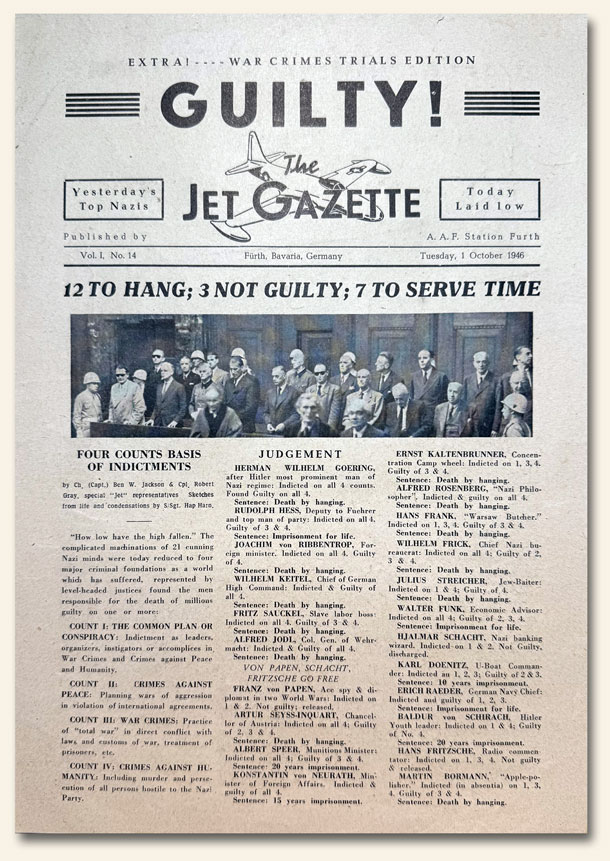
If you liked this post, you may also enjoy...
- Great Headlines Speak for Themselves… The Nuremberg Trials…
- The reason I collected it: a movement that went nowhere…
- This Month in History – October…
- First newspapers in Hawaii…
- Top ten: 16th and 17th centuries…
Announcing: Catalog #360 for November, 2025 – Rare & Early Newspapers…
October 31, 2025 by GuyHeilenman · Leave a Comment Email This Post
| Print This Post
|
 Catalog #360 (for November)
|
If you liked this post, you may also enjoy...
- Announcing: Catalog #358 for September, 2025 – Rare & Early Newspapers…
- Announcing: Catalog #357 for August, 2025 – Rare & Early Newspapers…
- Announcing: Catalog #361 for December, 2025 – Rare & Early Newspapers…
- Announcing: Catalog #359 for October, 2025 – Rare & Early Newspapers…
- Announcing: Catalog #348 for November, 2024 – Rare & Early Newspapers…
They Put It In Print – A U.S. President Seeks Permission…
October 27, 2025 by GuyHeilenman · Leave a Comment Email This Post
| Print This Post
In the U.S., only Congress can declare war. So how many wars have Americans actually fought since World War II? You might think of the Korean War, Vietnam, Kuwait, Iraq, or Afghanistan. But here’s the catch: the answer is technically zero.
How can that be? Modern presidents simply avoid the word “war,” using terms like “military engagement” or “conflict” instead. No official declaration, no congressional vote—problem solved.
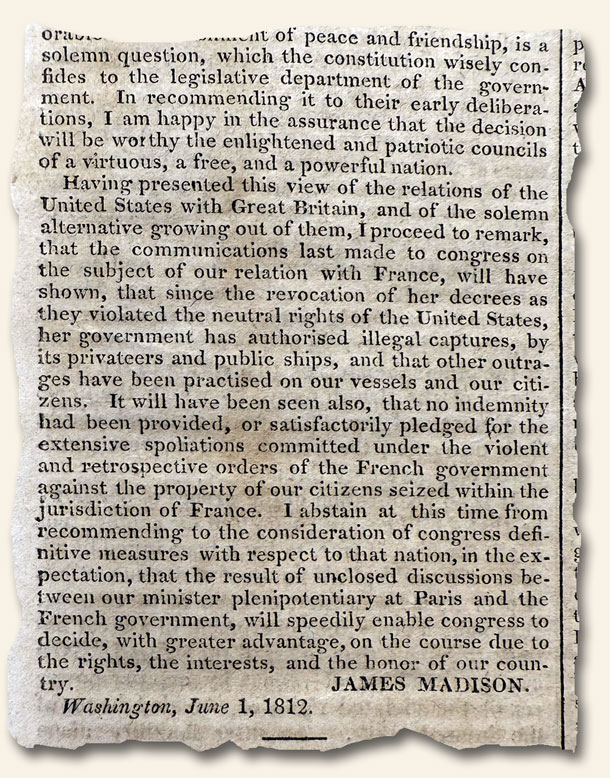
It wasn’t always this way. Take the War of 1812: President James Madison believed the U.S. needed to go to war with Great Britain. Did he send troops under a euphemism like “military operation”? No. He went straight to Congress with a detailed manifesto explaining why war was necessary. That document, printed in The War on June 27, 1812, shows just how seriously Madison took the Constitution’s war powers. The introduction and conclusion of his lengthy plea are shown below.
Today, renaming wars might serve convenience or strategy, but it raises a bigger question: if we can call war by any name we like, what happens to the checks and balances the Constitution set in place?
Do you think this trend is a necessary evolution—or a dangerous bypass of Congress?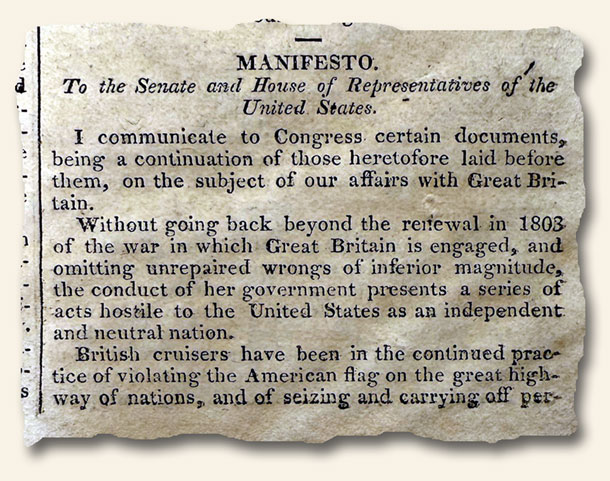
If you liked this post, you may also enjoy...
- George Washingon speaks out…
- A Fly on the Wall at the Constitutional Convention of 1787…
- When did the “Gentleman’s Magazine” print the Declaration of Independence?
- The Traveler… war declared…
- How does your state’s Constitution compare?
From the Vault: Headlines drive interest in World War II…
October 24, 2025 by TimHughes · Leave a Comment Email This Post
| Print This Post
For likely a multitude of reasons, interest in World War II newspapers ranks far higher than in the Korean War, World War I, or the Spanish-American War. It may be a generational thing, as most collectors today are children of World War II veterans and likely heard stories of the war first-hand, or found  newspapers in their parents attics which sparked an interest. One could debate a number of other possible reasons why other wars lack the intrigue found in that fought by the “greatest generation”.
Headline collecting has always been a focus for this hobby, and as any collector knows, bold, banner headlines did not become commonplace until late in the 19th century. With the increasing competitiveness of daily newspapers across the country–Hearst, Pulitzer & others rising to prominence–flashier front pages were needed to draw attention at the corner news stand. It’s a shame there is not more interest in the Spanish-American War and World War I as both events resulted in some huge, dramatic, & very displayable headlines.
Because there are a plethora of newspapers from the WWII era available, collectors have become very discriminating in what they collect. Only the “best of the best” will do, meaning just the major events and only those with huge and displayable headlines. If there is a “top 6” list of sought-after events, our experience is they would be: 1) attack on Pearl Harbor; 2) the D-Day invasion; 3) death of Hitler; 4) end of the war in Europe; 5) dropping of the atomic bomb; 6) end of the war in the Pacific. One could add any number of other battle reports such as Midway, battle of the Bulge, fall of Italy, Iwo Jima, battle for Berlin, and so much more. And we could step back before American involvement in the war and add Hitler’s invasion of Poland and the battle of Britain.
The bigger the headline the better. With some newspapers the entire front page was taken up with a headline and a related graphic. The U.S. flag was a common patriotic device. Tabloid-size newspapers commonly had the front page entirely taken up with a singular headline and tend to be better for display given their smaller size.
 And not just American newspapers draw interest. German newspapers hold a special intrigue, but the language barrier is a problem for many. But the British Channel Islands, located in the English Channel between England & France, were occupied by the Nazi during the war so their reports were very pro-Nazi while printed in the English language (ex., Guernsey Island). And the military newspaper “Stars and Stripes“, while certainly being American, was published at various locations in Europe and the Pacific. Collectors have a special interest in finding World War II events in the official newspapers of the American military forces. Plus there were a multitude of “camp” newspapers, amateur-looking newspapers printed on a mimeograph machine for consumption limited to a military base, and typically printed is very small quantities. Their rarity is not truly appreciated by many.
For obvious reasons, there is also a high degree of collectible interest from those wishing to make sure certain aspects of history are not forgotten. The Holocaust, and the Nazi propaganda used to provide a rationale for eliminating the Jewish people, is well documented in newspapers from the era. In addition to the Holocaust and its atrocities, issues providing context through reporting other pre-war events such as the Great Depression, fascism, and increased militarism, are also desirable.
True to any collectable field, newspaper collectors are always on the lookout for an issue better than what they have, and collection upgrades are constant. Finding that special, rare, unusual or fascinating headline is what makes the hobby fun. Will interest in the Korean War and the Vietnam War gain more interest in future years? Perhaps so. With interest currently low and availability and prices very attractive, it might be a good time to explore.
If you liked this post, you may also enjoy...
- Headlines drive interest in World War II…
- WW2 Era Newspapers Found In The Attic… Are They Worth Anything?
- From the Vault: Best of the 20th century?
- News worthy of the headline… Which would you choose?
- The Titanic… and newspapers…
Headlines That Never Happened: Germany’s Loss and Its Lasting Echoes…
October 20, 2025 by GuyHeilenman · Leave a Comment Email This Post
| Print This Post
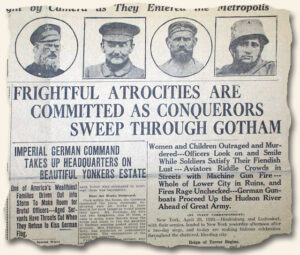
In April of 1918, a newspaper playfully speculated on what the headlines might have looked like if Germany had won World War I. A century later, we know the opposite outcome set in motion consequences far greater than most could have imagined. Germany’s defeat, and the way the Allies handled it, reshaped not just Europe but the modern world.
 The Ripple Effects of Germany’s World War I Defeat
The Treaty of Versailles (1919) imposed heavy reparations, territorial losses, and strict military limits on Germany. Instead of securing peace, these terms humiliated the nation and destabilized its young democracy. The resentment they bred became fertile ground for Adolf Hitler and the Nazi Party, leading to World War II and the Holocaust.
Europe’s New Order
Britain and France emerged victorious but weakened, while the United States stepped into global leadership. Versailles became a cautionary tale: punish a nation too harshly, and you may guarantee the next war. After World War II, the Allies took the opposite approach—rebuilding Germany through the Marshall Plan and anchoring it in NATO and the European Union. Today, Germany’s central role in both reflects that strategy.
Jews and the Holocaust
Germany’s turmoil fueled dangerous scapegoating. Conspiracy theories like the “stab-in-the-back” myth cast Jews as traitors, intensifying antisemitism that Nazi propaganda later weaponized. The Holocaust destroyed European Jewry and gave new urgency to the Zionist movement, leading to the founding of Israel in 1948.
Redrawing the Middle East
The collapse of Germany’s ally, the Ottoman Empire, allowed Britain and France to carve up the Middle East. Mandates in Iraq, Syria, and Palestine ignored ethnic and religious realities. Britain’s contradictory promises to Jews and Arabs in Palestine set the stage for the enduring Israeli-Palestinian conflict.
Lasting Echoes
The “war to end all wars” did not end conflict—it reshaped it. From NATO and the EU to Israel’s creation and Middle Eastern instability, the ripple effects of Germany’s defeat still define our world.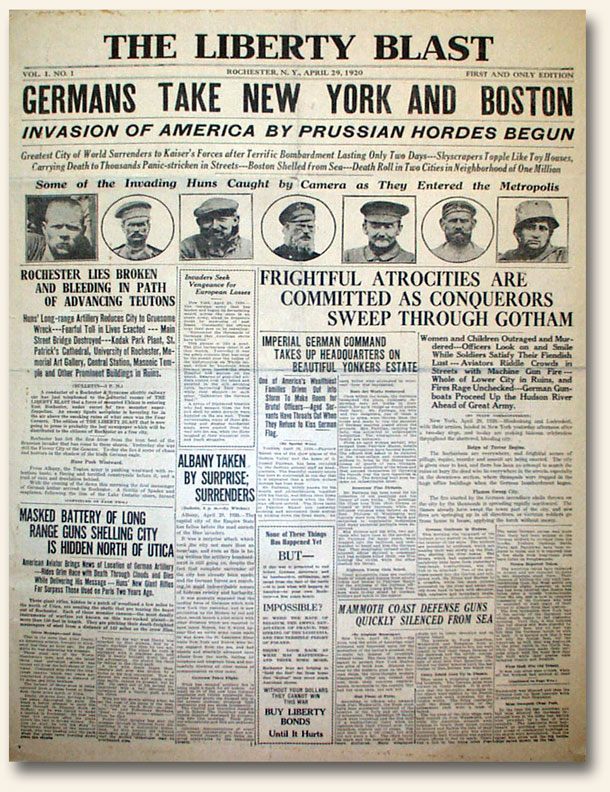
While the two photos above show The Liberty Blast with a dateline of April 29, 1920, this newspaper with “fictious reporting” was actually printed on April 20, 1918 “in the hope that in some small way it may serve to awaken in the hearts & minds of those who read it a realization of those horrors of a great world war, so far from and yet to near to American shores, American life, and American people…”.
If you liked this post, you may also enjoy...
- The Traveler… the beginning of war…
- What if Germany won World War I ?
- As we close the door on 2020…
- They put it in print… Nazi generals attempt an escape to Japan…
- Headlines drive interest in World War II…
October Newsletter (2025) – Timothy Hughes Rare & Early Newspapers…
October 17, 2025 by GuyHeilenman · Leave a Comment Email This Post
| Print This Post
|
|
If you liked this post, you may also enjoy...
- The October (2024) Newsletter from Timothy Hughes Rare & Early Newspapers…
- October newsletter from Timothy Hughes Rare & Early Newspapers…
- Announcing: Catalog #347 for October, 2024 – Rare & Early Newspapers…
- October Newsletter from Timothy Hughes Rare & Early Newspapers…
- Announcing: Catalog #335 for October, 2023 – Rare & Early Newspapers…
The reason I collected it: a single-focus newspaper…
October 13, 2025 by TimHughes · 1 Comment Email This Post
| Print This Post
The general rule for a newspaper of any era is to report the news of the day on a regular basis, typically daily or weekly. Some have a thematic focus whether it be the slavery issue, the military, masonic events, etc., but even such newspapers maintained a history of publishing on a regular basis.
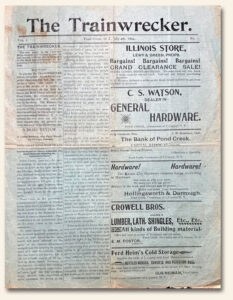 I don’t believe we have previously discovered a newspaper that had a singular focus on a specific event until we acquired “The Trainwrecker” from Pond Creek, Oklahoma Territory, 1894. This is not just a rare title; this could be a unique issue being the volume 1, number 1 issue of a newspaper about which nothing can be found. It is not listed in Gregory’s “Union List of Newspapers”, nor have we found anything on the internet.
Its purpose is noted on the front page, and it seems to have a singular focus: the dispute the Pond Creek area had with the Rock Island Railroad.
As a bit of background, I might encourage a visit to “Hell on Rails: Oklahoma Towns at War with the Rock Island Railroad“, which details the backdrop for why this newspaper was created. It is rather convoluted and relates much to how the Indian Territory, now Oklahoma, was settled and how the railroads were a factor in town settlements.
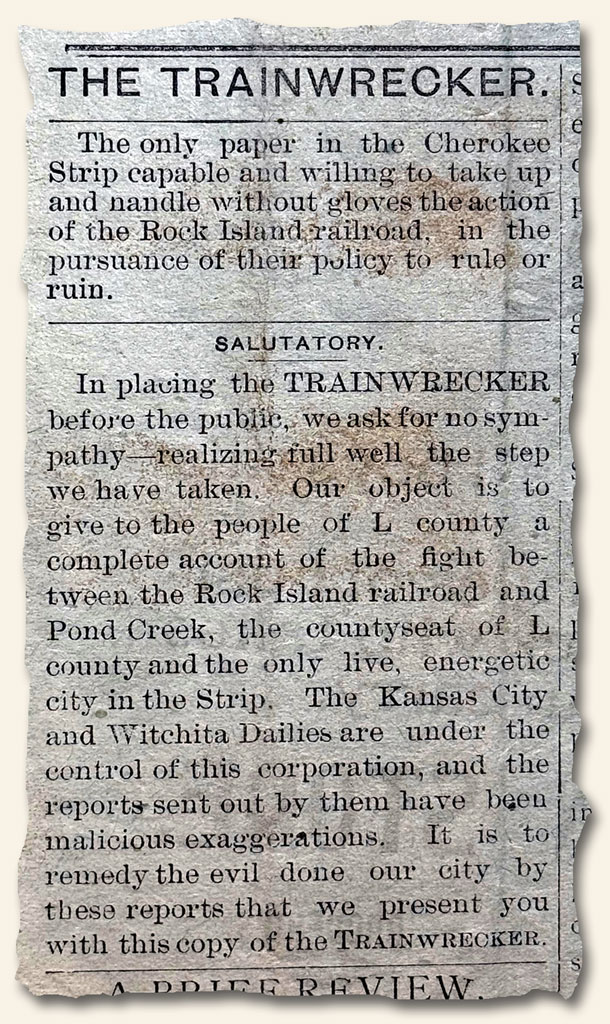
The issue begins with: “The only paper in the Cherokee Strip capable and willing to take up and handle without gloves the action of the Rock Island Railroad, in the pursuance of their policy to rule or ruin.”
Then the “Salutary” begins: “In placing the TRAINWRECKER before the public, we ask for no sympathy–realizing full well the step we have taken. Our object is to give to the people of L county a complete account of the fight between the Rock Island railroad and Pond Creek, the county seat of L county and the only live, energetic city in the Strip…” with much more not just on the front page but on inside pages as well.
It is possible this newspaper existed for just this one issue, but without documenting records we cannot confirm. Printed as it is on green paper, it certainly doesn’t seem as though the publisher planned for a lengthy run.
This is part of the fascination with rare titles, as their scarcity simply implies a lack of information. Although we have encountered other newspapers that failed to exist beyond just a few issues, this is the first that seems to have existed to exploit a singular concern.
Personal note from Guy: “If historical fiction is within your wheelhouse of interests, I found ‘The Assassin’ and ‘The Wrecker’, both by Clive Cussler, fun reads. The former focuses more on the O.T. region (with a mention of some of the locations indicated above), while the latter zeros in on the sabotaging of trains during this era.”
If you liked this post, you may also enjoy...
- Historic printing press returns home…
- The reason I collected it: The Semi-Weekly Argus from Washington Territory…
- First newspapers in Oklahoma…
- The first newspaper in Alabama…
- The reason I collected it: an “association piece” attached…
Who’s Who in Newspapers? Citizen Genêt edition…
October 10, 2025 by GuyHeilenman · 1 Comment Email This Post
| Print This Post
The 10th installment of Who’s Who in Newspapers
Citizen who? While exploring newspapers from the 18th and early 19th centuries over the past few decades, I noticed the name “Citizen Genet” appearing more than once—always tied to some sort of “affair.” As a novice historian at the time (my academic background is actually in mathematics and engineering), and given my aversion to sensationalized “yellow journalism,” I let it pass. With tens of thousands of fascinating topics to explore through our beloved collectible, I never stopped to uncover who he really was or what his “affair” involved.
 Recently, however, I embraced the old adage that “it’s never too late to learn” and finally took the plunge. What I found was a story worth the effort, one that offered both historical insight and a better appreciation for the newspapers that recorded it. A summary of my discovery is as follows:
Edmond-Charles “Citizen” Genet was a French diplomat sent to the United States in 1793 to gain American support for France’s wars with Britain and other European powers. Instead of observing diplomatic protocol, he jumped right into recruiting privateers to attack British ships and encouraging Americans to take up arms against Spain. These moves directly violated President George Washington’s Neutrality Proclamation of 1793. To make matters worse, Genet bypassed Washington altogether and appealed directly to the American public, an act that came across as both disrespectful and threatening to U.S. sovereignty.
The uproar that followed—known as the “Citizen Genet Affair”—quickly became a defining moment in America’s early history. Washington demanded Genet’s recall, reinforcing both the president’s authority in foreign affairs and the new nation’s commitment to neutrality. At home, the controversy deepened political divisions: Federalists supported Washington’s cautious stance, while Democratic-Republicans sympathized with revolutionary France. In the end, Genet was granted asylum in the United States and lived out his life in New York, but his story left behind a lasting lesson in diplomacy and America’s determination to remain independent from foreign influence.
So much for jumping to conclusions regarding his “affair”. I should have known better.
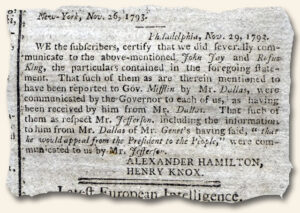
The photos shown are from two articles within the Columbian Centinel, Dec. 11, 1793. – the above in full, and the below of only an excerpt due to the length of the article. If original newspapers on this topic remain available, they would be found at: CITIZEN GENET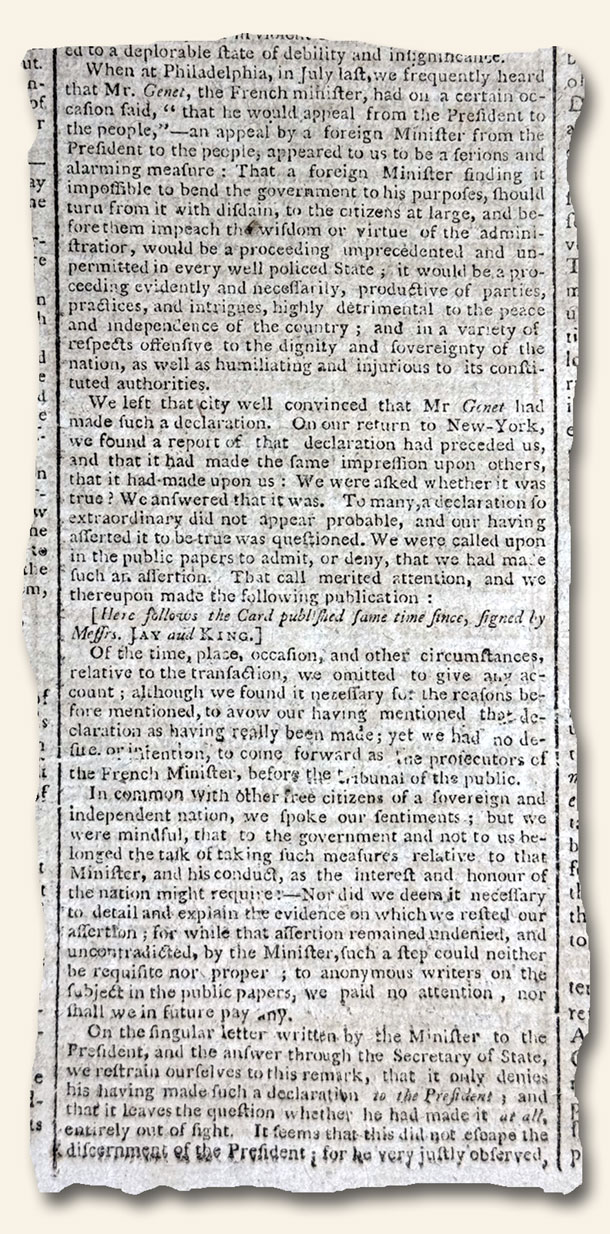
If you liked this post, you may also enjoy...
- The Traveler… the President takes office, again…
- Most Important Election Ever… Washington Takes the Reins…
- Properly Directed Thankfulness – George Washington and the Foundations of a New Nation…
- Thomas Jefferson helps to codify George Washington’s footsteps…
- Lead-up to a Nation… as reported in the newspapers of the day (October, 1775)…