

Search
The Rare & Early Newspapers Hobby

Receive the Newsletter

Buy Historic Newspapers

The Traveler… “Who’s the leader of the club…?”
December 19, 2016 by The Traveler · 2 Comments
 Today’s journey took me to New York City by the way of The New York Times dated December 16, 1966. There on the front page I found the headline “Walt Disney, 65, Dies on Coast; Founded an Empire on a Mouse.” “Walt Disney, who built his whimsical cartoon world of Mickey Mouse, Donald Duck and Snow White and the Seven Dwarfs into a $100-million-a-year entertainment empire; died in St. Joseph’s Hospital here this morning. He was 65 years old… Just before his last illness, Mr. Disney was supervising the construction of a new Disneyland in Florida…”
Oddly enough, Mr. Disney did not do any of the drawings of his famous Mickey Mouse.
~The Traveler
A December, 2016 stroll back thru time – 50, 100, 150, 200, & 250 years ago…
December 8, 2016 by GuyHeilenman · Leave a Comment
 the daily and weekly newspapers of the period can be quite revealing. This is why we often say, “History is never more fascinating than when it’s read from the day it was first reported.” The following links will take you back in time to show the available newspapers from the Rare & Early newspapers website. There’s no need to buy a thing. Simply enjoy the stroll.
The Traveler… “…I could see no promise in him…”
December 5, 2016 by The Traveler · Leave a Comment
Today I traveled to New York City by the means of Harper’s New Monthly Magazine dated December, 1866. I found the first appearance of Mark Twain in a national magazine with the publishing of “Forty-Three Days in an Open Boat. Compiled From Personal Diaries.”
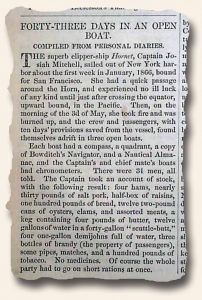 I also found through the Harper’s Monthly website the following information. “Mark Twain’s first article in Harper’s was miss-attributed to Mark Swain. The story, “Forty-three Days in an Open Boat” (December 1866), is an account of the Hornet, a clipper ship that caught fire in the ocean, leaving its crew adrift. Twain referred to it as the “first magazine article I ever published,” though he had published numerous pieces in other periodicals and newspapers under such names as Thomas Jefferson Snodgrass; W. Epaminondas Adrastus Blab; Rambler; Grumbler; and Peter Pencilcase’s Son, John Snooks.
Mark Twain was born thirty-one years earlier, and two months premature, as Samuel Langhorne Clemens, in Florida, Missouri. “When I first saw him I could see no promise in him,” his mother said. The Clemenses moved several miles upstate, to the Missouri River-side Hannibal, when he was four; the town would later inspire the fictional St. Petersburg of his two most famous works, The Adventures of Tom Sawyer (1876) and The Adventures of Huckleberry Finn (1885)…”.
Twain didn’t turn out too bad after-all!
~The Traveler
The Traveler… tired of pirating… checking out early?…
November 21, 2016 by The Traveler · Leave a Comment
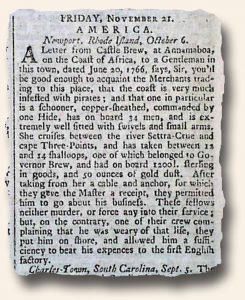 I traveled to London by The London Chronicle of November 22, 1766 where if found that not all Pirates are bad. An article with the dateline “Newport, Rhode Island, October 6” which is from “a letter from Castle Brew, at Annamaboa, on the Coast of Africa…”. It talks about the pirate infested areas along the coastline, but in particular the one ship “commanded by one Hide”. “…These fellows neither murder, or force any into their service; but, on the contrary, one of their crew complaining that he was weary of that life, they put him on shore, and allowed him a sufficiency to bear his expences to the first English factory.”
There is also an interesting article from Paris… “Within a month or six weeks past, several persons in this city, tired of life, have sought the means to deprive themselves of it. Some of them have done it by pistols; but a Baker who in cool blood leaped from the top of Pont-Royal… and was only slightly wounded:… however it was imitated a few days ago by a young man,… threw himself out of a window of the third story into the garden of the royal palace; whereby all his limbs were either broken, or dislocated; and when they raised him up, he only said that it was very unhappy for him that the houses of Paris were so low…”.
~The Traveler
Oddball collecting ideas – advice columns through time…
November 17, 2016 by GuyHeilenman · 3 Comments
One of the beauties of the Rare Newspapers hobby is the infinite possibilities old newspapers provide for collecting. Triumphs and tragedies, inventors and inventions, outlaws and gangsters, incredible feats and devastating failures, historic headlines and under-the-radar events – the reasons for collecting are almost endless.
A new idea (to me)…
Recently, as I was searching for historic content related to Thanksgiving, I was struck by the abundance of advice columns and wondered if the questions and corresponding advice had stood the test of time. This motivated me to grab a handful of issues from 50 years ago to randomly select a few to include within this post (see below). If I had more time and energy, the thought of amassing a collection of such columns through time and providing a bit of hind-sight analysis might make for an interesting coffee-table book – or perhaps a blog. Regardless, how’d she do? Does her advice still hold water? Are the questions still pertinent to those living today? I personally give her a 2 1/2 out of 3. Enjoy.


America – pulling a nation back together…
November 14, 2016 by GuyHeilenman · Leave a Comment
 My Fellow Americans: Devastating hurricanes, Pearl Harbor, 9-11, the end of WWII, Lindbergh’s 1st flight across the Atlantic – while there is much that divides us, there have been times throughout our history when both triumphs and tragedies have inspired us to lay down our weapons and to unite as one. While these times of mutual good will are typically short-lived, they often act as a reset to help center us on that which binds us together. We need such a time!
It is was with the current atmosphere of angst as a backdrop that I was moved by an under-the-radar prayer found buried on page 11 of an issue reporting the assassination of President JFK. His death, airmailed via television directly into the living room of nearly every home in America, brought together Republicans, Democrats, and Independents alike and unified us around shared grief. May a day come when such unity of spirit flourishes without the inspiration of deep sorrow, tragedy, or war. As another assassinated President once said: “A house divided against itself cannot stand (Abraham Lincoln).” It is time for us to lay down our weapons. Much is at stake.
The tension revealed between Halloween and All Saint’s Eve…
October 28, 2016 by GuyHeilenman · Leave a Comment
Who decides what is right and what is wrong – what is evil and what is good? Is it man – and therefore a moving target based upon a majority view, or is it static – absolute, established by a Supreme Being who calls the shots? Is truth relative, or fixed? This philosophical question has been debated since the dawn of time. If the answer is “man”, then we had better get “it” right, or the consequences to the human race could be catastrophic. If the answer is a Supreme Being, then  the debate is meaningless – regardless of who comes out on top.
Whereas most historic newspapers printed in Europe and the United States have shown to be rooted in a Judaeo-Christian ethic which promotes the latter view, one 19th-century Chicago title stands out as having embraced the former – elevating itself to a position of being a bearer of self-determined truth. There is no doubt the identification with another bearing this name is no accident. Read for yourself what it says about itself, and make your own decision as to the truthfulness of its claims:
Of course if the latter answer (Supreme Being) is correct, your (and my) opinion as to whether its claims are true will have no bearing on the truth. 🙂
Where did it end up? Boston
October 20, 2016 by GuyHeilenman · Leave a Comment
 As both collectors and sellers of historic newspapers, we (Rare Newspapers) often wonder what happens with many of the issues which pass through our hands. We know some have been given to Presidents, well-known authors, and various public figures throughout the world. Equally rewarding are those which end up in the hands of those whom either love history or have a personal connection with the issue’s content. Many are found in museums for all to see, yet others a likely stored away in boxes for protection and many never again see the light of day. Regardless of their final resting place, we derive a certain degree of satisfaction in knowing we play a part in preserving history in written form. With these thoughts as a backdrop…
We recently became aware of how one issue has been put to use (see image). Feel free to explore:
BOSTON SEMI-WEEKLY ADVERTISER, Sept. 20, 1856
The Traveler… giving thanks… not on the Sabbath…
October 17, 2016 by The Traveler · Leave a Comment
 I traveled to Boston today by the way of the Independent Chronicle dated October 14, 1816. I found “By His Excellency John Brooks, Governor of the Commonwealth of Massachusetts, A Proclamation, for a day of Public Thanksgiving and Prayer.” had been proclaimed. This was to be held on the Thursday, November 28.
Also found was an article entitled “Sabbath Laws” in which Judge Putnam “…repealed all former provisions upon the subject whether by statue or common law; that no act of labour, therefore, upon that day are lawful, except in cases of necessity or charity; and that prosecutions upon the statute are not within the exception…”. Too bad we cannot go back to those days…
~The Traveler
Final editions of newspaper publications…
October 14, 2016 by GuyHeilenman · 2 Comments
We are frequently asked to appraise final editions of newspaper titles which have gone defunct. Sadly, much like the specific publications themselves, collectors rarely find these final editions to be  attractive. Some might suggest the lack of interest in current newspapers (in general) might have a negative impact on the hobby of collecting historic newspapers, but our experience has shown no such correlation. Alternately, the decline in readership of current titles and the corresponding abundance of newspaper publications going out of business seems to be directly proportional to the ease and speed for which information can be had at a minimal (if any) cost. In most instances, by the time a newspaper hits a subscriber’s doorstep, much of the news is already outdated. One journalist of such a “final edition” had their own thoughts on the matter, and interestingly enough, whether you agree or disagree with his bitter-pill-tainted analysis, some of the social issues mentioned seem as appropriate for today as they did when the article was written in 1978. The article may be read in full at: Chicago Daily News, March 4, 1978 (see images 4-10).