
Search
The Rare & Early Newspapers Hobby

Receive the Newsletter

Buy Historic Newspapers

Who’s Who in Newspapers? George Ray Tweed edition (1944)…
August 10, 2026 by GuyHeilenman · 1 Comment
If you’re a World War II history enthusiast, you might recognize the name George Ray Tweed — a U.S. Navy radioman known to the world as the “Ghost of Guam.” Yet few realize the sheer grit, luck, and quiet resistance required to pull off one of the most remarkable survival stories in American military history.
When Japanese forces invaded Guam in December 1941, Tweed refused to surrender alongside his comrades. Instead, he slipped into the island’s rugged jungle with little more than a rifle, a radio, and an unwavering determination to stay free. For over two and a half years, Tweed evaded intense enemy patrols, relying on the immense courage of local Chamorro families who risked torture and execution to keep him hidden, fed, and supplied. Using his background as a technician, he even built a crude radio receiver to gather Allied news, transforming himself into a symbol of hope for the occupied islanders.
If you are fascinated by human resilience—and the incredible bravery of civilians who risked everything in wartime—spending a little time researching Tweed’s survival on Guam is deeply inspiring. It serves as a powerful reminder of how ingenuity, faith, and the loyalty of brave allies can overcome seemingly impossible odds.
We discovered him quite by accident as we were searching for a client’s request for a “birthday newspaper“ from the same week. Thankfully, while extracting the date he wanted, we noticed this headline and corresponding photo (in the Minneapolis Morning Tribune, Aug. 11, 1944) which motivated us to see what we could learn about him.
Below is a photo featuring the bold front-page headline: “Dodges Japs 2 1/2 Years on Guam”.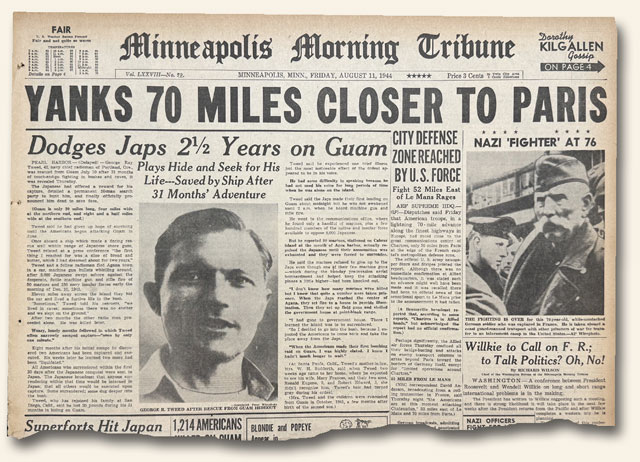
Lead-up to a Nation… as reported in the newspapers of the day (reflecting back on June/July, 1776)…
July 15, 2026 by GuyHeilenman · 1 Comment
- Revolution Gaining Momentum – Building on Resistance (Lead-up to a Nation – E44)
- Irreconcilable Actions of England – Royal Authority Suppressed (Lead-up to a Nation – E45)
- The Brink of Independence – England Clings to Hope of Peace (Lead-up to a Nation – E46)
- The Virginia Convention – Colonies urged toward Independence (Lead-up to a Nation – E47)
- Centuries of Struggle – One Declaration that Changed the World (Lead-up to a Nation – E48)
We hope you’ve are enjoyed this year-long trek to the 250th anniversary of The United States through the eyes of those who were fully engaged, first hand. As we continue with the next phase of the journey, as mentioned previously, all accounts will be rooted in what they read in the newspapers of the day.
“History is never more fascinating than when read from the day it was first reported.” (Timothy Hughes, 1975)
Strong Foundation … Liberty Takes Continual Work …
July 6, 2026 by Laura Heilenman · Leave a Comment
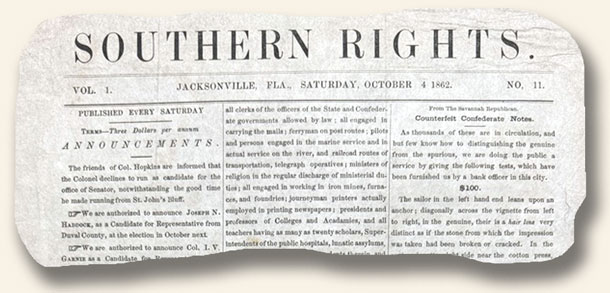
On October 4, 1862, the SOUTHERN RIGHTS out of Jacksonville, Florida had a fascinating issue with a story similar to that of the iconic Vicksburg Daily Citizen issue of July 4, 1863, when the Union troops found the newspaper still in the press, changed the final paragraph to report the Union takeover, and printed the issue.
The SOUTHERN RIGHTS newspaper’s story is found in a listing by the American Antiquarian Society and is as follows:
“Captain Valentine B. Chamberlain was in command of a company of the 7th Connecticut Volunteers who found the printing office and actually printed the issue for Oct. 4, 1862 from the standing type with Capt. Chamberlain’s addition in the first column on page 1 (see below). They then burnt the office and removed the press and types. The Oct. 4, 1862 issue was reissued in Hilton Head, South Carolina by Chamberlain, although retaining the Jacksonville imprint; and also reissued later in Jacksonville by the original printers once they had re-established their shop.
Printed at the bottom of this broadside issue is the following: Explanation–when the U.S. Forces under brigadier general J.M. Brannon visited Jacksonville, Fla., the form of the ‘Southern rights’ was found standing in this office just as it was left by the skedaddling rebels. The office was immediately ‘cleaned out,’ and–there being more ‘devils’ than printers present– the form was thrown into ‘pi’ in less time than it takes to write it. A proof sheet coming into our possession, we re-print the sheet as near like the original as possible, for the purpose of showing to our friends in the North, the ‘talent, vigor, heroism and military ardor’ that is not displayed in this trophy of Jacksonville.”–signed: Printers.
Captain Chamberlain’s addition mentioned above is headed: “Notice”, and reads, much tongue-in-cheek: “The Editor of this paper is absent from town for a few days on urgent business in the interior. It is therefore announced that the publication of this paper will hereafter be weekly suspended as it has been heretofore, weakly continued.
The taking of our battery after a loss of courage, but no blood, and the presence of the Yankee fleet, and the fearful proximity of Gen. Brannan and his forces, render the ‘Southern Rights’ precarious.”
Spinning the Yarn: The Power of Newspapers as Primary Sources…
June 21, 2026 by GuyHeilenman · Leave a Comment
A collecting friend of ours has published a newspapers-tethered book that might interest many of you. The following summary is provided in case you’d like to take a look:
Spinning the Yarn—written by author Paul M. Bohannon—offers a compelling and original contribution to early baseball history, grounded firmly in the rich evidentiary value of historic newspapers. Drawing extensively from period sources such as Porter’s Spirit of the Times and the Sunday Mercury, the book highlights how contemporary reporting captured not just the scores of early games, but the culture, personalities, and pivotal moments that shaped the sport.
One of the book’s most intriguing revelations centers on an 1855 dinner hosted by Samuel Godwin, president of Brooklyn’s Putnam Base Ball Club. This gathering—held after a decisive victory—brought together players, dignitaries, and crucially, newspaper representatives. As documented in these early publications, the evening marked a turning point: an intentional and strategic outreach to the press that helped ignite sustained baseball coverage. The following year’s reports, including detailed accounts of the Putnam Club’s contests, reveal the emergence of a narrative style that would evolve into modern sports writing.
We extend our thanks (and best wishes for success) to Paul for demonstrating so powerfully how (rare &) early newspapers serve as invaluable primary sources for uncovering and preserving… and in this instance, instrumental on forming the story of America’s past.
[newspapers with baseball content]
June 20, 2026 by GuyHeilenman · Leave a Comment
Extra, Extra, Read All About It!
After two decades, we (Timothy Hughes Rare & Early Newspapers), have a brand-new website!
The enhancements are best enjoyed first-hand.
Start your discovery at:
RareNewspapers.com
Who’s Who in Newspapers? Moses G. Farmer edition (1879)…
June 8, 2026 by GuyHeilenman · Leave a Comment
The 15th installment of: Who’s Who in Newspapers
 When it comes to “man on the street” interviews, the lack of knowledgeable responses often received never fails to confound. We enjoy watching these—which is a bit troubling in itself—but if an interviewer asked, “Who invented the light bulb?”, I’d bet 75% would answer correctly, especially with a few “Thom… Thomas… Thomas Ed…” clues.
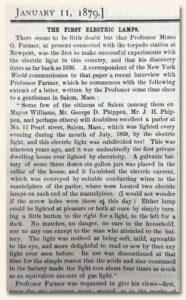
However, and to be fair, few of us (myself included) could name the pioneers who paved the way. Enter Moses G. Farmer. Thanks to a January 11, 1879, issue of Scientific American titled “THE FIRST ELECTRIC LAMPS,” I discovered this fascinating inventor who lit his Salem, MA, home in 1859—two decades before Edison’s breakthrough.
Using platinum filaments and batteries he had mounted for the purpose in his cellar, Farmer proved electricity could replace gas. Though the cost of platinum and the lack of a vacuum prevented commercial success, his “parlor lights” were the first to move electric light from the lab into a domestic reality – often enlightening dinner guests with his invention.
Farmer provided the “blueprint of failures” Edison needed. He proved electricity could light a home; Edison simply figured out how to make it last longer than a dinner party.
A modern sketch comparing Farmer’s and Edison’s work is shown below.
I love this collectible – and how it fuels the engine of life-long learning.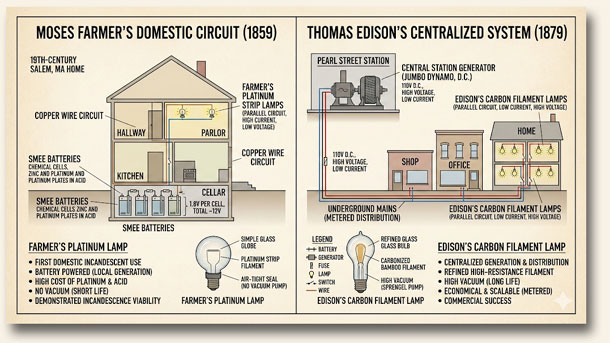
Lead-up to a Nation… as reported in the newspapers of the day (reflecting back on May, 1776)…
June 5, 2026 by GuyHeilenman · Leave a Comment
-
Hope and Defiance – French Sympathy (E39)
-
The New-England Chronicle – A Rare Voice (E40)
-
Powerful Resolves – Battlefield Successes (E41)
-
Addressing Military Overreach – Precedent for Restraint (E42)
- Common Sense – Condemnation of Monarchy (E43)
We hope you are enjoying this year-long trek to the 250th anniversary of The United States through the eyes of those who were fully engaged, first hand. As mentioned previously, all accounts are rooted in what they read in the newspapers of the day.
“History is never more fascinating than when read from the day it was first reported.” (Timothy Hughes, 1975)
An intriguing irony of American history, only to be found in a newspaper…
June 1, 2026 by TimHughes · Leave a Comment
There are times when we browse through a newspaper and, while looking for something else, come across an unexpected little gem of American history. And from what we are able to determine, this “little gem” has never been reported to this day.
The “Boston Daily Journal” of April 14, 1865 shares the date of the Lincoln assassination, he attending a performance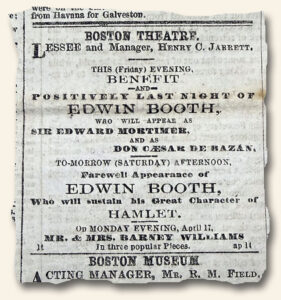 of “Our American Cousin” at Ford’s Theatre in Washington, D.C. Page 3 of this newspaper has an advertisement for the Boston Theatre, noting: “This (Friday) Evening Benefit and Positively Last Night of EDWIN BOOTH who will appear as Sir Edward Mortimer…To-Morrow (Saturday Afternoon, Farewell Appearance of EDWIN BOOTH, Who will sustain his Great Character of Hamlet…”.
So what did we find? The very evening that famed actor Edwin Booth was performing in a Boston theater, his younger brother was assassinating the President in a theater less than 400 miles away.
This advertisement, logically, would only be found in a Boston newspaper.
This is similar to another of our blog posts, concerning Lincoln attending a Washington, D.C. stage performance of John Wilkes Booth in 1863, the irony being Lincoln’s assumed applause at the conclusion of the performance for the person who would assassinate him less than 2 years later.
Such tidbits of history are fascinating finds, and could only be discovered in newspapers of the day. So look carefully at the issues you purchase. Will you discover a historical gem that the world knew nothing about?
Announcing: Catalog 367 – Released (early) for June, 2026 – Rare & Early Newspapers…
May 29, 2026 by GuyHeilenman · Leave a Comment
|
|
Stranger than fiction – Bobby Leach edition…
May 22, 2026 by GuyHeilenman · Leave a Comment
The Irony of Fate: The Bizarre Death of Daredevil Bobby Leach
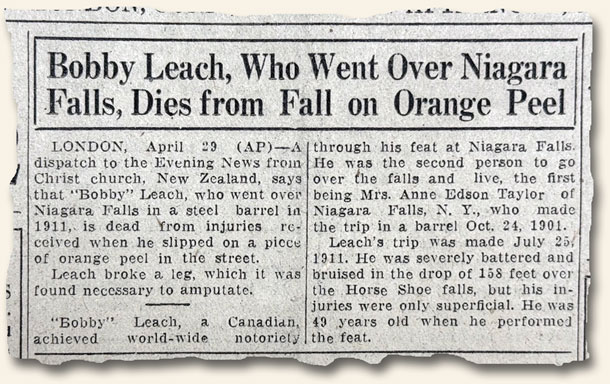
History is often written in the grandest of strokes, but sometimes it is defined by the cruelest of ironies. Such was the case for Bobby Leach, the legendary English daredevil who spent his life dancing on the edge of catastrophe, only to be brought down by a stray piece of fruit. In April 1926, the man who had famously conquered the roaring cataracts of Niagara Falls met a quiet, tragic end in a hospital bed in Auckland, New Zealand.
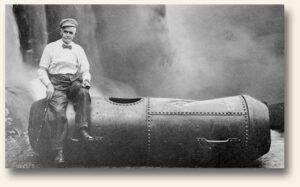
Source: Library of Congress
Leach’s claim to immortality was cemented on July 25, 1911, when he became the first man to survive a plunge over Niagara’s Horseshoe Falls in a custom-built steel barrel. The 170-foot drop was a violent ordeal that left him with a shattered jaw and two broken kneecaps, yet he emerged alive—a feat that many at the time considered a miracle. He spent the following years touring the globe, a living testament to human grit and the pursuit of the “impossible,” sharing his tales of survival with captivated audiences.
However, the luck that sustained him through death-defying stunts ran out during a lecture tour in New Zealand. While walking down Princes Street in Auckland, Leach slipped on an orange peel. The fall, seemingly minor compared to the crushing forces of the Niagara River, resulted in a severely broken leg. In the 1920s, medical limitations turned a simple fracture into a death sentence; the wound became infected, and gangrene soon followed.
Despite an emergency amputation intended to save his life, Leach succumbed to complications on April 26, 1926. He was buried in Auckland’s Hillsborough Cemetery, far from the waterfalls that made him famous. Today, his story serves as a poignant reminder for history enthusiasts: a man can survive the world’s most dangerous forces of nature, only to be defeated by the most mundane of accidents. It is a legacy defined not just by the height of his fall, but by the quiet irony of his final stumble.
What brought this to our attention was the following front page article from THE DAY, New London, CT, dated April 29, 1926.