
Search
The Rare & Early Newspapers Hobby

Receive the Newsletter

Buy Historic Newspapers

The many views of Niagara Falls – inspirating wood-cut illustration…
September 26, 2025 by Laura Heilenman · Leave a Comment  Email This Post
|
Email This Post
|  Print This Post
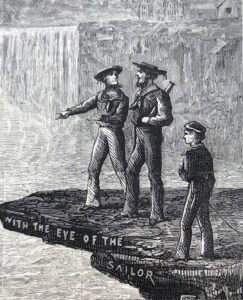 Decades ago, when my husband and I called Lancaster County, Pennsylvania, our home, we were immersed in a world where the Amish community was a constant presence – their simple way of life woven into the fabric of our daily existence. For fourteen years, we lived among the rolling farmlands, the clip-clop of horse-drawn buggies, and the quiet resilience of a people who shunned modern conveniences. Yet, despite this proximity, we rarely partook in the activities that drew countless visitors to Lancaster County’s doorstep. We never sat at an Amish family’s kitchen table, savoring a meal steeped in tradition. We never climbed aboard a buggy for a leisurely ride through the countryside, nor did we ever step foot in Dutch Wonderland – that colorful amusement park that beckons tourists with its promise of family-friendly thrills.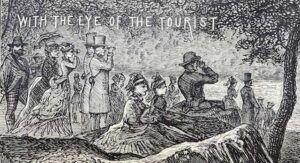
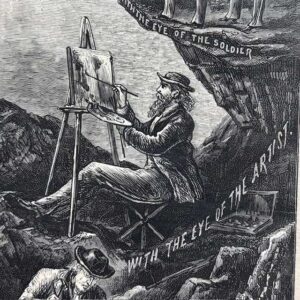
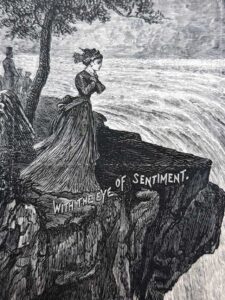 If we could train ourselves to view our surroundings through multiple sets of eyes—through the curious gaze of a child, the weathered perspective of an elder, or the fresh wonder of a newcomer—what richness we might uncover. Imagine the billions of impressions we could gather, each one a thread in the tapestry of our experience, pulling us toward the next moment with a heightened sense of anticipation and urgency. To live this way, with eyes wide open to the infinite possibilities around us, would be to embrace a life brimming with discovery, where every step forward is an invitation to marvel at the world anew.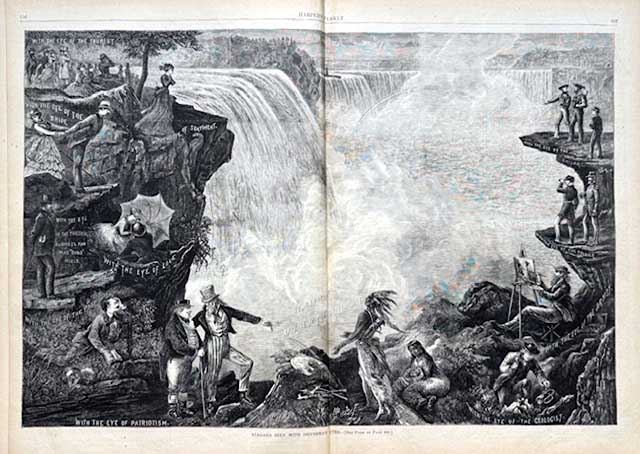
If you liked this post, you may also enjoy...
- A Thankful Heart from the Mouth of Babes…
- “Life’s Poetry”… Food for thought…
- A lament of a dying soldier…
- Special Moment: Father and Daughter – A Handshake for the Century…
- Recalling Paul Revere’s ‘midnight ride’…
Deal of a Lifetime… Doubling America with the Louisiana Purchase…
September 22, 2025 by Laura Heilenman · Leave a Comment Email This Post
| Print This Post
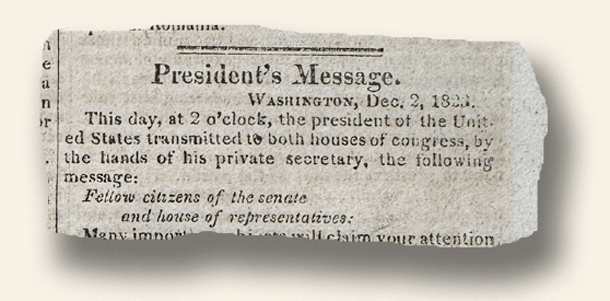
Everyone loves feeling as if they stuck a great deal! Coming off of Amazon Prime Days, many Americans are probably pretty pleased with their purchases; however, none of our delight can compare with what former Special Envoy James Monroe must have felt as he finalized the deal for the Louisiana Purchase… 3 cents/acre… 828,000 square miles… expanding the breadth of his country … setting the stage to establish a “hands-off” foreign policy doctrine as president 20 years later. Men like Monroe, who influenced our country’s founding by sculpting our future in a series of steps, helped define who America would be some 250 years later. On November 2, 1803, the COLUMBIAN CENTINEL covered the purchase of the Louisiana Territory and the NILES’ WEEKLY REGISTER, Baltimore, Dec. 6, 1823 later covered Monroe’s Annual Message to Congress as President in which he detailed his now famous Monroe Doctrine. I love seeing steps in the sand leading from our county’s founding to our 250th birthday, detailed in newspapers of the day. Well done President Monroe! You found us a GREAT deal!
If you liked this post, you may also enjoy...
- Most historic pre-Civil War 19th century event…
- The Louisiana Purchase is useless to the United States…
- First newspapers in Louisiana…
- Snapshot 1945… America’s youth are too soft…
- Reflection: George Washington’s Birthday…
The reason I collected it: our most remote newspaper yet…
September 15, 2025 by TimHughes · Leave a Comment Email This Post
| Print This Post
In addition to newspapers with historical content, or graphic presentations, or among the smallest (or largest) possible, another “extreme” that has fascinated me has been those that are exceedingly remote. We have an issue or two of the “Alaska Forum” which is the northernmost American newspaper to be found, but our discovery of “The Penguin Post” from 1957 trumps it in terms of being as close to one of the poles as possible.
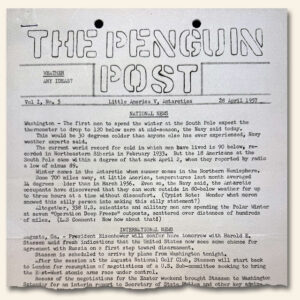 This is a fascinating “newspaper” from near the South Pole, published at “Little America V” in Antarctica. It has an intriguing history.
“Little America” was a series of Antarctic exploration bases from 1929 to 1958 located on the Ross Ice Shelf, south of the Bay of Whales. They were built on ice that is moving very slowly, the relative location on the ice sheet moves and eventually breaks off into an iceberg.
There were five such exploration bases, this being the last. Little America V was established on January 3, 1956, at Kainan Bay, some 30 miles east of Little America IV, as part of Operation Deep Freeze. Little America V served as the American base in the South Polar program in the International Geophysical Year, from July 1, 1957, to December 31, 1958. It was constructed by United States Navy Seabees in the three-month window before the Antarctic winter made construction nearly impossible. All of Little America V was constructed below the snow line in the ice, with individual living quarters, a generator room, a cafeteria, and ramps leading out at one end for tracked vehicles. This type of construction meant that none of those staying in Little America V had to go outdoors in the harsh winter when going from one section to another of the Antarctic town.
This–thus far–is assuredly the southernmost newspaper we have found.
If you liked this post, you may also enjoy...
- The reason I collected it: the Nuremberg trials…
- A Labor Day Weekend Tribute through rare newspapers…
- Scientific American & the Harlem River… 1890…
- The Traveler… permission to buzz the dome… if things could be redone…
- The Traveler… greetings… and something to chew on…
Is it Patriot Day, Patriot’s Day, or are they interchangeable?
September 11, 2025 by GuyHeilenman · Leave a Comment Email This Post
| Print This Post
Is it Patriot Day? Yes. Is it Patriot’s Day? Yes again. Are they interchangeable? If someone had asked me yesterday, I would have thought they were one and the same; but the answer is: No! So, for those like me who thought they were one and the same, I hope what follows clears things up.
 Patriot Day
Patriot Day is a United States observance held every year on September 11 to honor the nearly 3,000 people who lost their lives in the terrorist attacks on September 11, 2001. Established by a joint resolution of Congress and signed into law in 2002, the day commemorates the victims of the attacks on the World Trade Center, the Pentagon, and United Airlines Flight 93, as well as the first responders who risked and sacrificed their lives. Americans observe the day with moments of silence, memorial services, and the lowering of flags to half-staff as a tribute to national resilience and remembrance.
Shown to the left is a report from the Los Angeles Times, dated Sept. 11, 2001.
Patriot’s Day
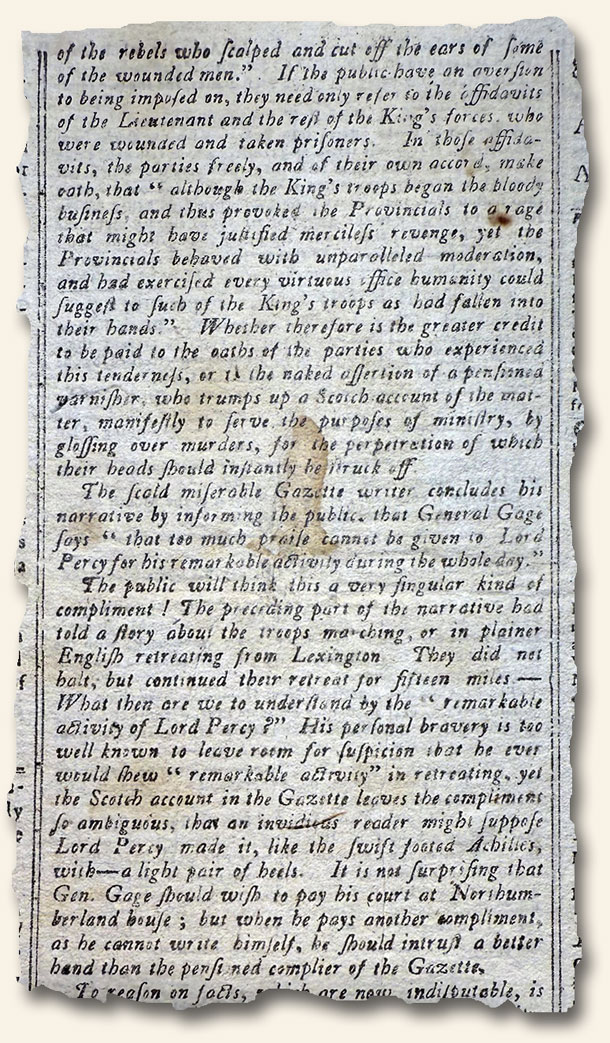
Patriots’ Day is a U.S. holiday commemorating the battles of Lexington and Concord, the first military engagements of the American Revolutionary War, fought on April 19, 1775. It originated in Massachusetts in the late 19th century to honor the bravery and sacrifice of colonial militiamen who resisted British forces. The holiday is observed annually on the third Monday in April, primarily in Massachusetts and Maine, with re-enactments, parades, and athletic events like the Boston Marathon. Patriots’ Day serves as a reminder of the American colonies’ fight for independence and the birth of the United States.
The following is a report from The New England Chronicle dated Sept. 7, 1775.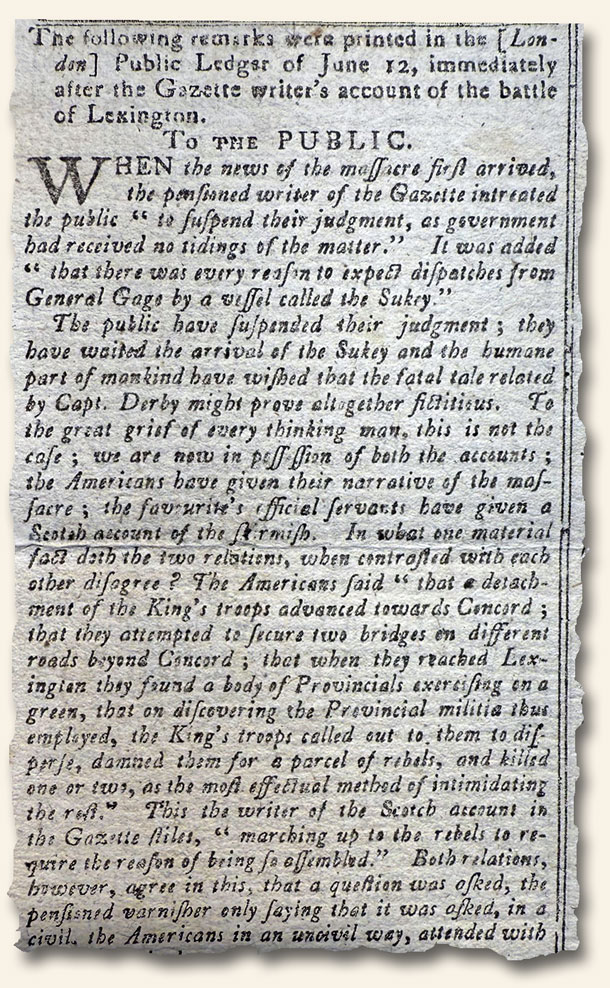
If you liked this post, you may also enjoy...
- How Paul Revere’s Ride Was Published And Censored IN 1775…
- Lead-up to a Nation… as reported in the newspapers of the day (December, 1775)…
- The Traveler… a man of determination…
- Lead-up to a Nation… as reported in the newspapers of the day (Intro & Sept., 1775)…
- The Traveler…Frigate President makes a capture… newspaper proposal…
Singers & Songwriters – 1776 edition…
September 8, 2025 by GuyHeilenman · Leave a Comment Email This Post
| Print This Post
Flashback – 1776
“And, the award for the songwriter of the year goes to… ‘wait for it… wait for it…’* … Benjamin Franklin, for his chart-busting mega-hit: “The KINGS own REGULARS, and their TRIUMPH over the IRREGULARS.”
Was there anything this man could not do? I could be wrong, but if those who have explored the life of this amazing forefather were asked to list his talents and accomplishments, I’m guessing that “lyricist” would not make anyone’s list. Yet, although unsigned, the satirical ditty printed in the Pennsylvania Evening Post on March 30, 1776 (shown below) has finally been universally acknowledged as being from his pen (and not just an autopen with his name on it). Furthermore, the fact that it would have likely topped the charts in such an historic year (1776) makes him a shoe-in for eventual entry into the Musicians Hall of Fame and Museum. Sadly, whether through the distraction of competing interests, lack of funding, or perhaps the waning of ongoing inspiration, history has proven him to be classified as a “one-hit wonder”. What a shame; he was off to such a great start.


*Quote borrowed from Ketanji Brown Jackson, honorable Associate Justice of the SCOTUS.
If you liked this post, you may also enjoy...
- Rare Newspapers – distracting?
- As we close the door on 2020…
- Recommended reading…
- Extensive list of reprinted newspapers…
- This Month in History – July…
Lead-up to a Nation… as reported in the newspapers of the day (Intro & August, 1775)…
September 5, 2025 by GuyHeilenman · Leave a Comment Email This Post
| Print This Post

Shown below are the first four installments.
The Necessity of Taking Up Arms – Lead-up to a Nation (E1)
The Olive Branch Petition – Lead-up to a Nation (E2)
The Speech of Edmund Burke – Lead-up to a Nation (E3)
England Declares War – Lead-up to a Nation (E4)
We hope you enjoy this year-long trek to the 250th anniversary of The United States through the eyes of those who were fully engaged, first hand. All accounts will be through what they read in the newspapers of the day. After all, as Tim Hughes proclaimed back in 1975: “History is never more fascinating than when read from the day it was first reported.”
If you liked this post, you may also enjoy...
- Lead-up to a Nation… as reported in the newspapers of the day (Intro & Sept., 1775)…
- Lead-up to a Nation… as reported in the newspapers of the day (October, 1775)…
- Lead-up to a Nation… as reported in the newspapers of the day (January, 1776)…
- Lead-up to a Nation… as reported in the newspapers of the day (November, 1775)…
- Lead-up to a Nation… as reported in the newspapers of the day (JFebruary, 1776)…
A 49 year search comes to an end… The 1765 “Tombstone” issue…
September 1, 2025 by TimHughes · Leave a Comment Email This Post
| Print This Post
There are a number of iconic American newspapers that every collector desires, most are for content alone such as the Declaration of Independence, the Constitution, the assassination of Abraham Lincoln, etc.
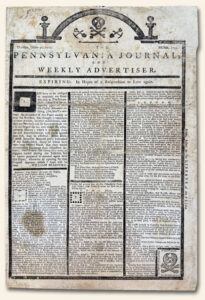
 Not many are desired for both historical significance as well as graphic appeal, but such is the case with the Pennsylvania Journal of October 31, 1765. Having been aware of it for many years (photos are found in many high school history books), I had always been in the search for a genuine issue (beware: many reprints exist). I came close about 35 years ago when an institution, which had two in their collection, gave thought to exchanging one with me for an unknown Philadelphia newspaper I had discovered. Ultimately, they opted not to do the swap, so the search was back on.
It ended earlier this year.
This particular edition, famously known as the “tombstone edition,” used striking visual and textual elements to express colonial outrage over the Stamp Act tax, which required many printed materials, including newspapers, to bear a revenue stamp. This tax directly impacted printers and publishers, placing a heavy economic burden on them and fueling widespread resistance.
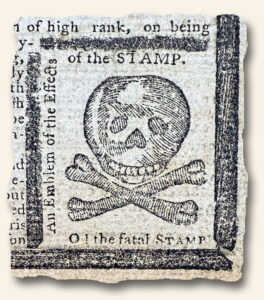
As seen in the photos, the masthead featured a skull and crossbones, a powerful symbol representing the “death” of the press under the weight of the Stamp Act. Also, an engraving of a coffin appears at the bottom of the back page, captioned: “The last Remains of the PENNSYLVANIA JOURNAL Which departed this Life, the 31st of October, 1765, Of a Stamp in her Vitals, Aged 23 Years.”
Publisher William Bradford begins the issue with poignant commentary, including: “I am sorry to be obliged to acquaint my readers, that as The Stamp Act is fear’d to be obligatory upon us after the First of November ensuing (the fatal to-morrow) the publisher of this paper unable to bear the burthen, has thought it expedient to stop a while, in order to deliberate whether any methods can be found to elude the chains forged for us…”.
Published just one day before the Stamp Act’s enforcement, this edition cleverly voiced dissent without yet violating the law, making it a strategic act of defiance.
This “tombstone edition” of the Pennsylvania Journal captured this economic strain and transformed it into a public rallying cry.
This edition stands as a vivid example of how the colonial press used creativity to oppose British policies, contributing to the growing revolutionary sentiment. It underscores the critical role newspapers played in shaping public opinion and mobilizing opposition in the years leading up to the American Revolution.
While other newspapers also protested the Stamp Act, the Pennsylvania Journal’s dramatic tombstone imagery made it particularly memorable and influential. It galvanized public resistance, cementing its place as a powerful symbol of defiance in American history.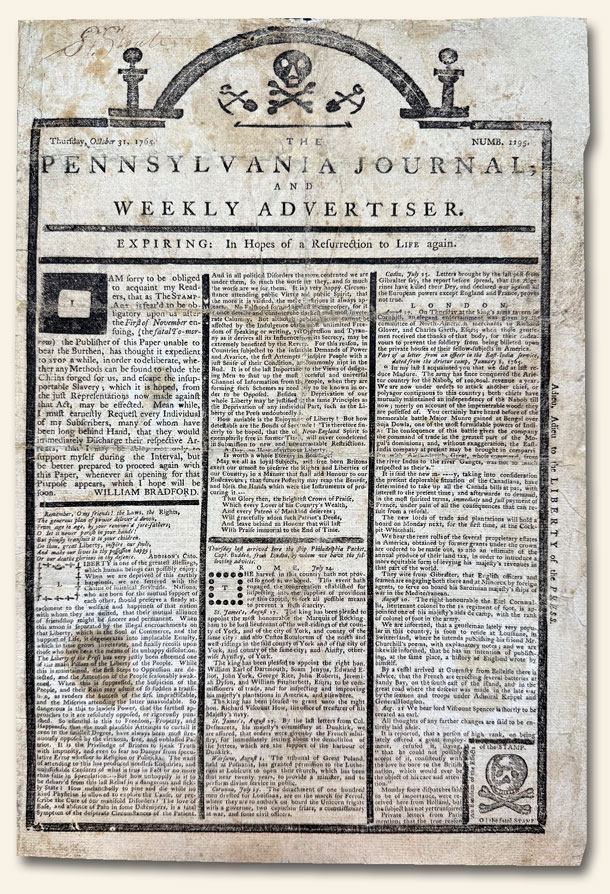
If you liked this post, you may also enjoy...
- Most historic: Pre-Revolutionary War…
- Tombstone was about to fade away…
- #17 – Most historic: Pre-Revolutionary War… (*revisited)
- The “top ten”: 18th century…
- More than just another anti-slavery newspaper… A recent find…
Announcing: Catalog #358 for September, 2025 – Rare & Early Newspapers…
August 29, 2025 by GuyHeilenman · Leave a Comment Email This Post
| Print This Post
|
 September’s catalog (#358)
|
If you liked this post, you may also enjoy...
- Announcing: Catalog #357 for August, 2025 – Rare & Early Newspapers…
- Announcing: Catalog #360 for November, 2025 – Rare & Early Newspapers…
- Announcing: Catalog #361 for December, 2025 – Rare & Early Newspapers…
- Announcing: Catalog #359 for October, 2025 – Rare & Early Newspapers…
- Announcing: Catalog #348 for November, 2024 – Rare & Early Newspapers…
Snapshot 1866 – Slavery: A Wound on the Soul of a Nation…
August 25, 2025 by GuyHeilenman · 1 Comment Email This Post
| Print This Post
 Few institutions in human history have inflicted more suffering or revealed deeper moral failings than slavery. Its cruelty was evident to many, even in its own time, and voices of conscience spoke out with clarity and passion against it.
Frederick Douglass exposed the hypocrisy of those who justified such inhumanity in the name of religion:
“The man who wields the blood-clotted cowskin during the week fills the pulpit on Sunday, and claims to be a minister of the meek and lowly Jesus.”
Abraham Lincoln, never one to shy away from blunt truths, offered this biting reflection:
“Whenever I hear anyone arguing for slavery, I feel a strong impulse to see it tried on him personally.”
William Lloyd Garrison cut to the heart of the injustice:
“The slave is doomed to toil, that others may reap the fruits.”
And Harriet Tubman, who risked everything to lead others to freedom, distilled its evil to its core:
“Slavery is theft — theft of a life, theft of work, theft of any opportunity to shape one’s own destiny.”
While President Lincoln’s Emancipation Proclamation, issued on January 1, 1863, marked a turning point, the road to slavery’s demise was long, brutal, and soaked in the blood of those who fought to end it. The institution did not go quietly—it clung on with all its bitter force until finally it was defeated, leaving behind a scar but also a renewed hope for the American promise.
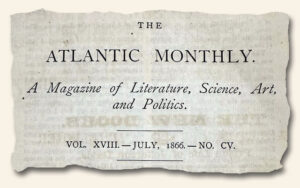
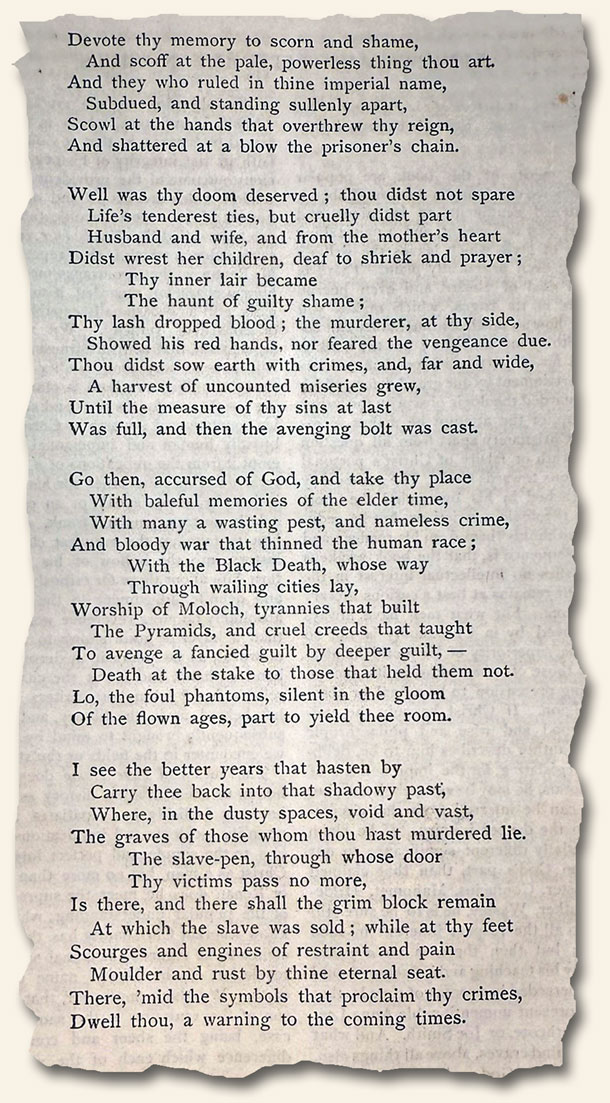
This complex and painful chapter was not lost on poet William Cullen Bryant. In 1866, just a year after the Civil War’s end, he shared his reflections in a powerful poem published in the July issue of The Atlantic Monthly. That poem, in its entirety, is presented below—a poignant reminder of what was endured, and what was overcome.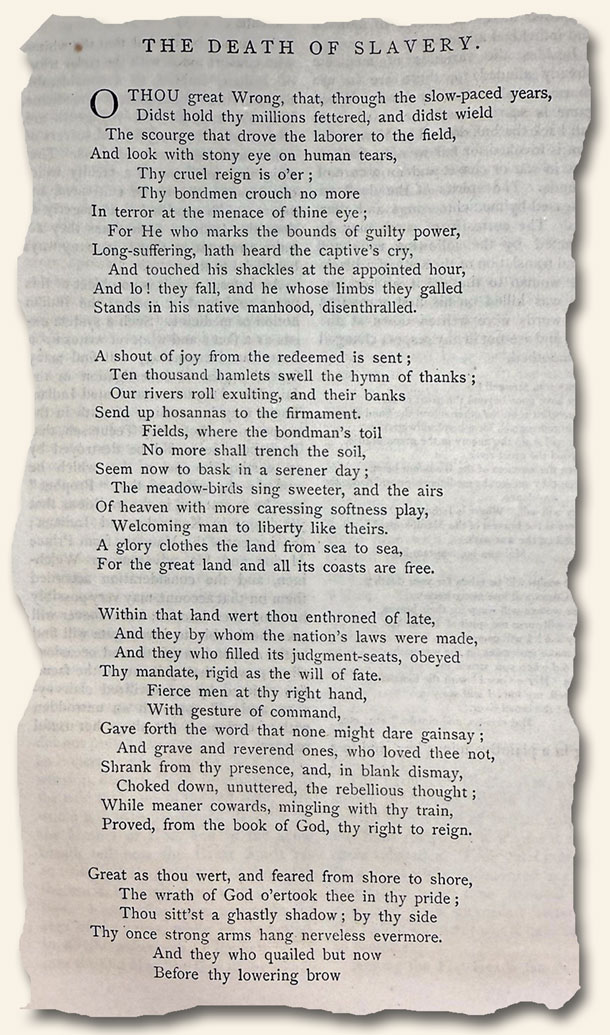
If you liked this post, you may also enjoy...
- Snapshot 1807… William Cowper and the Slave Trade…
- William Cowper speaks out against slavery (1791)… They put it in print…
- Contribution from N.G. – Anson Burlingame’s historic 1856 speech…
- Black History Month… looking back…
- The impact of Newspapers on the abolition of slavery…
A “hidden gem” within a 1785 newspaper leads to discovery, inspiration, and a correction…
August 22, 2025 by GuyHeilenman · Leave a Comment Email This Post
| Print This Post
Just for fun, guess the author and approximate date the following “Address to America” was published:
“PEOPLE of North America! Let the example of all nations which have preceded you, and especially that of the mother country, instruct you. Be afraid of the influence of gold, which brings with luxury the corruption of manners and contempt of laws; be afraid of too unequal a distribution of riches, which shews a small number of citizens in wealth, and a great number in miser; whence arises the insolence of one, and the disgrace of the other, Guard against the spirit of conquest; the tranquility of the empire decreases as it is extended; have arms to defend yourselves, and have none to attack.
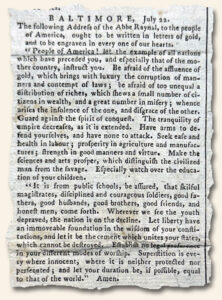 Seek ease and health in labour; prosperity, in agriculture and manufactures; strength, in good manners and virtue. Make the sciences and arts prosper, which distinguish the civilized man from the savage. Especially watch over the education of your children.
It is from public schools, be assured, that skillful magistrates, disciplined and courageous soldiers, good fathers, good husbands, good brothers, good friends, and honest men come forth. Wherever we see the youth depraved, that nation is on the decline. Let liberty have an immovable foundation in the wisdom of your contributions and let it be the cement which unites your states, which cannot be destroyed. Establish no legal preference in your different modes of worship. Superstition is every where innocent when it is neither protected nor persecuted; and let your duration be, if possible, equal to that of the world.”
I recently discovered this address on page 3 of The Independent Gazetteer; or, The Chronicle of Freedom dated July 30, 1785. After a bit of digging, in my humble opinion, a trek into the life of its author, Abbé Raynal, promises to not disappoint.
As for his “Address to America” itself, one cannot help but think his words fell on deaf ears. Sadly, even if we wanted to hit the reset button and start again while heeding his warnings, the last paragraph is problematic considering the current state of public education. However, as difficult as it would be to change course, status quo is obviously not an option.
As for the correction mentioned in the above heading for this post…
Multiple resources claim Abbé Raynal’s Address was first published posthumously (in 1800). It’s always fun when an old newspaper can prove the “experts wrong”.
A summary of the address using multiple AI resources is as follows:
Abbé Raynal’s “Address to America” is a powerful message written during the American Revolution in which the French Enlightenment thinker praises the American colonies for their fight for independence from British rule. He commends the courage of the revolutionaries and their commitment to liberty, viewing the struggle as a monumental step forward for human freedom. Raynal sees the revolution as a chance for a new nation to break from the oppressive traditions of Europe and create a society founded on justice, equality, and natural rights.
However, Raynal does not offer unconditional praise. He sharply criticizes the continued practice of slavery in the American colonies, pointing out the contradiction between fighting for freedom while denying it to enslaved people. He also expresses concern over the treatment of Indigenous peoples and warns the new republic against replicating the colonial abuses of European empires. His address is both a celebration of America’s potential and a moral challenge to align its actions with the ideals it professes.
The significance of Raynal’s message lies in its early and public call for America to confront its moral failings. His address exemplifies the Enlightenment belief that political freedom must be accompanied by social and ethical responsibility. By urging America to live up to its revolutionary ideals, Raynal’s words contributed to a broader conversation about liberty, justice, and the true meaning of independence—conversations that would shape not only American history but global ideas about human rights.
If you liked this post, you may also enjoy...