

Search
The Rare & Early Newspapers Hobby

Receive the Newsletter

Buy Historic Newspapers

Gentleman’s Magazine & Insanity…
August 10, 2020 by Stephanie Williams · Leave a Comment  Email This Post
|
Email This Post
|  Print This Post
Living in a time of health concerns brought on by a previously unknown viral threat brings me a heightened awareness of the historical mysteries recorded in these ledgers from the past. Advertisements give a clue to the extensive maladies that troubled mankind hundreds of years ago, many of which remain challenges even today. Liver ailments, gout, yellowed eyes, rashes, sleeplessness, and obesity are just a few things for which patented tonics and trusted treatments abound. Based on a sampling of papers such as Leslie’s Illustrated, Harper’s Weekly and any of the Wild West titles in  the vast Rare & Early Newspapers collection, there is no doubt left that disease is a plague of the human condition.
Nothing, however, seems to baffle and burden society as a whole, and physicians in particular, as diseases of the mind. And The Gentleman’s Magazine that I pulled out from October of 1808 describes the tension brought about by the ignorance in a field so relevant to our existence.
In particular, the writer addresses Mr. Urban on the unfairness of the societal and ecclesiastical condemnation of suicide, without considering the mitigating circumstances of mental illness.
In consequence of an unusual conflux of suicidal cases occurring nearly together a few months ago, the feelings of Humanity appeared to be much outraged; many calumnious and violent opinions, mingled with false censure, were inserted in our daily prints; the conduct of Juries was the subject of much unqualified condemnation; and al almost entire ignorance of the true state of the awful cases brought under their cognizance, laid the foundation of much unmerited reproach.
His pointed statement halfway through the piece provides an explanation for suicide with the following question and answer: “Why does it appear that Suicide is more general than formerly? The answer is at hand: Insanity is an increasing disease. A few of the bulky catalogue of human ailments have evidently decreased; unfortunately, this is not of the number.”
There’s so much more in this article that speaks to the same subject today. While I don’t know concerning the correlation between the two, I do applaud the perspective towards those who suffer in this way. It was a lofty goal then and is, in my humble opinion, still.
It is an absolutely demonstrable fact, that in nine cases out of twelve of self-destruction which our daily papers record, the previous situation of the subject is known, and the fatal crisis might be prevented were this knowledge acted upon with firmness, promptitude, and that just method which honour, humanity, and justice demand.
If you liked this post, you may also enjoy...
- Hawaiian Islands… ignorance is often the default position of the uninformed…
- “Guess & Click” – 1920’s Edition…
- The Gentleman’s Magazine & Bankruptcy…
- The Gentleman’s Magazine & Poetry… Still learning…
- The Traveler… giving thanks… not on the Sabbath…
The RareNewspapers.com website – how to search for historic newspapers…
August 7, 2020 by GuyHeilenman · Leave a Comment Email This Post
| Print This Post
Whether seeking to make a purchase, perform research, or just desiring to take a walk back through time through the eyes of those who lived through the events we now call history, many have taken advantage of the basic search functions on the RareNewspapers.com website to sift through tens of thousands of collectible newspapers which span the 1600’s to the early 21st century. To this end, using the basic search functions on the homepage to search by keyword, date (m/d/yyyy), key phrase, a 6-digit catalog number, date range, or by the title of a newspaper all can be done quite easily. Even searching within the search results or limiting a search to a certain era by using the pull-down menu to the far right of the screen are intuitive – and are used frequently by explorers (see the first image below). However, few realize the small print under the search button is actually a hyperlink which takes the user to a significantly more advanced searching interface where one can also explore by era, only a day of a month (to find issues through time for a specific day of the year), within a specific century or price range, an exact phrase, a list of key terms (called “comma list”), and more. One of my favorite tools is the ability to eliminate issues which contain specific words from within search results. All of these capabilities and more are shown in the 2nd image below.


So, now that you know how to search at an advanced level, feel free to take some time to discover why we say, “History is never more fascinating than when it’s read from the day it was first reported.” If you’re intrigued, why not start your exploration today at: RareNewspapers.com
If you liked this post, you may also enjoy...
- More than what meets the eye – categories on the RareNewspapers.com website…
- Prices realized… 19th century…
- Today’s month and day through the eyes of Rare & Early Newspapers… 9/26 edition…
- “Collecting Newspapers – The Basics” (Part IV) – Setting Values…
- Entry point to the Rare Newspapers Collectible… 19th Century…
Announcing: Catalog #297 (for August, 2020) is now available…
August 3, 2020 by GuyHeilenman · Leave a Comment Email This Post
| Print This Post
- Catalog 297 (in its entirety)
- Noteworthy Catalog 297 ($250+)
- Combined Catalogs (current, w/ remnants of previous)
Don’t forget about this month’s DISCOUNTED ISSUES.
The links above will redirect to the latest catalog in approx. 30 days,
upon which time it will update to the most recent catalog.
If you liked this post, you may also enjoy...
- Announcing: Catalog #304 (for March, 2021) is now available…
- Announcing: Catalog #282 (for May, 2019) is now available…
- Announcing: Catalog #280 (for March, 2019) is now available…
- Announcing: Catalog #292 (for March, 2020) is now available…
- Announcing: Catalog #300 (for November, 2020) is now available…
My Collecting Story… G. F. from Lexington, VA…
July 31, 2020 by GuyHeilenman · Leave a Comment Email This Post
| Print This Post
The following is the next installment of our series in which we post the “stories” graciously submitted by our collecting friends during the pandemic of 2020.
Received your email today and thought what a great idea. . . so here goes an answer to “Which issue within your collection do you value the most and why?” I love US history and as soon as I earned a permanent salary, I started visiting historical sites and eventually turn ed to collecting items of interest, particularly US Civil War. I collected many of my Harper’s from numerous civil war shows; my favorite is a Richmond Examiner, 23 June 1864 (long before I knew about your website); it talked of Sherman’s campaign and how it would end like Napoleon’s in Russia! Great reading. Years went by and I am a docent at the Stonewall Jackson House in Lexington, VA (come by when this contagion is past and we’re open again). I prepared a presentation on Jackson in the Mexican War; I came across your site and ordered a “National Intelligencer,” 16 Nov 1847 and “The Union,” also dated 1847. Future Civil War luminaries their exploits abound. Finally, and not about the Civil War, my wife loves to explore Scottish roots and your site had several papers regarding the Scottish rebellion of 1746, referencing the Battle of Culloden – yep, I bought it as a Christmas gift for her. Your site piques my curiosity and I’ll remain a customer!
As additional “stories” are posted they will be available at: MY COLLECTING STORY. We did this many years ago as well – and their posts are also included.
If you liked this post, you may also enjoy...
- My Collecting Story… G.F. in Lexington, Virginia…
- My Collecting Story… J. N. from Galveston, Texas…
- My Collecting Story… Robert (Bob) Cassidy…
- My collecting story… D.L. in Cranbury, NJ…
- My collecting story… M.M. in Freeport, NY…
The Woman’s Tribune & Frederick Douglass…
July 27, 2020 by Stephanie Williams · Leave a Comment Email This Post
| Print This Post
Many people who have faced difficult challenges in their personal lives become, in turn, sensitive to the struggles of others. It might be a similar difficulty, but it isn’t always. In the history of discrimination, a less-than-equal status has been designated to individuals or groups for reasons of socioeconomic status, color of skin, or gender. Specific 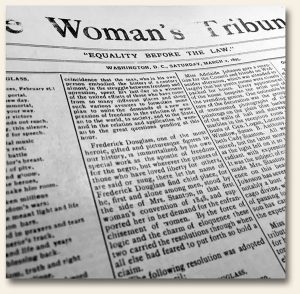 publications sprang up to give a voice to the unrepresented, and, at the very least, the power of the pen documented the demand to be heard. Within the newspapers of early America are the abolitionist papers and the working men’s papers and the women’s papers. The writers and editors called for equal status under the law, the right to own property (starting with the freedom of an individual over his or her own life) and the right to vote.
It’s this last one that has me looking intently at the front page of The Woman’s Tribune from March 2, 1895. In the first place, I noticed that the paper is much better quality than, say, the New York Times from this era. It seems the publishing board of this newspaper did not make the downgrade from rag paper. But mostly I noticed that the masthead “EQUALITY BEFORE THE LAW” is followed by the column heading “Frederick Douglass“. There is a poem written by Mary Lowe Dicks in honor of the great abolitionist, followed by a tribute/obituary that fills two columns delineating his impact for the cause of freedom. The ending portion is particularly poignant:
In him the hopes of his race were realized; in him humanity was dignified. The world is poorer because he is gone; humanity is richer because he came. The legacy of his life and service attests the truth that God keepeth watch above His own, that He shall turn and overturn until injustice dies and the right eternally triumphs.
I like this honoring of another who had a different set of obstacles to overcome, but was admired for the battle he fought and the way he waged it. I picture the huddled masses of abolitionists, suffragists, laborers — not pitted against one another, but rooting for the common goal of “liberty and justice for all.”
If you liked this post, you may also enjoy...
- Time-Lapse… Frederick Douglass (1834) to Henry Garnett (1865)…
- The Frederick Douglass’ Paper… Solomon Northup…
- One More Reason to Love Collecting Historical Newspapers… Revisiting 9/11…
- Frederick Douglass – A true American hero…
- I’m New Here: Week Twenty-Seven…
My collecting story… L.H. in Williamsport, PA…
July 23, 2020 by GuyHeilenman · Leave a Comment Email This Post
| Print This Post
Below we continue our series in which we post the “stories” graciously submitted by our collecting friends during the pandemic of 2020.
 (to unfamiliar surroundings) for me soon became so much more! Over the years each of our children have worked at the “History’s Newsstand” and have developed a deep appreciation of history and all it’s lessons.
As additional “stories” are posted they will be available at: MY COLLECTING STORY. We did this many years ago as well – and their posts are also included.
If you liked this post, you may also enjoy...
- Golden Nuggets… the “hits” just keep on coming…
- My collecting story… OHPC, Virginia…
- My collecting story… J. W. in Stow, MA…
- My collecting story… B.R. in Grosse Ile, Michigan…
- My collecting story… J.R. in Ipswich (UK)…
My collecting story… J. W. in Stow, MA…
July 20, 2020 by GuyHeilenman · Leave a Comment Email This Post
| Print This Post
Below we continue our series in which we post the “stories” graciously submitted by our collecting friends during the pandemic of 2020.
Why do I collect rare/historic newspapers? How did I get started?
In 2004, shortly after the Boston Red Sox won World Series, I received a January 7, 1920 copy of the New York Times as a gift from my wife. After not seeing any significant headlines in the paper, my wife  said, “Check out the sports page”. There on page 22 was the trade of Babe Ruth to the New York Yankees, the legendary “Curse of the Bambino”. This inspired my interest to assemble a collection that epitomizes what it meant to be a true Red Sox fan including the 1918 World Series victory (Christian Science Monitor dated September 12, 1918), the aforementioned sale the legendary slugger to the Yankees, the subsequent 86 years of agony including the ’46, ’67, ’75, and ’86 World Series defeats, and finally the breaking of “the curse” by beating the Yankees and Cardinals to win the World Series that I had just secured in my October 2004 copies of the Boston Globe.
During my efforts to find these papers at Rarenewspapers.com and on eBay, I found a 1791 copy of the Middlesex Gazette, Middletown, CT announcing that Vermont has become the 14th state of the union and the FIRST to enter under the terms of the new federal Constitution. My wife  and I were married in Vermont (where her parents lived for 35 years and where her ancestry has been traced to one of Ethan Allen’s brothers and the “Green Mountain Boys”) so it was of some personal interest as well. For only $30, I thought this paper was amazing and my wife suggested that I try to collect papers announcing statehood for each of our 50 states. With the prospect of searching for another 49 papers seeming a bit overzealous, I decided instead to focus on finding papers announcing statehood of the original 13 colonies.
 It took a couple of years to secure all these statehood ratification newspapers and in the process, I found a paper with Maine becoming a state in 1820. Although this was beyond the scope of my original search, I remembered that Maine’s statehood was a part of the Missouri Compromise. So certainly, I had to search for a Missouri statehood paper! This was what is equivalent to today’s Google searches are on so many levels … one piece of history leads to another to another to another! And with this, my affinity for newspaper collecting had begun.
At the same time, by reading books such as David McCullough’s “1776 “and “John Adams”, “The Founding Brothers” by Joseph Ellis, and James Madison’s notes on the Constitutional Convention, my interest in U.S. history was further awakened and my interest began to shift to 18th and 19th century papers. These papers provide primary source documentation described in rich and colorful language that is not experienced in academic settings. As my appreciation of the hobby grew, I began to assemble groups of papers that are linked together by a particular event or series of events that “tell the story” in real time by those who were living at the time. It is with this mindset and approach that I have continued to be an avid collector to this day.
As additional “stories” are posted they will be available at: MY COLLECTING STORY. We did this many years ago as well – and their posts are also included.
If you liked this post, you may also enjoy...
- My collecting story… J.R. in Ipswich (UK)…
- Collecting statehood newspapers…
- They Put It In Print (1941)… World Series – Cardinals vs. Yankees…
- My collecting story… L.H. in Williamsport, PA…
- World Series bound… Before the “Curse of the Bambino”… The Traveler…
The July (2020) Newsletter from Rare & Early Newspapers…
July 17, 2020 by GuyHeilenman · Leave a Comment Email This Post
| Print This Post
Monthly Newsletter ~ Rare & Early Newspapers
Welcome to the July 2020 edition of our monthly newsletter. This month we’d like to bring your attention to the following:
A New Set of Discounted Newspapers – 50% Off
Catalog 296 – New Items Added
Four Interesting Items on eBay
Catalog 296
History’s Newsstand
Newly Discovered Items
|
|

|
|
See what’s happening on our social sites
|


If you liked this post, you may also enjoy...
- The October (2019) Newsletter from Rare & Early Newspapers…
- The October (2021) Newsletter from Rare & Early Newspapers…
- The June (2020) Newsletter from Rare & Early Newspapers…
- The September (2020) Newsletter from Rare & Early Newspapers…
- The April (2021) Newsletter from Rare & Early Newspapers…
Still Learning… Womankind & Bread Flour…
July 13, 2020 by Stephanie Williams · Leave a Comment Email This Post
| Print This Post
Written during the heart of the Covid-19 pandemic of 2020…
There have been odd shortages during these recent times of collective concern, and my own personal challenge has been procuring my favorite flour for baking. I can’t understand why stock has been depleted in every brick-and mortar supplier as well as the major online providers. The positive takeaway is that more homes are filling  with the unparalleled aroma of freshly baked treats. In my opinion, the general well being of the entire planet might be elevated by that means.
Anyway, concerns for the homey details of life took me this week to the publication Womankind. Although it is shelved with our titles that often focus on suffrage in detail and politics in general, this is a different content altogether. The January 1893 issue holds a “Household Department” column headed “DOMESTIC ECONOMY. How to Cut Over Stockings for the Little Ones. How the Thoughtful Mother Can Save Many Dollars in the Course of a Year–Diagram for Remodeling Hosiery.” The title is quite daunting, but the attendant copy delivers on its promise with remarkable detail. Further subheadings deal with egg white for sore throats, lemon juice to whiten frosting, salad oil to remove tar and the ingredients to make coffee jelly. I can well imagine that households eagerly awaited the next installment of this handy publication. In fact, in a corner of the paper that solicited letters to “Aunt Celia” from area children, I found evidence of that very fact.
“My papa takes your paper and we like it very much. I don’t go to school now, but will go in the Summer. I have never gone to school much but I can read and write…I can help papa plow and tend to the bees, can help gin and grind.”
Advertisements for angler’s hooks, gloves, egg baskets, and cameras mix with cures for rheumatism, headache or obesity, and a litany of virtues proceeding from the ingestion of syrup of figs. It is a delightful, entertaining 18 page ticket to the late 19th century, and completely distracted me from my fruitless quest for a missing ingredient. Additionally, it reminded me how thankful I am for the levels of work that have been accomplished by others prior to my purchasing a ten pound paper sack of ground, filtered, cleaned and delivered flour.
If you liked this post, you may also enjoy...
- Labor Day – back to school, end of summer, and hurricanes – Oh My!
- The first newspapers in Mississippi…
- The reason I collected it: never-bound issues…
- My collecting story… L.H. in Williamsport, PA…
- Hawaii’s first “regular” newspaper…
They Put It In Print (1862)… Slavery At The Capital…
July 10, 2020 by GuyHeilenman · Leave a Comment Email This Post
| Print This Post
We all have a tendency to view things through a lens of our own creation – and the internet and social media – both which customize our “news” to our liking, only help refine our “news” into that which reinforces our worldview. In the end, honest, open dialogue – once the fabric of our public discourse, is reduced to mere noise falling upon deadened ears. Truth is, all Republicans… all Democrats… all Libertarians… all those who disagree with our point of view are not uneducated, haters, bigots and/or evil. Republicans do not “own” patriotism, and Democrats do not possess the mantle of black-American advocacy. How do we know? Back in 1862, The New York Tribune dated March 14, 1862 put it in print:
If you liked this post, you may also enjoy...
- Snapshot 1941 – Crushing Debt’s Impact on Democracy…
- They Put It In Print (1848)… “Lincoln that is, political gold, Illinois tea…”
- The tension revealed between Halloween and All Saint’s Eve…
- National Day of Prayer… Love our neighbors… Newspapers provide perspective…
- They Put It In Print… Schools need to teach The Constitution…