
Search
The Rare & Early Newspapers Hobby

Receive the Newsletter

Buy Historic Newspapers

Stories Surrounding the Declaration of Independence… the Treason of Thomas Hickey…
July 13, 2026 by Laura Heilenman · Leave a Comment  Email This Post
|
Email This Post
|  Print This Post
In light of the historic birthday for the American Declaration of Independence, I thought it might be nice to look at some of the surrounding stories that occurred which could have helped or hindered this momentous time in history. Perhaps one of the more intriguing stories is the treason of Thomas Hickey and those who were likely involved at some level.
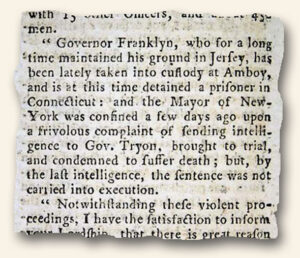 In June 1776, as British forces threatened New York, General George Washington faced betrayal within his own ranks. Thomas Hickey, an Irish-born soldier and member of Washington’s elite Life Guard, became central to a Loyalist conspiracy reportedly backed by New York Governor William Tryon. The plot allegedly involved recruiting guardsmen, sabotaging supplies, and possibly assassinating Washington when British troops arrived.
Hickey’s downfall began when he was arrested for passing counterfeit money. While jailed, he bragged to fellow prisoner Isaac Ketcham about enlisting Life Guardsmen and receiving payments from Loyalists. Ketcham alerted authorities, exposing the scheme.
On June 26, Hickey faced a swift court-martial. Charged with mutiny, sedition, and corresponding with the enemy, he was convicted on witness testimony and sentenced to death by hanging. Washington approved the sentence the next day.
On June 28—the same day John Adams was presenting Thomas Jefferson’s draft of the Declaration of Independence to the Continental Congress in Philadelphia—Hickey was hanged before an estimated 20,000 soldiers and civilians near Bowery Lane in Manhattan. Washington ordered the mass attendance to deter treason, making Hickey the first Continental soldier executed for such crimes. The event underscored the fragility of the Patriot cause and reinforced discipline on the eve of battle.
Coverage of this conspiracy can be found in THE LONDON CHRONICLE, August 8, 1776. Ironically, parts of this British plot can also be found in THE GENTLEMAN’S MAGAZINE, August 1776 … the same GENTLEMAN’S MAGAZINE containing the entire printing of the Declaration of Independence. 
If you liked this post, you may also enjoy...
- When did the “Gentleman’s Magazine” print the Declaration of Independence?
- Most historic: The Declaration of Independence in your collection…
- The Declaration of Independence…Our Lives, Our Fortunes and Our Sacred Honor…
- The Founding of the CIA… John Jay’s Committee for Detecting and Defeating Conspiracies…
- Editorial policy (?) and the potential impact upon an issue’s collectibility…
Strong Foundation … Liberty Takes Continual Work …
July 6, 2026 by Laura Heilenman · Leave a Comment Email This Post
| Print This Post
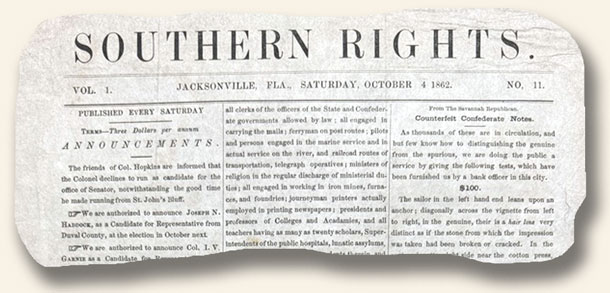
On October 4, 1862, the SOUTHERN RIGHTS out of Jacksonville, Florida had a fascinating issue with a story similar to that of the iconic Vicksburg Daily Citizen issue of July 4, 1863, when the Union troops found the newspaper still in the press, changed the final paragraph to report the Union takeover, and printed the issue.
The SOUTHERN RIGHTS newspaper’s story is found in a listing by the American Antiquarian Society and is as follows:
“Captain Valentine B. Chamberlain was in command of a company of the 7th Connecticut Volunteers who found the printing office and actually printed the issue for Oct. 4, 1862 from the standing type with Capt. Chamberlain’s addition in the first column on page 1 (see below). They then burnt the office and removed the press and types. The Oct. 4, 1862 issue was reissued in Hilton Head, South Carolina by Chamberlain, although retaining the Jacksonville imprint; and also reissued later in Jacksonville by the original printers once they had re-established their shop.
Printed at the bottom of this broadside issue is the following: Explanation–when the U.S. Forces under brigadier general J.M. Brannon visited Jacksonville, Fla., the form of the ‘Southern rights’ was found standing in this office just as it was left by the skedaddling rebels. The office was immediately ‘cleaned out,’ and–there being more ‘devils’ than printers present– the form was thrown into ‘pi’ in less time than it takes to write it. A proof sheet coming into our possession, we re-print the sheet as near like the original as possible, for the purpose of showing to our friends in the North, the ‘talent, vigor, heroism and military ardor’ that is not displayed in this trophy of Jacksonville.”–signed: Printers.
Captain Chamberlain’s addition mentioned above is headed: “Notice”, and reads, much tongue-in-cheek: “The Editor of this paper is absent from town for a few days on urgent business in the interior. It is therefore announced that the publication of this paper will hereafter be weekly suspended as it has been heretofore, weakly continued.
The taking of our battery after a loss of courage, but no blood, and the presence of the Yankee fleet, and the fearful proximity of Gen. Brannan and his forces, render the ‘Southern Rights’ precarious.”
If you liked this post, you may also enjoy...
- Rare Newspapers found on The Freedom Trail…
- This famous Confederate issue, with a contemporary explanation…
- Southern Illustrated News images on Pinterest…
- “All the News That’s Fit to Print”… one editor gets it right…
- Washington’s first newspaper…
The Declaration of Independence…Our Lives, Our Fortunes and Our Sacred Honor…
July 4, 2026 by Laura Heilenman · Leave a Comment Email This Post
| Print This Post
 For roughly 5,000 years of recorded history, human civilization largely moved at a glacial pace. Empires rose and fell under kings, emperors, and tyrants. Most people lived under arbitrary rule, with limited rights, widespread slavery or serfdom, and slow technological and economic advancement. Then, in a remarkable burst beginning in the late 18th century, progress exploded, accelerated by the American Founding.
The Founders didn’t invent ideas from nothing—they synthesized the best principles from millennia of human experience, rooted in natural law, Judeo-Christian morality, English common law, and selective Enlightenment thought. They implemented these ideas into a new system of government that protected individual liberty and unleashed human potential like never before.
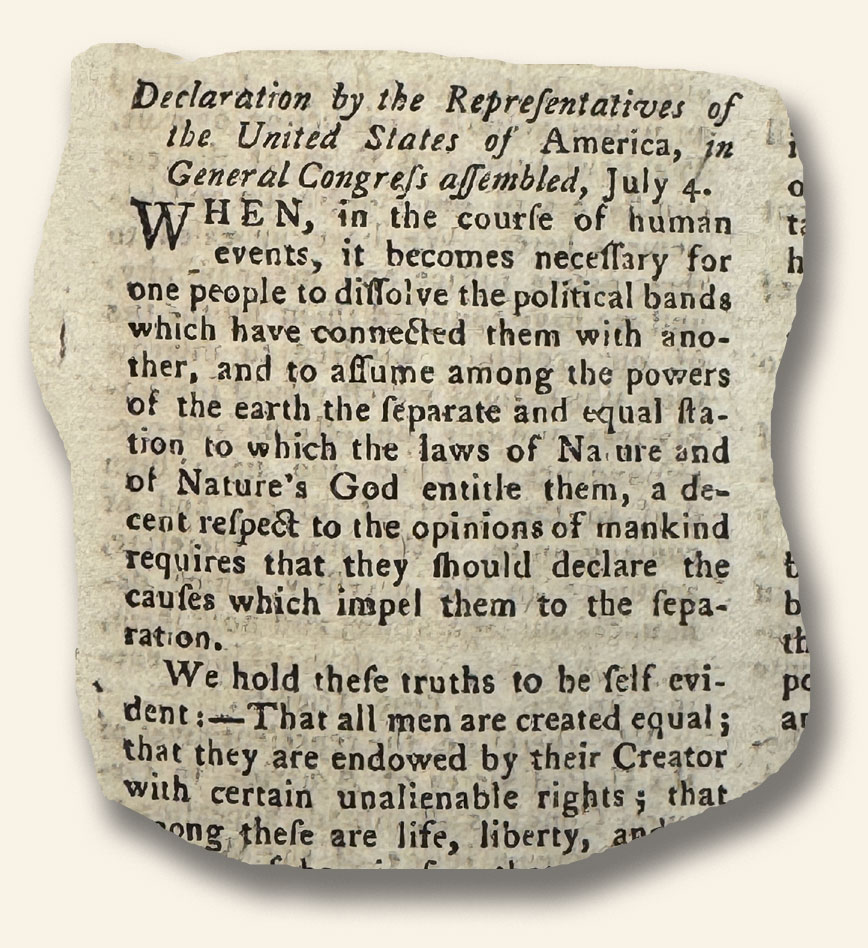
The intellectual roots of the Declaration of Independence (photo shown is from The Gentleman’s Magazine, London, August, 1776) stretch back thousands of years. Natural Law formed the bedrock with ancient thinkers like Aristotle and Cicero describing universal principles of justice discoverable by reason. Medieval Christian philosophers, especially Thomas Aquinas, integrated this with divine order. English common law and documents like the Magna Carta (1215) began limiting monarchical power and affirming rights.
Judeo-Christian traditions emphasized the inherent dignity of every person created in God’s image, moral accountability, and the idea that rulers are not above the law.
The Enlightenment provided key modern refinements. John Locke’s Second Treatise of Government (1689) powerfully argued for natural rights to life, liberty, and property; government by consent of the governed; and the right of the people to overthrow tyranny. Montesquieu influenced ideas of separated powers.
The American colonists, steeped in these traditions through education, sermons, and experience with British overreach, saw the Crown’s actions as violations of these timeless principles. They didn’t seek to create something entirely novel but to restore and perfect ancient liberties in a new republic.
The Declaration didn’t end history’s challenges, but it marked a turning point. By grounding government in natural law, consent, and unalienable rights—while building institutions around virtue, limited power, and free enterprise—the Founders created conditions where human potential could flourish as never before.
Below you will find the fruit of the painstaking assembly of thoughts these Founders labored through, searching history & the heart of their creator to lay a framework for all mankind. Today of all days, may we appreciate their singular focus on creating a republic that would last and inspire others.
Declaration of Independence: A Transcription | National Archives
If you liked this post, you may also enjoy...
- The Declaration of Independence – Jefferson’s Original Draft…
- A “hidden gem” within a 1785 newspaper leads to discovery, inspiration, and a correction…
- Stories Surrounding the Declaration of Independence… the Treason of Thomas Hickey…
- Most historic: The Declaration of Independence in your collection…
- More than just another anti-slavery newspaper… A recent find…
Catalog 368 (for July, 2026) is now available!
July 2, 2026 by GuyHeilenman · Leave a Comment Email This Post
| Print This Post
|
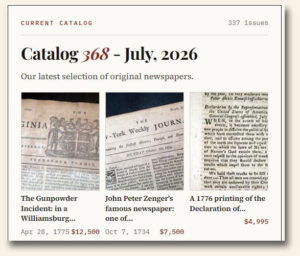 Catalog #368 (for July) is now available. For those residing in the United States: Happy 250th! For everyone… the links below will take you to the new catalog, a new video in the “Lead-Up to a Nation” series, a set of discounted newspapers, and the most recent post on the History’s Newsstand blog. Please enjoy!
|
If you liked this post, you may also enjoy...
- Announcing: Catalog #320 (for July, 2022) – Rare & Early Newspapers (for purchase)…
- Announcing: Catalog #316 (for March, 2022) – Rare & Early Newspapers (for purchase)
- Announcing: Catalog #332 for July, 2023 – Rare & Early Newspapers…
- Announcing: Catalog #319 (for June, 2022) – Rare & Early Newspapers (for purchase)
- Announcing: Catalog #318 (for May, 2022) – Rare & Early Newspapers (for purchase)
Phillis Wheatley… From Slave to Hero…
June 29, 2026 by Laura Heilenman · 1 Comment Email This Post
| Print This Post
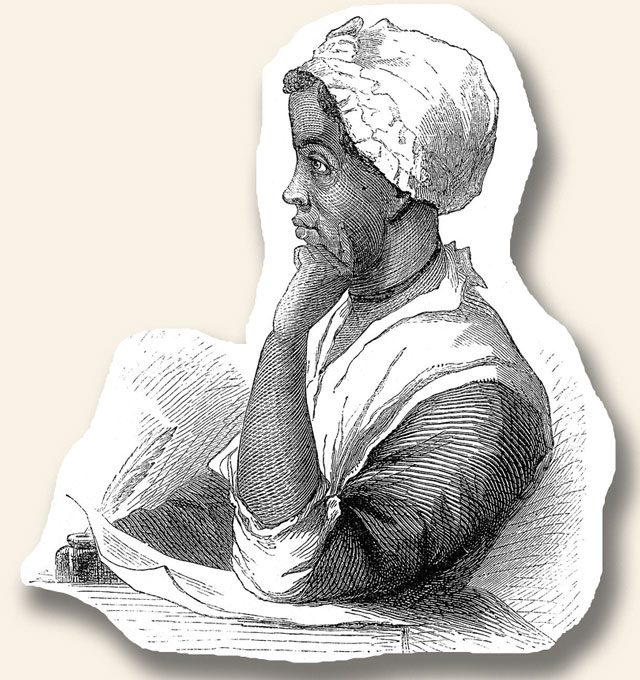 Few of us began our lives with hardships remotely resembling being kidnapped from Africa as a child, transported to a foreign land, and sold into slavery. The comfortable First World culture so many of us live in does not usually place upon our shoulders the kind of burden a child would carry from such an origin story. Although one might assume such a beginning would doom a child to destruction, that is not always the case. Sometimes people rise above their circumstances and seize any silver lining that comes their way. This is precisely what happened with Phillis Wheatley.
In the midst of unimaginable hardship, an enslaved teenager in colonial Boston penned verses that would echo through the centuries and earn her the distinction of being the first African American woman to publish a book of poetry. Her 1773 collection, Poems on Various Subjects, Religious and Moral, astonished readers on both sides of the Atlantic and challenged the era’s deeply held prejudices about race and intellect.
Among her most striking works is “On Imagination,,” a soaring neoclassical ode that celebrates the boundless power of the human mind. In it, Wheatley personifies Imagination as an “imperial queen” capable of transcending winter’s frost, traveling among the stars, and transforming harsh reality into beauty and joy. Written while she was still enslaved, the poem stands as a profound testament to mental freedom and creative resilience—the idea that even when the body is chained, the spirit and intellect can soar.
Though composed some 250 years ago, Wheatley’s words still resonate powerfully today, reminding us of the enduring strength of imagination in the face of adversity. Below is the entirety of this masterpiece. Perhaps allow your imagination to run free.
On Imagination
by Phillis Wheatley (1773)
Thy various works, imperial queen, we see,
How bright their forms! how deck’d with pomp by thee!
Thy wond’rous acts in beauteous order stand,
And all attest how potent is thine hand.
From Helicon’s refulgent heights attend,
Ye sacred choir, and my attempts befriend:
To tell her glories with a faithful tongue,
Ye blooming graces, triumph in my song.
Now here, now there, the roving Fancy flies,
Till some lov’d object strikes her wand’ring eyes,
Whose silken fetters all the senses bind,
And soft captivity involves the mind.
Imagination! who can sing thy force?
Or who describe the swiftness of thy course?
Soaring through air to find the bright abode,
Th’ empyreal palace of the thund’ring God,
We on thy pinions can surpass the wind,
And leave the rolling universe behind:
From star to star the mental optics rove,
Measure the skies, and range the realms above.
There in one view we grasp the mighty whole,
Or with new worlds amaze th’ unbounded soul.
Though Winter frowns to Fancy’s raptur’d eyes
The fields may flourish, and gay scenes arise;
The frozen deeps may break their iron bands,
And bid their waters murmur o’er the sands.
Fair Flora may resume her fragrant reign,
And with her flow’ry riches deck the plain;
Sylvanus may diffuse his honours round,
And all the forest may with leaves be crown’d:
Show’rs may descend, and dews their gems disclose,
And nectar sparkle on the blooming rose.
Such is thy pow’r, nor are thine orders vain,
O thou the leader of the mental train:
In full perfection all thy works are wrought,
And thine the sceptre o’er the realms of thought.
Before thy throne the subject-passions bow,
Of subject-passions sov’reign ruler thou;
At thy command joy rushes on the heart,
And through the glowing veins the spirits dart.
Fancy might now her silken pinions try
To rise from earth, and sweep th’ expanse on high:
From Tithon’s bed now might Aurora rise,
Her cheeks all glowing with celestial dies,
While a pure stream of light o’erflows the skies.
The monarch of the day I might behold,
And all the mountains tipt with radiant gold,
But I reluctant leave the pleasing views,
Which Fancy dresses to delight the Muse;
Winter austere forbids me to aspire,
And northern tempests damp the rising fire;
They chill the tides of Fancy’s flowing sea,
Cease then, my song, cease the unequal lay.
If you liked this post, you may also enjoy...
- Who’s Who in Newspapers – Robert Smalls edition…
- Juneteenth Revisited – “The rest of the story”…
- July 2026 Newsletter – Rare & Early Newspapers…
- Announcing: Catalog #261 (for August, 2017) is now available…
- Snapshot 1863… A slave mother’s attempted escape…
“Broken hearts cannot be photographed”… Matthew Brady…
June 26, 2026 by TimHughes · Leave a Comment Email This Post
| Print This Post
War has always inflicted its pains and sorrows upon a nation. But the brutality and reality of war never fully struck home until the Civil War. It was different.
Many lives were lost in the French & Indian War, the Revolutionary War, and the 19th century events of the War of 1812 and Mexican War, but until the invention of photography, there was a certain amount of callousness to what war was really about.
The Civil War changed all that, and perhaps one person, Matthew Brady, did more to make that change than anyone.
The Civil War was the first war to be photographed. In 1862, famed photographer Mathew Brady exhibited a series of pictures taken by protégés Alexander Gardner and James Gibson immediately after the Battle of Antietam. Gardner and Gibson, two of the many photographers Brady hired to document the war, produced at least 95 images at Antietam. Their images were the first to show dead bodies on the field.
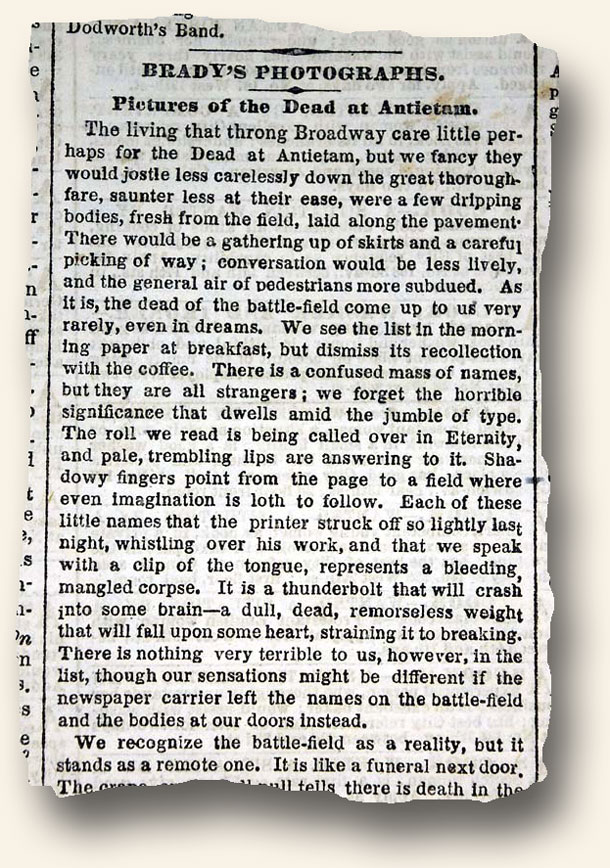
The October 20, 1862 issue of the “New York Times” contains one of the more moving articles on the horrors of war, brought home to the residents of New York through an exhibition of “Pictures of the Dead at Antietam” in Matthew Brady’s Manhattan Gallery.
The article is headed: “‘Brady’s Photographs” and it reports on the exhibition by comparing the brutality & reality of war, to the callousness of New York’s residents who read the daily papers but did not relate to the horrors they reported.
The article is extremely well-written, taking most of a column. The full text can be seen in the attached photos, however a few bits are worthy of noting here: “The living that throng Broadway care little perhaps for the dead at Antietam, but…they would jostle less carelessly down the great thoroughfare, saunter less at their ease, were a few dripping bodies, fresh from the field, laid along the payment…We see the list in the morning papers…but dismiss its recollection with the coffee. There is a confused mass of names, but they are all strangers…We recognize the battle-field as a reality, but it stands as a remote one…” with more.
Then: “Mr. Brady has done something to bring home to us the terrible reality and earnestness of war. If he has not brought bodies and laid them in our dooryards and along the streets, he has done something very like it. At the door of his gallery hangs a little placard, ‘The Dead of Antietam’…There is one side of the picture that the sun did not catch…It is the background of widows and orphans, torn from the bosom of their natural protectors by the red remorseless hand of Battle, and thrown upon the fatherhood of God. Homes have been made desolate & the light of life in thousands of hearts has been quenched forever. All of this desolation imagination must paint–broken hearts cannot be photographed…” and much more.
In 50 years of selling early newspapers, this issue most powerfully brings home the grief, sorrows, tragedies, realities, and unanswered questions that war inflicts upon a nation. What a difference a photograph can make.
If you liked this post, you may also enjoy...
- Pictures… Is a thousand words always enough?
- Yes, he’s dead again (but not really)…
- July 2026 Newsletter – Rare & Early Newspapers…
- The Civil War… 150 years ago today… April 27, 1861
- The Traveler… digging into his job…
Spinning the Yarn: The Power of Newspapers as Primary Sources…
June 21, 2026 by GuyHeilenman · Leave a Comment Email This Post
| Print This Post
A collecting friend of ours has published a newspapers-tethered book that might interest many of you. The following summary is provided in case you’d like to take a look:
Spinning the Yarn—written by author Paul M. Bohannon—offers a compelling and original contribution to early baseball history, grounded firmly in the rich evidentiary value of historic newspapers. Drawing extensively from period sources such as Porter’s Spirit of the Times and the Sunday Mercury, the book highlights how contemporary reporting captured not just the scores of early games, but the culture, personalities, and pivotal moments that shaped the sport.
One of the book’s most intriguing revelations centers on an 1855 dinner hosted by Samuel Godwin, president of Brooklyn’s Putnam Base Ball Club. This gathering—held after a decisive victory—brought together players, dignitaries, and crucially, newspaper representatives. As documented in these early publications, the evening marked a turning point: an intentional and strategic outreach to the press that helped ignite sustained baseball coverage. The following year’s reports, including detailed accounts of the Putnam Club’s contests, reveal the emergence of a narrative style that would evolve into modern sports writing.
We extend our thanks (and best wishes for success) to Paul for demonstrating so powerfully how (rare &) early newspapers serve as invaluable primary sources for uncovering and preserving… and in this instance, instrumental on forming the story of America’s past.
[newspapers with baseball content]
If you liked this post, you may also enjoy...
- “Take Me Out to the Ball Game” – Historic Baseball Coverage…
- Reporting the world of sports…
- They put it in print… Cheating in baseball predates the “Black Sox” scandal of 1919…
- Women and baseball… Have things changed?
- Lead-up to a Nation… as reported in the newspapers of the day (December, 1775)…
June 20, 2026 by GuyHeilenman · Leave a Comment Email This Post
| Print This Post
Extra, Extra, Read All About It!
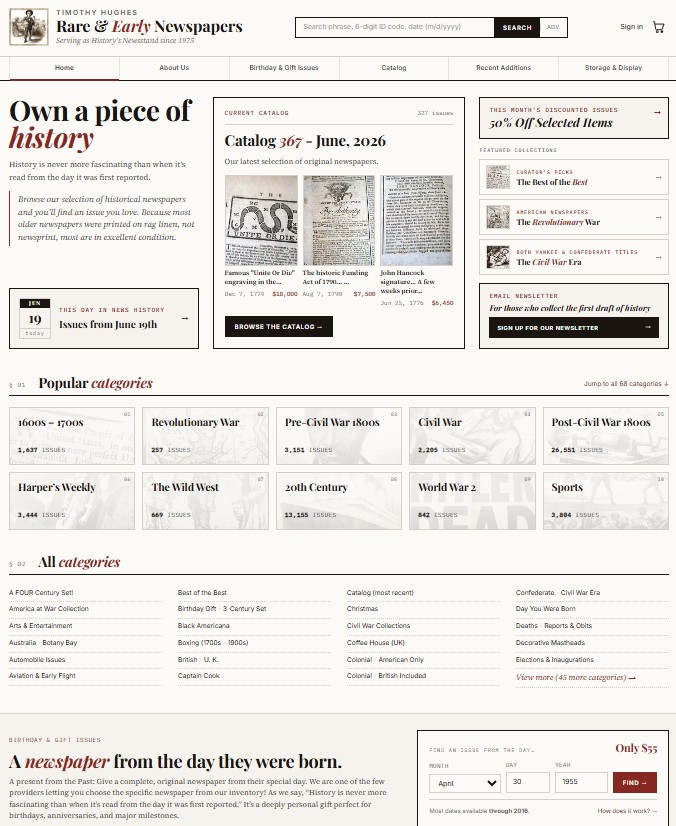
After two decades, we (Timothy Hughes Rare & Early Newspapers), have a brand-new website!
The enhancements are best enjoyed first-hand.
Start your discovery at:
RareNewspapers.com
If you liked this post, you may also enjoy...
- Contest/drawing… humorous nuggets…
- The end of an era… Thank you Jerry…
- Finding little gems within volumes of old newspapers…
- Civil War Era Newspapers on Pinterest…
- More than what meets the eye – categories on the RareNewspapers.com website…
Juneteenth… The Nuances of Slavery’s End…
June 19, 2026 by Laura Heilenman · Leave a Comment Email This Post
| Print This Post
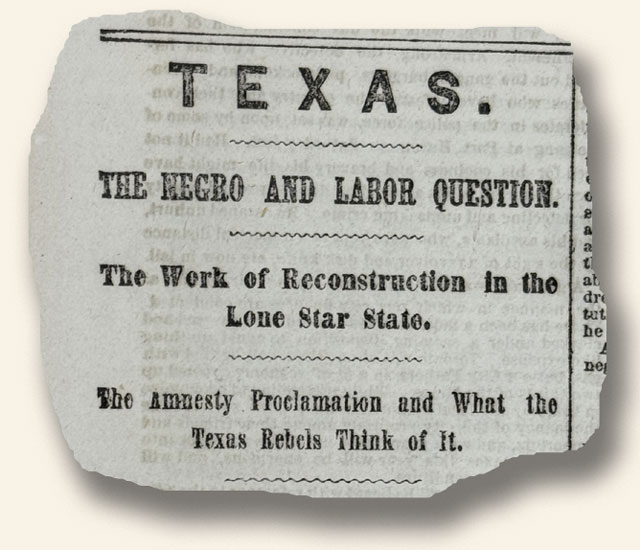 The saying, “History is a set of lies agreed upon,” often attributed to Napoleon, reminds us how easily we can simplify the past. A few days ago, I read about the story of General Granger’s landmark announcement in Galveston on June 19, 1865. Today, while digging deeper into the same moment, I came across Colonel G.W. Clark’s follow-up order issued in Houston just three days later. Reading both orders side by side offers a fascinating window into how emancipation actually unfolded on the ground in Texas.
General Granger’s General Order No. 3 was the pivotal statewide declaration that brought the Emancipation Proclamation to the last major Confederate holdout. Addressed to “the people of Texas,” it formally informed roughly 250,000 enslaved people that they were free, stressing “absolute equality of personal rights and rights of property” and transforming the old master-slave relationship into one of “employer and hired labor.” Its importance cannot be overstated: this was the public, official moment that ended legal slavery in Texas and gave birth to Juneteenth as a day of celebration and remembrance.
Colonel Clark’s General Orders No. 3, issued on June 22, 1865, for the Post of Houston, played a more localized but equally necessary role. It provided the practical instructions needed to prevent chaos in a major occupied city, directing freedmen to remain temporarily with former owners while reassuring them that doing so would “forfeit none of their rights of freedom.” Clark added details about upcoming labor contracts and consequences for idleness, showing the administrative work required to turn grand declarations into orderly reality.
Though both orders advanced the same goal of peaceful transition, their tones on freedom differed in telling ways. Granger’s language was bold and expansive, celebrating equality and a clean break with the past. Clark’s was more measured and reassuring, carefully balancing direction with the promise that freedom remained intact. Reading them together reveals how emancipation was not a single dramatic event but a layered process—announced with inspiring clarity in one breath and managed with cautious practicality in the next. In that sense, these two orders from 1865 still rhyme with the challenges of turning high ideals into lived experience.
If you liked this post, you may also enjoy...
- Juneteenth Revisited – “The rest of the story”…
- June 19, 1865 – The historical foundation of “Juneteenth”…
- You’re Now Free – so get to work and don’t expect help!
- Snapshot 1864… Confederacy’s fight – for independence or slavery?
- Let Freedom Ring. . . The Emancipation Proclamation …
Most Important Election Ever… Washington Takes the Reins…
June 12, 2026 by Laura Heilenman · Leave a Comment Email This Post
| Print This Post
If you liked this post, you may also enjoy...