
Search
The Rare & Early Newspapers Hobby

Receive the Newsletter

Buy Historic Newspapers

Advice to the working men of England…
October 22, 2011 by TimHughes · Leave a Comment  Email This Post
|
Email This Post
|  Print This Post
The very first issue of: “The British Workman” from London, our item 541456, offers advice from Lord Palmerston, a British statesman and two-time Prime Minister of the United Kingdom, which included forward-thinking comments no the use of tobacco. The comments on alcohol are very appropriate today as well:
If you liked this post, you may also enjoy...
- Ten Golden Rules…
- Who will be the Superpowers of the 22nd century?
- The Traveler… war declared…
- Oddball collecting ideas – advice columns through time…
- Some back-handed compliments for Abe Lincoln…
The Civil War… October 19, 1861…
October 19, 2011 by GuyHeilenman · Leave a Comment Email This Post
| Print This Post
This week we continue with the our reflection upon the Civil War events of 150 years ago… as seen through the eyes of the original readers of the Harper’s Weekly issue printed for October 19, 1861.
Note: The following commentary was written by Dr. James Robertson* as part of a weekly review for the reprint edition of the “Harper’s Weekly” which was done at the 100th anniversary of the Civil War. It provides much insight into the events of the day and scholarly commentary on both the illustrations and reporting found in the original 1861 newspaper.

* The Virginia Tech website provides the credentials of Dr. James Roberson:
“One of the most distinguished names in Civil War history, Dr. Robertson was Executive Director of the U.S. Civil War Centennial Commission and worked with Presidents Truman, Kennedy, and Johnson in marking the war’s 100th anniversary. Today his Civil War Era course at Virginia Tech, which attracts 300 students per semester, is the largest of its kind in the nation.
The Danville, Va., native is the author or editor of more than 20 books that include such award-winning studies as “Civil War! America Becomes One Nation”, “General A.P. Hill”, and “Soldiers Blue and Gray”. His massive biography of Gen. “Stonewall” Jackson won eight national awards and was used as the base for the Ted Turner/Warner Bros. mega-movie, “Gods and Generals”. Robertson was chief historical consultant for the film.”
If you liked this post, you may also enjoy...
- The Civil War… October 26, 1861…
- The Civil War… October 12, 1861…
- The Civil War… October 5, 1861…
- The Civil War… December 21, 1861…
- The Civil War… December 7, 1861…
The Traveler… we’ve come a long way baby…
October 17, 2011 by The Traveler · Leave a Comment Email This Post
| Print This Post
This week I traveled to The Woman’s Journal of October 14, 1911. This issue was celebrating after waiting two days for the outcome of the California election on the  suffrage vote… “reading first with despair, then with growing hope and finally with jubilation the conflicting reports that came over the wires… Praise God. Victory ours. Four thousand majority.” The front page contains a photo of the Statue of Liberty with six stars surrounding her. These represented the states which have passed the “equal suffrage” — Wyoming, Colorado, Utah, Idaho, Washington and now adding California.
The 1848 Seneca Falls Convention is traditionally viewed as the beginning of the Women’s Rights Movement. It was not until June 4, 1919 that Congress sent the proposal for the 19th Amendment, the woman’s right to vote, and then it was not until August 18, 1920 that the final ratification was passed, by the vote from Tennessee. It was a long road, but “we’ve come a long way baby” since then!
~The Traveler
If you liked this post, you may also enjoy...
- The Traveler… suffrage is defeated… groom and bride-to-be divided…
- The Woman’s Rights Convention, Seneca Falls, 1848…
- The Traveler… election time of the year… Standard Oil anti-trust case…
- The Traveler… Too Much Pain and Suffraging…
- Snapshot 1847… Woman’s Suffrage meets dripping sarcasm…
The Civil War… October 12, 1861…
October 12, 2011 by GuyHeilenman · Leave a Comment Email This Post
| Print This Post
This week we continue with the our reflection upon the Civil War events of 150 years ago… as seen through the eyes of the original readers of the Harper’s Weekly issue printed for October 12, 1861.
Note: The following commentary was written by Dr. James Robertson* as part of a weekly review for the reprint edition of the “Harper’s Weekly” which was done at the 100th anniversary of the Civil War. It provides much insight into the events of the day and scholarly commentary on both the illustrations and reporting found in the original 1861 newspaper.

* The Virginia Tech website provides the credentials of Dr. James Roberson:
“One of the most distinguished names in Civil War history, Dr. Robertson was Executive Director of the U.S. Civil War Centennial Commission and worked with Presidents Truman, Kennedy, and Johnson in marking the war’s 100th anniversary. Today his Civil War Era course at Virginia Tech, which attracts 300 students per semester, is the largest of its kind in the nation.
The Danville, Va., native is the author or editor of more than 20 books that include such award-winning studies as “Civil War! America Becomes One Nation”, “General A.P. Hill”, and “Soldiers Blue and Gray”. His massive biography of Gen. “Stonewall” Jackson won eight national awards and was used as the base for the Ted Turner/Warner Bros. mega-movie, “Gods and Generals”. Robertson was chief historical consultant for the film.”
If you liked this post, you may also enjoy...
- The Civil War… October 5, 1861…
- The Civil War… October 26, 1861…
- The Civil War… October 19, 1861…
- The Civil War… December 21, 1861…
- The Civil War… December 7, 1861…
Condition and pricing…
October 10, 2011 by TimHughes · 3 Comments Email This Post
| Print This Post
 Many collectors may wonder what the relationship is between the condition of a newspaper and its price. Obviously the condition of a newspaper is subjective, and some problems bother some collectors more than others. But for issues offered through our company here are my thoughts as to how I price our newspapers:
* “Natural” faults are less of a problem than human-created. By this I mean problems with foxing (a darkening of portions due to the natural aging of the chemicals in the paper or the environment in which the newspaper was stored), folds, and minor edge tears. Such disfigurements are to be expected with newspapers of a certain age, and if considerable do affect the price but less so than other disfigurements. Even water staining I would consider a natural fault and can be excused as something to be expected and a minor problem if not causing loss of readability.
* Human-created disfigurements would include old tape mends & stains, trimming at the margins such that letters or words are partially shaved (caused when the bindery cuts too close to the text), lengthy tears into text, holes, portions clipped, etc. Such problems are annoying & could have been avoided with better care and I tend to discount the price of a newspaper more liberally than newspapers with natural faults. How much? It depends on the degree of the problem, so subjectivity is very important. If a newspaper has a noteworthy report which is not affected by the damage, it would be discounted less than had the notable report been affected. A small 2 by 1 inch piece clipped from the back leaf would be discounted less than a 2 by 10 inch clipped issue. A disfigurement to an inside page might result in a minimal price adjustment if the issue is offered for the displayability of the front page.
* Irregular margins, caused when a newspaper is improperly removed from a bound volume, will result in lowered values if the irregularity causes loss of type. Most irregular margins involve only the blank spine & the price adjustment would be minimal.
* Some damaged issues are relegated to our damaged pile to be sold in lots of 100 or more at a discounted price. But rare or historic issues are offered individually & priced according to the damage. Many collectors are attracted to damaged, discounted newspapers as they provide an opportunity for rare or historic reports at a much lower cost.
* Particularly bothersome to me are issues which are close-trimmed. Had the worker doing the trimming at the bindery been more carefully such faults could easily be avoided.
* Less bothersome are wear problems with “never bound” newspapers. Such issues are in their natural state as provided to the subscriber or sold on the newsstand, and logically tend to be more worn than issues taken from bound volumes. Such natural wear, when minimal, adds a certain patina to the item and would not detract from its value. For serious collectors, never-bound issues are preferable to issues from bound volume, but tend to be considerably less common.
* Guillotined issues, which are mechanically cut cleanly at the spine to facilitate microfilming, is a minor disfigurement if ample spine margin remains. Depending on the issue we might rejoin the issue at the spine with glue, rejoin using archival tape, or simply keep the issue loose.
* Repairing issues can be controversial. Some believe in repairing tears and others prefer they be left as is. In general I tend to repair rather than not repair. My primary reason is to prevent further tearing which can occur when a leaf is turned, as a tear is a weak spot which often gets worse when handling. We use a very thin strip of archival tape which does not stain and is almost invisible if properly used. When an issue is extensively repaired mention is made in the description. A newspaper’s price may be affected when archivally repaired, depending on the extensiveness of such repairs.
If you liked this post, you may also enjoy...
- Uncut newspapers: leave as they are?
- The reason I collected it: never-bound issues…
- The reason I collected it: magazines in original bindings…
- Removing old newspapers from bound volumes (disbinding)…
- Wrappers and no wrappers…
How Sitting Bull got his name…
October 8, 2011 by TimHughes · Leave a Comment Email This Post
| Print This Post
This interesting tidbit appeared in the “Pittsfield Sun“, Massachusetts, March 16, 1881 issue: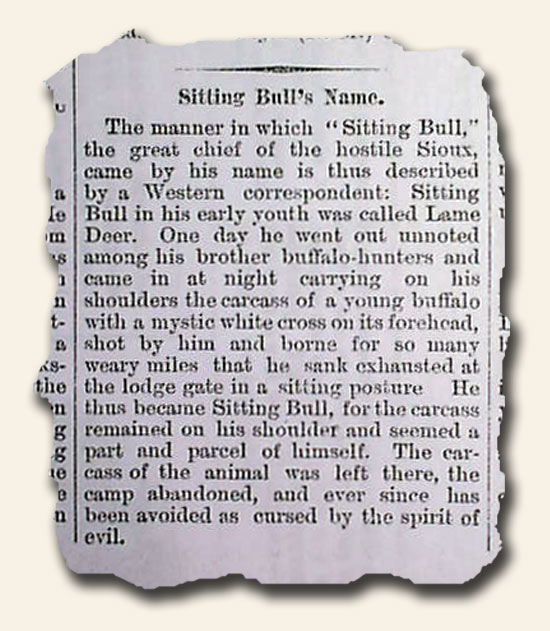
If you liked this post, you may also enjoy...
- Definition of “half drunk” and “whole drunk”…
- How bad do you have to dress to offend a horse?
- Perhaps we should increase the size of our coffins…
- They put it in print… A life-preserving mattress?
- Stating the obvious…
The Civil War… October 5, 1861…
October 5, 2011 by GuyHeilenman · Leave a Comment Email This Post
| Print This Post
This week we continue with the our reflection upon the Civil War events of 150 years ago… as seen through the eyes of the original readers of the Harper’s Weekly issue printed for October 5, 1861.
Note: The following commentary was written by Dr. James Robertson* as part of a weekly review for the reprint edition of the “Harper’s Weekly” which was done at the 100th anniversary of the Civil War. It provides much insight into the events of the day and scholarly commentary on both the illustrations and reporting found in the original 1861 newspaper:

* The Virginia Tech website provides the credentials of Dr. James Roberson:
“One of the most distinguished names in Civil War history, Dr. Robertson was Executive Director of the U.S. Civil War Centennial Commission and worked with Presidents Truman, Kennedy, and Johnson in marking the war’s 100th anniversary. Today his Civil War Era course at Virginia Tech, which attracts 300 students per semester, is the largest of its kind in the nation.
The Danville, Va., native is the author or editor of more than 20 books that include such award-winning studies as “Civil War! America Becomes One Nation”, “General A.P. Hill”, and “Soldiers Blue and Gray”. His massive biography of Gen. “Stonewall” Jackson won eight national awards and was used as the base for the Ted Turner/Warner Bros. mega-movie, “Gods and Generals”. Robertson was chief historical consultant for the film.”
If you liked this post, you may also enjoy...
- The Civil War… October 12, 1861…
- The Civil War… October 26, 1861…
- The Civil War… October 19, 1861…
- The Civil War… December 21, 1861…
- The Civil War… December 7, 1861…
The Traveler… the dam burst… the judge “solomonizes” it…
October 3, 2011 by The Traveler · Leave a Comment Email This Post
| Print This Post
 In the travels of The New York Tribune dated October 3, 1911, I found several reports on the destruction of the town of Austin, Pennsylvania. This occurred just a few days prior and was the result of the breaking of a fifty foot high and thirty foot wide concrete dam which then flooded this small town, destroying everything in its path.
In contrast to the above tragedy… A bit of an amusing story is included of a court case which involved the owners of two cows, each of which became the mother to a calf. They wanted to have the court decide which rightfully owned the calf. The magistrate literally took to the fields (the pasture) and “solomonized” his decision by the conduct of the cows and the calf. See image for details.
~The Traveler
If you liked this post, you may also enjoy...
- The Traveler… up the canal… ready to sign on the dotted line…
- The Traveler… the monolopy is ended… hoping for better sailing ahead…
- The Traveler… victory over Indians… horrible finding…
- Deciding which newspapers to offer – Bond Hall Explosion edition…
- The Traveler… Standard Oil dissolved… now that makes sense…
Newspaper publisher shows his bias…
October 1, 2011 by TimHughes · 1 Comment Email This Post
| Print This Post
This curious item appeared in “The Weekly Crescent City” newspaper from New Orleans, August 15, 1841. He goes to some length to show the value in paying for a subscription…
If you liked this post, you may also enjoy...
- A related collectible…
- They put it in print… Not much hope for a reconciliation…
- Words of wisdom…
- Desperate spy tactics…
- The first newspaper in Kentucky…
The Civil War… September 28, 1861…
September 28, 2011 by GuyHeilenman · Leave a Comment Email This Post
| Print This Post
We continue with the our reflection upon the Civil War events of 150 years ago… as seen through the eyes of the original readers of the Harper’s Weekly issue printed for September 28, 1861.
Note: The following commentary was written by Dr. James Robertson* as part of a weekly review for the reprint edition of the “Harper’s Weekly” which was done at the 100th anniversary of the Civil War. It provides much insight into the events of the day and scholarly commentary on both the illustrations and reporting found in the original 1861 newspaper:

* The Virginia Tech website provides the credentials of Dr. James Roberson:
“One of the most distinguished names in Civil War history, Dr. Robertson was Executive Director of the U.S. Civil War Centennial Commission and worked with Presidents Truman, Kennedy, and Johnson in marking the war’s 100th anniversary. Today his Civil War Era course at Virginia Tech, which attracts 300 students per semester, is the largest of its kind in the nation.
The Danville, Va., native is the author or editor of more than 20 books that include such award-winning studies as “Civil War! America Becomes One Nation”, “General A.P. Hill”, and “Soldiers Blue and Gray”. His massive biography of Gen. “Stonewall” Jackson won eight national awards and was used as the base for the Ted Turner/Warner Bros. mega-movie, “Gods and Generals”. Robertson was chief historical consultant for the film.”
If you liked this post, you may also enjoy...