
Search
The Rare & Early Newspapers Hobby

Receive the Newsletter

Buy Historic Newspapers

When did the “Gentleman’s Magazine” print the Declaration of Independence?
November 14, 2011 by TimHughes · 5 Comments  Email This Post
|
Email This Post
|  Print This Post
 Fellow collector Michael Gulvin asks a question which many other collectors may have wondered: “On what day of the month did the Gentleman’s Magazine for August, 1776 become available? We have a time-line for the American newspapers, and we know that the London Chronicle printed the Declaration in its August 17th issue, but do we know the actual date the Gentleman’s Magazine printed the Declaration of Independence for its August issue?”
Magazines typically published very late in the month shown on the title/contents page. With the “London Chronicle” publishing the Declaration of Independence in its August 17, 1776 issue, and presuming they had interest in publishing such a significant document as early as possible, it is presumed the Declaration was received in London very close to that date. Their previous issue was dated Aug. 15, so August 15-17 would be the presumed period when the document arrived in London. It is curious to note that the “London Gazette” never printed the Declaration of Independence.
Monthly publications are more difficult to pin down in terms of publication dates, however datelines of news reports found within offer great clues. The Historical Chronicle near the back of the August issue of the “Gentleman’s Magazine” has datelines beginning July 10 and the latest date mentioned is August 31, the very last day of the month. Obviously the magazine could not have printed prior to August 31, so the first day or two of September would be the presumed printing dates.
The same was true with American magazines as I recall the June, 1776 issue of “The Pennsylvania Magazine” had the very significant announcement that Congress had voted to approve the Declaration of Independence, with a dateline of July 2, 1776. Obviously that June issue was printed early the following month.
If you liked this post, you may also enjoy...
- Most historic: The Declaration of Independence in your collection…
- Print date for the Gentleman’s Magazine…
- Editorial policy (?) and the potential impact upon an issue’s collectibility…
- 18th century American magazines: one to share…
- Stories Surrounding the Declaration of Independence… the Treason of Thomas Hickey…
“Nursery Rhymes” on the Civil War…
November 12, 2011 by TimHughes · Leave a Comment Email This Post
| Print This Post
Parody songs are not uncommon on the airwaves today, particularly around Christmas time. Apparently adapting words to fit an existing tune–or poem–is nothing new as this May 17, 1865 issue of “The Springfield Daily Republican” shows (see below). These were certainly not the high-water mark of the varied Union responses to the end of the war: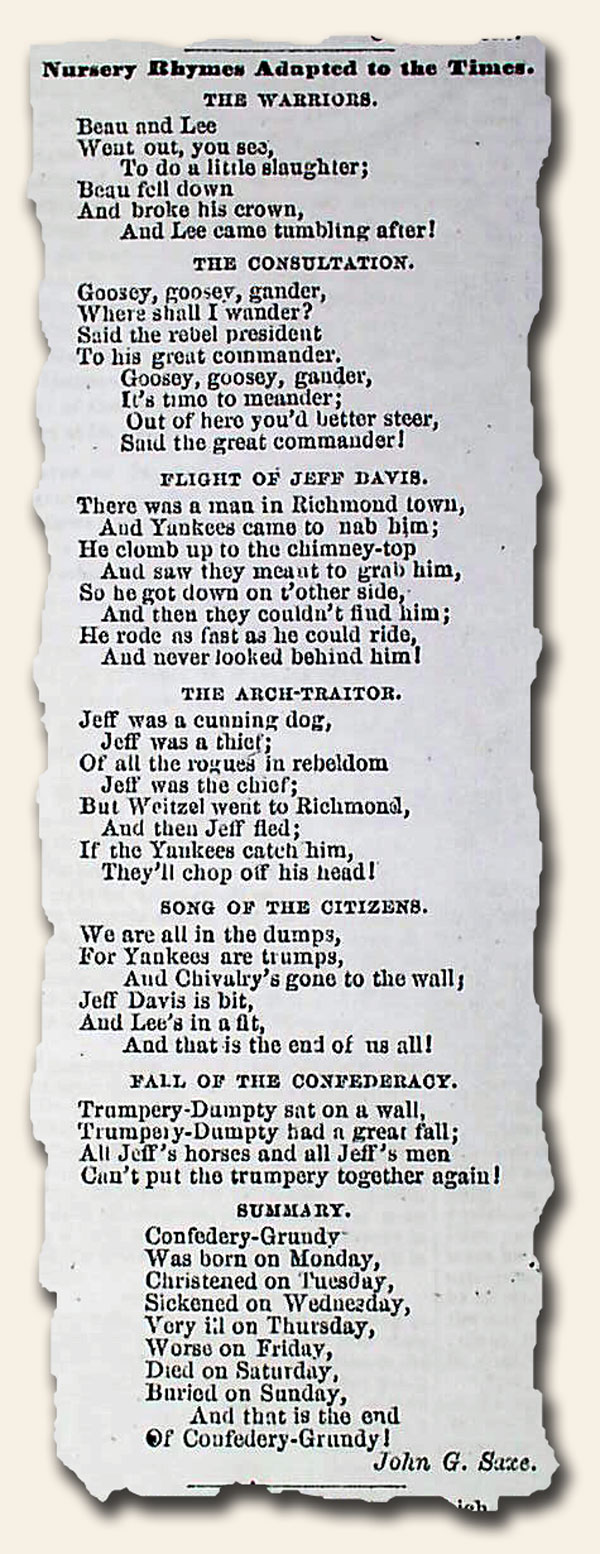
If you liked this post, you may also enjoy...
- Collecting spurs research, spurs “neat stuff”…
- Christmas through the eyes of a newspaper from 1794…
- They Put It In Print… FDR “packs” Supreme Court… In his own words…
- Snapshot 1969… Teddy Kennedy in hot water…
- Snapshot 1969… Teddy Kennedy (was) in cold water…
The Civil War… November 9, 1861…
November 9, 2011 by GuyHeilenman · Leave a Comment Email This Post
| Print This Post
This week we continue with the our reflection upon the Civil War events of 150 years ago… as seen through the eyes of the original readers of the Harper’s Weekly issue printed for November 9, 1861.
Note: The following commentary was written by Dr. James Robertson* as part of a weekly review for the reprint edition of the “Harper’s Weekly” which was done at the 100th anniversary of the Civil War. It provides much insight into the events of the day and scholarly commentary on both the illustrations and reporting found in the original 1861 newspaper.

* The Virginia Tech website provides the credentials of Dr. James Roberson:
“One of the most distinguished names in Civil War history, Dr. Robertson was Executive Director of the U.S. Civil War Centennial Commission and worked with Presidents Truman, Kennedy, and Johnson in marking the war’s 100th anniversary. Today his Civil War Era course at Virginia Tech, which attracts 300 students per semester, is the largest of its kind in the nation.
The Danville, Va., native is the author or editor of more than 20 books that include such award-winning studies as “Civil War! America Becomes One Nation”, “General A.P. Hill”, and “Soldiers Blue and Gray”. His massive biography of Gen. “Stonewall” Jackson won eight national awards and was used as the base for the Ted Turner/Warner Bros. mega-movie, “Gods and Generals”. Robertson was chief historical consultant for the film.”
If you liked this post, you may also enjoy...
- The Civil War… November 23, 1861…
- The Civil War… November 16, 1861…
- The Civil War… November 2, 1861…
- The Civil War… December 21, 1861…
- The Civil War… December 7, 1861…
The Traveler… the President’s State-of-the-Union address… a wife’s rebuttal…
November 7, 2011 by The Traveler · Leave a Comment Email This Post
| Print This Post
Today I traveled to the Columbian Centinel dated November 9, 1811 where I found the second page of this issue contained James Madison’s state-of-the-union message which was delivered on November 5th and is signed in type: JAMES MADISON. In the message, he reflects on the past year. He closes the address with “I cannot close this communication without expressing my deep sense of the crisis in which you are assembled…“. As we know we would soon be in the War of 1812.
Under a heading of “NOTICE” (see below) is an unusual, albeit difficult to read, posting for this time period. It is from a wife in response to a “notice” that had been posted earlier by her husband. From the reading of this, I think that he should have thought twice before making public notice!! The editor was kind enough to reprint her husband’s initial appeal above her response.
~The Traveler
If you liked this post, you may also enjoy...
- The Traveler… promise to pay…
- They put it in print… Forget the boxer: don’t mess with his wife…
- The Traveler… West Florida and fencing…
- The State of the Union… Did you know…?
- Interesting comments on Jesse James…
Ten Golden Rules…
November 5, 2011 by TimHughes · Leave a Comment Email This Post
| Print This Post
The very first issue of “The British Workman” from 1856, our item 541456, contains a list of “Ten Golden Rules” which are as appropriate today as they were over 150 years ago:
If you liked this post, you may also enjoy...
- Advice to the working men of England…
- From long before he would become famous…
- Golden Nugget Discovery Contest…
- Rules for mourning…
- From the Vault: American history in British newspapers…
The Civil War… November 2, 1861…
November 2, 2011 by GuyHeilenman · Leave a Comment Email This Post
| Print This Post
This week we continue with the our reflection upon the Civil War events of 150 years ago… as seen through the eyes of the original readers of the Harper’s Weekly issue printed for November 2, 1861.
Note: The following commentary was written by Dr. James Robertson* as part of a weekly review for the reprint edition of the “Harper’s Weekly” which was done at the 100th anniversary of the Civil War. It provides much insight into the events of the day and scholarly commentary on both the illustrations and reporting found in the original 1861 newspaper.

* The Virginia Tech website provides the credentials of Dr. James Roberson:
“One of the most distinguished names in Civil War history, Dr. Robertson was Executive Director of the U.S. Civil War Centennial Commission and worked with Presidents Truman, Kennedy, and Johnson in marking the war’s 100th anniversary. Today his Civil War Era course at Virginia Tech, which attracts 300 students per semester, is the largest of its kind in the nation.
The Danville, Va., native is the author or editor of more than 20 books that include such award-winning studies as “Civil War! America Becomes One Nation”, “General A.P. Hill”, and “Soldiers Blue and Gray”. His massive biography of Gen. “Stonewall” Jackson won eight national awards and was used as the base for the Ted Turner/Warner Bros. mega-movie, “Gods and Generals”. Robertson was chief historical consultant for the film.”
If you liked this post, you may also enjoy...
- The Civil War… November 23, 1861…
- The Civil War… November 16, 1861…
- The Civil War… November 9, 1861…
- The Civil War… December 21, 1861…
- The Civil War… December 7, 1861…
Colonial newspaper founded by a woman… A rare find…
October 31, 2011 by TimHughes · Leave a Comment Email This Post
| Print This Post
A recent collection which came into our inventory included a rare title which didn’t strike me until I looked more closely.
 “Salem Gazette” is a somewhat common from the 18th century so I wasn’t surprised to see the title when quickly examining the collection. But then I noticed the date from the Revolutionary War, which I thought odd. Upon investigation I found there were actually four different newspapers titled “Salem Gazette“, one from 1774-1775, one from 1781-85, and one from 1790 thru the 19th century. These latter two are were quite familiar to me, but our issue was yet a fourth title, one which I had never encountered in 35 years, and this one lasted but 36 issues during the year 1781. But of greater significance was that the masthead noted it was published by a woman, Mary Crouch. See the hyperlink for much more on her fascinating life, but suffice it to say she was no stranger to publishing a newspaper as she had much experience in South Carolina.
The hyperlinked article mentions she took over the publication of her husband’s (Charles) “South Carolina Gazette” after he died in 1772. She then began her own newspaper, the “Charlestown Gazette“, in August of 1778. When the British occupied her town in 1780, being a staunch patriot, she moved north to Salem, Massachusetts, where she began publishing this “Salem Gazette” in 1781. The number we have is dated February 6, 1781 and is issue number 6 of the 36 published (see the hyperlink). Relatively few institutions hold any issues of this title, and only four issues of this date are held by institutions.
There were a number of women who published newspapers in the 18th century & virtually all that I could discover did so by continuing a printing business upon the demise of their respective husbands. One exception was Mary Goddard who published the “Maryland Journal” during her brother’s absence from 1774-1783. But Anne Catherine Green took over her late husband’s “Maryland Gazette” upon his death in 1767; Hannah Watson took over her husband’s (Ebenezer) “Connecticut Courant” upon his death in 1777; Margaret Draper took over the “Massachusetts Gazette” upon the death of her husband Richard in 1774; Clementine Rind took over “The Virginia Gazette” in 1773 when her husband William died; and Ann Franklin published the “Newport Mercury” upon the death of her son James in 1762. I am sure there are others as well.
From what I could determine Mary Crouch may well be the first American woman to create a newspaper, and she did so twice. Her first being the “Charlestown Gazette” and her second the “Salem Gazette“. Any research to the contrary would be gratefully received and shared with our fellow collectors.
If you liked this post, you may also enjoy...
- Maryland’s first newspapers…
- South Carolina’s first newspapers…
- The first newspapers in North Carolina…
- The time lag in news reporting, 1776…
- In the beginning…
Mark Twain on Mark Twain…
October 29, 2011 by TimHughes · Leave a Comment Email This Post
| Print This Post
This item, originally appearing in the “Edinburgh Scotsman” was picked up by the “Jerusalem News” issue of March 20, 1920.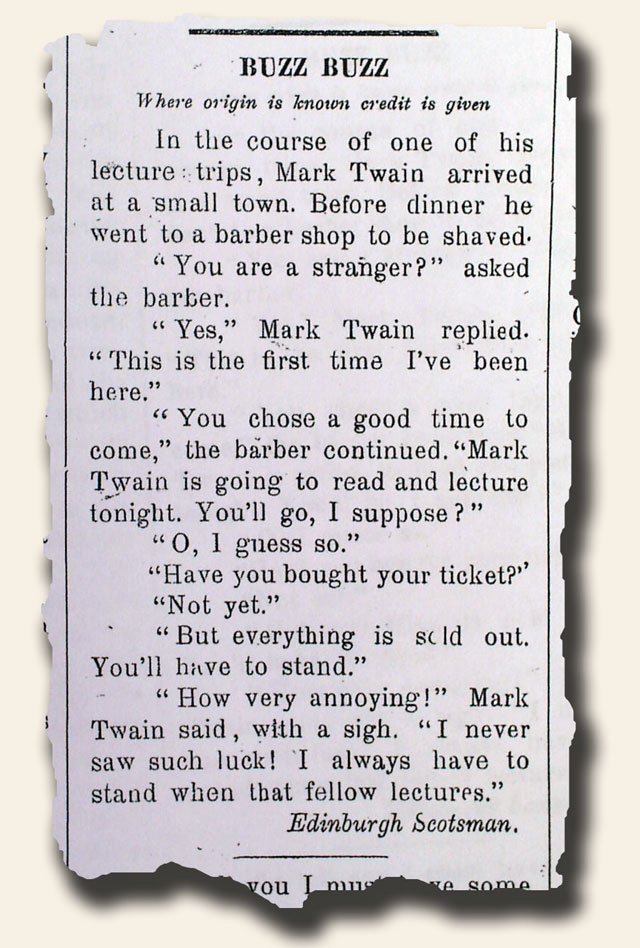
If you liked this post, you may also enjoy...
- Before they became famous…or “infamous”…
- Snapshot 1886… Mark Twain – yet another hidden gem…
- Mark Twain… on the Jews…
- The Traveler… Stamped out…
- March, 2024 Newsletter from Timothy Hughes Rare & Early Newspapers…
The Civil War… October 26, 1861…
October 26, 2011 by GuyHeilenman · Leave a Comment Email This Post
| Print This Post
This week we continue with the our reflection upon the Civil War events of 150 years ago… as seen through the eyes of the original readers of the Harper’s Weekly issue printed for October 26, 1861.
Note: The following commentary was written by Dr. James Robertson* as part of a weekly review for the reprint edition of the “Harper’s Weekly” which was done at the 100th anniversary of the Civil War. It provides much insight into the events of the day and scholarly commentary on both the illustrations and reporting found in the original 1861 newspaper.

* The Virginia Tech website provides the credentials of Dr. James Roberson:
“One of the most distinguished names in Civil War history, Dr. Robertson was Executive Director of the U.S. Civil War Centennial Commission and worked with Presidents Truman, Kennedy, and Johnson in marking the war’s 100th anniversary. Today his Civil War Era course at Virginia Tech, which attracts 300 students per semester, is the largest of its kind in the nation.
The Danville, Va., native is the author or editor of more than 20 books that include such award-winning studies as “Civil War! America Becomes One Nation”, “General A.P. Hill”, and “Soldiers Blue and Gray”. His massive biography of Gen. “Stonewall” Jackson won eight national awards and was used as the base for the Ted Turner/Warner Bros. mega-movie, “Gods and Generals”. Robertson was chief historical consultant for the film.”
If you liked this post, you may also enjoy...
- The Civil War… October 19, 1861…
- The Civil War… October 12, 1861…
- The Civil War… October 5, 1861…
- The Civil War… December 21, 1861…
- The Civil War… December 7, 1861…
Collector Eric Fettmann on Babe Ruth & Yankee Stadium…
October 24, 2011 by TimHughes · 2 Comments Email This Post
| Print This Post
 Our website item #584134 offers a New York Times newspaper from 1914 which has the earliest mention of Babe Ruth in that newspaper, and possibly any newspaper. Has anyone found earlier mention? The listing also mentions a report of a new Yankee Stadium being built–with an illustration of it–but I could find no documentation of it elsewhere. Eric offers further information on both with his comments:
Tim,
If you liked this post, you may also enjoy...