
Search
The Rare & Early Newspapers Hobby

Receive the Newsletter

Buy Historic Newspapers

The Battle of Los Angeles…
March 14, 2014 by TimHughes · 2 Comments  Email This Post
|
Email This Post
|  Print This Post
 The “Los Angeles Times–Extra” of February 24, 1942 has one of the more dramatic, screaming headlines to be found in any newspaper: “L.A. AREA RAIDED ! ” with a smaller head noting: “Jap Planes Peril Santa Monica, Seal Beach, El Segundo, Redondo, Long Beach, Hermosa, Signal Hill”. The report begins: “Roaring out of a brilliant moonlit western sky, foreign aircraft flying both in large formation and single, few over Southern California early today and drew heavy barrages of anti-aircraft fire–the first ever to sound over United States continental soil against an enemy invader…” (see).
The Battle of Los Angeles, also known as The Great Los Angeles Air Raid, is the name given to this rumored enemy attack and subsequent anti-aircraft artillery barrage which took place from late February 24 to early February 25, 1942 over Los Angeles. The incident occurred less than three months after the United States entered World War II as a result of the Japanese Imperial Navy’s attack on Pearl Harbor.
Initially, the target of the aerial barrage was thought to be an attacking force from Japan, but speaking at a press conference shortly afterward, Secretary of the Navy Frank Knox called the incident a “false alarm.” Newspapers of the time published a number of reports and speculations of a cover-up. Some modern-day UFOlogists have suggested the targets were extraterrestrial spacecraft. When documenting the incident in 1983, the U.S. Office of Air Force History attributed the event to a case of “war nerves” likely triggered by a lost weather balloon and exacerbated by stray flares and shell bursts from adjoining batteries.
Air raid sirens sounded throughout Los Angeles County on the night of February 24-25, 1942. A total blackout was ordered and thousands of air raid wardens were summoned to their positions. At 3:16 am the 37th Coast Artillery Brigade began firing .50 caliber machine guns and 12.8-pound anti-aircraft shells into the air at reported aircraft; over 1,400 shells would eventually be fired. Pilots of the 4th Interceptor Command were alerted but their aircraft remained grounded. The artillery fire continued sporadically until 4:14 am. The “all clear” was sounded and the blackout order lifted at 7:21 am.
Several buildings and vehicles damaged by shell fragments, and five civilians died as an indirect result of the anti-aircraft fire, three of them killed in car accidents in the ensuing chaos and two of heart attacks attributed to the stress of the hour-long action. The incident was front-page news along the U.S. Pacific coast, and earned some mass media coverage throughout the nation.(credit to Wikipedia)
If you liked this post, you may also enjoy...
- *Error headlines make interesting collectibles…
- Dramatic Headlines Speak for Themselves… WWII – Attack on Los Angeles…
- The Last Surviving Veterans Who Served at Pearl Harbor…
- The Traveler… Battle of Baltimore…
- Who’s Who in Newspapers? Denmark Vesey edition…
The peaceful transfer of power…
March 10, 2014 by GuyHeilenman · Leave a Comment Email This Post
| Print This Post
As we approach President’s Day, there is a part of me which is somewhat sentimental about my childhood memories surrounding Washington’s Birthday. I sure do miss it as a stand alone national celebration. I fondly remember my father bringing home a cardboard version of an ax (with a chocolate-covered cherry hidden within) to present to each of us to commemorate the holiday, and without fail, reminding us to be just like George Washington – that is, to never tell a lie. Was there a bit of lore surrounding this sacred event? Sure. Did it teach us a valuable lesson? Absolutely. Somehow we’ve lost the innocence and value of oral tradition, and I wonder if we are the better for it.
Perhaps Washington never chopped down a cherry tree… and my guess is he probably told a lie at some point, but I challenge anyone to name another political leader who, in the face of such power, tradition, and popularity, was willing to hand over the reigns of power with such humility and grace. The Massachusetts Spy, Or Worcester Gazette for March 15, 1797 records much of the proceedings of this momentous event. The link provides access to considerable details. Of particular note is his response to the Massachusetts’ Representatives of Congress who basically asked him, “What now?” His response is precious (see below). Please enjoy!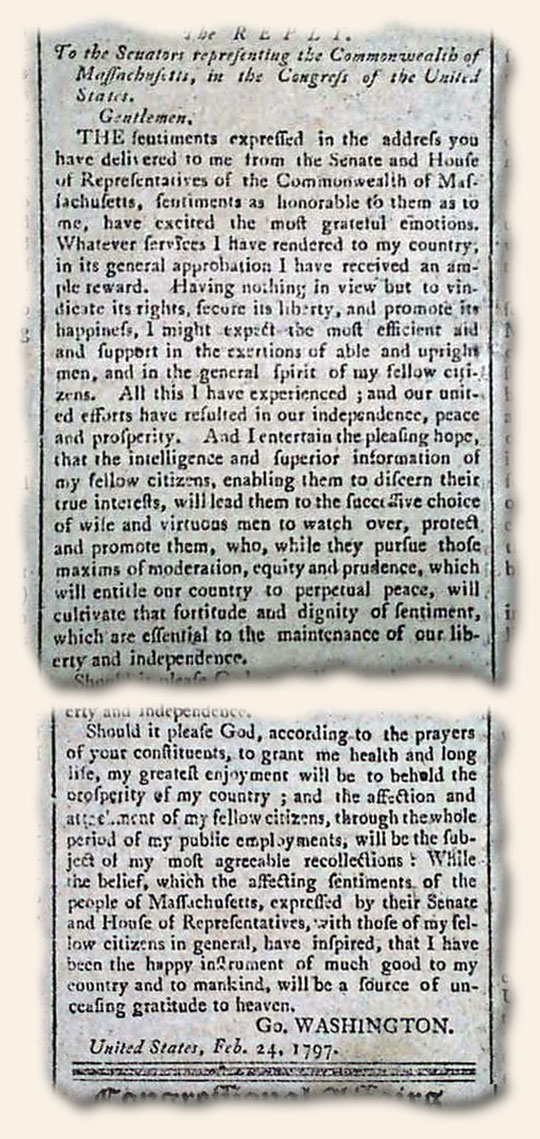
If you liked this post, you may also enjoy...
- Reflection: George Washington’s Birthday…
- Lead-up to a Nation… as reported in the newspapers of the day (October, 1775)…
- George Washingon speaks out…
- My Collecting Story… Brent Lacy…
- Happy Passover… Happy Easter…
#21 – Pricing newspapers over 30 years ago… (*revisited)
March 7, 2014 by GuyHeilenman · Leave a Comment Email This Post
| Print This Post
 In conversations with people about how I started this business, a common question is, “How did you know how to prices newspapers back then?” Well, the short answer is I didn’t.
This venture started as a hobby with no thought of it turning into a business. But when I started getting too many of a similar title or date, selling off the “unwanteds” became a more common occurrence. My simple thought was, if I had $3 for it, try to sell it for $5. If I did, the price stuck for future issues; if it didn’t, the price dropped to $4.
But this became trickier years later when I was buying for resale but didn’t have enough experience to know what to pay, nor what to price them at. Nor did anyone for that matter, as there were no price guides, nor sufficient auction records to offer a clue.
I was flying by the seat of my pants. If I thought an event was historic, say a major Civil War battle, I would pay the $5 price and increase it by 50% or so. If it sold, then the next time I inched it up a bit more. If it didn’t, I reduced the price a bit. Never knowing how high customers might go for an event, I might have “inched up” the price of an event 15 times over the coarse of 4 or 5 years until there was some resistance. I was careful to keep records of sales through the years–even in the pre-computer days–which was a tremendous assistance in assigning values to the myriad of historical events covering 300 years of history.
 Did I sell some great material too cheaply in the early years? I sure did. Looking at some of my earlier catalogs I gladly pay five times the selling price of many items I sold. But it was part of the process. I remember nce having a volume of a Las Vegas, New Mexico newspaper from 1881. There must have been 30 or 40 issues with a small “Reward” ad for the capture of Billy the Kid. I think I sold those issues for less than $20 each. If I had 40 of them how rare could they be? Certainly I’ve learned through the years, and became smarter as well.
But we are still challenged today with some items. As we continue to find truly rare, almost unique issues it becomes difficult to assign values with no history or prior sales. But these are the fun challenges. As much as you may enjoy finding interesting items in our catalogs, I enjoy finding the unusual to offer.
Although this is a business, I have always gotten more joy from buying newspapers than selling them.
—————
*The Fall of 2013 marked the 5th anniversary of the History’s Newsstand Blog by Timothy Hughes Rare & Early Newspapers. We are grateful to have the opportunity to contribute to the newspaper collecting community, and appreciate those who have participated through guest posts, comments, and readership. This year (2014) we are revisiting the top 25 posts (measured by activity), with the number 1 post being re-posted during the first week of 2015. Please enjoy. If you would like to contribute a post for consideration of inclusion on the blog, please contact Guy Heilenman at guy@rarenewspapers.com.
If you liked this post, you may also enjoy...
- Pricing newspapers back in the 1970’s…
- “Collecting Newspapers – The Basics” (Part IV) – Setting Values…
- Obama election victory : a follow-up…
- Prices of newspapers… How have the changed?
- The May (2019) Newsletter from Rare & Early Newspapers…
The Traveler… victory over Indians… horrible finding…
March 3, 2014 by The Traveler · Leave a Comment Email This Post
| Print This Post
 Today I traveled through Boston, Massachusetts, by the way of The Yankee (March 4, 1814). There I found a lengthy report on the Indian battle taking place, known as the Battles of Emuckfaw and Enotachopo Creek. The battles were under the leadership of Maj. Gen. Andrew Jackson, General Coffee and Captain Hamilton. This battle included “friendly Indians” fighting against the Creek Indians. This report was submitted by Andrew Jackson.
“A Tale of Horror” report from Rutland, Vermont, was of a merchant, Joseph Green, who suddenly went missing. The town people thought he may have gone out of town, but when he did re-appear, they investigated his business and found his mangled remains behind a large woodpile under the stairs. “A person by the name of James Anthony, a hatter by trade, was strongly suspected of being accessory to his secretion, if not murder, in consequence of marks of violence which appeared on his face, and the manner in which he accounted for the same.” He was found guilty and commitment to prison until the sitting of the supreme court in the town the following Monday.
~The Traveler
If you liked this post, you may also enjoy...
- The Traveler… Battle of Tippecanoe…
- Interesting comments on Jesse James…
- The Traveler… treaty ratified…
- The first newspaper in Alabama…
- The Traveler… capturing Pensacola… plundering away…
Whatcha Got? Harry Rinker interviews Tim Hughes…
February 28, 2014 by GuyHeilenman · Leave a Comment Email This Post
| Print This Post
 Many collectors are quite familiar with Harry Rinker’s nationally syndicated radio talk show, “Watcha Got?”. Harry recently interviewed Tim regarding the Rare Newspapers collectible. Please enjoy the interview at (click on the audio mp3 button): Watcha Got?
Note: The interview lasts about 15 minutes and begins at the 28:50 time marker (just slide the bar to this point). Better yet, enjoy Harry’s entire broadcast. 🙂
If you liked this post, you may also enjoy...
- An Interview with Timothy Hughes…
- Collectible Magazines… Rich West… Periodyssey – Part II
- “Guess & Click” – 1920’s Edition…
- Old news is good news for collectors…
- Looking back at past elections…
The Frederick Douglass’ Paper… Solomon Northup…
February 24, 2014 by GuyHeilenman · Leave a Comment Email This Post
| Print This Post
 I absolutely love this collectible!
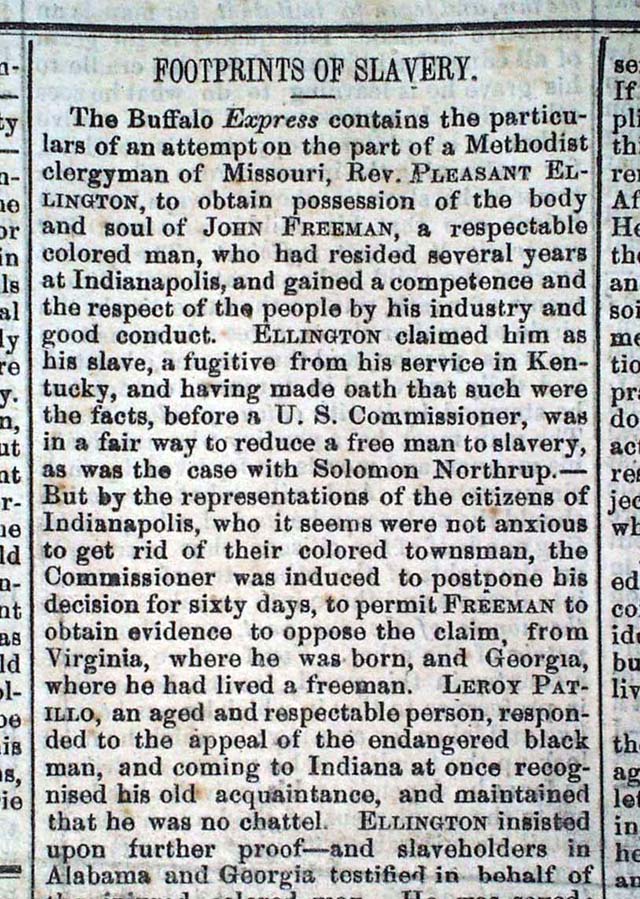
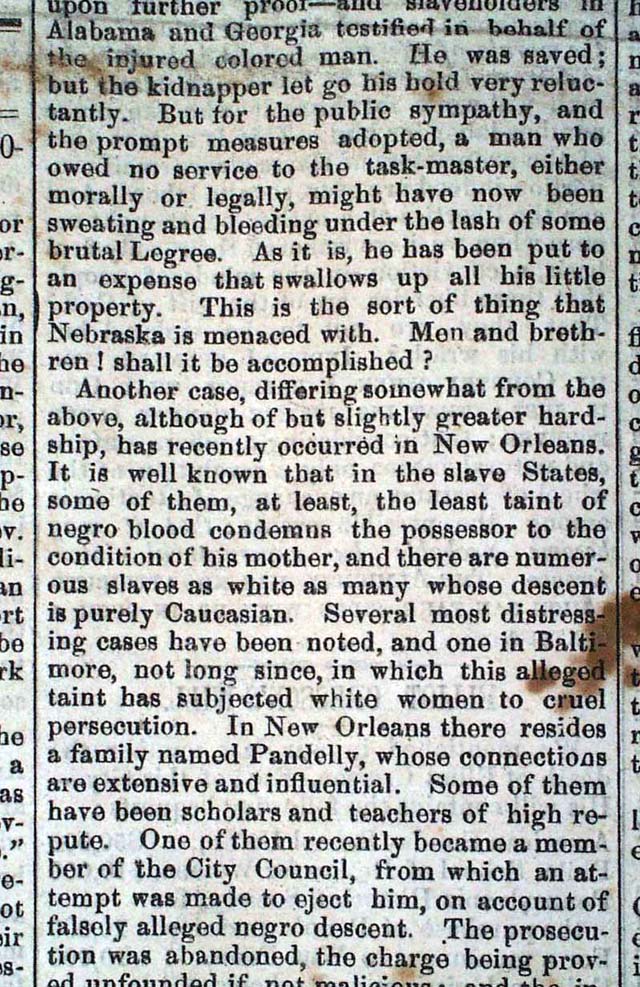
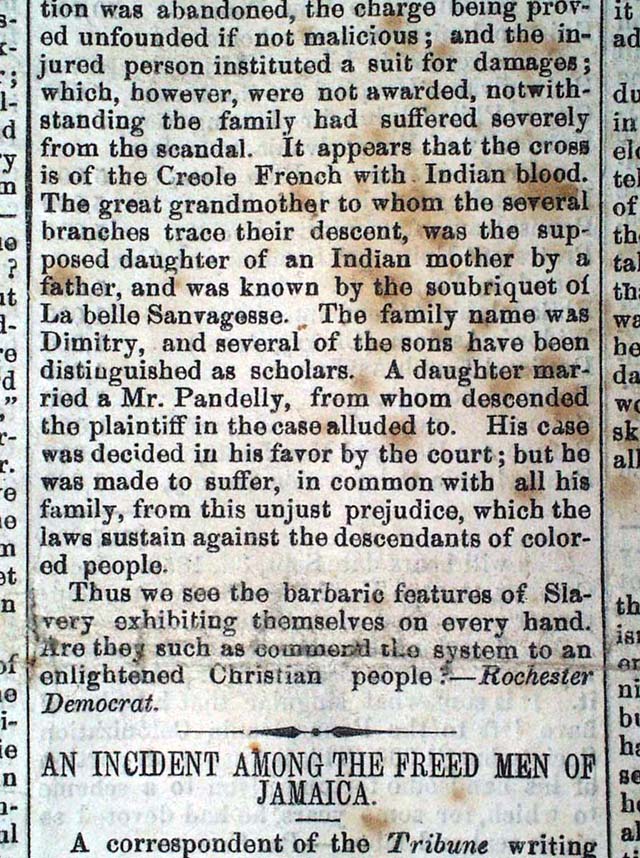
We had in our possession for a number of years an original issue of the Frederick Douglass’ Paper, dated March 17, 1854. It certainly was a grand paper – it being a continuation of Douglass’ North Star. However, while the notoriety of the title was well-established and the angst of slavery oozed throughout, it was a 21st century movie which infused new life into it’s weary 150+ year-old raglinen pages.
A collector recently went to see the theatrical adaptation of “Twelve Years a Slave – The Memoir of Solomon Northup“, and was moved to visit the Rare & Early Newspapers‘ website to see if we had newspapers with his mention. Searches for his name were unsuccessful – but this collector was not to be deterred. Having previously viewed the Frederick Douglass’ Paper in question, he took the next step and began to go over the corresponding images with a fine-tooth comb. Success. The newspaper was not only noteworthy for its editor and rarity, but it also had an article on the front page with mention of Solomon Northrup (see below). Fantastic.
Like I said, I love this collectible!
If you liked this post, you may also enjoy...
- We all need a North Star… Wisdom from Frederick Douglass…
- Frederick Douglass – A true American hero…
- Time-Lapse… Frederick Douglass (1834) to Henry Garnett (1865)…
- “Things I Never Knew”… Fredrick Douglass Edition…
- The Woman’s Tribune & Frederick Douglass…
The end of an era… Thank you Jerry…
February 21, 2014 by GuyHeilenman · 3 Comments Email This Post
| Print This Post
 Today marks the end of an era – decades of dedication and love from one of the most cheerful and faithful members of our Rare & Early Newspapers team. At the ripe young age of 87, Gerald Hughes, the father of our founder, Timothy Hughes, will hang up his folder making tools to spend more time at home with his wife, Lois.
His history with our office/warehouse goes far beyond the founding of the company, as he literally built the office portion of our building back in 1960 when he owned a band saw filing business. And it was extra storage space in that building that allowed Tim to make his first sizable purchase in the 1970’s. With warehouse additions built in later decades, all of the wood shelving which holds our considerable inventory was built by Jerry, and his mechanical ingenuity has been a blessing in solving the many unique challenges our business has encountered through the years.
Thank you Jerry! You will be greatly missed.
With All Our Love,
Guy, Doreen, Brian, Tim, Mike, Josh, Sarah, & Rebekah
If you liked this post, you may also enjoy...
- The End of an Era at Rare & Early Newspapers… Thanks Mike!
- Meet the staff: Guy Heilenman, our President…
- Happy Birthday to us!
- Be sure you are buying what you think you are buying…
The Traveler… to catch a bear… He’s what?… No whites allowed?
February 17, 2014 by The Traveler · Leave a Comment Email This Post
| Print This Post
Today I traveled back to London, England, by the way of The London Chronicle: or, Universal Evening Post dated February 18, 1764. There I found an interesting article on “The manner of catching Bears at Kamtschatka” (see photo below) which is a peninsula in Russia Far East. Although that article itself is quite interesting in the manner of how to catch these animals, the introduction is even more fascinating. “Bears and wolves are so numerous, that they fill the woods and fields like cattle; the bears in summer, and the wolves in winter. The bears of Kamtschatka are neither large nor fierce, and never fall upon people, unless they find them asleep; and then they seldom kill any outright, but most commonly tear the scalp from the back part of the head; and, when fiercer than ordinary, tear off some of the fleshy parts, but never eat them… It is remarked here that the bears never hurt women; but, in the summer, go about with them like tame animals, especially when they gather berries. Sometimes, indeed, the bears eat up the berries which the women have gathered, and this is the only injury they do them…”
Another article is of a death of a “…woman that went by the name of John Chivy. She dressed always in man’s apparel, and passed for a man; and notwithstanding she had been married upwards of 20 years, her sex never discovered till her death…”.
The following article caught my attention. “Among the sundry fashionable routs or clubs, that are held in town, that of the Blacks or Negro servants is not the least. On Wednesday night last, no less than fifty-seven of them, men and women, supped, drank, and entertained themselves… till four in the morning. No Whites were allowed to be present, for all the performers were Blacks.” The closing sentence made me ponder as to its meaning. I welcome your thoughts and explanations as well.
~ The Traveler
If you liked this post, you may also enjoy...
- The Traveler… the loss of a first…
- The Traveler… the death of Queen Anne…
- Victor Hugo – poetry in early 19th century Gentleman’s Magazines…
- The Traveler… promise to pay…
- Who’s Who in Newspapers? Jack Johnson edition (1910)…
Valentine’s Day flowers… chocolates… rare newspapers?
February 13, 2014 by GuyHeilenman · Leave a Comment Email This Post
| Print This Post
 “I love you!” Why is this so hard to say to those whom we love? The old adage goes that when I seasoned relic from the mid-20th century school of cold-knocks was asked why he never tells his wife he loves her, he replied, “I told her I loved her the day we married. If anything changes I’ll let her know.” While a bit humorous, one can’t help but hear the sad sound of little-girl dreams gone unrealized. Valentine’s Day has certainly served its role in helping to remind us to say the things that often go unsaid. Chocolates, flowers, and cards are great tokens of our love, but they pale in comparison to the very words themselves: I love you!
The following historic newspapers, like the February 16, 1861 issue of Harper’s Weekly (shown to the right), provide a chronological look through time at how the holiday has been viewed: Newspapers with Valentine’s Day coverage.
If you liked this post, you may also enjoy...
- Catching Everyone By Suprise… A Valentine’s Day to Remember…
- Valentine’s Day – So Many Entertainment Choices…
- Exploring Mother’s Day with Rare Newspapers…
- It’s amazing what one often finds buried in old newspapers…
- A Labor Day Weekend Tribute through rare newspapers…
#23 – Thoughts on the collecting of Obama inauguration newspapers… (*revisited)
February 7, 2014 by GuyHeilenman · Leave a Comment Email This Post
| Print This Post
It seems that with every election or inauguration I get asked about the collectability of such newspapers, so I thought I might share my thoughts with you, and encourage you to do the same.

USA Today – Obama Election & Inuguration
As for pure collectability, sure, election and inauguration issues are collectible because they document a very important part of American history and the democratic process. The smooth transfer of power from one person or administration to another does not come easily to many countries today. And to be able to add such historic issues to a collection for 50 cents or a buck is a great opportunity.
But I suspect the real interest of many who inquire about the collectability (of Barrack Obama election and inauguration issues) is the potential for such issues to increase in value. My opinion is, in general, no. They will not increase much in value in years to come. Now I’m speaking of “recent” history, say the last 30 years or so. I feel the public has become very collector-focused the last several decades, and many, many “historic” newspapers have been set aside in attics and drawers only to be found by their children many years later.
For a newspaper to appreciate dramatically in value I believe it requires several things: 1) Historic content. Yes, elections and inaugurations are historic; 2) Rarity. No, elections and inaugurations of the past 30 years are not rare because they were hoarded in large quantities and will always be relatively common; and 3) Something unique or dramatic. A “screaming” headline in tall, bold letters, or a cleverly worded headline, or something else which makes the issue unusual.
Supposedly the New York Times printed an extra one million issues of its January 21 inauguration issue, and I suspect most of them will be hoarded in quantity. The Washington Post printed a much larger quantity than normal, but they didn’t comment on the exact quantity. I’m sure it was sizable, and many of those issues will be hoarded. All this means that 20 years from now issues will be showing up on eBay (or its equivalent at that time) and anywhere else people might try to sell collectibles. With millions of such newspapers in the marketplace will the values get higher and higher? I doubt it.
Issues which tend to increase in value are those which were NOT saved. Most major headlines pre-World War II have appreciated nicely in value because they were not hoarded in quantities. I just don’t think the American public was collector-conscience then, so consequently they are genuinely rare in additional to being historic. And add a huge headline or terrific graphic and you have the potential for a very desirable newspaper; one which has appreciated nicely in value.
As an interesting side note, I understand that the New York Post printed a special afternoon inauguration edition on January 20. Given that most major newspapers are morning publications, coverage of the inaugural proceedings would be in their September 21 issue. But the Post had coverage in their January 20 issue, the same day as the election. A friend, stopping by a newsstand in New York city bought several issues of the Times of January 21 and noted a stack of other issues in the back. Inquiring what they were he was told it was the Post of the 20th, “…but they came in too late to be sold on the newsstand, so they will be returned. We can’t sell a day old newspaper…” the friend promptly purchased them all. I’d be curious to hear how many of the January 20 afternoon edition were actually sold on the streets and not returned for destruction. Perhaps that edition will have a real rarity component.
But don’t let this deter you from collecting historic events of the last 30 years and events yet to come. One of the great aspects of this hobby is the ability to assemble a great collection of truly historic newspapers at a nominal cost–at the newsstand price if you are lucky.
What are your thoughts?
Note: The Times News (out of Lehighton, PA) interviewed Tim concerning this topic. The article may be accessed at: http://www.tnonline.com/about
—————
*The Fall of 2013 marked the 5th anniversary of the History’s Newsstand Blog by Timothy Hughes Rare & Early Newspapers. We are grateful to have the opportunity to contribute to the newspaper collecting community, and appreciate those who have participated through guest posts, comments, and readership. In 2014 we will revisit the top 25 posts (measured by activity), with the number 1 post being revisited during the first week of 2015. Please enjoy. If you would like to contribute a post for consideration of inclusion on the blog, please contact Guy Heilenman at guy@rarenewspapers.com.
If you liked this post, you may also enjoy...