

Search
The Rare & Early Newspapers Hobby

Receive the Newsletter

Buy Historic Newspapers

The Traveler… giving thanks… not on the Sabbath…
October 17, 2016 by The Traveler · Leave a Comment
 I traveled to Boston today by the way of the Independent Chronicle dated October 14, 1816. I found “By His Excellency John Brooks, Governor of the Commonwealth of Massachusetts, A Proclamation, for a day of Public Thanksgiving and Prayer.” had been proclaimed. This was to be held on the Thursday, November 28.
Also found was an article entitled “Sabbath Laws” in which Judge Putnam “…repealed all former provisions upon the subject whether by statue or common law; that no act of labour, therefore, upon that day are lawful, except in cases of necessity or charity; and that prosecutions upon the statute are not within the exception…”. Too bad we cannot go back to those days…
~The Traveler
An October, 2016 stroll back thru time – 50, 100, 150, 200, & 250 years ago…
October 3, 2016 by GuyHeilenman · Leave a Comment
 What news was reported in the month of October – 50, 100, 150, 200, and 250 years ago (1966, 1916, 1866, 1816, 1766)? Such a walk back through time via the eyes of those who read the daily and weekly newspapers of the period can be quite revealing. This is why we often say, “History is never more fascinating than when it’s read from the day it was first reported.” The following links will take you back in time to show the available newspapers from the Rare & Early newspapers website. There’s no need to buy a thing. Simply enjoy the stroll.
Introducing: RareNewspapers.com – The Civil War…
September 29, 2016 by GuyHeilenman · 2 Comments
Collectible Civil War Era Newspapers
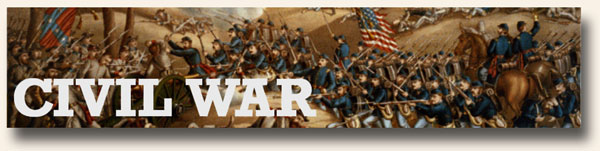 “History is never more fascinating than when it’s read from the day it was first reported.”
Records of a Nation in Turmoil
In the 1860s, Americans’ interest in the Civil War, and its collateral effects, caused a spike in demand for news reports. These were days of heightened concern, and newspapers were one of the few resources that people were able to rely upon for war news.
Aside from specific war news, Civil War newspapers also reported on citizens’ reactions to how the war was shaping the American economy and politics, and opinions about slavery.
Reading an authentic Civil War newspaper and holding the original print paper between your fingers will transport you to the frontlines of battle, and provide a glimpse into the psyche of Civil War-era citizens, politicians, and soldiers.
Original Civil War newspapers are genuine pieces of American history a collector or anyone interested in American history must have.
Harper’s Weekly
Harper’s Weekly was one of the most popular newspapers during the Civil War. Although its base was in New York, its moderate stance on slavery (pre-war) was seen as a way not to upset the newspaper’s Southern readership. However, once the Civil War began, President Lincoln and the Union received Harper’s complete loyalty and support.
As the war went on, the many illustrations and prints from Thomas Nast and Winslow Homer provided a vivid visual account of the battlefields, the people, and the bloodshed—”I’m hoping next week’s edition will show scenes of the battle of Fort Sumter in Charleston Harbor. I’ve read all about it, now I want to see it!” – A Harper’s Weekly reader in 1861. Another Harper’s reader noted, “I look forward to the end of the month and seeing just what transpired at Charleston.”
The illustrations and prints from Harper’s Weekly remain striking in both their detail and artistry. We have several noteworthy issues of Harper’s Weekly in our inventory.
Civil War People & Generals
The Southern States’ call for secession from the Union grew louder after the election of Abraham Lincoln in 1860. A disagreement between President Lincoln and Confederate leader Jefferson Davis over control of Fort Sumter led to overwhelming demand for war. Many men began enlisting for military service shortly after the battle of Fort Sumter.
Our vast inventory of genuine, historic Civil War newspapers highlight the efforts of military heroes from the North and the South that we have all come to know, including Ulysses S. Grant, George McClellan, Robert E. Lee, George Meade, “Stonewall” Jackson, William T. Sherman, and more.
Significant Civil War Battles & Events
Battle reports were common, including struggles at Fort Sumter, Bull Run, Manassas, Antietam, Shiloh, Gettysburg, Chickamauga, Vicksburg, Fredericksburg, Richmond, and so much more.
We have newspapers covering the first shots at Charleston Harbor to the final surrender at Appomattox, plus the Lincoln assassination.

Southern Illustrated News
The Southern Illustrated News was to the Confederacy what Harper’s Weekly was to the Union. Based in Richmond, Virginia, Southern Illustrated News had a rather ornate masthead and its front pages regularly featured portraits of notable Confederate figures, such as Robert E. Lee, “Stonewall” Jackson, and John S. Mosby. Southern Illustrated remains one of the most sought-after Civil War-era titles in the collecting hobby to date. Visit our Southern Illustrated Pinterest board to view several interesting portraits.

Reporting the Civil War
Before the start of the war, there were 3,725 newspapers in the United States. American newspapers accounted for one-third of all newspapers printed in the world. Most of them were weeklies. At the time, standards for what constituted sound, thorough, and responsible journalism did not exist on the eve of the war, according to Ford Risley, a Civil War journalism expert and head of the Department of Journalism at Penn State University.
Newspapers printed news dispatches, editorials, illustrations, maps, and various other tidbits, such as President Lincoln’s famous letter to Mrs. Bixley “…to have laid so costly a sacrifice upon the altar of freedom.” At times, the dispatches were entirely hearsay and wildly inaccurate, such as this series of short reports from the Daily Journal of Wilmington, NC or this report from the New York Tribune stating that Stonewall Jackson was “Dead Again.”
The Reporters
Reporters were a diverse group. Some had previous experience, but many reporters were lawyers, teachers, clerks, bookkeepers, and ministers. Their levels of education ranged from Ivy-league educated to only basic schooling.
Civil War reporters faced many difficulties, among them uncooperative and unreliable sources, difficulties with dispatching reports back to their newspapers, and even death. One correspondent closed a story with “Your readers must pardon a short letter. No man can write in a happy vein or style while minnie [sic] balls are flying uncomfortably close to his head.” Needless to say, conditions for Civil War reporters were not safe or ideal. More on how reporters lived and worked can be found here.

Unique Printing and Reporting Conditions
After the Union won the Battle of Memphis in June 1862, the Memphis Daily took to the road and became known as the Moving Appeal. During just a four-year period, this newspaper published in nine different cities.
A truly one-of-a-kind newspaper was “printed on board Steamer Des Moines” on blue-lined ledger paper in 1864. This issue also contains a letter written by a soldier to his wife. Letters from soldier correspondence frequently contained glorified accounts of battlefield glory meant to inspire confidence in the readers back home. Occasionally, letters from soldiers had reliable news and insights.
—————————–
Much more can be said regarding newspapers from the Civil War, but for now, please enjoy the Rare Newspapers dedicated page dedicated to original and historic issues from this era:
The Civil War
Early no-smoking cars on trains…
September 26, 2016 by TimHughes · Leave a Comment
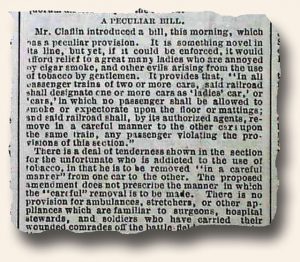 While the most significant feature of the “St. Louis Daily Globe” of February 2, 1875 is a report regarding Frank and Jesse James, the front page has a curious report headed: “A Peculiar Bill” concerning the need to create nonsmoking cars which would: “…afford relief to a great many ladies who are annoyed by cigar smoke, and other evils arising from the use of tobacco by gentlemen…” (see image).
For whom the Baby Ruth candy bar was named…
September 12, 2016 by TimHughes · 2 Comments
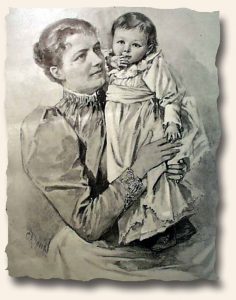
The history of the origin of the name of the “Baby Ruth” candy bar by the Curtis Candy Company is interesting, brought to light recently with our finding the “Frank Leslie’s Illustrated” issue of Jan. 5, 1893. The full front page is an illustration captioned: “Baby Ruth and Her Mother” being the child of President Grover Cleveland. This is the person for whom the “Baby Ruth” candy bar was named, not Babe Ruth the famous baseball star as was popularly though. And the story behind the name is interesting.
 In Chicago in 1921 Otto Schnering had a turnaround plan for his Curtis Candy Company. He reformulated his “Kandy Kake” brand confection—a conglomeration of milk chocolate, peanuts and a pudding center “richer than marshmallow, fluffier than nougat, better than either of them”—into a chocolate-covered candy bar with peanuts, caramel and nougat. Along with the new recipe came a new name—Baby Ruth. At first glance, it seemed clear that Schnering had taken advantage of the home run king’s well-known name and tweaked it by one letter in order to avoid paying the “Sultan of Swat” any royalties.
Perhaps because of its perceived connection to the Yankee slugger, Baby Ruth was a big success. By 1926, sales of the candy bar totaled $1 million a month, and the company’s candy-making facilities were the largest of their kind in the world.
In 1926, Ruth decided to enter the candy business himself and licensed his name to the George H. Ruth Candy Company, which sought to register “Ruth’s Home Run Candy” with the U.S. Patent and Trademark Office. Wrappers showed a head shot of a smiling Ruth in his uniform along with the note “Babe Ruth’s Own Candy.” The Curtiss Candy Company sued for copyright infringement and claimed that the candy bar had not been named after the baseball star, but Ruth Cleveland, eldest daughter of President Grover Cleveland. The explanation seemed odd given that the girl nicknamed “Baby Ruth” by the press had been born in 1891, three decades before the introduction of the candy bar. By 1921, not only was she not a baby, she wasn’t even alive, having died of diphtheria in 1904. Newspapers and the American public paid close attention to “Baby Ruth” after her father returned to the White House in 1893 for his second presidential term, but the Clevelands fiercely protected their daughter’s privacy and refused repeated requests by American newspapers to take her photograph. Few Americans ever knew what “Baby Ruth” looked like. By 1921, Babe Ruth was a household name while “Baby Ruth,” who died 17 years beforehand, was an historical footnote. (credit www.history.com)
Given the above, it is curious that this image of Baby Ruth Cleveland appeared on the front page of this very popular illustrated newspaper. Perhaps it is the only image of her in a newspaper.
Announcing: The 250th Catalog from Rare Newspapers…
September 8, 2016 by GuyHeilenman · Leave a Comment
Catalog 250 is now available. This latest offering of authentic newspapers is comprised of nearly 350 new items. Some of the noteworthy content includes: a printing of the Constitution of the United States, an issue of The Royal Gazette from Charleston (1782), a 1659 newsbook we’ve never offered before, Winslow Homer’s famous “Snap The Ship”, an issue with the British response to the Declaration of Independence, coverage of Cornwallis surrenders at Yorktown, and more. Key items which include the remaining items from the above may be viewed at: Noteworthy Catalog 250
Whereas the entire catalog is shown at Catalog 250, the following links are intended to aid in quickly finding items from the catalog based on era:
• 1500-1799 (full view OR quick-scan “compact” view)
• 1800-1899 (full view OR quick-scan “compact” view)
• 1900-2015 (full view OR quick-scan “compact” view)
To view items from both the current and the previous catalog, go to: Combined Catalogs
A September, 2016 stroll back thru time – 50, 100, 150, 200, & 250 years ago…
September 1, 2016 by GuyHeilenman · Leave a Comment
 What news was reported in the month of September – 50, 100, 150, 200, and 250 years ago (1966, 1916, 1866, 1816, 1766)? Such a walk back through time via the eyes of those who read the daily and weekly newspapers of the period can be quite revealing. This is why we often say, “History is never more fascinating than when it’s read from the day it was first reported.” The following links will take you back in time to show the available newspapers from the Rare & Early newspapers website. There’s no need to buy a thing. Simply enjoy the stroll.
The Traveler… the first “learned society” of Washington, D.C.
August 15, 2016 by The Traveler · Leave a Comment
I traveled today to Washington, D.C. by the way of the National Intelligencer dated August 15, 1816. I found there the announcement of the creation of the first “learned society” in Washington D.C.: “A number of the citizens of the District of Columbia, impressed with the importance of forming an association for the purpose of promoting useful knowledge, met on the 28th day of June, 1816,… agreeably to public notice the committee appointed as aforesaid reported the following draft of a constitution which was unanimously agreed to, after having changed the name of the association to that of the COLUMBIAN INSTITUTION for the promotion of Arts and Sciences…” (see image below).
They were responsible for the acquiring the many different species of plants and trees, an idea to apply to Congress for “the appropriation of about 200 acres of ground called “the Mall” which was designed in the original plan of the city for a public garden, the beginning of the botanic garden, many items which are now in the Smithsonian Institute, and more. Many prominent people of the day became were members, including some Presidents.
~The Traveler
A gem from the American Antiquarian Society… The Kentucky Spy…
August 8, 2016 by TimHughes · Leave a Comment
In celebration of its 20oth anniversary the American Antiquarian Society published a beautiful exhibition catalog titled “In Pursuit Of A Vision – Two Centuries of Collecting at the American Antiquarian Society”. Featured are a fascinating array of books, documents, maps & other paper ephemera, as well as several very rare & unusual newspapers we felt worthy of sharing with our collectors (with permission from the A.A.S.).
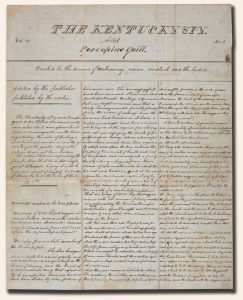 181. “The Kentucky Spy and Porcupine Quill“, Frankfort, Kentucky, January 25, 1849
In recent years AAS has actively collected issues of pre-1877 American manuscript periodicals. These handwritten examples mimic printed periodicals in format and content, containing stories, news, and advertisements. Sometimes they were produced by individuals, serving as the manuscript equivalent of amateur newspapers, and sometimes they were issued by small groups. Others were produced as an activity of a school or lyceum.
AAS has held manuscript periodicals since the nineteenth century; but because these were long shelved alongside printed periodicals, they were easily overlooked. In the 1990s AAS staff began to pull them together into a separate collection, in the process discovering not only how many titles were already at AAS, but also the frequency with which they were produced. As it became apparent that the more specimens AAS had, the more they collectively revealed about early American scribal culture, AAS began to seek them actively. The collection now numbers more than sixty titles.
One of the more unusual is “The Kentucky Spy and Porcupine Quill.” The masthead claims that it is “Devoted to the science of matrimony, union, wedlock and the ladies.” However, the chief story, entitled “Wonderful rumpus in the town of Irvine,” is a fictional account, humorous in tone, of a revolt by 5,000 heavily armed slaves which in the story turns out to be a hoax. The editor and contributor(s) are unnamed.
An August, 2016 stroll back thru time – 50, 100, 150, 200, & 250 years ago…
August 4, 2016 by GuyHeilenman · Leave a Comment
 What news was reported in the month of August – 50, 100, 150, 200, and 250 years ago (1966, 1916, 1866, 1816, 1766)? Such a walk back through time via the eyes of those who read the daily and weekly newspapers of the period can be quite revealing. This is why we often say, “History is never more fascinating than when it’s read from the day it was first reported.” The following links will take you back in time to show the available newspapers from the Rare & Early newspapers website. There’s no need to buy a thing. Simply enjoy the stroll.