
Search
The Rare & Early Newspapers Hobby

Receive the Newsletter

Buy Historic Newspapers

Who’s Who in Newspapers? Citizen Genêt edition…
October 10, 2025 by GuyHeilenman · 1 Comment
The 10th installment of Who’s Who in Newspapers
Citizen who? While exploring newspapers from the 18th and early 19th centuries over the past few decades, I noticed the name “Citizen Genet” appearing more than once—always tied to some sort of “affair.” As a novice historian at the time (my academic background is actually in mathematics and engineering), and given my aversion to sensationalized “yellow journalism,” I let it pass. With tens of thousands of fascinating topics to explore through our beloved collectible, I never stopped to uncover who he really was or what his “affair” involved.
 Recently, however, I embraced the old adage that “it’s never too late to learn” and finally took the plunge. What I found was a story worth the effort, one that offered both historical insight and a better appreciation for the newspapers that recorded it. A summary of my discovery is as follows:
Edmond-Charles “Citizen” Genet was a French diplomat sent to the United States in 1793 to gain American support for France’s wars with Britain and other European powers. Instead of observing diplomatic protocol, he jumped right into recruiting privateers to attack British ships and encouraging Americans to take up arms against Spain. These moves directly violated President George Washington’s Neutrality Proclamation of 1793. To make matters worse, Genet bypassed Washington altogether and appealed directly to the American public, an act that came across as both disrespectful and threatening to U.S. sovereignty.
The uproar that followed—known as the “Citizen Genet Affair”—quickly became a defining moment in America’s early history. Washington demanded Genet’s recall, reinforcing both the president’s authority in foreign affairs and the new nation’s commitment to neutrality. At home, the controversy deepened political divisions: Federalists supported Washington’s cautious stance, while Democratic-Republicans sympathized with revolutionary France. In the end, Genet was granted asylum in the United States and lived out his life in New York, but his story left behind a lasting lesson in diplomacy and America’s determination to remain independent from foreign influence.
So much for jumping to conclusions regarding his “affair”. I should have known better.
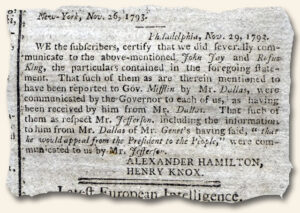
The photos shown are from two articles within the Columbian Centinel, Dec. 11, 1793. – the above in full, and the below of only an excerpt due to the length of the article. If original newspapers on this topic remain available, they would be found at: CITIZEN GENET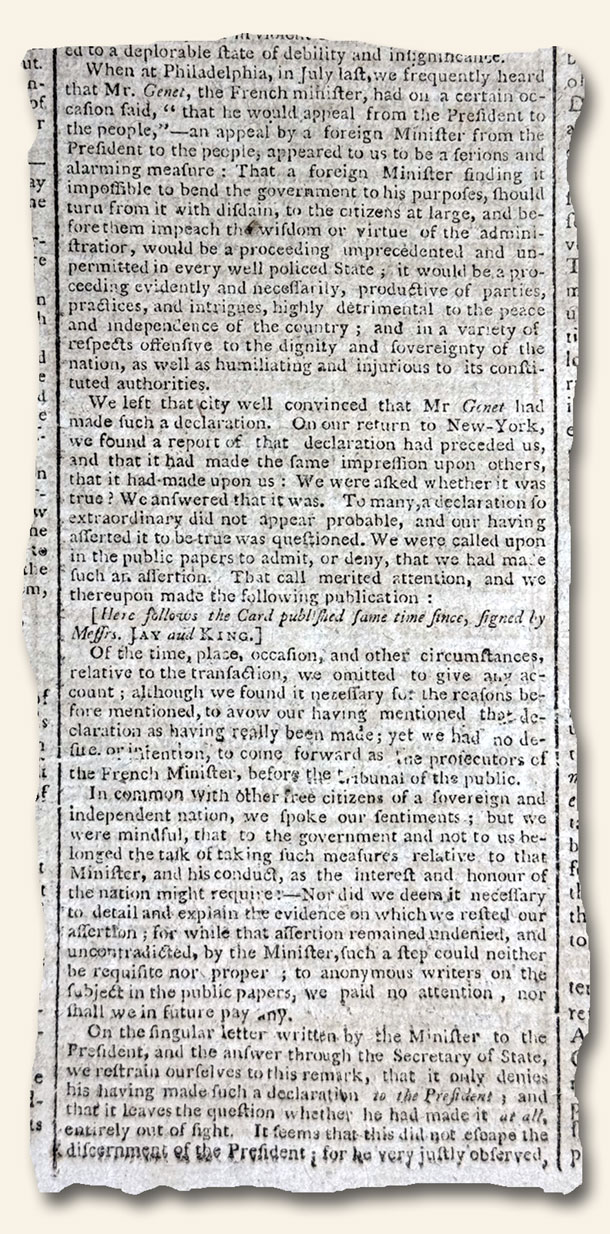
Announcing: Catalog #359 for October, 2025 – Rare & Early Newspapers…
September 30, 2025 by GuyHeilenman · Leave a Comment
|
 October’s catalog (#359)
|
A 49 year search comes to an end… The 1765 “Tombstone” issue…
September 1, 2025 by TimHughes · Leave a Comment
There are a number of iconic American newspapers that every collector desires, most are for content alone such as the Declaration of Independence, the Constitution, the assassination of Abraham Lincoln, etc.
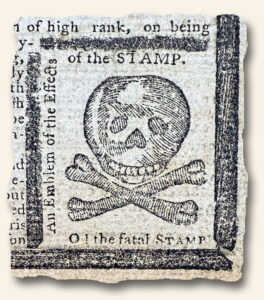 Not many are desired for both historical significance as well as graphic appeal, but such is the case with the Pennsylvania Journal of October 31, 1765. Having been aware of it for many years (photos are found in many high school history books), I had always been in the search for a genuine issue (beware: many reprints exist). I came close about 35 years ago when an institution, which had two in their collection, gave thought to exchanging one with me for an unknown Philadelphia newspaper I had discovered. Ultimately, they opted not to do the swap, so the search was back on.
It ended earlier this year.
This particular edition, famously known as the “tombstone edition,” used striking visual and textual elements to express colonial outrage over the Stamp Act tax, which required many printed materials, including newspapers, to bear a revenue stamp. This tax directly impacted printers and publishers, placing a heavy economic burden on them and fueling widespread resistance.
As seen in the photos, the masthead featured a skull and crossbones, a powerful symbol representing the “death” of the press under the weight of the Stamp Act. Also, an engraving of a coffin appears at the bottom of the back page, captioned: “The last Remains of the PENNSYLVANIA JOURNAL Which departed this Life, the 31st of October, 1765, Of a Stamp in her Vitals, Aged 23 Years.”
Publisher William Bradford begins the issue with poignant commentary, including: “I am sorry to be obliged to acquaint my readers, that as The Stamp Act is fear’d to be obligatory upon us after the First of November ensuing (the fatal to-morrow) the publisher of this paper unable to bear the burthen, has thought it expedient to stop a while, in order to deliberate whether any methods can be found to elude the chains forged for us…”.
Published just one day before the Stamp Act’s enforcement, this edition cleverly voiced dissent without yet violating the law, making it a strategic act of defiance.
This “tombstone edition” of the Pennsylvania Journal captured this economic strain and transformed it into a public rallying cry.
This edition stands as a vivid example of how the colonial press used creativity to oppose British policies, contributing to the growing revolutionary sentiment. It underscores the critical role newspapers played in shaping public opinion and mobilizing opposition in the years leading up to the American Revolution.
While other newspapers also protested the Stamp Act, the Pennsylvania Journal’s dramatic tombstone imagery made it particularly memorable and influential. It galvanized public resistance, cementing its place as a powerful symbol of defiance in American history.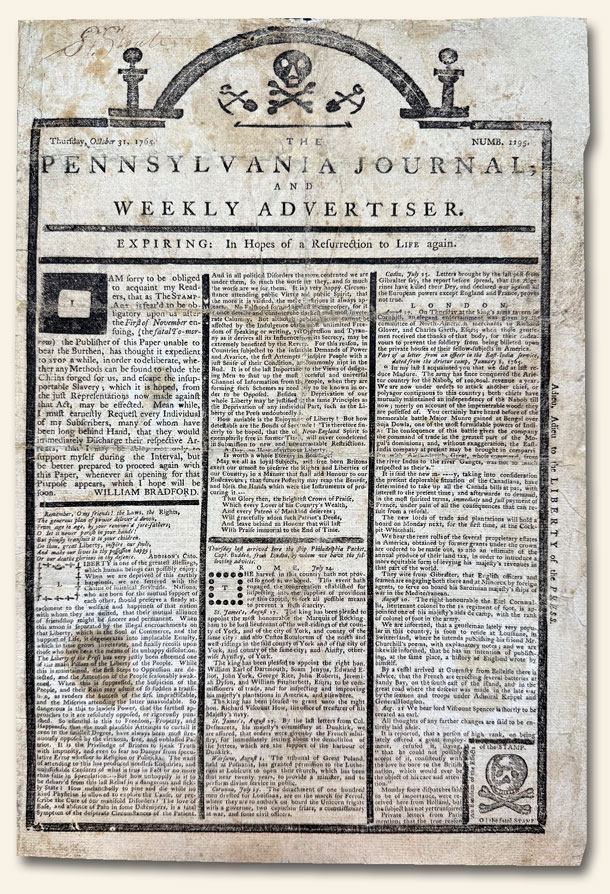
Announcing: Catalog #358 for September, 2025 – Rare & Early Newspapers…
August 29, 2025 by GuyHeilenman · Leave a Comment
|
 September’s catalog (#358)
|
A “hidden gem” within a 1785 newspaper leads to discovery, inspiration, and a correction…
August 22, 2025 by GuyHeilenman · Leave a Comment
Just for fun, guess the author and approximate date the following “Address to America” was published:
“PEOPLE of North America! Let the example of all nations which have preceded you, and especially that of the mother country, instruct you. Be afraid of the influence of gold, which brings with luxury the corruption of manners and contempt of laws; be afraid of too unequal a distribution of riches, which shews a small number of citizens in wealth, and a great number in miser; whence arises the insolence of one, and the disgrace of the other, Guard against the spirit of conquest; the tranquility of the empire decreases as it is extended; have arms to defend yourselves, and have none to attack.
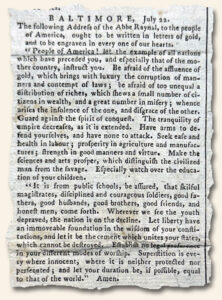 Seek ease and health in labour; prosperity, in agriculture and manufactures; strength, in good manners and virtue. Make the sciences and arts prosper, which distinguish the civilized man from the savage. Especially watch over the education of your children.
It is from public schools, be assured, that skillful magistrates, disciplined and courageous soldiers, good fathers, good husbands, good brothers, good friends, and honest men come forth. Wherever we see the youth depraved, that nation is on the decline. Let liberty have an immovable foundation in the wisdom of your contributions and let it be the cement which unites your states, which cannot be destroyed. Establish no legal preference in your different modes of worship. Superstition is every where innocent when it is neither protected nor persecuted; and let your duration be, if possible, equal to that of the world.”
I recently discovered this address on page 3 of The Independent Gazetteer; or, The Chronicle of Freedom dated July 30, 1785. After a bit of digging, in my humble opinion, a trek into the life of its author, Abbé Raynal, promises to not disappoint.
As for his “Address to America” itself, one cannot help but think his words fell on deaf ears. Sadly, even if we wanted to hit the reset button and start again while heeding his warnings, the last paragraph is problematic considering the current state of public education. However, as difficult as it would be to change course, status quo is obviously not an option.
As for the correction mentioned in the above heading for this post…
Multiple resources claim Abbé Raynal’s Address was first published posthumously (in 1800). It’s always fun when an old newspaper can prove the “experts wrong”.
A summary of the address using multiple AI resources is as follows:
Abbé Raynal’s “Address to America” is a powerful message written during the American Revolution in which the French Enlightenment thinker praises the American colonies for their fight for independence from British rule. He commends the courage of the revolutionaries and their commitment to liberty, viewing the struggle as a monumental step forward for human freedom. Raynal sees the revolution as a chance for a new nation to break from the oppressive traditions of Europe and create a society founded on justice, equality, and natural rights.
However, Raynal does not offer unconditional praise. He sharply criticizes the continued practice of slavery in the American colonies, pointing out the contradiction between fighting for freedom while denying it to enslaved people. He also expresses concern over the treatment of Indigenous peoples and warns the new republic against replicating the colonial abuses of European empires. His address is both a celebration of America’s potential and a moral challenge to align its actions with the ideals it professes.
The significance of Raynal’s message lies in its early and public call for America to confront its moral failings. His address exemplifies the Enlightenment belief that political freedom must be accompanied by social and ethical responsibility. By urging America to live up to its revolutionary ideals, Raynal’s words contributed to a broader conversation about liberty, justice, and the true meaning of independence—conversations that would shape not only American history but global ideas about human rights.
Announcing: Catalog #357 for August, 2025 – Rare & Early Newspapers…
August 1, 2025 by GuyHeilenman · Leave a Comment
|
 August’s catalog (#357)
|
Ben Franklin’s 1st contribution to The Gentleman’s Magazine, London…
July 25, 2025 by GuyHeilenman · 1 Comment
Many are aware Ben Franklin was a frequent contributor to The Gentleman’s Magazine (London); however, few can name his 1st appearance. What makes the task more difficult is his proclivity for signing his work using pseudonyms. Thankfully his work has been extensively researched – an effort which was aided by his prolific record keeping.
So, was it an article related to electricity, a game (“the morals of chess”), a puzzle (“magic square of squares”), he thoughts on marriage, or a treatise regarding the poor? No, it was the text of a speech (supposedly) given before a Colonial Court by a woman named of Polly Baker.
Thanks to enhanced research tools, a synopsis is as follows:
“The Speech of Polly Baker” is a satirical essay first published anonymously in The Gentleman’s Magazine in April 1747. It is now widely attributed to Benjamin Franklin, who is believed to have written it around 1746. Although the piece was initially published without attribution, Benjamin Franklin is almost certainly the author. This is supported by evidence from Franklin’s own correspondence, accounts from contemporaries, and stylistic analysis. Franklin was known for using pseudonyms and anonymous satire to criticize social and political norms, and this work fits that pattern.
Summary
- The essay takes the form of a fictional courtroom speech by a woman named Polly Baker, who is on trial for the fifth time for having an illegitimate child out of wedlock—a crime under colonial law.
- In her speech, Polly eloquently defends herself by questioning the justice of punishing women for fornication while men (the fathers) go unpunished and even rise to positions of honor.
- She argues that she has done nothing wrong morally, since she brought children into the world and cared for them, and should be praised, not punished.
- The satire points to:
- Hypocrisy in the legal system.
- The unequal treatment of women, particularly in matters of sexuality and reproduction.
- Broader critiques of colonial laws and moral attitudes.
Historical Significance
- “The Speech of Miss Polly Baker” is one of the earliest American critiques of gender inequality.
- It reflects Enlightenment ideals—particularly reason, natural rights, and critiques of tradition.
- The piece prefigures later feminist arguments about the double standards in sexual morality.
Reception in 1747
- When it was published, readers largely did not know it was a satire by Franklin.
- Many believed the account was true, and some thought Polly Baker was a real person.
- The piece generated significant interest and discussion in Britain and the American colonies, especially because of its radical tone.
- It was reprinted widely in newspapers and magazines, suggesting it was popular and provocative.
Some clergy and conservative voices were critical, viewing the essay as undermining traditional moral values, while Enlightenment thinkers and reform-minded readers praised its rhetorical skill and boldness.
Legacy
- Today, “The Speech of Polly Baker” is studied as a landmark example of early American satire and as a precursor to later feminist and legal critiques.
- It shows Franklin’s ability to use humor and irony to challenge unjust systems and conventions.

Note: The full text of this Franklin work can be read at Founders Online of the National Archives.
Claiming the Land… America Presses Westward…
June 30, 2025 by Laura Heilenman · Leave a Comment
 There are few events which capture the enormity and drama of America and her people more than the Westward Expansion. Vast lands to be settled and courageous people have produced tales and legends which continue to inspire generations to dream big and bravely press into the great unknown.
As our founder Tim Hughes states in his discription… “Considered to be one of the most significant achievements of the Congress of the Confederation, the Northwest Ordinance of 1787 put the world on notice not only that the land north of the Ohio River and east of the Mississippi would be settled but that it would eventually become part of the United States. Until then this area had been temporarily forbidden to development.
Increasing numbers of settlers and land speculators were attracted to what are now the states of Ohio, Indiana, Illinois, Michigan and Wisconsin. This pressure together with the demand from the Ohio Land Company, soon to obtain vast holdings in the Northwest, prompted Congress to pass this Ordinance.”
THE NEW HAVEN GAETTE & THE CONNECTICUT MAGAZINE on August 2, 1787 captures this monumental event at the moment of its birth. Feel free to browse this rare issue and let your dreams run wild.
Announcing: Catalog #356 for July, 2025 – Rare & Early Newspapers…
June 27, 2025 by GuyHeilenman · Leave a Comment
|
|
Where game history, moral philosophy, and educational theory collide…
June 9, 2025 by GuyHeilenman · 1 Comment
Ben Franklin’s contributions to The Gentleman’s Magazine of the 18th century are well documented, and in multiple instances, quite collectible. A handful of the his more noteworthy appearances include several regarding electricity, the “Magic Square of Squares”, “On the Increase in Mankind”, “Albany Union Plan”, and “The Speech of Miss Poly Baker”. One of the more interesting is his desirable (from a collecting standpoint) “The Morals of Chess”, which appeared in the July, 1787 issue. A bit of research regarding its significance is as follows:
 Benjamin Franklin’s essay The Morals of Chess, written in the late 18th century, is a groundbreaking work that presents chess as more than a game, but as a tool for building moral character. Franklin highlights virtues like courtesy, patience, humility, and attentiveness, which he saw as essential to fair play. This focus on etiquette not only pioneered the concept of sportsmanship in chess but also influenced the formal codes of conduct later embraced by chess clubs and federations, establishing the game as a model for civil behavior.
Beyond etiquette, Franklin uses chess as a metaphor for life, reflecting virtues such as prudence and generosity against vices like rashness and envy. He positions the game as a didactic instrument, capable of teaching both strategic thinking and ethical decision-making. This perspective helped cement the idea that games can mirror real-world challenges, offering lessons in intellect and morality—a notion that resonated with later educators and writers who championed “learning through play.”
Finally, the essay embodies Franklin’s Enlightenment ideals of rationality, self-improvement, and social responsibility. By promoting chess as an accessible activity for all, not just the elite, he democratized it, framing it as a means of personal and civic growth. The Morals of Chess thus transformed the game from a courtly pastime into a lasting symbol of strategic thought and ethical conduct, shaping its role in education and society to this day.
Additional details can be viewed on our website at: Franklin’s Morals of Chess