
Search
The Rare & Early Newspapers Hobby

Receive the Newsletter

Buy Historic Newspapers

Beyond the historic headline…
November 1, 2012 by TimHughes · Leave a Comment
 “Newspapers that shaped the world…“
Some of the better & more fascinating items found in old newspapers are not the most historic or significant, but rather the casual appearance of seemingly innocuous reports which excite collecting interest beyond the historic headline or dramatic presentation which are the more usual draw.
Much of what intrigues collectors can be lost within the body of reports, yet they tell a story of their own, such as the patriotic fervor of some colonist during the Revolutionary War. I recall an issue of the Edinburgh Evening Courant of June, 1776 reporting on American soldiers: “…Their uniform is a dark grey coarse linen frock, which covers the whole body…with the words, ‘Death or Liberty’ marked in large red letters on the right sleeve; and many of them are so enthusiastic as to have them marked with their own blood…”. This report is almost lost on page 3 yet its message is very telling of the spirit which caused the Americans to win the war against a world power despite insurmountable odds.
Some reports are fascinating by their bias. A Richmond newspaper of July, 1863 reporting on the Battle of Gettysburg notes: “…The Confederates did not gain a victory, neither did the enemy. He succeeded in defending himself & we failed in some portions of an attack…We killed more of the enemy than we lost; we took very many more prisoners than lost. The Confederate army did not leave the enemy until it had tried every link of his armour…” Another newspaper notes: “ ..Information, certainly authentic, is in the hands of the Government, which leaves no doubt of the safety & triumph of the noble army. General Lee was victorious in all the combats which have taken place. He has been engaged with the whole force of the United States & has broken its backbone…”, Perhaps the most extraordinary example of optimism appeared in the Richmond Examiner of July 25: “…The result was not a defeat, it was not a loss; it was only not a victory…It was little else than a disappointment of extraordinary expectations…”. What a precious statement as an example of Confederate optimism.
Other little gems were very prophetic in their reporting, particularly when read with an historic perspective. A Scottish newspaper from 1775 sensed a lasting war with America as it reflected on the Battle of Bunker: “…The mischiefs which have already arisen & the greater calamities which are threatened from the unnatural war excited in America…It is impossible we can see, without the utmost alarm, preparations making for the prosecution of an expensive & ruinous war with our own Colonies…”. Some can be very recent, like the New York Times comment on rookie Mickey Mantle in 1951: “…Mantle, who gives every promise of developing into an outstanding baseball star, was ordered to report to his draft board next Wednesday…” An editorial comment in the Army & Navy Journal just after the Gettysburg Address opined: “…a dedicatory speech by President Lincoln, which we give in full, as decidedly the best feature of the occasion, as well as one of the most felicitous utterances of its author.” How true.
Some were prophetic even when the reports were simply wrong, like the Illustrated American article of 1898 reporting on “A New Flying Machine That Flies”–five years before the Wright brothers–when it said: “…It is impossible to imagine without terror the day when these mechanical birds, these flying apparitions, will be able to rain upon armies, hostile towns and escalating parties most deadly and most destructive explosives…”. How true it would become.
There can be much to be found in newspapers beyond the headline. What a thrill it is to discover such hidden gems; reports that have escaped hundreds of years of history only to rediscovered with new-found relevance today. Such are just some of the joys of collecting early newspapers.
Please enjoy: “Newspapers that shaped the world…“
Countdown to “Newspapers that changed the world…”
October 24, 2012 by GuyHeilenman · Leave a Comment
Each month Timothy Hughes Rare & Early Newspapers releases a catalog containing a new set of historic and collectible newspapers (1600′s through 20th century). However, on November 1, 2012, at 12:01 AM ET, the special edition, “Newspapers that changed the world…” will be released. Whether you already collect newspapers, or desire to simply view a sampling of what the hobby has to offer, check back for this special occasion:
Prior to November 1, 2012 and after November 30, 2012, the link below will take you to the most recent offerings of Timothy Hughes Rare & Early Newspapers… History’s Newsstand! During the month of November it will take you to the special release catalog, “Newspapers that changed the world”.
View: “Newspapers that changed the world…“
Period printing… Did you ever notice…?
April 30, 2012 by GuyHeilenman · 1 Comment
A few months ago we received an inquiry from one of our friends wondering why pre-1900 newspapers included a period after the newspaper’s title in the masthead. While I hold hundreds of such issues in my hands each week, I had never taken notice of this. Wondering if this was in fact the case, I quickly began searching through our 19th and 18th century archives, and low and behold, every title ended with a period. Searching through our 20th century inventory I discovered that none of the issues did. I asked Tim Hughes his thoughts on the matter, and his response was as follows:
Regarding the query about periods at the end of 19th century titles, I don’t believere there is a reason beyond it simply being the grammatical style of the  period. In fact the practice goes back to the 17th and 18th centuries as well. It was just the way newspapers (and magazines) were laid out, perhaps following some sort of grammatical “rule” of the day. There was also–compared to today–an excessive use of commas within text, which again was just the style of the day.
Perhaps the more interesting question would be when & why was the period eliminated at some point in the 20th century? I would suspect one paper just made the decision and everyone else eventually followed, as there was much competition and copying among newspapers. Sorry I don’t have a more intriguing answer!
If any of our readers have additional information in regards to this, feel free to respond.
Entry point to the Rare Newspapers Collectible… 16th & 17th Centuries…
February 17, 2011 by GuyHeilenman · 2 Comments
Our peek at the lower-end entry points into the hobby of collecting rare and early newspapers draws to a conclusion today with a gander at inexpensive newspapers published prior to 1700. A list of titles priced at under $50 includes: The London Gazette, The Athenian Mercury, Votes of the House of Commons, The Observator, and The Weekly Pacquet of Advice From Rome, all of which are British publications.
The following link will take you to these potential pre-1700 entry-point issues: Pre-1700 Inexpensive Issues
Enjoy!
Note: View the following to explore the History’s Newsstand Blog’s featured posts on the upper end of the collectible: “Prices Realized” and “Most Collectible Issues“.
Prices realized… 16th & 17th centuries…
September 6, 2010 by GuyHeilenman · 7 Comments
While we’ve written several posts identifying some of the factors which impact the value of a rare and/or historic newspaper, a “price guide” showing prices realized is as of yet unavailable. Our hope would be to have such a resource accessible within the not-too-distant future. In the meantime, we’ll be taking the next few Mondays to provide some information in this regard which we hope you will find helpful.
 16th & 17th Centuries:

One of the earliest issues you will find… ZEITUNGEN, AUS WELSCHLANDEN, 1546 ($1,752, 2007)
Finding authentic newspapers from this period (16th and 17th centuries) is becoming exceedingly difficult. As a result, what would these same issues be valued at today? What impact did the condition, displayability, content, proximity (date and location to the content), rarity, etc. have on each? While these factors, and more, impact the valuation of an issue, the above examples are what they are – prices realized.
Note: Many price guides (in other collectible areas) show highly inflated prices. This enables resellers to offer items at slightly under “established” prices, giving buyers the illusion that they are getting a bargain. However, the truth is, the value of an item is really the price that others are actually willing to pay – not what a catalog/price guide lists. In the field of Rare Newspapers, our approach will always be to base prices on hard data – the track record of previous sales. Additionally, at Rare Newspapers, we try to set prices at a point where both resellers and individual collectors are comfortable. As a result, we do not have a two-tier system (one price for resellers, and another for collectors). We believe this policy provides a degree of integrity within the collectible community. We hope you agree.
Early reports can be unassuming…
May 17, 2010 by TimHughes · Leave a Comment
 As many collectors have found, the earliest report of an historic or significant event is often not the best or more detailed. Usually the report of a day or two later is best, when all the particulars were known and the accuracy more credible. Yet there is still the fascination of reading of a major event before it would become part of world history.
The first report of the Great Fire of London–one of the more notable events in 17th century British history–is somewhat unassuming. The bottom of the back page of “The London Gazette“, September 3, 1666, has a report datelined the day before noting: “About two a clock this morning a sudden and lamentable Fire brake out in this City, beginning not far from Thames Street, near London Bridge, which continues still with great violence, and hath already burnt down to the ground many houses thereabouts, which sad accident affected His Majesty with that tenderness, and compassion, that he was pleased to go himself in Person with his Royal Highness to give order that all possible means should be used for quenching the fire, or stopping its further spreading…” with a bit more (see).
The next several issues would provide more detail, but this first report gives some indication this was to be more than a small event. Indeed, it would grow to consume some 13,200 houses, 87 parish churches, and make homeless 70,000 of the city’s 80,000 inhabitants.
Fascinating titles…
January 28, 2010 by TimHughes · Leave a Comment
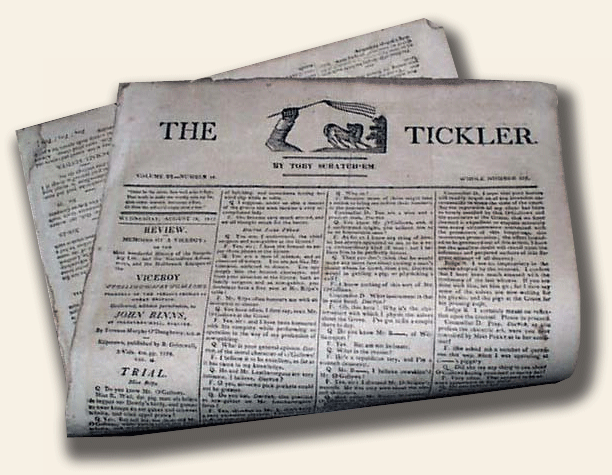 Over the course of the last 350+ years tens of thousands of newspapers have come and gone, too few remaining outside of microfilm, microfiche or digital format for us hold and enjoy. Early on in my pursuit of old newspapers I was intrigued by the names of many, and decided to keep examples of newspapers which had what I considered to be “odd” titles. I am glad I did, as few have since surfaced for me to get a second chance to add to my collection. I thought I might share a few of the more interesting titles. Perhaps you’ve come across some interesting ones as well. Here are among my more curious :
The Occasional Reverberator, The Whisperer, The Dessert to the True American, The Tickler, The Devil In London, The Quizzical Register, Galaxy of Comicalities, The Whip & Spur, The Wag, The Hangman, Wecli Fonetic Advocat, The Grape Shot (from Canonsburg, Pa.), The Boomerang, Our Dumb Animals, Measure For Measure, Wise And Unwise, Our Compliments, Squirrel Island Squid, The Drill (mining town in Arizona), The Headlight, Hoof & Horn, Camp Carnes Anti-Bushwhacker, The Yaller Dog, The Menace, The Gangplank News, The Bull Sheet Special, Bunk, Guinea Pig, Jerk, Tar Paper, and The Ape.
Do you have some unusual titles as well? Feel free to share.
Death of Blackbeard, the pirate…
January 18, 2010 by TimHughes · Leave a Comment
Pirates have fascinated many through the years, both the historian and the average man on the street, evidenced by the large number of successful movies with a pirate theme. Witness the recent success of the three “Pirates of the Caribbean” movies starring Johnny Depp.
Blackbeard remains one of the more interesting characters from the golden age of piracy, primarily 1680 thru 1720. The report of his death was provided with some detail on the front page of “The London Gazette” issue of April 25, 1719. Enjoy the photos.

18th century & pre-18th century newspapers… revisited…
December 17, 2009 by GuyHeilenman · Leave a Comment
Over the past two weeks Timothy Hughes has explored his thoughts on what he believes to be the top ten pre-18th century and the top ten 18th century newspapers (see below). Some of these thoughts were captured in the following video:
Collecting authentic rare and historic newspapers from the 1500’s – 1700’s can be exciting, rewarding and surprisingly affordable. British titles such as the London Gazette, London Chronicle, Gentleman’s Magazine and more, are all available for much less than you would expect, as are their American counterparts, the Columbian Centinel, Dunlap’s Daily American Advertiser, Concord Herald, and more.
Whether your interest is in the Colonial Era or the Revolutionary War Era, or extends to the 1500’s and/or 1600’s, original newspapers provide an excellent view of history in context. History is never more fascinating than when when it’s read from the day it was first reported. If you love history… you deserve to have it in your hands. Rare and early historic newspapers make this possible. Please enjoy the hobby!
Top ten newspapers: 16th and 17th centuries…
Top ten newspapers: 18th century…
Walmart sells them too…
December 12, 2009 by TimHughes · Leave a Comment
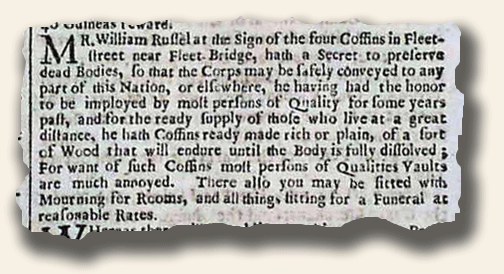
A 1685 issue of the “London Gazette” newspaper contains on the back page the following interesting advertisement, not the type typically found in newspapers–at least not in more modern times. Interesting that the coffin maker notes that he makes them: “…of a sort of wood that will endure until the body is fully dissolved…”.
I saw a piece recently where Walmart now sells coffins on-line. And just in time for Christmas: