
Search
The Rare & Early Newspapers Hobby

Receive the Newsletter

Buy Historic Newspapers

A “hidden gem” within a 1785 newspaper leads to discovery, inspiration, and a correction…
August 22, 2025 by GuyHeilenman · Leave a Comment
Just for fun, guess the author and approximate date the following “Address to America” was published:
“PEOPLE of North America! Let the example of all nations which have preceded you, and especially that of the mother country, instruct you. Be afraid of the influence of gold, which brings with luxury the corruption of manners and contempt of laws; be afraid of too unequal a distribution of riches, which shews a small number of citizens in wealth, and a great number in miser; whence arises the insolence of one, and the disgrace of the other, Guard against the spirit of conquest; the tranquility of the empire decreases as it is extended; have arms to defend yourselves, and have none to attack.
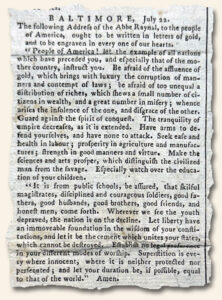 Seek ease and health in labour; prosperity, in agriculture and manufactures; strength, in good manners and virtue. Make the sciences and arts prosper, which distinguish the civilized man from the savage. Especially watch over the education of your children.
It is from public schools, be assured, that skillful magistrates, disciplined and courageous soldiers, good fathers, good husbands, good brothers, good friends, and honest men come forth. Wherever we see the youth depraved, that nation is on the decline. Let liberty have an immovable foundation in the wisdom of your contributions and let it be the cement which unites your states, which cannot be destroyed. Establish no legal preference in your different modes of worship. Superstition is every where innocent when it is neither protected nor persecuted; and let your duration be, if possible, equal to that of the world.”
I recently discovered this address on page 3 of The Independent Gazetteer; or, The Chronicle of Freedom dated July 30, 1785. After a bit of digging, in my humble opinion, a trek into the life of its author, Abbé Raynal, promises to not disappoint.
As for his “Address to America” itself, one cannot help but think his words fell on deaf ears. Sadly, even if we wanted to hit the reset button and start again while heeding his warnings, the last paragraph is problematic considering the current state of public education. However, as difficult as it would be to change course, status quo is obviously not an option.
As for the correction mentioned in the above heading for this post…
Multiple resources claim Abbé Raynal’s Address was first published posthumously (in 1800). It’s always fun when an old newspaper can prove the “experts wrong”.
A summary of the address using multiple AI resources is as follows:
Abbé Raynal’s “Address to America” is a powerful message written during the American Revolution in which the French Enlightenment thinker praises the American colonies for their fight for independence from British rule. He commends the courage of the revolutionaries and their commitment to liberty, viewing the struggle as a monumental step forward for human freedom. Raynal sees the revolution as a chance for a new nation to break from the oppressive traditions of Europe and create a society founded on justice, equality, and natural rights.
However, Raynal does not offer unconditional praise. He sharply criticizes the continued practice of slavery in the American colonies, pointing out the contradiction between fighting for freedom while denying it to enslaved people. He also expresses concern over the treatment of Indigenous peoples and warns the new republic against replicating the colonial abuses of European empires. His address is both a celebration of America’s potential and a moral challenge to align its actions with the ideals it professes.
The significance of Raynal’s message lies in its early and public call for America to confront its moral failings. His address exemplifies the Enlightenment belief that political freedom must be accompanied by social and ethical responsibility. By urging America to live up to its revolutionary ideals, Raynal’s words contributed to a broader conversation about liberty, justice, and the true meaning of independence—conversations that would shape not only American history but global ideas about human rights.
Announcing: Catalog #357 for August, 2025 – Rare & Early Newspapers…
August 1, 2025 by GuyHeilenman · Leave a Comment
|
 August’s catalog (#357)
|
The July, 2025 Newsletter from Timothy Hughes Rare & Early Newspapers…
July 19, 2025 by GuyHeilenman · Leave a Comment
|

|
Announcing: Catalog #356 for July, 2025 – Rare & Early Newspapers…
June 27, 2025 by GuyHeilenman · Leave a Comment
|
|
The June, 2025 Newsletter from Timothy Hughes Rare & Early Newspapers…
June 13, 2025 by GuyHeilenman · Leave a Comment
|
|
The reason I collected it: the perfect logo for the company…
June 2, 2025 by TimHughes · Leave a Comment
When I began this company back in 1975, my offerings were simply typed lists of newspapers I had recently purchased. When an issue sold, I cut it out, added new ones to the bottom of the list, made photocopies of the 8 1/2 by 14 sheets, and mailed them to those expressing interest.

I later evolved my offerings into a small catalog, essentially 8 1/2 by 11 sheets folded in half resulting in 16 pages of 5 1/2 by 8 1/2 inches. I wanted a logo for the cover that would represent what I was selling. Not finding anything magical, I opted for a print of a colonial printing press. Perhaps some of you still have some of those old catalogs featuring the printing press.
But a printing press was too generic. It was not specific to newspapers; books, pamphlets, broadsides–anything with ink–were printed on a printing press. So my quest for a more perfect image continued.
Back in the late 1900’s I was doing research on a collection of the “Illustrated London News“, the model that would be followed by Leslie’s Illustrated, Harper’s Weekly, and a host of other illustrated newspapers. On the back page of an issue from 1862 there was a brief article titled: “The Newsboy“ and it was accompanied by a great print of a young newsboy offering a newspaper (shown below). It was the perfect find. It had an old-time look (it was from 1862 after all), it was specific to newspapers, and it had a generally pleasant appearance that I thought would work well as a logo.
And so it became the framework for our logo (shown to the right above). You will find it front & center on our website and on any number of printed pieces we produce each year. So if you’ve ever wanted how it was created, perhaps appropriately, it came from an old newspaper.
Announcing: Catalog #355 for June, 2025 – Rare & Early Newspapers…
May 30, 2025 by GuyHeilenman · Leave a Comment
|
 The June catalog (#355) is now available. Shown below are links to various segments of the catalog, our currently discounted
|
[The links above will redirect to the latest catalog in approx. 30 days
upon which time it will update to the most recent catalog.]
Announcing: Catalog #354 for May, 2025 – Rare & Early Newspapers…
May 2, 2025 by GuyHeilenman · Leave a Comment
|
 The May catalog (#354) is now available. Shown below are links to various segments of the catalog, our currently discounted
|
[The links above will redirect to the latest catalog in approx. 30 days
upon which time it will update to the most recent catalog.]
Americana at it’s best… The annual Egg Roll on the lawn of The White House…
April 20, 2025 by Laura Heilenman · Leave a Comment
 I apologize upfront for the fact that so many of my posts lean heavily on nostalgia. Truth be told, I often have to apologize to my kids for how quickly I tear up when I think of the past. Keeping my soft pot for the “good” of the past in mind, it will come as no surprise that I chose the following issue for today’s installment.
The FRANK LESLIE’S ILLUSTRATED for April 23, 1887 featured a delightful full-page illustration of the annual White House Egg Roll. Whoever the artist was (it was described as being from a “staff artist”), they perfectly captured the best of America in all its innocence and deep-felt sense of community. American traditions are part of our core essence as a unified people and they build bonds between us which help us stand firm during the hardships of life. Keep in mind, as Spring and Summer arrive, we are about to be flooded with National Holidays drenched with American traditions. Especially during the upcoming year, in light of our nation’s 250th birthday, may we all pause to appreciate the small but powerful traditions which help define us as Americans.

PS “Red and yellow back and white”… playing out in 1887 🙂
PPS As much as I get weepy when thinking about the past, I do find myself very misty-eyed at what I see and experience in my present as well. Perhaps I’m just a softie?!!
Snapshot 1768 – Ben Franklin’s thoughts on the poor…
April 7, 2025 by GuyHeilenman · Leave a Comment
I am currently reading “Benjamin Franklin: An American Life” (by Walter Isaacson), and often struggle to put it down. One of the many new things I’ve learned about Franklin: he was always a “work in progress”. Many of his views on significant topics of the day changed over his lifetime – often as a result of his ongoing quest for new information. He was certainly the poster-child for a “life-long learner”.
Two among these adjustments were his thoughts regarding the capabilities of blacks (specifically slaves), and his royalist (devotion to England) inclinations – both which morphed into positions more in line with current thought. However, one stance which stood the test of time and adjusted only microscopically (if at all) was his strong posture towards personal industry – regardless of one’s societal rank. If you were poor, you should work to the best of your abilities in all you do. If you were wealthy, your industry should overflow into looking for ways to contribute to the betterment of society – which included caring for those who were less fortunate. While he was always compassionate toward those at the bottom of the economic ladder, he was also a firm believer in the mantra: “If you don’t work, you don’t eat.” He was convinced that handouts to those who were not industrious would only inspire others to join the ranks of the lazy. As harsh as this sounds, his attitude towards those who personally consumed the bulk of their own abundance was no less gracious.
While he spoke on this topic quite often, he put his thoughts to paper through a letter printed in The Gentleman’s Magazine for April, 1768: “Hardheartedness to the Poor Considered”. As was often the case, he signed it using one of his many pseudonyms (Medius). The entire letter is shown below. Whether you agree with his stance or not, one can not argue that he was being vague.
 \
\