
Search
The Rare & Early Newspapers Hobby

Receive the Newsletter

Buy Historic Newspapers

I’m New Here: Week Thirty-Five…
October 25, 2019 by Stephanie Williams · Leave a Comment
 Sometimes I think that the constant hum of political discourse is unique to our time. Certainly, the tone is billed as uniquely vitriolic – in stark contrast to the bucolic days of yore. Except, I keep uncovering these eviscerating denouncements of a certain elected leader, or particular view, or specific cause, or controversial vote – with all the surrounding discussion and debate. The only difference I can see is that a certain level of pride seemed to stamp each public statement – as if a political position was strengthened by dissent. These days, nearly as much time is spent disassociating from one’s words as in the pontificating.
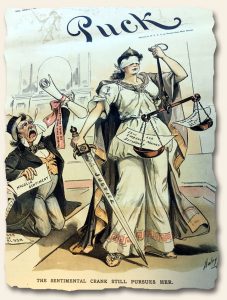
Adding a second distinguishing feature, this week I discovered the satirical Puck – begun in Germany and published in America in 1877. Interestingly, the founder collaborated with the renowned Leslie’s Illustrated prior to making the transition. Headed with the Shakespearean character’s wry commentary, “What fools these mortals be,” the clever magazine takes the tone of an outside, slightly mocking, observer.
The one I selected for perusal deals with the Justice System on the cover, and New York’s participation in the World Fair of 1839. A brief glance at the latter conveys a fairy tale worthy, beautifully colored double page centerfold that on closer inspection mocks the greed associated with the exposition and its participants.
It’s an elevated tone, when compared with the shrill modern volume on television and radio. Somehow, satire is more palatable to me — a velvet glove of watercolor illustration covering the iron fist of debate in a place where freedom of speech was so highly esteemed that it was almost an art form.
The October (2019) Newsletter from Rare & Early Newspapers…
October 22, 2019 by GuyHeilenman · Leave a Comment
Each month the staff of Timothy Hughes Rare & Early Newspapers sends out a newsletter to our members which includes special offers, discounts, alerts to new inventory, and information related to the rare newspaper collectible.
The October, 2019 newsletter:
|
 Welcome to the October 2019 edition of our monthly
|
I’m New Here: Week Thirty-Four…
October 18, 2019 by Stephanie Williams · Leave a Comment
Today’s post is a bit harried because Guy was away for a few days. There is nothing like his absence to bring home to me how much I still have left to learn. Thankfully, he has returned and no one was irrevocably distressed by my continued ineptitude — which was blatantly apparent without his buffering.
 That said, I juggled as successfully as I could, and in the process found a sphere of knowledge of which I have somehow remained ignorant. The covers of Harper’s Weekly publications are often pen and ink constructions that are balanced and aesthetically appealing. Many collectors purchase these to frame and subsequently decorate walls and offices. An issue from 1859 passed under my gaze while fulfilling a request that had been paired with a name unfamiliar to me. The collector was searching for Garibaldi reports. As I was completely unfamiliar with the name, my shipping room buddy brought the June 18, 1859 Harper’s to my desk before commencing his painstaking shipping process.
Clearly, I have been missing out. This “famous Italian patriot whose exploits on the slopes of the Alps are at present in every one’s mouth” was featured on the full front page, and continued onto one inside column. His visage is coldly angular, and his narrowed eyes appeared to find me across the length of my desk. My reaction must have been noteworthy, because an hour or so later Mike brought me a different date for that same title. “This artist had a kinder interpretation,” he said as he carefully placed another Garibaldi side by side with the first. And, the difference was so pronounced I spent a bit of time looking for the minute changes that dramatically influenced the whole.
Then I thought of all the people who search out issues containing Lincoln portraits, or a date among the seemingly unending eight years of Teddy Roosevelt covers. How funny it is to realize that our collective views of historically foundational people have been based on the interpretation of artists! Based on the shape of Joseph G.’s eyes, I suspect that some of them had a distinct bias that has unconsciously colored our perspective.
Even with my reasoning braced against my imagination, I find the introductory paragraph to the report does nothing to soften the aggressive life chosen by this commander. “Joseph Garibaldi is the type of gallant soldier of fortune, to whom the excitement of war is a necessity; but when his country’s opportunity arrives, is never found wanting among her defenders.”
Were you there – 1981? The Kinks perform at Madison Square Garden…
October 14, 2019 by GuyHeilenman · 1 Comment
You may have really got them going, but did they get you going enough to get you to go to their 1981 concert at Madison Square Garden? The Kinks, who are considered by many as one of the most influential British rock groups of the 1960’s, as of 1981 were still selling out at some of the biggest and greatest venues of the day. The full-page ad below, printed in The Village Voice dated September 9-15, 1981 (for the week of September 8th), is for their October 3rd concert at Madison Square Garden. Were you there? If so, feel free to share your family-friendly memories. Just as an FYI – Three of the four original members, and all who are living, are still playing concerts as of 2019. 
Announcing: Catalog #287 (for October, 2019) is now available…
October 1, 2019 by GuyHeilenman · Leave a Comment
- Catalog 287 (in its entirety)
- Noteworthy Catalog 287 ($250+)
- Combined Catalogs (current, w/ remnants of previous)
Don’t forget about this month’s DISCOUNTED ISSUES.
(The links above will redirect to the latest catalog in approx. 30 days, upon which time it will update to the most recent catalog.)
I’m New Here: Week Thirty-Two…
September 27, 2019 by Stephanie Williams · Leave a Comment
This week as I was pulling some Gentleman’s Magazines to fill online catalog gaps, I hovered over an issue prior to searching within the computer system. It was dated July 1776, and I took a minute to let that soak in. I am regularly awestruck at handling all these papers, but particularly anything from such an important, pivotal year and month in American history. Actually, I suppose it was significant to world history as well.
 This is not a museum, however, but a place of business and conscience compelled me to limit my sighing to less than a minute before turning to the keyboard and pulling up the listing for this title and date. And, as I read the opening lines of the description, I felt again the great privilege I have to be here.
“It is rare to find newspapers or magazines with the magical date of 1776, let alone ‘July, 1776’. Here is one.”
These paragraphs are such valuable tools for searching as well as learning. While Timothy Hughes Rare and Early Newspapers can boast 44 years in existence as a business, the depth of knowledge of history and its significance that is applied to filtering through the millions of papers in order to present each one goes far beyond a mere business listing. And the one that filled my screen only served to deepen my wonder at this treasure trove chronicling the earliest days of this country.
The first article contains 3 pages of text on events in America, including: “Proceedings of the American Colonists since the Passing the Boston Port Bill” with various reports, one stating that: “…the main army of the United Colonies has changed its situation; and that the head-quarters are now at New-York, where Gen. Washington has already taken up his residence…”. A proclamation issued by Congress concerning a redress of the grievances of the colonies says in part: “Therefore, Resolved, that it be recommended to the respective Assemblies and Conventions of the United Colonies, where no government sufficient to…their affairs has been…established, to adopt such a government…”, signed in type: John Hancock. Perhaps the most significant report is one mentioning the convention at Williamsburgh containing an important resolve (see) passed by the delegates which reads in part: “…That the delegates appointed to represent this colony…be instructed to propose to that…body to declare the united colonies free and independent…and that they give the assent of this colony to such declaration …..
I remember in my first days here, wondering if I would be required to wear gloves when handling these issues. My query was shrugged off, but I have been asked the same by friends and acquaintances when I talk about my job. We are used to seeing important things enclosed and protected behind glass and velvet ropes. But these papers were made to be read, and passed around so the news could spread. The older ones are often in better condition than the ones from the past few decades. Still, they are individually protected within folders, as much to keep the edges safe and protected as to shield from light and other environmental contaminants. I like that the storage options we use are the same as those we offer to our collecting community. Even though the crew here is much more seasoned than I, there is an unspoken acknowledgement that this is really amazing stuff, and I am not the only one that gets a bit awestruck…
Were you there – 1980? Elton John performs in Central Park…
September 16, 2019 by GuyHeilenman · Leave a Comment
Price being equal, would you typically choose a tangible gift, or an experience? Why do I ask?
Context: My wife and I have been blessed with 6 children. As each approached the end of their high school education, we offered each of them a sizeable (to us – the parents of a large family with only one of us working outside the home) amount of money as a graduation gift, or its equivalent in cost to go on a trip of their own creation. Two of them opted for the $$$ to put toward items they wanted (at the time), while the other four each elected to go on a trip. Many years later, as we all reflect back on the “gifts”, those who chose the “experience” are pleased they did – and have vivid fond memories, and the others struggle to remember what it was they had purchased. The reality is, “things” are typically for the moment, and have short life-spans, whereas memories are for a lifetime.
It is with this in mind we embark on a new, experiential series of posts: “Where you there?” Our hope is that in so doing, those of you who were present will be flooded with good memories of your experience. To kick things off…
On September 13, 1980, Elton John performed a free concert in Central Park, New York. To this day, it remains one of the top ten most-highly attended musical events held in Central Park. Were you there? The ad below was printed in the September 9th, 1980 (f0r the 10th-16th) issue of The Village Voice. Feel free to share your family-friendly memories.
I’m New Here: Week Thirty (gasp!)
September 13, 2019 by Stephanie Williams · Leave a Comment
 Even eight months into my first year here, I still have important job skills to acquire. This week Guy introduced me to The Weekly Register, also known as the Niles’ Weekly Register. He actually didn’t provide much of an introduction as there was new inventory to pick up, but he mentioned the title and left me to find my way to the back wall of the annex.
Before I started the metaphorical digging in, I tried to get my bearings first by looking into the background of this publication that stretched from 1811 until 1848. Our own item description mentions “significant coverage of the War of 1812”, so I extracted an issue from the title year, settling on December 5, 1812. Just below the town and date, a centered, italicized quote from Virgil’s “The Aeneid” assured me I would appreciate this new acquaintance.
Forsan et haec olim meminisse juvabit, “Maybe someday you will rejoice to recall even this.” I wonder if it was intended to bolster the staff or the new country. At any rate, the printing address on the following line is a cheery thing. “Printed and published by H. Niles, South-st. next door to the Merchants’ Coffee House”.
The issue I borrowed from the racks covers the legislatures of New Hampshire, New York, New Jersey and North Carolina, where (if the reports are accurate) the members were busily balancing affairs of their individual states with decisions concerning the authority of the president to call out a state’s militia. I was struck by the measured, pragmatic way one William Plumer attempted to persuade the governing body of New Hampshire. My pile of recommended reading for current politicians is growing taller every day.
A list of the “excellent toasts drank at New York, in commemoration of the evacuation of that city by the British” lauds the particular prowess of American sloops of war and the late Captain Jones, resting “on the bosom of the Atlantic.”
There is a four page section devoted to “Events of the War” packed with locations of ships, letters from various regiments, descriptions of force strength, and even a transcription of a Brigadier-General’s stirring call to arms.
“Rewards and honors await the brave. Infamy and contempt are reserved for cowards.
Companions in arms! — You came to vanquish a valiant foe. I know the choice you will make. Come on, my heroes!”
I can’t help but think that if we continued to work at bringing forth great words we might encourage heroic ideals in a culture so untethered to traditions of excellence in speech and conduct. Then again, I am only seeing the parts of 1812 that made it into print.
Anyway, if you don’t know The Weekly Register, I hope you too have opportunity to become acquainted. It has certainly been my pleasure.
I’m New Here: Week Twenty-Eight…
August 29, 2019 by Stephanie Williams · Leave a Comment
 It’s probably obvious by now that histories of people are the most intriguing aspect of life to me and it helps me when I enter into the customer service aspect of this job. Each longtime collector, or birthday dabbler, or train-of-thought/rabbit trail follower (I made that term up) is led or driven by his or her own tale. And I am privileged to hear about the whys and wherefores of the quests.
This week I worked with an Earth Science teacher who has been collecting early records of hurricanes, tidal surges and solar eclipses with an intensity I can’t help but appreciate, even though I could barely follow his pontificating. It makes me happy that he is teaching, and I hope his enthusiasm is contagious to at least one of the jaded high schoolers trudging through the eleventh grade of our system of education. A writer in Manhattan checked in five times this week, and added titles that were absolutely vital to the history she is compiling and I have a mental image of scraps of paper covered in scribbles from which she cross checks and matches our latest catalog offerings. Her exclamations of delight are always tinged with the “I really shouldn’t…” tone that most dieters adopt.
Preferences aside, details really matter in this job. Enthusiasm over stories within a volume cannot excuse my neglect to mark the proper location for return. With thirty-one rows of interior shelving that is fifteen feet high and thirty feet long, a misfiled collection may never be found again, however valuable the issues or concentrated the search. Similarly, folks who ordered a hundred times don’t appreciate a letter that welcomes them as a new collector, and our six-digit item codes can’t have a single transposition without becoming wrong. By this error, I did not locate a New York Tribune from the Civil War period but a Scientific American from January 24, 1891. Tracing my mistake to the original point at which I veered from the straight and narrow path of accuracy, I ended up sitting down to a cup of tea and a technical description of the “Electrical Base Ball Bulletin.” It caught my eye because we are located in “The Birthplace of Little League” and host the annual World Series every August. As with the Science instructor, the technical jargon jumbles me a bit so I cannot begin to comprehend how the contraption worked. However, the description is clearly an invention of Mr. S. D. Mott of Passaic, New Jersey from 129 years ago, that was possibly the precursor to the system for the modern scoreboard display.
So, there you have it.
In the world of Rare and Early Newspapers, even a wrong turn (in a timely fashion) can land me in a place I learn something new.
I’m New Here: Week Twenty-Six (aka, “She’s Still New Here – the first six months”)…
August 15, 2019 by GuyHeilenman · Leave a Comment
 There has rarely (if ever) been someone who has walked through our archives of historic newspapers and not been overwhelmed by the history that courses through the premises, but what is uncommon is to have such an individual become a member of our staff. Unlike many things that initially overwhelm or amaze us but soon lose their wonderment, if you love history, there are enough hidden treasures buried deep within our stacks to create excitement and appreciation for a lifetime. It was with this unique opportunity in mind we decided to have Stephanie Williams, our new office manager, chronicle her “learning curve” through a series of ongoing posts titled, “I’m New Here…”. Now that she has eclipsed the six-month mark, we thought it might be nice to assemble the posts into one easy-to-access location. Please enjoy her initial 6-month trek.
I’m New Here…
Week 1, 2, 3, 4, 5-6, 7, 8, 9-10, 11, 12, 13, 14-15, 16, 17, 18, 19, 20-21, 22-23, 24, and 25 (this being week 26)
(Also, Stephanie was on vacation so we thought it was a good time to create this chronology.)