
Search
The Rare & Early Newspapers Hobby

Receive the Newsletter

Buy Historic Newspapers

A gem in the American Antiquarian Society… Charleston Mercury Extra…
January 14, 2013 by TimHughes · Leave a Comment
In celebration of its 20oth anniversary the American Antiquarian Society published a beautiful exhibition catalog titled “In Pursuit Of A Vision – Two Centuries of Collecting at the American Antiquarian Society”. Featured are a fascinating array of books, documents, maps & other paper ephemera, as well as several very rare & unusual newspapers we felt worthy of sharing with our Rare & Early Newspapers’ collectors (with permission from the A.A.S.).
 “Charleston Mercury Extra“, December 20, 1860
The divisive political events of the 1850s had pitted North against South on numerous issues, including the expansion of slavery into the western territories, tariffs on goods such as cotton, and broader concepts of states’ rights vs. federal law. Political compromises made throughout the decade in an attempt to keep the nation together effectively collapsed with the election of Abraham Lincoln in November 1860. South Carolina, heir to the legacy of states’ rights lion John C. Calhoun, was the first to address the possibility of leaving the Union. On November 10, 1860, four days after the presidential election, South Carolina brought the issue to a head by calling a secession convention for the following month.
Considered by virtue of timing to be the first Confederate imprint, this broadside announced to the public the convention’s declaration, on December 20, 1860, that South Carolina would secede from the United States. This sheet was removed from a wall in Charleston by the Boston-born author Caroline Howard Gilman (1794-1888), who had moved permanently to Charleston following her marriage to the Rev. Samuel Gilman. Gilman mailed the broadside to her daughter Eliza in Salem, Massachusetts. Eliza in turn presented the document to AAS member Nathaniel Paine who, heeding the Society’s call to preserve all printed material relating to the unsettling national events, passed the broadside along to AAS.
A high-resolution image of this issue is viewable at: American Antiquarian Society, #47
Wisconsin’s first newspapers…
January 13, 2013 by TimHughes · Leave a Comment
The state of Wisconsin was under several governances before coming onto its own with statehood in 1848. It began as part of the Indiana territory, then part of the Illinois territory, then part of the Michigan territory, then detached as the Wisconsin territory in 1836.
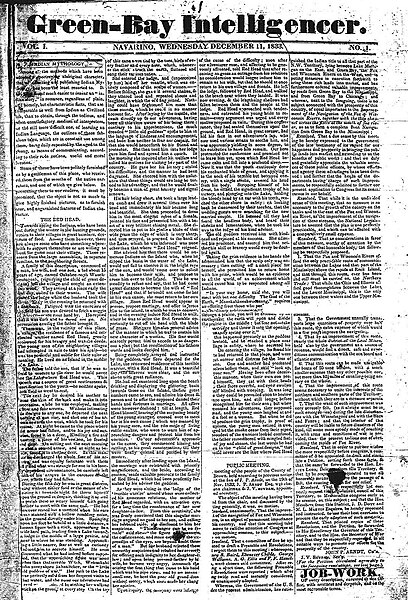 Printing began in the territory in 1827, and it was on December 11, 1833 that Wisconsin had its first newspaper titled the “Green-Bay Intelligencer“, done by Albert Ellis and John Suydam. The city was actually listed as Navarino, which today is a small suburb of Green Bay, population at the 2000 census listed as 442. Ellis was also the very first printer in Wisconsin, printing lottery tickets in 1827 and an almanac in the Chippewa language.
The second newspaper in Wisconsin was actually created as a vehicle to support the candidacy of Morgan Martin for territorial delegate to Congress. He employed William Stevenson and Joseph Dickinson to produced the “Wisconsin Free Press” at Green Bay in August of 1835. But it lasted for less than a year with the printing equipment sold to the “Intelligencer“.
Two more newspapers were created in the 1830’s, they being the “Wisconsin Enquirer” in November of 1838 at Madison, the newly created capital of the territory, and then the “Milwaukee Advertiser” on July 14, 1836. During the 1840’s many newspapers were created as Wisconsin worked towards statehood.
Merry Christmas… looking back…
December 24, 2012 by GuyHeilenman · Leave a Comment
 A few year’s ago we posted an article which is worthy of a revisit. It regards the interaction of enemy troops on Christmas Eve from during WWI. Some stories are worth repeating (see link below). We’ve also created a Christmas-themed Pinterest pinboard we believe will be worth your time to view. Please have a wonderful Christmas. As for our Jewish friends, thanks for providing us with the reason for our season. Happy Chanukah to you as well.
Pinterest: Viewing Christmas thru Historic Newspapers…
Christmas Eve – WWI: A Christmas thought… loving our enemies…
George Washingon speaks out…
December 21, 2012 by GuyHeilenman · Leave a Comment
 As the so-called fiscal cliff rapidly approaches and political tension fills the air, let’s take time to reflect on a time when unity of spirit & purpose under the blessing of God were all we had going for us… and as time would quickly show, it was all that we needed. The September 3, 1777 issue of the Edinburgh Evening Currant, Scotland, contains George Washington’s Manifesto of America. As Tim Hughes describes it:
I’m not sure I’ve seen a newspaper from the UK so replete with American content than this one. One-third of the front page is taken up with the complete & lengthy text of: “The Manifesto of America, By George Washington, Esq., Commander in Chief of the Forces of the United States, In answer to General Burgoyne’s Proclamation“. This document begins: “The associated armies of America act from the noblest motives, and for the purest purposes. Their ‘common principle’ is virtue, their ‘common object’ is Liberty!…” followed by a litany of eloquence which must be read. In the document he makes much reference to Christian values and the guidance of God, bits including: “…that the content has been made a foundation for the completed system of tyranny that ever God, in his displeasure, suffered for a time to be exercised over a forward & stubborn generation…Thus hath God, in his divine and just displeasure, suffered for a time, the exercise of the completest system of tyranny…In our consciousness of Christianity we pray, in all humility, for peace and good will among men, & invite all nations to mutual friendship and brotherly love. These truly Christian objects, we conceive, are to be attained only by Christian means…” and near the end: “…Its event we submit to Him, who speaks the fate of nations, in humble confidence, that as his omniscient eye taketh note even of the sparrow that falleth to the ground, so he will not withdraw his countenance from a people who humbly array themselves under his banner in defence of the noblest principles with which he hath adorned humanity.” The document is signed in type: George Washington.
To view the entire content along with images, please go to: Washington’s Manifesto
Reading the entire Manifesto of America will be worth your time!
Details of a slave auction…
November 26, 2012 by TimHughes · Leave a Comment
Mentions in pre-Civil War newspapers of slave auctions are not uncommon, and those which mention prices fetched for various slaves are somewhat more rare. But it is very difficult to find period articles which offers detail as to how an auction is conducted, how the slaves are examined, and comments on the slaves’ reaction to their sale.
The “New York Tribune” issue of April 28, 1860 includes an article titled: “The Negro Market In Savannah” which has such detail. It offers an interesting perspective on this institution which seems so barbaric today, but which was an accepted part of business in the pre-war South. A snippet of the text is found below, with the text in it’s entirety, along with a report of a fugitive slave case, is found at: “The Negro Market In Savannah“.
Reflecting on a Day of Thanksgiving & Prayer from 1776…
November 22, 2012 by GuyHeilenman · Leave a Comment
On this (American) day of thanksgiving, it seems appropriate to reflect on such a day from the past through the eyes of those who were embarking on what may have been the most historic event in U.S. history – July 4, 1776. A special thanks is in order for our friends in Scotland who captured this significant moment on the pages of the Edinburgh Evening Courant, dated September 2, 1776. Please enjoy:
Thanksgiving Proclamations… a survey through American History…
November 21, 2012 by GuyHeilenman · Leave a Comment
 This Thanksgiving, why not take the family on a historically “Pinteresting”walk through a survey of Thanksgiving Proclamations made at key moments in American History?
http://pinterest.com/rarenewspapers/thanksgiving-proclamations/
Happy Thanksgiving!
A visit to Jim Thorpe (Mauch Chunk), PA…
November 16, 2012 by GuyHeilenman · Leave a Comment
 A few weeks ago my wife and I had the pleasure of visiting a relatively unknown town steeped in history. Upon our return to the Rare & Early Newspapers office/archives, I spent some time exploring one aspect of the town’s history (The Molly Maguires) through the eyes of contemporary newspapers. A sampling of what was discovered both on the excursion and upon our return has been posted through images on Pinterest. Please enjoy:
Jim Thorpe & The Molly Maguires
Additional posts regarding Jim Thorpe himself, the town’s name since shortly after his death in 1953, may be viewed at: Jim Thorpe… “the greatest athlete that ever lived.”
Communication… My how far we’ve come…
November 12, 2012 by GuyHeilenman · Leave a Comment
 When it comes to collecting historic newspapers related to progress in the area of communication, collectors (rightfully so) typically focus on the telegraph, Morse code, the Pony Express, the typewriter, and the telephone. However, we recently came across a newspaper from New York which may rival some of the most collectible issues in the area of communication development – the report of the first successful use of a cell phone. At the time this historic event was only deemed worthy of a page 57 report, and most newspapers never reported it. As a result, this may end up being one of the most difficult reports to find… and collect. Once again we are reminded of one of the greatest joys of the hobby – uncovering hidden gems… instantly transforming what was once an average newspaper into a noteworthy collectible. Please enjoy the report on our website at New York Times, April 4, 1973 or on eBay at Historic Cell Phone Call – Motorola DynaTAC:
Beyond the historic headline…
November 1, 2012 by TimHughes · Leave a Comment
 “Newspapers that shaped the world…“
Some of the better & more fascinating items found in old newspapers are not the most historic or significant, but rather the casual appearance of seemingly innocuous reports which excite collecting interest beyond the historic headline or dramatic presentation which are the more usual draw.
Much of what intrigues collectors can be lost within the body of reports, yet they tell a story of their own, such as the patriotic fervor of some colonist during the Revolutionary War. I recall an issue of the Edinburgh Evening Courant of June, 1776 reporting on American soldiers: “…Their uniform is a dark grey coarse linen frock, which covers the whole body…with the words, ‘Death or Liberty’ marked in large red letters on the right sleeve; and many of them are so enthusiastic as to have them marked with their own blood…”. This report is almost lost on page 3 yet its message is very telling of the spirit which caused the Americans to win the war against a world power despite insurmountable odds.
Some reports are fascinating by their bias. A Richmond newspaper of July, 1863 reporting on the Battle of Gettysburg notes: “…The Confederates did not gain a victory, neither did the enemy. He succeeded in defending himself & we failed in some portions of an attack…We killed more of the enemy than we lost; we took very many more prisoners than lost. The Confederate army did not leave the enemy until it had tried every link of his armour…” Another newspaper notes: “ ..Information, certainly authentic, is in the hands of the Government, which leaves no doubt of the safety & triumph of the noble army. General Lee was victorious in all the combats which have taken place. He has been engaged with the whole force of the United States & has broken its backbone…”, Perhaps the most extraordinary example of optimism appeared in the Richmond Examiner of July 25: “…The result was not a defeat, it was not a loss; it was only not a victory…It was little else than a disappointment of extraordinary expectations…”. What a precious statement as an example of Confederate optimism.
Other little gems were very prophetic in their reporting, particularly when read with an historic perspective. A Scottish newspaper from 1775 sensed a lasting war with America as it reflected on the Battle of Bunker: “…The mischiefs which have already arisen & the greater calamities which are threatened from the unnatural war excited in America…It is impossible we can see, without the utmost alarm, preparations making for the prosecution of an expensive & ruinous war with our own Colonies…”. Some can be very recent, like the New York Times comment on rookie Mickey Mantle in 1951: “…Mantle, who gives every promise of developing into an outstanding baseball star, was ordered to report to his draft board next Wednesday…” An editorial comment in the Army & Navy Journal just after the Gettysburg Address opined: “…a dedicatory speech by President Lincoln, which we give in full, as decidedly the best feature of the occasion, as well as one of the most felicitous utterances of its author.” How true.
Some were prophetic even when the reports were simply wrong, like the Illustrated American article of 1898 reporting on “A New Flying Machine That Flies”–five years before the Wright brothers–when it said: “…It is impossible to imagine without terror the day when these mechanical birds, these flying apparitions, will be able to rain upon armies, hostile towns and escalating parties most deadly and most destructive explosives…”. How true it would become.
There can be much to be found in newspapers beyond the headline. What a thrill it is to discover such hidden gems; reports that have escaped hundreds of years of history only to rediscovered with new-found relevance today. Such are just some of the joys of collecting early newspapers.
Please enjoy: “Newspapers that shaped the world…“