
Search
The Rare & Early Newspapers Hobby

Receive the Newsletter

Buy Historic Newspapers

Strong Foundation … Liberty Takes Continual Work …
July 6, 2026 by Laura Heilenman · Leave a Comment
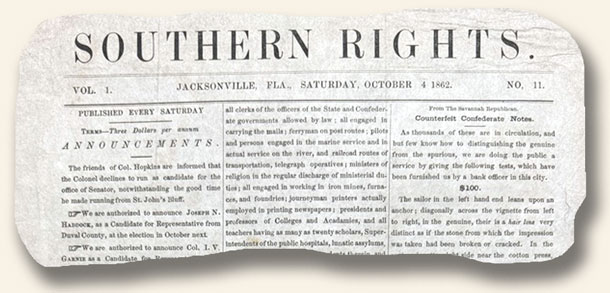
On October 4, 1862, the SOUTHERN RIGHTS out of Jacksonville, Florida had a fascinating issue with a story similar to that of the iconic Vicksburg Daily Citizen issue of July 4, 1863, when the Union troops found the newspaper still in the press, changed the final paragraph to report the Union takeover, and printed the issue.
The SOUTHERN RIGHTS newspaper’s story is found in a listing by the American Antiquarian Society and is as follows:
“Captain Valentine B. Chamberlain was in command of a company of the 7th Connecticut Volunteers who found the printing office and actually printed the issue for Oct. 4, 1862 from the standing type with Capt. Chamberlain’s addition in the first column on page 1 (see below). They then burnt the office and removed the press and types. The Oct. 4, 1862 issue was reissued in Hilton Head, South Carolina by Chamberlain, although retaining the Jacksonville imprint; and also reissued later in Jacksonville by the original printers once they had re-established their shop.
Printed at the bottom of this broadside issue is the following: Explanation–when the U.S. Forces under brigadier general J.M. Brannon visited Jacksonville, Fla., the form of the ‘Southern rights’ was found standing in this office just as it was left by the skedaddling rebels. The office was immediately ‘cleaned out,’ and–there being more ‘devils’ than printers present– the form was thrown into ‘pi’ in less time than it takes to write it. A proof sheet coming into our possession, we re-print the sheet as near like the original as possible, for the purpose of showing to our friends in the North, the ‘talent, vigor, heroism and military ardor’ that is not displayed in this trophy of Jacksonville.”–signed: Printers.
Captain Chamberlain’s addition mentioned above is headed: “Notice”, and reads, much tongue-in-cheek: “The Editor of this paper is absent from town for a few days on urgent business in the interior. It is therefore announced that the publication of this paper will hereafter be weekly suspended as it has been heretofore, weakly continued.
The taking of our battery after a loss of courage, but no blood, and the presence of the Yankee fleet, and the fearful proximity of Gen. Brannan and his forces, render the ‘Southern Rights’ precarious.”
I’m New Here: Week Forty-Three…
January 3, 2020 by Stephanie Williams · Leave a Comment
 Recently, a collector asked me to verify the presence of a continuing report within the Gazette of the United States – the Davila Discourse, which discusses political implications of a republican form of government, as perceived by John Adams in the early days of the young country. Mr. K offered the information that the section title printed within the sub-heading was not accurate, but a misidentification on the part of the publisher. Instead, he referenced an outside scholarly source to identify the sequence of text.
My son was old enough during the 2000 presidential election to be fascinated with the process. At his request, his grandmother kept every newspaper from the week before, through the many days following that strange Tuesday in this nation’s history. Most notable in his collection, however, is the issue that proclaimed Al Gore as the winner. This week I began thinking about the erroneous publication of “news” at historically crucial times.
Various reports of death have been “grossly exaggerated” – in fact, Wikipedia has alphabetically indexed 14 pages of such premature obituaries. In the Rare and Early Newspaper world one of the most well-known gaffes is the Chicago Tribune “Dewey Defeats Truman”. As I am new and just learning of these, I am appalled to find yet another winding road away from the details I am supposed to be taking care of during my working day.
Ultimately, a thing is not true just because it appeared in print. However, an editorial error can be quickly identified by reviewing the publishing context. Those of this community who have a more seasoned perspective might enjoy sharing some favorite errors with me via this blog, in case an opportunity arises to do a little wandering in my second year…
The Articles of Confederation formally united the 13 colonies (revisited)…
August 29, 2016 by GuyHeilenman · Leave a Comment
An oldie, but a goodie…
The following post was originally published in 2008:
For a collector of historic American documents as printed in period newspapers a printing of the “Articles of Confederation” would be a very significant issue. With much credit to Wikipedia, the creation & importance of this document provides some fascinating reading:
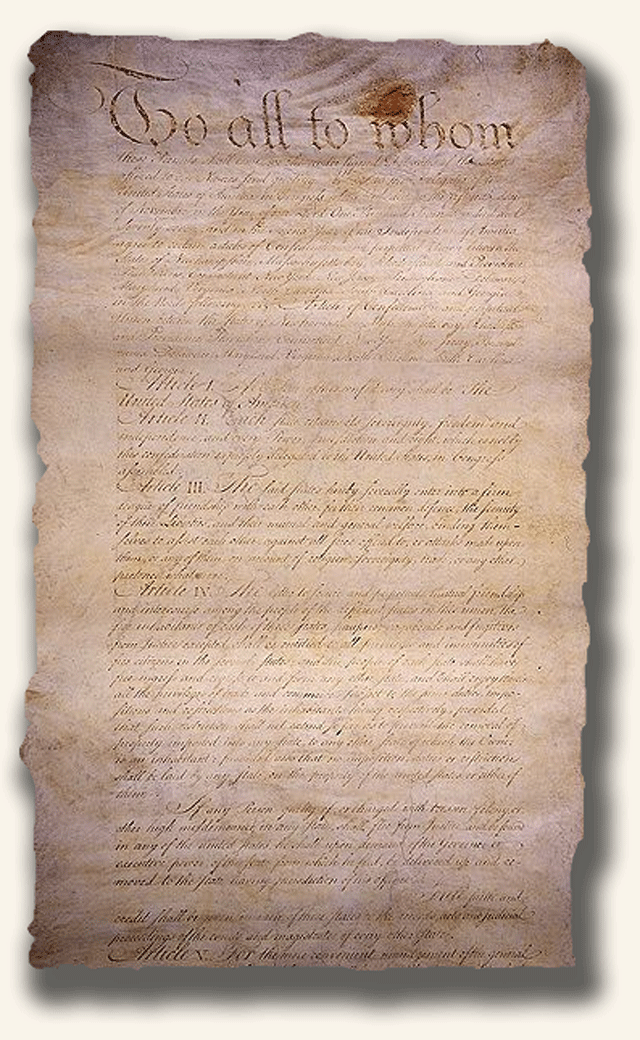 The Articles of Confederation was the governing constitution of the alliance of thirteen independent and sovereign states known as the “United States of America.” The Articles’ ratification, proposed in 1777, was completed in 1781, legally uniting the states by agreement into the “United States of America” as a union with a confederation government. Under the Articles (and the succeeding Constitution) the states retained sovereignty over all governmental functions not specifically deputed to the central government.
The last draft of the Articles was written in the summer of 1777 and adopted by the Second Continental Congress on November 15, 1777 in York, Pennsylvania after a year of debate. The Articles set the rules for operations of the “United States” confederation. The confederation was capable of making war, negotiating diplomatic agreements, and resolving issues regarding the western territories; it could not mint coins (each state had its own currency) nor could it borrow money, whether inside or outside the United States. An important element of the Articles was that Article XIII stipulated that “their provisions shall be inviolably observed by every state” and “the Union shall be perpetual”.
The Articles were created by the chosen representatives of the states in the Second Continental Congress out of a perceived need to have “a plan of confederacy for securing the freedom, sovereignty, and independence of the United States.” Although serving a crucial role in the victory in the American Revolutionary War, a group of “federalists” felt that the Articles lacked provisions for a sufficiently effective government. The key criticism by those who favored a more powerful central state (the federalists) was that the government lacked taxing authority; it had to request funds from the states. Another criticism of the Articles was that they did not strike the right balance between large and small states in the legislative decision making process. Due to its one-state, one-vote structure, the larger states were expected to contribute more but had only one vote. The Articles were replaced by the United States Constitution when created in 1787.
Our issue of the Pennsylvania Ledger dated March 11, 1778 contains the complete printing of the Articles of Confederation. The many photos will allow you to enjoy the significance of the newspaper and to appreciate how those who held this actual edition some 230 years ago might have felt knowing the independent colonies were joining together for a common cause–to not only provide a foundation for a united country which might some day–hopefully–become a world player, but for more immediate purposes, to survive the incursions of the British during the ongoing Revolutionary War. In 1778 no one knew how either effort might turn out.
Enjoy the issue!
“The United States of America”… humble beginnings?
September 14, 2012 by GuyHeilenman · 2 Comments

One of our rare newspaper friends recently discovered an interesting news item regarding the (potential) first use of “The United States of America” as referring to the American colonies. If true, the first use appeared in a newspaper – a Revolutionary War Era issue of The Virginia Gazette. To add to the intrigue, the origin of the phrase still retains an element of mystery as the article in which it appears was merely signed, A Planter. Thanks to the Byron DeLear of The Christian Science Monitor, and to NBCNEWS.com for bringing this to light. To view the entire article, please see: Who coined ‘United States of America’? New twist to mystery…
The Articles of Confederation formally united the 13 colonies…
December 18, 2008 by TimHughes · 1 Comment
For a collector of historic American documents as printed in period newspapers a printing of the “Articles of Confederation” would be a very significant issue. With much credit to Wikipedia, the creation & importance of this document provides some fascinating reading:
The Articles of Confederation was the governing constitution of the alliance of thirteen independent and sovereign states known as the “United States of America.” The Articles’ ratification, proposed in 1777, was completed in 1781, legally uniting the states by agreement into the “United States of America” as a union with a confederation government. Under the Articles (and the succeeding Constitution) the states retained sovereignty over all governmental functions not specifically deputed to the central government.
The last draft of the Articles was written in the summer of 1777 and adopted by the Second Continental Congress on November 15, 1777 in York, Pennsylvania after a year of debate. The Articles set the rules for operations of the “United States” confederation. The confederation was capable of making war, negotiating diplomatic agreements, and resolving issues regarding the western territories; it could not mint coins (each state had its own currency) nor could it borrow money, whether inside or outside the United States. An important element of the Articles was that Article XIII stipulated that “their provisions shall be inviolably observed by every state” and “the Union shall be perpetual”.
The Articles were created by the chosen representatives of the states in the Second Continental Congress out of a perceived need to have “a plan of confederacy for securing the freedom, sovereignty, and independence of the United States.” Although serving a crucial role in the victory in the American Revolutionary War, a group of “federalists” felt that the Articles lacked provisions for a sufficiently effective government. The key criticism by those who favored a more powerful central state (the federalists) was that the government lacked taxing authority; it had to request funds from the states. Another criticism of the Articles was that they did not strike the right balance between large and small states in the legislative decision making process. Due to its one-state, one-vote structure, the larger states were expected to contribute more but had only one vote. The Articles were replaced by the United States Constitution when created in 1787.
Our issue of the Pennsylvania Ledger dated March 11, 1778 contains the complete printing of the Articles of Confederation. The many photos will allow you to enjoy the significance of the newspaper and to appreciate how those who held this actual edition some 230 years ago might have felt knowing the independent colonies were joining together for a common cause–to not only provide a foundation for a united country which might some day–hopefully–become a world player, but for more immediate purposes, to survive the incursions of the British during the ongoing Revolutionary War. In 1778 no one knew how either effort might turn out.
Enjoy the issue!