

Search
The Rare & Early Newspapers Hobby

Receive the Newsletter

Buy Historic Newspapers

A gift for your barber…
April 5, 2013 by TimHughes · Leave a Comment
Although the purpose of the ad in the “Rhode Island American & Gazette”, Providence, February 1, 1831 was to give notice of this barber’s change of location, it’s the description of the service he performs which is most interesting–and amusing (see below).
Collecting the Revolutionary War on a budget…
March 28, 2013 by TimHughes · 2 Comments
 I would argue that beyond the Civil War, the era of American history which evokes the most interest among our collectors is unquestionably the Revolutionary War. With a cast of characters who still rank among the most memorable in history—Washington, Adams, Hancock, Jefferson, Henry, Franklin, Paine, and more—and a plot, which if it were not true history would serve as an excellent screenplay for an exciting movie—an oppressed, energized people seek to break free from the reigns of oppression and dominance from abroad—it is easy to see how the events of the Revolutionary War continue to intrigue and offer a foundation upon which to reflect as today’s world grapples with many of the same issues despite the 230+ years which distance us from those notable events.
And what could be better than experiencing those events just as those who lived through them? Newspapers offer that opportunity. Genuine issues, once held and read by those who lived through those turbulent days before being relegated to the back shelves of libraries, are now part of the inventory of Hughes Rare & Early Newspapers. And at prices which might surprise many (see Revolutionary War issues for $60 and under), as a hobby which is relatively unknown to the collecting world has yet to cause demand and scarcity to drive prices beyond the means of the average collector. Of course, there are still many that fall into the category of what we refer to as, “The Best of the Best – Revolutionary War Edition“.
Of significance is that British titles, which offer excellent coverage of all American events given their role in attempting to placate the demands of the Americans while maintaining control of their colonies, allow ownership of battle reports of the war for under $100, with  some very notable events in the $200-$300 range. American newspapers remain among the most desired but their scarcity is reflected in their prices. With a collection of the “Pennsylvania Evening Post” which included the Declaration of Independence bringing $600,000 in auction recently, it would amaze many that the same document is available in London’s “Gentleman’s Magazine” issue of August, 1776 (took news 3-4 weeks to traverse the Atlantic) for under $4,000. Other disproportionate prices between British and American newspapers entice many to gravitate to the British titles while prices and availability remain attractive.
The “London Chronicle” is one of the better British titles in reporting the Revolutionary War. From the Battle of Lexington and Concord, to Bunker Hill, Battle of New York, Saratoga, Washington crossing the Delaware, treason of Benedict Arnold, Guilford Court House, to Cornwallis’ surrender at Yorktown, this newspaper offers coverage which equals the American newspaper accounts. In fact many British reports were taken verbatim from American newspapers. Of equal quality in report news of the day was the “Edinburgh Evening Courant” from Scotland as I have found all events of the Revolutionary War to be reported in this title as well. Other UK titles which covered the war include “The Glocester Journal”, “Aris’s Birmingham Gazette”, the “Edinburgh Advertiser” and the “Glasgow Mercury” to name a few.
But perhaps the best and most available title of the Revolutionary War period would be the “Gentleman’s Magazine” from London, it having a long printing history from 1731 to the 20th century so it encompasses not just the Revolutionary War in great detail by the entire scope of American history. As an added treat this title typically included one of more plates within each issue, which included maps as well. And during the years of the Revolutionary War were found many maps of American colonies, battle sites as well as large foldout maps showing the entire scope of the united colonies at that time. The maps alone have found a keen interest among collectors, separate from the issues in which they were stored for over 200 years. As is true with the British titles mentioned, “Gentleman’s” included all notable events and documents, including the Articles of Confederation, the Causes and Necessity For Taking Up Arms, all major battles of the war thru the treaty between Washington and Cornwallis, and even the document by King George III which officially ended the war. And all the major names of the war from both the British and American sides have found their way into the pages of “Gentleman’s Magazine”.
 American titles are available as well. Some of the more rare would be those from the South which are virtually impossible to find, and when they do surface their prices are beyond the means of most collectors. Some of the more commonly found titles would be the “Pennsylvania Evening Post” from Philadelphia, the “Pennsylvania Ledger” “Boston Gazette” (which featured an engraving by Paul Revere in the masthead), “The Pennsylvania Gazette” and “Pennsylvania Packet” among others. And dipping back a few years before the outbreak of the war, when tensions were building with much evidence in the newspapers of the day, the “Pennsylvania Chronicle” and the “Boston Chronicle” offer excellent insight into events of the day from the years 1767-1769 for under $200 for most issues.
Regardless of your interest in the Revolutionary War, whether it be the famous names that came to prominence, the battles of the war, or a focus on a singular event or locality, genuine newspapers of the day are available for the collector. It is a hobby with limitless possibilities, and offers a unique opportunity to literally hold history in your hands.
The 1600’s and 1700’s on a budget…
March 25, 2013 by TimHughes · Leave a Comment
A genuine collectible, over 300 years old, for $60 or less. Is there a field of collecting today which has items of such age– in nice condition–for $60? The hobby of collecting rare & historic newspapers likely sits at the top of what must  be a very short list. And such prices, along with tremendous availability of titles & content, are part of the intrigue of this fascinating hobby which remains unknown to almost everyone. And this, in large part, is the reason prices are outrageously low in comparison to the relative rarity of other collectibles. While issues do run the gamut price-wise from newsbooks (at the upper end) to coffeehouse newspapers (typically at the lower end), it is a fascinating field for the historical hobbyist on a budget ($20 and under).
The ‘London Gazette‘ is the world’s oldest continually published newspaper, having begun in 1665 and is still publishing today. With such historical depth you would expect to find virtually every major event in world history within its pages, and you would be right. The Great Plague and Great London Fire, William Penn being granted land in the New World, the death of noted pirate Captain Kidd, the battles of the French & Indian War and Revolutionary War and so much more are found in not only this title but other newspapers of the era. First reports of such notable events can sell in the thousands of dollars, but an interesting facet of this hobby is that follow-up reports of a few days later can fall well within the comfort level of the average collector.
Both age and graphic appeal come together in the London ‘Post-Boy‘ newspaper, with issues from the 1718-1725 period featuring two ornate engravings in the masthead in addition to a very decorative first letter of the text. Add to this the relative small size of this single sheet newspaper and you have a terrific item for display for under $55.
With American newspapers not beginning until the first decade of the 18th century (one title was published in 1690 but lasted just one day), and most American newspapers through the Revolutionary War being very rare, British titles are an excellent source for collecting all the notable events not only in American history, but in world history as well. And the reporting was often extensive, for remember that the colonies were part of Great Britain through 1776.
The ‘London Chronicle’ was a popular British newspaper which documented amongst its pages virtually all American events since its founding during the French & Indian War. Yet another periodical, the ‘Gentleman’s Magazine‘, is an 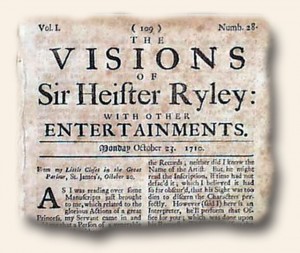 excellent source for period reports of American events since its beginning in 1731, and one of its features was the printing of maps of all corners of the globe, many of which show North America and specific colonies. From James Oglethorpe’s settling the colony of Georgia, to Ben Franklin‘s famous kite experiment, installation of the Liberty Bell, the enactment & repeal of the hated Stamp Act, all events of the Revolutionary War, to the mutiny on the Bounty & so much more, the ‘Gentleman’s Magazine’ offers a terrific repository of American and world history at very affordable prices. Plus, there are reports of Colonel George Washington from 1754 when he was just 22 years old and relatively unknown, and for the music buffs there are works by the composers Hayden, Handel, and death reports of Mozart and Beethoven within its pages. The early battles of Napoleon & other European reports are logically found in this title as well.
While American newspapers of the Revolutionary War and before are generally pricey, ranging in the $400 – $1000+ range, two notable exceptions exist being the ‘Boston Chronicle’ and the ‘Pennsylvania Chronicle’, both from the 1768-1769 years. Because their circulation was widespread they are among the more commonly held colonial titles by institutions, & consequently come on the market when libraries convert from hard copy to microfilm or digital. They detail the entire spectrum of American life from just before the Revolutionary War while providing an interesting perspective on American politics during those critical years. Complete, genuine issues are typically available for under $200.
American newspapers from after the American Revolution become more available and at dramatically lower prices while still containing a wealth of notable content on the founding years of the federal government. The ‘Pennsylvania Packet’ of Philadelphia was one of the more successful titles, and was the very first to print the Constitution of the United States. While that issue, September 19, 1787, ranks well into six figures, 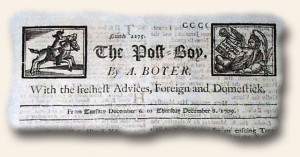 dates surrounding it are typically found in the $45 – $80 range and offer a perspective of life in the city where and when the Constitution was being created. The ‘Columbian Centinel’ from Boston was perhaps the most successful title in 18th century America and its pages document the complete scope of America politics and life from 1785 thru Washington’s election and inauguration to his death just weeks before the end of the century.
Other 18th century American titles which are within the budgets of even the most modest collectors are the ‘Connecticut Courant’, ‘Dunlap’s American Daily Advertiser’, ‘Gazette of the United States’, the ‘Massachusetts Spy’, and ‘The Herald, A Gazette For The Country’ and others. Nice issues from the formative years of the federal government can be had for under $50 each.
While first reports of the most historic events of the 17th and 18th centuries will always command top dollar among the most savvy of collectors, the hobby of collecting rare newspapers offers a tremendous wealth of issues at surprisingly low prices, while at the same time offering fascinating content on life only known to others through history books. And this hobby is one that offers the entire spectrum of political, economic, and social history to every collector. What other hobby can make that claim? But perhaps most importantly, this hobby let’s you hold—quite literally—history in your hands.
Still a few more fools around…
March 22, 2013 by TimHughes · Leave a Comment
The headline (see below) pretty much says it all in this October 2, 1890 report in the “Allegany County Reporter“ of Wellsville, New York…
Mormon history in newspapers…
March 15, 2013 by TimHughes · 3 Comments
As is true with any historical event or founding of an institution, collectors of historical newspapers strive for the earliest reports possible. The Declaration of Independence first appeared in a newspaper on July 6, 1776, and that issue commands a six figure price much higher than printings of the document in other newspapers of later dates  (such as the British Gentleman’s Magazine from August, 1776). Battle reports from the Revolutionary War are most coveted when in newspapers dated as close to the battle as possible. With the widespread use of the telegraph just before the Civil War, timeliness became less of an issue, as events would typically be found in the next day’s edition of newspapers regardless of how distance the printing press was from the event.
With institutions, societies & organizations the collector strives for the earliest reports on their creation. Reports from the Continental Congress, the Constitutional Convention, the creation of military academy at West Point, the first baseball game mention, are just a few examples of icons of present-day societies which collectors like to find in newspaper reports dated as early as possible.
Such is true with development of the Church of Jesus Christ of Latter-Day Saints, or the Mormons. Formally organized in upstate New York in 1829 accounts from that year or 1830 would rank among the most desired. Our earliest account was found in the ‘Christian Intelligencer” issue of February 4, 1831. As was typical with reporting of the day, bias, discrimination and prejudice were rampant within the newspaper pages, with the publisher’s mind-set not encumbered by political correctness. This early report notes that: “…the career of some fanatical individuals, who pretend to work miracles and to preach a new gospel. They profess to have discovered somewhere in New York a new revelation, hidden under a stone, which enables them to work miracles…a delusion and phrenzy with which these individual have wrought up the public mind…something like 500 adherents who follow those ignorant and deluded men with the same submission that sheep are led to slaughter…”. This intriguing report was likely the first its subscribers learned of this new religious movement,and with a current membership of over 14 million, this report dates to when just 500 were followers.
 A slightly later report in the popular ‘Niles’ Weekly Register‘ newspaper from Baltimore, July 16, 1831, shows a similar bias & prejudice: “…that certain knaves, pretending to have found some holy writings hidden under a stone…started a new religion! The leaders make bold pretensions and assert a gift to work miracles…now said to amount to 1,000 souls…some of whom…no doubt believe in all things that are told them…” and more.
Newspaper accounts found in the 1831-1835 period were very few and remain among the most desired among collectors.
By the time the leader Joseph Smith and the Mormons moved from Kirtland, Ohio, to Missouri and then Nauvoo, Illinois by 1839, reports in newspapers became more numerous, as their travels were often made dangerous by the suspicious locals who didn’t want them in their vicinity.
An interesting and desired collection of Mormon-related newspapers would include period reports of their movement westward, from New York to Ohio to Missouri to Illinois and ultimately to their own state of “Deseret” in the present-day state of Utah. With their arrival in 1847, Utah was not only not a state, it was not even a territorial possession. It was part of Mexico, but with the Treaty of Guadalupe Hidalgo which ended the Mexican War in 1848, it became a territory of the United States, and the disputes between the Mormons and the federal government would be legendary, the Mountain Meadows Massacre being among the most publicized. In additional to federal battles, disputes within their organization were quick to make the newspapers, and the practice of plural marriage did not set well with the typical Judeo-Christian ethic of the day.
 Typical of religious movements of the 19th century, the Mormons published several of their own periodicals, among the earliest and occasionally available being ‘Times & Seasons’ done during their turbulent stay in Nauvoo, Illinois. Within its pages was the report of the killing of founder and leader Joseph Smith. Other titles which occasionally surface for collectors are ‘The Latter-Day Saints’ ‘Millennial Star‘, the ‘Gospel Reflector’, and some three years after their arrival at Salt Lake City they set up the ‘Deseret News‘ in 1850, which was the first first newspaper to be published in present-day Utah, some 46 years before it would become a state.
The fascinating and troublesome history of the Mormons and their trek across the frontier of America is now part & parcel of American history. Finding reports in newspapers from when they happened makes for an interesting segment of any rare newspaper collection.
Headlines drive interest in World War II…
March 11, 2013 by TimHughes · 2 Comments
For likely a multitude of reasons, interest in World War II newspapers ranks far higher than in the Korean War, World War I, or the Spanish-American War. It may be a generational thing, as most collectors today are children of World War II veterans and likely heard stories of the war first-hand, or found 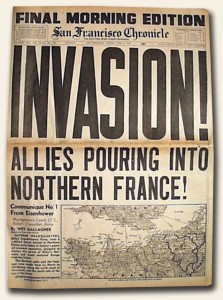 newspapers in their parents attics which sparked an interest. One could debate a number of other possible reasons why other wars lack the intrigue found in that fought by the “greatest generation”.
Headline collecting has always been a focus for this hobby, and as any collector knows, bold, banner headlines did not become commonplace until late in the 19th century. With the increasing competitiveness of daily newspapers across the country–Hearst, Pulitzer & others rising to prominence–flashier front pages were needed to draw attention at the corner news stand. It’s a shame there is not more interest in the Spanish-American War and World War I as both events resulted in some huge, dramatic, & very displayable headlines.
Because there are a plethora of newspapers from the WWII era available, collectors have become very discriminating in what they collect. Only the “best of the best” will do, meaning just the major events and only those with huge and displayable headlines. If there is a “top 6” list of sought-after events, our experience is they would be: 1) attack on Pearl Harbor; 2) the D-Day invasion; 3) death of Hitler; 4) end of the war in Europe; 5) dropping of the atomic bomb; 6) end of the war in the Pacific. One could add any number of other battle reports such as Midway, battle of the Bulge, fall of Italy, Iwo Jima, battle for Berlin, and so much more. And we could step back before American involvement in the war and add Hitler’s invasion of Poland and the battle of Britain.
The bigger the headline the better. With some newspapers the entire front page was taken up with a headline and a related graphic. The U.S. flag was a common patriotic device. Tabloid-size newspapers commonly had the front page entirely taken up with a singular headline and tend to be better for display given their smaller size.
 And not just American newspapers draw interest. German newspapers hold a special intrigue, but the language barrier is a problem for many. But the British Channel Islands, located in the English Channel between England & France, were occupied by the Nazi during the war so their reports were very pro-Nazi while printed in the English language (ex., Guernsey Island). And the military newspaper “Stars and Stripes“, while certainly being American, was published at various locations in Europe and the Pacific. Collectors have a special interest in finding World War II events in the official newspapers of the American military forces. Plus there were a multitude of “camp” newspapers, amateur-looking newspapers printed on a mimeograph machine for consumption limited to a military base, and typically printed is very small quantities. Their rarity is not truly appreciated by many.
For obvious reasons, there is also a high degree of collectible interest from those wishing to make sure certain aspects of history are not forgotten. The Holocaust, and the Nazi propaganda used to provide a rationale for eliminating the Jewish people, is well documented in newspapers from the era. In addition to the Holocaust and its atrocities, issues providing context through reporting other pre-war events such as the Great Depression, fascism, and increased militarism, are also desirable.
True to any collectable field, newspaper collectors are always on the lookout for an issue better than what they have, and collection upgrades are constant. Finding that special, rare, unusual or fascinating headline is what makes the hobby fun. Will interest in the Korean War and the Vietnam War gain more interest in future years? Perhaps so. With interest currently low and availability and prices very attractive, it might be a good time to explore.
Collecting the Old West…
March 8, 2013 by TimHughes · Leave a Comment
 Few eras in the broad range of American history have the appeal as that of the “Wild West“, a romanticized period following the end of the Civil War thru the end of the 19th century. It was a time when America was healing from the wounds of war and the adventurous were pushing the American boundary further West. It was the 1849 California Gold Rush which sparked interest. Now with the war over, new adventures were sought by many.
Those of the Baby Boom generation grew up on western movies and cowboy & Indian television shows. Even Disney’s hugely popular Mickey Mouse Club and the newly minted Disneyland had the Wild West as a popular theme. What we remember are battles with Native Americans, saloon brawls, gunfights, and a multitude of other events which seem to define the era. And to the delight of collectors, all are found in newspapers from the Old West.
Geographically our “Old West” definition would be any from west of the Mississippi. Some 25 years ago we were fortunate enough to purchase a sizable collection of Old West newspapers which were deaccessioned from the Bancroft Library, including many titles which existed only there, then only in our inventory. With some regret many have long since sold out, but most remain available.
Ways of collecting this era are many. Some might pursue one of as many different titles as are available. Content is a lesser concern; they just want one of everything. Some might collect one from every state from before the 20th century. Many states would be easily found but others can be challenging, particularly Arizona, New Mexico & perhaps Idaho. Others might be more specific and collect only titles from before statehood, typically known as “territorial newspapers” (note: Arizona & New Mexico joined the Union in 1912 so early 20th century issues are “territorial”). Again, many can be easily found while others are more of a challenge. California became a state in 1850 (interesting how quickly Congress can act when a pile of gold is found in the backyard) and the number of titles which existed in the Golden State before 1850 were very few. For the best of collections, finding an early issue of the first newspaper to publish in each state can be a special challenge. But of course this is the fun of collecting.
Then there is a larger segment of collectors who pursue content, whether it be the iconic events of the Old West such as Custer‘s Massacre, Killing of Jesse James, the gunfight at the O.K. Corral, capture of Sitting Bull, or just mundane reports of iconic events such as skirmishes with Indians, barroom brawls, bank & railroad robberies, and general reports of lawlessness. Yes, they are all found in Western newspapers of the day, and the search can be exciting.
As a subset of an Old West collection is Mormon content, as the story of the Church of Jesus Christ of Latter-Day Saints is part & parcel of the westward expansion. Many titles from Salt Lake City are available and contain a wealth of Mormon content from shortly after their settlement in Utah. Another subset  might be popular Western towns. Yes, 19th century newspapers are available from Tombstone, Sacramento, Deadwood City, Tucson, Albuquerque, San Francisco, Laramie, Reno, Los Angeles, San Diego, Leavenworth, and on and on. Of special intrigue is finding newspapers from ghost towns. Bodie, California is a great example of a once booming mining town which is currently a California State Park and popular ghost town attraction. Many of our titles from Northern California are from towns which are today a fraction of their size in the 19th century.
The world of Old West collecting is endless, and to the surprise of many prices for most newspapers of the era are unexpectedly low. Explore this interesting era of American history and discover a new facet of collecting!
Thomas Nast in Harper’s Weekly…
March 1, 2013 by TimHughes · 2 Comments
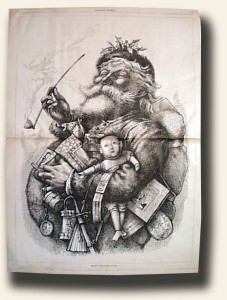 Thomas Nast ranks as one of the most successful, powerful, and prolific artists of the 19th century, and is a name linked closely to one of the most successful, powerful, and prolific newspapers of the 19th century. Through their successes, both Nast and Harper’s Weekly gained sufficient power to influence American politics in the second half of the 19th century and help shape the political climate of America during the industrial revolution.
Thomas Nast was German born, moving to America in 1846. Skilled as an artist, he first went to work for Frank Leslie’s Illustrated Newspaper in 1859, but within 3 years he began working for its competitor, Harper’s Weekly. His work continued to appear in Harper’s thru 1886.
It was a symbiotic relationship for the two. Circulation of Harper’s Weekly grew as Nast drawings were found in more and more of its pages, and Nast‘s notoriety and popularity grew in large part to the increased circulation of Harper’s Weekly. Nast‘s powerful pen in support of the prosecution of the Civil War was honored by President Lincoln when he called Nast “our best recruiting sergeant”.
With original artwork by Thomas Nast commanding prices far beyond the pocketbooks of most collectors, prints found in Harper’s–and only in Harper’s–remain a popular way to assemble a collection of this famed artist’s work at relatively low prices given the current availability of genuine issues.
For today’s collector, interest in Nast falls into three categories:
1) His portrayal of battles & events of the Civil War, which often featured human interest themes & the effect of the war on those back home, remain as some of the best and most heart-felt scenes of the Civil War. Daily newspapers only provided written text; Harper’s Weekly and the prints of Thomas Nast provided a visual representation of the reality of war.
2) Perhaps most noticed as a political cartoonist, his work did much to expose the graft and corruption of William “Boss” Tweed, the powerful Tammany Hall political machine of New York City. In fact it was a Nast cartoon which caused Tweed to be arrested following his escape from jail and flight to Spain. A customs official recognized him from his many appearances in “Harper’s Weekly”. Nast has been credited with doing much to cause elections of all in the hands of those he supported (Grant’s two Presidencies), and cause to fail those he disliked.
 It was Nast who created the caricatures of the Democratic donkey and the Republican elephant to represent those parties, political icons which remain to this day. Desired among collectors are the first donkey to appear in the pages of Harper’s Weekly (January 15, 1870) and the first elephant to appear (November 7, 1874), as well as the first time they appeared together (December 27, 1879). All three command premium prices due to their desirability, but collectors are encouraged by the inexpensive prices for other genuine issues of Harper’s which include Nast illustrations of both.
3) Santa Claus prints. It is Thomas Nast who is credited with creating the modern version of Santa Claus, the jolly, rosy-cheeked, rotund purveyor of gifts in the uniform as we know him today. Nast’s first Santa Claus to appear in Harper’s Weekly was titled “Santa Claus in Camp” from during the Civil War, appearing on the front page of the January 3, 1863 issue. Yet it is the January 1, 1881 issue which has the Santa Claus centerfold which still appears in many Christmas advertisements and is perhaps his most famous rendition. There are many issues of Harper’s Weekly which have Santa Claus prints, all very desired among collectors.
True to any symbiotic relationship, with Nast leaving Harper’s Weekly at the end of 1886, he lost his forum to reach the masses, and in losing Nast, Harper’s Weekly lost its political importance. Nast continued his work in other publications, none being very successful, until his death in 1902 to yellow fever. Harper’s Weekly never regained its success from the Nast years, and it ultimately ceased publication in 1916.
Harper’s Weekly issues with Nast prints are very displayable, particularly those which feature Nast images on the front page, or notable icons such as popular politicians, Santa Claus, Uncle Sam and Abraham Lincoln. A very famous Nast cartoon featuring Lincoln is the “Long Abraham Lincoln A Little Longer” cartoon which is in the November 26, 1864 issue, signifying his successful second Presidential election.
All issues offered by Hughes Rare & Early Newspapers are genuine & complete in 16 pages, save for a few described otherwise. In many cases two or three Nast prints appear in one issue.
A gem in the American Antiquarian Society… “The Royal Danish American Gazette”…
February 11, 2013 by TimHughes · 3 Comments
In celebration of its 20oth anniversary the American Antiquarian Society published a beautiful exhibition catalog titled “In Pursuit Of A Vision – Two Centuries of Collecting at the American Antiquarian Society”. Featured are a fascinating array of books, documents, maps & other paper ephemera, as well as several very rare & unusual newspapers we felt worthy of sharing with our collectors (with permission from the A.A.S.).
 104. “The Royal Danish American Gazette“, Christiansted, St. Croix, September 11, 1776
The Waldo Lincoln collection of eighteenth- and nineteenth-century West Indian newspapers numbers several thousand issues — many being the only known copies — and is one of the most important to be found anywhere.
The Royal Danish American Gazette was the first newspaper published in what is now the Virgin Islands. It was founded in 1770, when publisher Daniel Thibou relocated from St. Kitts to establish the first press on St. Croix. Portions were printed in Danish for the benefit of St. Croix’s sizable Danish population. We know that it had a fairly wide circulation, for a number of its articles were reprinted in contemporary American newspapers. Scholars have recently taken renewed interest in the significance of the West indies for early American history; but given the tropical climate, relatively few primary sources survive in West Indian libraries.
A shocking cure for what ails you…
February 1, 2013 by TimHughes · Leave a Comment
Here’s an interesting medical devise which never seemed to catch on, as reported in the “Scientific American” issue of March 14, 1891. I wonder how many investors in this product were shocked when this one went belly-up?