
Search
The Rare & Early Newspapers Hobby

Receive the Newsletter

Buy Historic Newspapers

West Virginia’s first newspapers…
January 28, 2013 by TimHughes · Leave a Comment
 The history of West Virginia newspapers dates some 70 years before West Virginia became a state. Statehood came late to West Virginia, carved from Virginia in the midst of the Civil War, happening officially on June 20, 1863. But its first newspaper began in 1790 when Nathaniel Willis began his “Potowmac Guardian & Berkeley Advertiser” at Shepherd’s-Town, near Harper’s Ferry. Less than two years later Willis moved the newspaper to Martinsburg.
The second newspaper was the “Shepherd’s Town, Charles-Town and County Advertiser” begun by Philip Rootes and Charles Blagrove on June 28, 1797. No copies beyond October 11, 1797 have been located. The third newspaper was the “Berkeley Intelligencer” done at Martinsburg on April 3, 1799 by John Alburtis. Many followed, including what is shown in the image, “The Observer, and Western Advertiser”, Lewisburg, [West] Virgina, 1884.
Summing up the Revolutionary War through 1779…
January 25, 2013 by TimHughes · Leave a Comment
The front page of “The Edinburgh Advertiser“, July 23, 1779, has a great letter (see below) signed by “An Englishman” which pretty much sums up the Revolutionary War through the mid-point of 1779. Never before have I seen a more accurate appraisal of the situation in so few words.
A gem in the American Antiquarian Society… Charleston Mercury Extra…
January 14, 2013 by TimHughes · Leave a Comment
In celebration of its 20oth anniversary the American Antiquarian Society published a beautiful exhibition catalog titled “In Pursuit Of A Vision – Two Centuries of Collecting at the American Antiquarian Society”. Featured are a fascinating array of books, documents, maps & other paper ephemera, as well as several very rare & unusual newspapers we felt worthy of sharing with our Rare & Early Newspapers’ collectors (with permission from the A.A.S.).
 “Charleston Mercury Extra“, December 20, 1860
The divisive political events of the 1850s had pitted North against South on numerous issues, including the expansion of slavery into the western territories, tariffs on goods such as cotton, and broader concepts of states’ rights vs. federal law. Political compromises made throughout the decade in an attempt to keep the nation together effectively collapsed with the election of Abraham Lincoln in November 1860. South Carolina, heir to the legacy of states’ rights lion John C. Calhoun, was the first to address the possibility of leaving the Union. On November 10, 1860, four days after the presidential election, South Carolina brought the issue to a head by calling a secession convention for the following month.
Considered by virtue of timing to be the first Confederate imprint, this broadside announced to the public the convention’s declaration, on December 20, 1860, that South Carolina would secede from the United States. This sheet was removed from a wall in Charleston by the Boston-born author Caroline Howard Gilman (1794-1888), who had moved permanently to Charleston following her marriage to the Rev. Samuel Gilman. Gilman mailed the broadside to her daughter Eliza in Salem, Massachusetts. Eliza in turn presented the document to AAS member Nathaniel Paine who, heeding the Society’s call to preserve all printed material relating to the unsettling national events, passed the broadside along to AAS.
A high-resolution image of this issue is viewable at: American Antiquarian Society, #47
Wisconsin’s first newspapers…
January 13, 2013 by TimHughes · Leave a Comment
The state of Wisconsin was under several governances before coming onto its own with statehood in 1848. It began as part of the Indiana territory, then part of the Illinois territory, then part of the Michigan territory, then detached as the Wisconsin territory in 1836.
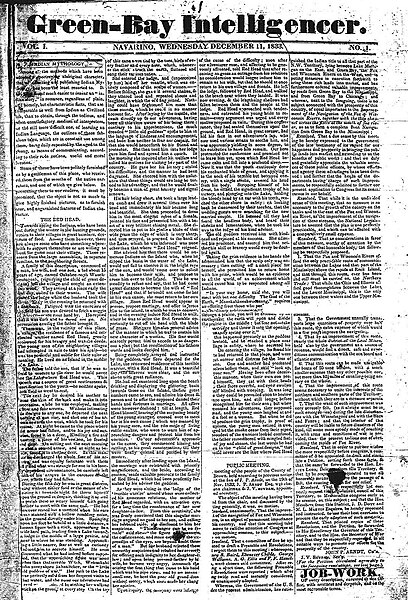 Printing began in the territory in 1827, and it was on December 11, 1833 that Wisconsin had its first newspaper titled the “Green-Bay Intelligencer“, done by Albert Ellis and John Suydam. The city was actually listed as Navarino, which today is a small suburb of Green Bay, population at the 2000 census listed as 442. Ellis was also the very first printer in Wisconsin, printing lottery tickets in 1827 and an almanac in the Chippewa language.
The second newspaper in Wisconsin was actually created as a vehicle to support the candidacy of Morgan Martin for territorial delegate to Congress. He employed William Stevenson and Joseph Dickinson to produced the “Wisconsin Free Press” at Green Bay in August of 1835. But it lasted for less than a year with the printing equipment sold to the “Intelligencer“.
Two more newspapers were created in the 1830’s, they being the “Wisconsin Enquirer” in November of 1838 at Madison, the newly created capital of the territory, and then the “Milwaukee Advertiser” on July 14, 1836. During the 1840’s many newspapers were created as Wisconsin worked towards statehood.
Call it triple irony…
January 4, 2013 by TimHughes · Leave a Comment
The “Detroit Free Press” issue of December 12, 1939 report this interesting incident which affected–of all organizations–a fire company…

Details of a slave auction…
November 26, 2012 by TimHughes · Leave a Comment
Mentions in pre-Civil War newspapers of slave auctions are not uncommon, and those which mention prices fetched for various slaves are somewhat more rare. But it is very difficult to find period articles which offers detail as to how an auction is conducted, how the slaves are examined, and comments on the slaves’ reaction to their sale.
The “New York Tribune” issue of April 28, 1860 includes an article titled: “The Negro Market In Savannah” which has such detail. It offers an interesting perspective on this institution which seems so barbaric today, but which was an accepted part of business in the pre-war South. A snippet of the text is found below, with the text in it’s entirety, along with a report of a fugitive slave case, is found at: “The Negro Market In Savannah“.
Beyond the historic headline…
November 1, 2012 by TimHughes · Leave a Comment
 “Newspapers that shaped the world…“
Some of the better & more fascinating items found in old newspapers are not the most historic or significant, but rather the casual appearance of seemingly innocuous reports which excite collecting interest beyond the historic headline or dramatic presentation which are the more usual draw.
Much of what intrigues collectors can be lost within the body of reports, yet they tell a story of their own, such as the patriotic fervor of some colonist during the Revolutionary War. I recall an issue of the Edinburgh Evening Courant of June, 1776 reporting on American soldiers: “…Their uniform is a dark grey coarse linen frock, which covers the whole body…with the words, ‘Death or Liberty’ marked in large red letters on the right sleeve; and many of them are so enthusiastic as to have them marked with their own blood…”. This report is almost lost on page 3 yet its message is very telling of the spirit which caused the Americans to win the war against a world power despite insurmountable odds.
Some reports are fascinating by their bias. A Richmond newspaper of July, 1863 reporting on the Battle of Gettysburg notes: “…The Confederates did not gain a victory, neither did the enemy. He succeeded in defending himself & we failed in some portions of an attack…We killed more of the enemy than we lost; we took very many more prisoners than lost. The Confederate army did not leave the enemy until it had tried every link of his armour…” Another newspaper notes: “ ..Information, certainly authentic, is in the hands of the Government, which leaves no doubt of the safety & triumph of the noble army. General Lee was victorious in all the combats which have taken place. He has been engaged with the whole force of the United States & has broken its backbone…”, Perhaps the most extraordinary example of optimism appeared in the Richmond Examiner of July 25: “…The result was not a defeat, it was not a loss; it was only not a victory…It was little else than a disappointment of extraordinary expectations…”. What a precious statement as an example of Confederate optimism.
Other little gems were very prophetic in their reporting, particularly when read with an historic perspective. A Scottish newspaper from 1775 sensed a lasting war with America as it reflected on the Battle of Bunker: “…The mischiefs which have already arisen & the greater calamities which are threatened from the unnatural war excited in America…It is impossible we can see, without the utmost alarm, preparations making for the prosecution of an expensive & ruinous war with our own Colonies…”. Some can be very recent, like the New York Times comment on rookie Mickey Mantle in 1951: “…Mantle, who gives every promise of developing into an outstanding baseball star, was ordered to report to his draft board next Wednesday…” An editorial comment in the Army & Navy Journal just after the Gettysburg Address opined: “…a dedicatory speech by President Lincoln, which we give in full, as decidedly the best feature of the occasion, as well as one of the most felicitous utterances of its author.” How true.
Some were prophetic even when the reports were simply wrong, like the Illustrated American article of 1898 reporting on “A New Flying Machine That Flies”–five years before the Wright brothers–when it said: “…It is impossible to imagine without terror the day when these mechanical birds, these flying apparitions, will be able to rain upon armies, hostile towns and escalating parties most deadly and most destructive explosives…”. How true it would become.
There can be much to be found in newspapers beyond the headline. What a thrill it is to discover such hidden gems; reports that have escaped hundreds of years of history only to rediscovered with new-found relevance today. Such are just some of the joys of collecting early newspapers.
Please enjoy: “Newspapers that shaped the world…“
The first newspapers in Texas…
October 25, 2012 by TimHughes · Leave a Comment
Texas had a fascinating history, with flags of six nations having flown over some portion of the present state: Spain, France, Mexico, Republic of Texas, United States of America, & Confederates States of America.
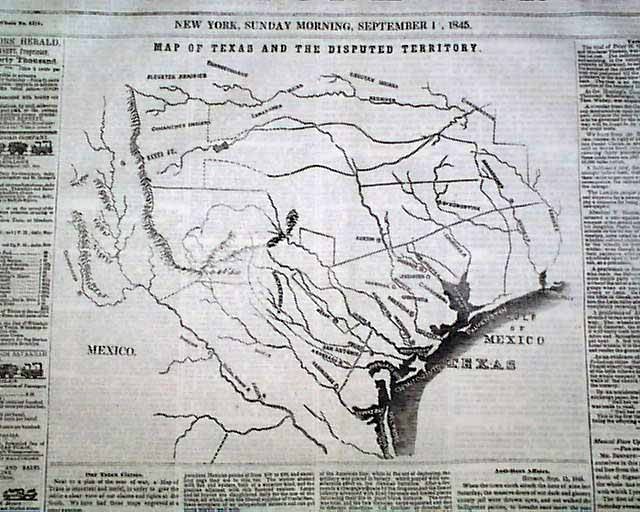 It was during the time when the Mexico flag flew over its land that a periodical titled “El Mejicano” was reportedly printed in Nacogdoches in May , 1813, as noted in Oswald’s “History of Printing In The Americas”. One report, from the “Southwestern Historical Quarterly” notes that a newspaper was printed from the same press at about the same time, titled “Gaceta de Texas” with a date of May 25, 1813. Some years later Horatio Bigelow and Eli Harris put out the first issue of the “Texas Republican” on Aug. 14, 1819. When Nacogdoches was captured by the Mexicans two months later the printing office was destroyed.
Milton Slocum, a printer from Massachusetts, established the “Mexican Advocate“, a newspaper in both English and Spanish, in Nacogdoches in September, 1829. Unfortunately no copies have survived. Outside of Nacogdoches a weekly paper titled the “Texas Gazette” was begun on Sept. 25, 1829 in San Felipe de Austin. This paper then moved to Brazoria in July 1832 and ultimately was sold to the publisher of an existing newspaper titled the “Texas Gazette & Brazoria Commercial” which had begun just two years earlier. The combined enterprise became the “Constitutional Advocate and Brazoria Advertiser“.
Beginning in the 1830’s a multitude of newspapers sprang up in present-day Texas, continuing in the 1840’s and beyond.
There must be a man in the moon…
October 12, 2012 by TimHughes · Leave a Comment
The “Bellows Falls Intelligencer” newspaper from Vermont, issue of May 10, 1824 has an interesting article reporting evidence of life on the moon (see). It’s interesting that astrological science was so rudimentary in 1824 that this report was to be believed by those who read it, although providing some humor when read today.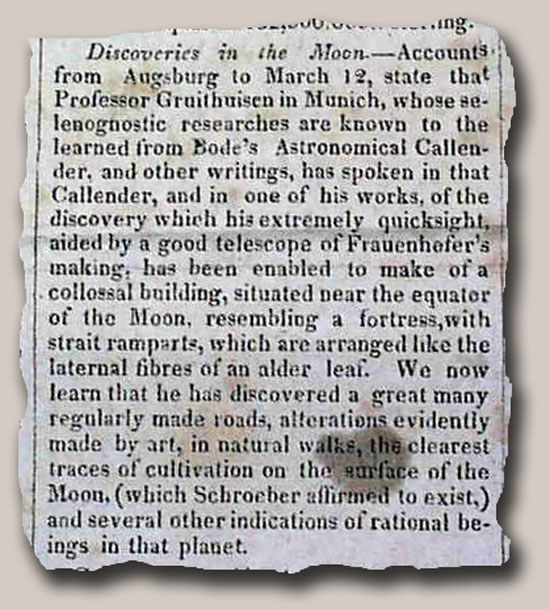
Newspaper Confederate bank note creates a crisis…
October 1, 2012 by TimHughes · 2 Comments
Having recently come across the Feb. 24, 1862 issue of “The Philadelphia Inquirer” (see photo) it reminded me of what this innocent looking front page image of the Confederate five dollar note did in creating a crisis in the Confederate Treasury.
Several months ago the “Opinionator” blog of the New York Times did a very nice piece on the fascinating history of this note and its consequences, which we share with our collectors:
 In March 1862, an unusual ad began appearing in Northern newspapers. Among the shops selling pianos and patent medicines, sheet music and sewing machines, this one stood out: it promised “perfect fac-similes” of Confederate currency. There were seven kinds of notes for sale, and testimonials from The New York Tribune and others praising the replicas for their high quality and low prices. Five cents bought you one. Two dollars bought a hundred. Fifteen dollars bought a thousand. The word “counterfeits” never appeared. These were “Mementos of the Rebellion,” sold by a Philadelphia shopkeeper named Samuel Curtis Upham.
Upham didn’t look like a counterfeiter. He didn’t hide out in the woods or perform daring jailbreaks. He didn’t run from the police. He was a respectable small-business owner and devoted Northern patriot. He ran a store that sold stationery, newspapers and cosmetics. But he was also an entrepreneur with an eye for easy profit, and the Civil War offered the business opportunity of a lifetime: the ability to forge money without breaking the law. Confederate currency, issued by a government that was emphatically not recognized by the Union, had no legal status in the North, which meant Upham could sell his “fac-similes” with impunity.
Over the next 18 months he built the most notorious counterfeiting enterprise of the Civil War — one that also happened to be perfectly legal. His forgeries flooded the South, undermining the value of the Confederate dollar and provoking enraged responses from Southern leaders. He waged war on the enemy’s currency, serving his pocketbook and his country at the same time.
Upham first got the idea the month before, on Feb. 24, 1862. That day, customers kept coming into his shop to buy The Philadelphia Inquirer. Puzzled, he asked one of them what made that particular edition so popular. The answer was on the front page: the Inquirer’s editors had printed a copy of a five-dollar Confederate note. Philadelphians had never seen Rebel money before and were fascinated by it.
Upham saw a chance to cash in. He raced to the Inquirer’s offices, bought the plate of the note, and printed 3,000 copies on French letter paper. They sold extremely well. Along the bottom of each bill, he included a thin strip that read, in small print, “Fac-simile Confederate Note,” with his name and address. The tags could easily be clipped off, transforming the “fac-simile” into an excellent counterfeit.
After his first print run, Upham rapidly expanded his inventory. He took out ads in newspapers, promising to pay in gold for more specimens of Southern money. At first, it seemed possible that he sincerely thought of his reproductions as souvenirs. In early 1862, most Northerners still expected the war to be brief and glorious. They wanted “mementos of the Rebellion” before the Union crushed it. By the time Upham launched his publicity campaign in March, however, his business had clearly evolved from a modest retail operation into a high-volume wholesaling enterprise. No one needed 1,000 souvenirs: people were clearly using his products for a less innocent purpose.
By April, Upham’s fakes began appearing in Richmond, the Confederate capital. They caused a sensation at the Confederate Treasury Department, and a Treasury officer persuaded the editors of the Richmond Daily Dispatch to inform the public about the new threat. “This note is well calculated to deceive, and in nearly every particular is a fac-simile of the original,” they wrote, condemning the forgeries as “Yankee scoundrelism.” In May, the Dispatch discovered one of Upham’s notes with the margin bearing his name and address still attached. “Who is this man Upham?” they asked. “A knave swindler, and forger of the most depraved and despicable sort.”
By then, Upham had grown his business considerably. In an advertisement published in late May, he claimed to have sold half a million notes in the past three months. He now offered 14 varieties of Confederate notes, postage stamps, and “shinplasters” — fractional bills worth anywhere from 5 to 15 cents — and printed his fakes on real banknote paper. Ingeniously, he even fulfilled orders through the mail. For 50 cents, plus 18 cents for postage, customers throughout the Union could have a hundred of Upham’s notes delivered.
Southerners responded with outrage. They became convinced that Upham belonged to a covert Union plot to devalue the Confederate dollar. For the Philadelphia shopkeeper to be able to advertise his counterfeits openly and send them through the mail meant the authorities must have given him permission or, possibly, material support. Moreover, Union troops spent counterfeit Confederate cash in large quantities — evidence of “a deep laid scheme on the part of the thieving, counterfeiting North … to undermine the Confederate currency,” in the eyes of the Daily Richmond Examiner.
In the summer of 1862, Upham’s notes inundated northern Virginia, brought by Union forces marching south from Washington. A Southern journalist observed men “fortified with exhaustless quantities of Philadelphia Confederate notes,” which they used to buy everything from horses to sugar to tobacco. When one of the soldiers ended up a prisoner in Richmond, the Confederates found one of Upham’s advertisements on him. The shopkeeper’s counterfeits appeared “wherever an execrable Yankee soldier polluted the soil with his cloven foot,” fumed the Richmond Daily Dispatch.
By the summer of 1862, as fake cash flowed across the border in ever greater quantities, the Confederate leadership took notice. On Aug. 18, President Jefferson Davis discussed the threat in a message to the Confederate Congress. Counterfeit Confederate notes were “publicly advertised for sale” and furnished to “the soldiers of the invading army” with the full “complicity” of the Union government, Davis declared. Later that day, Confederate Treasury Secretary Christopher Memminger submitted a report to the House of Representatives that reiterated Davis’s concerns and singled out Upham’s role in the crisis: “[P]rinted advertisements have been found stating that the counterfeit notes, in any quantity, will be forwarded by mail from Chestnut street, in Philadelphia.” By then, forged bills had been found far from the Union border, in Atlanta, Savannah, Montgomery and other cities of the Deep South. There was “no means of knowing to what extent they have been circulated,” the Richmond Daily Dispatch warned.
Hamstrung by a disorganized government and mounting logistical challenges, the Confederacy couldn’t stanch the surge of counterfeit currency. Despite Southern claims, however, it’s unlikely that the Union government ever actively promoted the forging of Confederate money. Federal authorities most likely found it easier to ignore the forging of Southern bills than to take a position either for or against it. They certainly never interfered with Upham, who freely continued forging Confederate cash until August 1863. By that time, the value of the Southern dollar had fallen so low that it was hardly worth counterfeiting. During the 18 months that Upham operated his venture, the purchasing power of the Confederate dollar disintegrated. Between February 1862 and August 1863, the value of Confederate paper money fell by ninety percent.
Upham wasn’t the only reason behind this collapse. Fake cash plagued the Confederacy from the beginning, supplied by Northern and Southern counterfeiting gangs. Gross mismanagement of Southern finances led to runaway inflation, which posed an even greater danger to the Confederate dollar. But Upham’s impact was significant. He later estimated that he had produced $15 million worth of Confederate bills. If all of that ended up in the South, it would have made up almost 3 percent of the total money supply — a large amount for a single counterfeiter. In March 1862, his business had only just begun. Over the next year and a half, he would become one of the strangest success stories of the Civil War: a legal counterfeiter, driven by patriotism and personal gain, who struck at the financial heart of the Confederacy from the safety of downtown Philadelphia.