

Search
The Rare & Early Newspapers Hobby

Receive the Newsletter

Buy Historic Newspapers

Niles’ Weekly Register documented the first half of the 19th century…
June 14, 2013 by TimHughes · 2 Comments
 Of the many notable newspapers published in the history of the United States there are a few stand-outs for different eras. Of the colonial era the “Pennsylvania Gazette” came to prominence under the guidance of publisher Ben Franklin, and in the latter decades of the 1700’s the “Gazette of the United States“, and the “Columbian Centinel” were two of the more significant titles which informed the American populace for many years. Of the 19th century the “National Intelligencer” and the “New York Times” were certainly among the more prominent, but a title which did as much as any other to bring the news into the households of America was “Niles’ Weekly Register“.
Considered by some a magazine due to its small size, I like to consider it a small newspaper, as its content was more aligned to presenting the politics & other news of the day rather than the literary content more associated with magazines. But of curious note is that it was devoid of advertising, relying entirely upon the strength of its subscription base for its existence.
Hezekiah Niles edited and published his newspaper in Baltimore from 1811 until 1836, making it into one of the most widely-circulated periodicals in the United States and himself into one of the most influential journalists of his day. Devoted primarily to politics, “Niles’ Weekly Register” is considered an important source for the history of the period. It continued beyond his demise until 1849.
Given its close proximity to the nation’s capital it was in an excellent position to print political reports but also the wealth of other news from all corners of the then-growing country which would eventually find its way to Washington, D.C. Having collected early newspapers for over 37 years I can attest to the quality of reporting–very in depth–in comparison to the physically larger newspapers of the day.
Founded just a year before the outbreak of the War of 1812 and lasting through the early period of the California Gold Rush, a great wealth of American history was printed within each of its 16 weekly pages, and a nice spectrum of America in the first half of the 19th century can be gathered by simply focusing on this one title.
 Early in its publication the battle of Tippecanoe brought the name William Henry Harrison to prominence with his victory over the Indians, the details of which made the pages of “Niles’ Weekly Register“. Then all the event of the War of 1812, from President Monroe’s war proclamation to the war-ending Battle of New Orleans led by Andrew Jackson (actually fought after the treaty ending the war was signed) with the host of naval battles of 1812-1815.
There is hardly a topic or event from American history not found in Niles’ Weekly Register. Much Judaica content, the creation of the Mormon Church and their journey west, much on the historic Maryland Jew Bill, and even mention of Abraham Lincoln and Robert E. Lee long before they would be names known to the American public were found in this newspaper.
The slavery issue was certainly not side-stepped, as reports on Nat Turner’s Rebellion and the Denmark Vesey case were two of the more notably events which received much coverage. The Amistad affair–not found in every newspaper of the day–was reported in many issues of Niles’ as the events & trial unfolded. Certainly the issue is slavery was ever-present in congressional reports, and was a factor in the Missouri Compromise, also published in this newspaper.
As the country continued to expand, the westward march was documented in many reports including the development & opening of the Erie Canal, the exploring of the Yellowstone region, and the creation of the Santa Fe Trail being just a few. Several states joined the union during the years of Niles’ and as they did even the alterations to the United States flag were documented by the newspaper. Names such as Daniel Boone, infamous pirate Jean LaFitte, Samuel Morse, Daguerre and Eli Whitney are a few which were featured as their actions and inventions made news.
The Texas war for independence made the news in 1835 and 1836 and many of the notable battles were reported. There is even mention of Davy Crockett leaving Congress and heading to Texas to fight for their cause, where he would meet his end at the famous Battle of the Alamo.
With politics as a focus it is no surprise that elections and inaugurations were all documents in “Niles’ Weekly Register“, including the short term of President William Henry Harrison who just one month after being inaugurated would die in office.
 There is so much more history to be found within the pages of Niles’. Our troubling (and often disgraceful) relationship with the Native American Indians, including the Black Hawk War & Trail of Tears, was covered in much detail. The Mexican War and all its events was the last of the military encounters to appear in this newspaper, the treaty ending that war being signed in 1848, just one year before the demise of the newspaper.
The ironic same-day deaths of Presidents Thomas Jefferson and John Adams, and on the 50th anniversary of the Declaration of Independence, received much coverage; the Monroe Doctrine and the curious efforts of Mordecai Manuel Noah to create a Jewish settlement on an island in the Niagara River are just two of the fascinating events of American history documented. And it was not just American history that was reported, as world-wide events, as their significance would dictate, would make the pages of Niles’ as well, not the least of which was the historic battle of Waterloo which spelled the doom of Napoleon’s efforts in Europe.
It was a pint-sized newspaper with a powerful impact upon the documentation of American history in the first half of the 19th century. It is a title every collector should not overlook as they consider the best newspapers for reporting some of the major events in history. They all will be found in “Niles’ Weekly Register“.
Reporting the world of sports…
June 10, 2013 by TimHughes · Leave a Comment
 One of the passions held by many is sports, and each season provides a new opportunity to cheer on one’s favorite teams as they follow their efforts through to a hopeful championship. It is not coincidence that “fan” is a diminutive form of the word “fanatic”. The hobby of collecting early newspaper adds an opportunity to broaden support for a team by including an historical perspective possible only through all this hobby has to offer.
Baseball, football, basketball, tennis, golf, horse racing, soccer, and on and on. You name the sport and reports can be found in newspapers going back to the very beginning of the sport, or the beginning of newspapers. We once offered a newspaper from Springfield, Massachusetts—where basketball was founded—reporting the very first public game ever played. It is the holy grail of newspaper reports on basketball, and now resides in the archives of the Library of Congress. Similar gem items can be found for other sports as well.
If a report cannot be found on the very beginning days of a sport, finding reports as old as possible is a quest which never ends. Baseball traces its history back to 1839 (although exactly when & how it was founded is up for some discussion) so finding a newspaper with a bonafide baseball report as close to this year is a worthy goal. We have some issues back to 1855 on our website, and game reports become more frequent during and just after the Civil War.
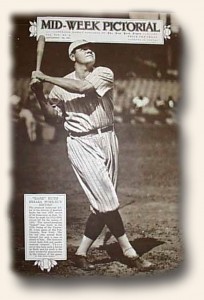 But with baseball it’s often the golden era that attracts the most attention, from when Babe Ruth, Lou Gehrig and other standouts from the 1920’s and 1930’s were making headlines. Just following Ruth’s standout career can create a formidable collection, from early mention of him in the majors (how about 1914?), his first Major League game appearance, his first home run, a report of him being sold to the Yankees, and then his stellar career as a home run record-setter. All were reported in newspapers.
And there was a host of notable ball players from a generation before, including Nap Lajoie, Branch Rickey, Henry Chadwick, Honus Wagner, Walter Johnson, Ty Cobb, Joe Jackson, & Christy Mathewson to name a few. In fact baseball had its own daily newspaper from the 1880’s titled the “Official Record” which chronicled nothing but baseball reports of the day.
Illustrations of baseball players are a special treat and add a graphic & displayable dimension to any collection. The popular illustrated newspaper “Harper’s Weekly” (and other well-know illustrated issues of the day) had many issues which featured half page or full page baseball prints, as well as a few doublepage centerfolds and front page prints which are particularly desirable.
There are some ancillary items which are intriguing, several found in the scientific-themed periodical “Scientific American”, which featured a new electric scoreboard dating back to the 1800’s, and a  novel invention of a “mechanical baseball pitcher”. There are baseball reports of Jim Thorpe, who, although was more famous for his Olympic and football prowess, was a notable baseball player as well. Newspapers with reports involving Jesse Owens are equally noteworthy. And just a focus on World Series games would result in a sizable collection, with the goal of owning the championship report for every World Series from 1903 to the present. The “Black Sox” scandal of 1919, which involved members of the Chicago White Sox team being accused of throwing the Series, made headline reports for the next two years as the case was investigated and brought to a painful conclusion.
Although the most collectible of sports, baseball is by no means the only. Football reports became common in the 1890’s and into the early 20th century. Again, “Harper’s Weekly” did much to provide a graphic account of the sport, with both illustrations and photos of players and action, showcasing the minimal amount of protection that was worn in comparison to what’s found in the game today.
Collecting by team makes for even more focused collection. Among the more popular would have to be the Yankees in baseball, and Notre Dame in collegiate football. But any team name for any sport can be  searched out of our website, whether it be collegiate football, the NFL, or nearly any other sport you can think of. Even something as obscure as pre-1800 boxing reports and ballooning can be found within collectible newspapers. Give it a try.
With golf it was Bobby Jones who gave the sport some prominence with his accomplishments which culminated in the “triple crown” victory, after which he left the sport to pursue a movie career. But again “Harper’s Weekly” put many golf themed prints in its pages, several done by noted artist A.B. Frost, which make for displayable items for any golf enthusiast.
Tennis was another sport which made the pages of “Harper’s Weekly” and those that are framed make great display items for any den. Track and field, bowling, bicycling, curling, fishing (with prints by A.B. Frost and Frederic Remington), hunting, sailing (including the America’s Cup), skiing, automobile racing, archery, and even surfing are a portion of a lengthy list of sporting events found in newspapers of the day.
Whatever sport you follow and whatever the era, the world of rare & early newspapers has much to offer. Add an historical dimension to your hobby. There is much from which to choose.
Beyond the big, historic headline…
June 6, 2013 by TimHughes · Leave a Comment
Some of the better & more fascinating items found in old newspapers are not the most historic or significant, but rather the casual appearance of seemingly innocuous reports which excite collecting interest beyond the historic headline or dramatic presentation which are the more usual draw.
Much of what intrigues collectors can be lost within the body of reports, yet they tell a story of their own, such as the patriotic fervor of some colonist during the Revolutionary War. I recall an issue of the Edinburgh Evening Courant of June 17, 1776 reporting on American soldiers: “…Their uniform is a dark grey coarse linen frock, which covers the whole body…with the words, ‘Death or Liberty’  marked in large red letters on the right sleeve; and many of them are so enthusiastic as to have them marked with their own blood…“. This report is almost lost on page 3 yet its message is very telling of the spirit which caused the Americans to win the war against a world power despite insurmountable odds.
Some reports are fascinating by their bias. A Richmond newspaper’s (Daily Examiner for July 13, 1863) reporting on the Battle of Gettysburg notes: “…The Confederates did not gain a victory, neither did the enemy. He succeeded in defending himself & we failed in some portions of an attack…We killed more of the enemy than we lost; we took very many more prisoners than lost. The Confederate army did not leave the enemy until it had tried every link of his armour…” Another newspaper notes: “ ..Information, certainly authentic, is in the hands of the Government, which leaves no doubt of the safety & triumph of the noble army. General Lee was victorious in all the combats which have taken place. He has been engaged with the whole force of the United States & has broken its backbone…”, Perhaps the most extraordinary example of optimism appeared in the Richmond Examiner of July 25: “…The result was not a defeat, it was not a loss; it was only not a victory…It was little else than a disappointment of extraordinary expectations…”. What a precious statement as an example of Confederate optimism.
Other little gems were very prophetic in their reporting, particularly when read with an historic perspective. A Scottish newspaper from 1775 (EDINBURGH EVENING COURANT, October 7, 1775) sensed a lasting war with America as it reflected on the Battle of Bunker: “…The mischiefs which have already arisen & the greater calamities which are threatened from the unnatural war excited in America…It is impossible we can see, without the utmost alarm, preparations making for the prosecution of an expensive & ruinous war with our own Colonies…”. Some can be very recent, like the New York Times comment on rookie Mickey Mantle in 1951 (NYT, April 5, 1951): “…Mantle, who gives every promise of developing into an outstanding baseball star, was ordered to report to his draft board next Wednesday…” An editorial comment in the Army & Navy Journal of November 28, 1863, just after the Gettysburg Address opined: “…a dedicatory speech by President Lincoln, which we give in full, as decidedly the best feature of the occasion, as well as one of the most felicitous utterances of its author.” How true.
 Some were prophetic even when the reports were simply wrong, like the Illustrated American article of 1898 reporting on “A New Flying Machine That Flies”–five years before the Wright brothers–when it said: “…It is impossible to imagine without terror the day when these mechanical birds, these flying apparitions, will be able to rain upon armies, hostile towns and escalating parties most deadly and most destructive explosives…”. How true it would become.
There can be much to be found in newspapers beyond the headline. What a thrill it is to discover such hidden gems; reports that have escaped hundreds of years of history only to rediscovered with new-found relevance today. Such are just some of the joys of collecting early newspapers.
The post-Civil War: an era rich in history…
May 27, 2013 by TimHughes · Leave a Comment
 Few eras of American history have been romanticized as the Post-Civil War 19th Century. For those who grew up in the 1950’s & 1960’s, television had more than its fair share of Western-themed shows. And the “Wild West” was a common feature on the silver screen as well.
Not only can one capture a flavor of that time when the American frontier was pushing further West, but actual historical events can be read as captured in newspapers of the day, when the events happened. This is the intrigue of collecting rare and historic newspapers.
From the moment the Civil War ended, the national focus was on the lands west of the Mississippi. It was common to find reports, even in newspapers from the big cities of the East, of skirmishes with Indians on the Great Plains and elsewhere. The Custer Massacre perhaps ranking as the most notable, but reports can be found on the Battle of Wounded Knee, Captain Jack and the Modoc Indian War, reports of Geronimo, Sitting Bull, the Apaches and others. Newspapers are a great resource for those wishing to explore/collect Native American history.
And what about Outlaws & Gunfights? Stage coach robbery reports are not an uncommonly found in newspapers from the 1870’s and 1880’s, and train robberies and bank robberies could be found scattered throughout newspapers of this period as well. It was a time when some of the more famous—and infamous–names of American history could be found in newspapers, including Jesse James and his gang, Billy the Kid, Wyatt Earp (yes, there are newspaper reports of the Gunfight at the O.K. Corral), the Dalton Gang, Younger brothers, Robert Ford, Buffalo Bill, Jim Bridger, Vasquez, Doc Holliday, Kit Carson, Lizzie Borden, and on and on. Although “Jack the Ripper” was a name from London crime history his deeds made headlines on this side of the Atlantic as well. Reports of their deeds are not fictionalized; they are the events as reported in newspaper accounts of the day.
 Some the famous towns of the Old West had their own newspapers and can be purchased for anyone’s collection, including titles from Tombstone, Leavenworth, Deadwood, Tucson, Reno, San Francisco, Leadville, Carson City, Denver, Salt Lake City, and many more.
Although crime reports were common, there is so much more in newspapers from this era. Politics certainly found their way into newspapers on a daily basis. Ulysses S. Grant and James Garfield were perhaps the most notable Presidents of the era, and reports on the latter’s assassination are commonly found. Science and innovation were the focus of the famous title “Scientific American” which began in 1845 and still publishes today. Within its pages were many reports on Thomas Edison, Alexander Graham Bell and their inventive work, plus illustrations of the creations of many of the devices and improvements we still enjoy today. Many were first unveiled in Philadelphia’s Centennial Exposition of 1876 and the Columbian Exposition at Chicago in 1893.
It was a time when Brigham Young and the Mormons were venturing west, ultimately to settle in the Salt Lake City Valley. P.T. Barnum was making news with his circus, and Frederick Douglass & Booker T. Washington were coming to national prominence as spokesmen for the newly emancipated slaves. The Chicago Fire & the Johnstown Flood were but two disasters which changed the American landscape and graphic accounts were more brutal in the 19th century then they are today.  As is the case with present-day newspapers, sporting reports were typically found, with baseball, football, tennis and golf gaining widespread popularity as diversions for not just the wealthy but for everyone.
As you see the post-Civil War era was very rich in history. And I only touched on a few of the highlights. Newspapers of the era reported not just the events & names we know of through history books, but captured the mundane events of daily existence which provide a fascinating flavor of life in America when the wealth & prestige of the United States was emerging upon the world landscape. A world awaits the collector who delves into this fascinating era of American history.
Just another reason not to smoke…
May 24, 2013 by TimHughes · Leave a Comment
This advertisement for the “Beauty” Bower cigar, found in the Daily Free Press, June 3, 1881, from Bodie, California doesn’t seem to hold true to its name. If this is what the smokers looked like “after”, I’d hate to see the “before”. I wonder if 19th century travelers to the region where confronted with signs stating, “Beware of non-smokers!”.
The Civil War in newspapers…
April 29, 2013 by TimHughes · 1 Comment
Could there be a period in American history which fascinates and intrigues more than the Civil War? As we celebrate the 150th anniversary of the battle between the North and the South, collecting interest in genuine newspapers which reported the news as it was happening, remains strong among the relatively small number of rare newspaper collectors. Any visit to a Civil War collector’s show will give evidence to the high prices of genuine memorabilia, from guns to uniforms to every bit and scrap of war-related material a collector might desire. But newspapers remain a very welcomed low-priced option, perhaps largely because they have yet to be discovered by majority of Civil War collectors.
But that has always been the case with this hobby, regardless of the time period. Rare newspaper have always remained relatively unknown in the world of historical collectables—a reality which continues to amaze—but its consequence has provided one of the benefits of those who enjoy the hobby: low prices. Across the entire spectrum of collectables, be they coins, stamps, furniture, books, autographs, toys—you name it–items of comparable age to newspapers are much higher than newspapers.
And what a world is available to the Civil War collector who discovers rare newspapers. You name the battle or political event that happened from 1861 to 1865 and it will be found in a newspaper of the day. And this hobby allows a collection to showcase not just the events of the war but the lead-up to the conflict between the states, as the issue of slavery and the troubling relationship between the Northern and Southern states making news for more than a decade before the outbreak of war.
From the Battle of Fort Sumter to the assassination of Abraham Lincoln, a collector can create a notable collection of newspapers as large or small as their budget will allow. Some might focus on the top ten most significant battles of the Civil War (see previous post) and include newspapers with accounts of Fort Sumter, First and Second Bull Run (Manassas), Hampton Roads (the Monitor vs. the Merrimac), Shiloh (Pittsburg Landing), capture of New Orleans, Antietam, Gettysburg, Vicksburg, Chickamauga, fall of Atlanta, Savannah and Richmond as well as the surrender of General Lee to U.S. Grant. Wikipedia offers an excellent and very inclusive list of all the battles of the Civil War which can be used as a checklist for the collector seeking the most notable events of the war.
Typically daily newspapers have war reports on the front page with additional news on inside pages as well, and a select few included graphics. The “New York Times”, “New York Tribune” “New York Herald” and the “Philadelphia Inquirer” are—in my opinion—the “big 4” titles of the war, as they more than most printed Civil War maps and other war-related graphics on their front pages. Such issues remain favorites for framing and display.
Not to be overlooked are the political events and speeches which were perhaps more significant than the battles, including the election and inauguration of Abraham Lincoln, the Emancipation Proclamation and the Gettysburg Address. All events appeared in newspapers within a day of their happening.
Yet another area of focus for various collectors is the gathering of contemporary reports surrounding certain historic figures such as Abraham Lincoln, Robert E. Lee, Ulysses S. Grant, “Stonewall” Jackson, George Meade, James Longstreet, William Sherman, Jefferson Davis, Ambrose Burnside, Nathan B. Forrest, Colonel Robert Shaw, John Hunt Morgan (and his raiders), to name a few. Textbooks simply cannot capture the essence of these noteworthy individuals in the same way newspapers can.
Some collectors might focus on the Civil War from the Confederate perspective as newspapers from the Southern state are available, albeit more rare, and offer an interesting perspective on the events of the war. Issues from Richmond, the capital of the Confederacy, offer some of the best coverage of the war as all news eventually found its way to Richmond. And the editorials offer fascinating reading in the “Daily Richmond Examiner” or the “Daily Dispatch”. Charleston newspapers also offer great coverage, after all the war began in its harbor. The “Charleston Daily Courier” was one of the best, and one of but a few Southern newspapers which printed in the masthead “Confederate States of America”. Venturing beyond the more “common” of the Confederate titles, newspapers from other states are available, a few of the more accessible being the “Daily Progress” (from Raleigh) and the “Louisville Daily Courier” from Kentucky. The “Daily Memphis Appeal” is an intriguing title, as during its Civil War history it was chased by the Yankees out of Memphis and published in 8 other Confederate cities before succumbing in the final weeks of the Civil War.
A “Confederate” newspaper from the North might seem like a oxymoron, but “The Crisis” from Columbus, Ohio, was an intriguing newspaper by a copperhead publisher who was very much opposed to the Lincoln administration and strongly supported the Confederate effort believing that slavery could not be prohibited by law.
One cannot mention newspapers of the Civil War without discussing “Harper’s Weekly”, the illustrated newspaper which put all the action, drama and cruelty of war into the homes of every American. For the first time, citizens were able to see what their leaders looked like, as an abundance of portraits of the Civil War officers appeared throughout the war years, not to mention the great wealth of battle scenes and city views not found elsewhere during the Civil War. Not to be outdone by the Yankees, the Confederates created their own version of “Harper’s Weekly”, titled the “Southern Illustrated News” published in Richmond, but it was a poor imitation at best. It’s lack of success resulted in a considerably smaller circulation and obviously more rare title for collectors today.
Whatever your interest in the Civil War, collectible newspapers have much to offer. With prices relatively low for 150 year old items and containing virtually every event which happened during that fascinating era, a notable collection can be amassed which can be enjoyed and admired without breaking the bank. A fascinating world awaits those who discover this interesting collectible.
Before the days of Raid…
April 19, 2013 by TimHughes · Leave a Comment
Here’s an interesting “sport” as reported in “The Evening Times“, Pawtucket, Rhode Island, June 4, 1912. Talk about fun!!!
Curious juncture of image, date, and event…
April 14, 2013 by TimHughes · Leave a Comment
The “Sunday Magazine” issue of the Detroit News Tribune, April 14, 1912 offers a curious juxtaposition of date, image, and event (see below). The color print on the cover shows a woman waving from what would appear to be the deck of a ship. This also happens to be the very day the Titanic stuck the iceberg, which would go down in history as one of the more tragic maritime disasters of all time.
At times cover prints or content within newspapers offer some interesting collectibles, even when the the relevance could not have been known when published.
Always the pessimist…
April 12, 2013 by TimHughes · Leave a Comment
The “Allegany County Reporter” issue, dated July 28, 1887, with a lengthy article on the “Exhaustion of Petroleum” could have been written 5 years ago or 30 years ago, but in fact it was from 1887. Great evidence that pessimism was alive and well over a century ago. Enjoy the entire text of the article (shown below):
Gift of newspapers can spark a life-long hobby…
April 8, 2013 by TimHughes · Leave a Comment
 A recent piece on the web concerning the gift of a “stack of old newspapers” (see the hyperlink) to a grandson is a common story in our collecting world. A woman from Racine, Wisconsin, gave her grandson a box of historic newspapers, mostly World War II headline reports but including other events of the post-war era, collected by her husband. The photos show some nice banner headlines, several of the issues being the “Chicago Tribune” but including other titles from the Midwest.
Such finds, or gifts, are typically the catalyst for a new-found hobby. And newspapers from the last 60 or 70 years can be found for even the most modest of collecting budgets. Our website features major events of World War II, the Holocaust, the space race, baseball, Korean War, Vietnam War, Watergate–you name the event and it’s likely among the 2600+ issues from this era found on our website. Many prices range from $20 to $40 while some more significant events or dramatic headlines achieve higher values, and would be among the best newspapers for any collection.
For the beginning collector, the 20th century is an excellent entree to the much bigger world of our hobby which can includes newspapers back to the 16th century. Large headlines or events remembered by elder relatives bring to life the events which were formative to the American experience of the last 70 years. See: Stack of Old Newspapers