

Search
The Rare & Early Newspapers Hobby

Receive the Newsletter

Buy Historic Newspapers

Juneteenth… The Nuances of Slavery’s End…
June 19, 2026 by Laura Heilenman  Email This Post
|
Email This Post
|  Print This Post
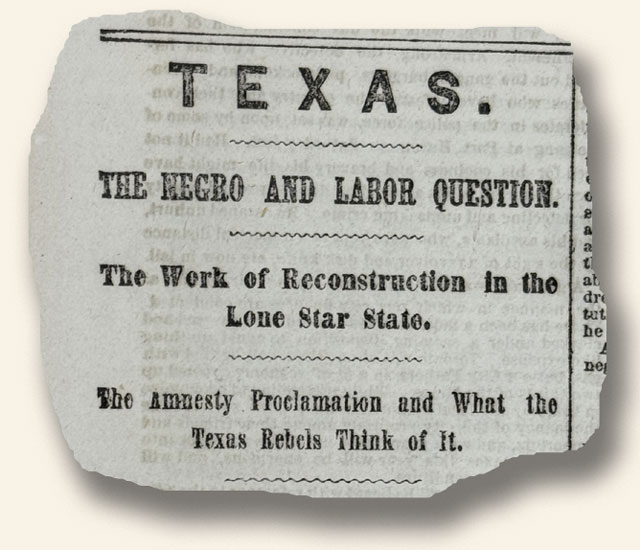 The saying, “History is a set of lies agreed upon,” often attributed to Napoleon, reminds us how easily we can simplify the past. A few days ago, I read about the story of General Granger’s landmark announcement in Galveston on June 19, 1865. Today, while digging deeper into the same moment, I came across Colonel G.W. Clark’s follow-up order issued in Houston just three days later. Reading both orders side by side offers a fascinating window into how emancipation actually unfolded on the ground in Texas.
General Granger’s General Order No. 3 was the pivotal statewide declaration that brought the Emancipation Proclamation to the last major Confederate holdout. Addressed to “the people of Texas,” it formally informed roughly 250,000 enslaved people that they were free, stressing “absolute equality of personal rights and rights of property” and transforming the old master-slave relationship into one of “employer and hired labor.” Its importance cannot be overstated: this was the public, official moment that ended legal slavery in Texas and gave birth to Juneteenth as a day of celebration and remembrance.
Colonel Clark’s General Orders No. 3, issued on June 22, 1865, for the Post of Houston, played a more localized but equally necessary role. It provided the practical instructions needed to prevent chaos in a major occupied city, directing freedmen to remain temporarily with former owners while reassuring them that doing so would “forfeit none of their rights of freedom.” Clark added details about upcoming labor contracts and consequences for idleness, showing the administrative work required to turn grand declarations into orderly reality.
Though both orders advanced the same goal of peaceful transition, their tones on freedom differed in telling ways. Granger’s language was bold and expansive, celebrating equality and a clean break with the past. Clark’s was more measured and reassuring, carefully balancing direction with the promise that freedom remained intact. Reading them together reveals how emancipation was not a single dramatic event but a layered process—announced with inspiring clarity in one breath and managed with cautious practicality in the next. In that sense, these two orders from 1865 still rhyme with the challenges of turning high ideals into lived experience.
If you liked this post, you may also enjoy...
- Juneteenth Revisited – “The rest of the story”…
- June 19, 1865 – The historical foundation of “Juneteenth”…
- You’re Now Free – so get to work and don’t expect help!
- Snapshot 1864… Confederacy’s fight – for independence or slavery?
- Let Freedom Ring. . . The Emancipation Proclamation …
Comments
Feel free to leave a comment...
and oh, if you want a pic to show with your comment, go get a gravatar!