
Search
The Rare & Early Newspapers Hobby

Receive the Newsletter

Buy Historic Newspapers

Catalog #372 (for November, 2026) – Rare & Early Newspapers…
October 30, 2026 by GuyHeilenman · Leave a Comment
|
|
As always, thanks for collecting with us! Sincerely, Guy Heilenman & The Rare & Early Newspapers Team |
19th century Stacked Headlines vs. 20th century Banner Headlines – both served their eras well…
October 26, 2026 by GuyHeilenman · Leave a Comment
 If you’re a collector of historic newspapers, you know that front-page design underwent a seismic shift between the 19th and 20th centuries. Nowhere is this evolution more dramatic than in how publishers announced history-defining news.
In the 19th century, newspapers relied on stacked headlines – a vertical sequence of bold, short phrases and illustrations packed into a single column. Without the technology to print massive type across the page, editors built suspense line by line. Take the April 10, 1865 issue of the Daily Evening Traveller (Boston) reporting Lee’s surrender at Appomattox. The column reads like a drumbeat: woodcut eagles, exclamatory “HURRAH!” banners, and stacked subheads detailing the terms of surrender. It was a typographic ladder, guiding readers down through the overwhelming joy of the Civil War’s end.
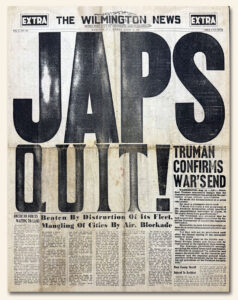
By the mid-20th century, layout technology and competition from radio transformed front pages into visual megaphones. Enter banner headlines – giant, full-width typography designed to scream from newsstands. Look at the August 14, 1945 Wilmington News-Extra announcing the end of WWII. The towering headline “JAPS QUIT” spans nearly the entire page, dwarfing every other element. It didn’t ask you to read down a column; it delivered an immediate, visceral emotional punch from across the street.
Both styles are masterclasses in drama. The 19th-century stacked headline invites you into a story with rhythmic anticipation, while the 20th-century banner stops you dead in your tracks.
Below are photos from our collection showing these two distinct eras of historic news design side-by-side!
Note: The stacked headlines from the April 10, 1865 Boston Evening Traveller may very well be the best we have ever seen for this historic event:
Are these the top 10 History’s Newsstand posts? AI thinks so…
October 23, 2026 by GuyHeilenman · Leave a Comment
 Let’s face it, while AI can be helpful, by its own admission, it isn’t always right. I’m sure we’ve all experienced responses which were head-scratchers. So, just for fun I used AI (GROK in this case) to obtain a top ten list of the most desirable posts on our History’s Newsstand blog – based on the number of views, comments, posting, and post-backs. Do you agree with the results? As of 2026, the (so -stated) top 10 are:
– Do Old and Antique Newspapers Have Any Collectible Value?
– “Collecting Newspapers – The Basics” (Part IV) – Setting Values...
– Framing and Storing Newspapers… the ongoing story…
– The 1600’s and 1700’s on a budget…
– More on printing newspapers in the 1700’s…
– The reprint issues of the “Honolulu Star-Bulletin” Pearl Harbor issue… and the reprint set…
– WW2 Era Newspapers Found In The Attic… Are They Worth Anything?
– Journalists at Their Gritty Best…
If you have a favorite or two of your own, please let the collectible community know by commenting to this post.
Do You Believe in Ghosts? The OSS and World War II’s “Ghost Foxes”…
October 19, 2026 by GuyHeilenman · Leave a Comment
If you’re a rare & early newspaper enthusiast or a history buff who loves the strange and surreal, you might think you’ve heard every bizarre military scheme concocted during World War II. But few wartime projects can rival the sheer, eerie oddity of the Office of Strategic Services’ (OSS) top-secret psychological warfare plot: Operation Fantasia.
During the height of the Pacific War, intelligence strategists were looking for unconventional ways to demoralize the enemy and spark widespread panic. They turned to anthropologists, who pointed out a deeply ingrained piece of Japanese folklore regarding the Kitsune—supernatural fox spirits. According to tradition, sighting a glowing fox spirit at night, especially one running on its hind legs, was a sure omen of impending doom and disaster.
Taking the myth literally, the OSS sprang into action. They ordered the capture of dozens of wild foxes, secured a dedicated building guarded by covert agents, and tasked chemists with developing a special radium-based paint that would make the animals glow brightly in the dark. The grand vision? Release an army of radioactively glowing “ghost foxes” into the forests of Japan to strike psychological terror into the population.
The tale was brought to our attention when we came across an intriguing post-war issue of the Springfield Sunday Republican (Mass.) dated August 18, 1946. There, featured prominently on the front page, was the newly declassified report revealing just how far the military was willing to go in the name of psychological warfare.
Of course, as compelling as the supernatural scheme sounded on paper, reality had other plans. The early tests were a comedy of errors: the paint was difficult to formulate, the disoriented foxes tried furiously to lick off the glowing chemical, and in field runs, they ended up terrifying each other just as much as anyone else. Between the logistical absurdities of deploying live glowing animals overseas and the sudden end of the war following Japan’s surrender, the “Ghost Foxes” were ultimately retired before ever setting foot on enemy soil.
Below is a photo from the front page featuring the wonderful headline: “Ghostly Foxes That Ran Upright Nearly Haunted Japan’s Forests”. It serves as a hilarious, astonishing reminder of the desperate ingenuity and bizarre tactics birthed in the shadows of wartime intelligence.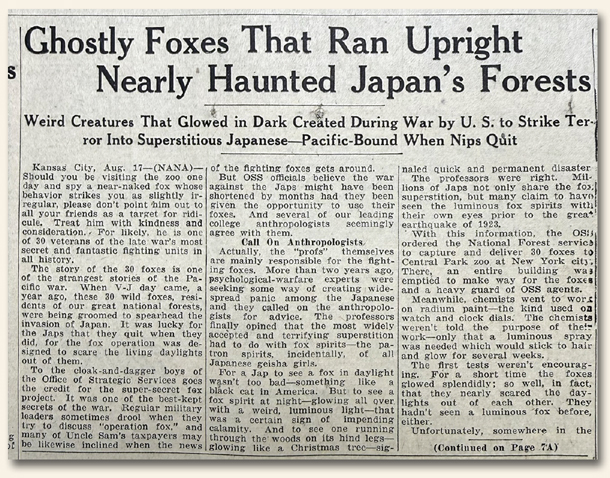
October 2026 Newsletter – Rare & Early Newspapers…
October 16, 2026 by GuyHeilenman · Leave a Comment
Welcome to the October newsletter from Timothy Hughes Rare & Early Newspapers. Shown below are links to an unusual (fun?) find, newly added catalog items, a fresh set of newspapers (including a handful of gems) discounted by 50%, newly listed Nast/Homer prints at a bargain, links to our most recent posts on the History’s Newsstand blog, and We hope you enjoy.
 Newly Added Catalog Items – a list which includes the announcement of Girard College opening to black students, Ben Franklin’s Pennsylvania Gazette at a reduce price, a front page printing of the Louisiana Purchase, the Battle of the Alamo, a newspaper from Carlisle (PA) that is a one-of-a kind, a report on the Liberty Bell being erected in Philadelphia, earliest (?) image of Karl Marx in an American periodical, planning the 1863 dedication and consecration Soldier’s National Cemetery in Gettysburg without even a mention of President Abraham Lincoln, election fraud in 1840 – perhaps the first “October Surprise”, the death of John Lennon from where a was shot, and more.
October’s Discounted Newspapers – a Boston newspaper from 1768, a confederate newspaper with a report on the Battle of Antietam, the death of James Garfield, a North Carolina newspaper from 1861, Adolf Hitler’s call for the extermination of the Jews, the death of Jesse James, a patent by George Washington, Superman debuts in the Macy’s Day Parade – along with a host of others.
Recent Posts on the History’s Newsstand Blog
An Unusual Find – Foxes that glow in the dark! Operation Fantasia
At a Bargain – An updated list of key stand-alone Winslow Homer & Thomas Nast prints
Links to the October Catalog (#371)
- The Complete October Catalog (INCLUDES al catalog items)
- Combined Catalogs (October’s, w/ remnants of September’s)
- PDF Version
As always, thanks for collecting with us!
A “whispering” report presages a significant event in American history…
October 12, 2026 by TimHughes · 1 Comment
One of the joys of collecting early newspapers and magazines–as I’ve mentioned several times before–is discovering little gems buried inconspicuously within an issue but would later gain considerably more significance. Huge headlines dramatically presented on the front page are always wonderful, but sometimes it’s the opposite presentation that adds to the collecting joy.
Such is the case with the July, 1753 issue of the “Gentleman’s Magazine” from London. Although one would suspect there would be no notable American content from this year, still some months away from the beginning of the French & Indian War, a seemingly insignificant item defies that assumption.
Tucked within the “America” news on an inside page, the item simply records that Philadelphia has raised: “…the great bell…with this inscription, ‘Proclaim liberty throughout all the land…’.” At the time, it was just a functional addition to the State House steeple. Yet today, this understated mention represents one of the earliest printed acknowledgments of what would become a cornerstone of American identity.
What makes the piece truly remarkable is how ordinary the installation seemed in 1753—long before the bell would crack, long before it would be embraced as a symbol of independence, abolition, and unity. For collectors, this is the Liberty Bell before the legend. Over the next century, the bell’s voice—and its silence—would mark defining moments in American history.
This issue is a gem of an item for any collector of Revolutionary War-era reports.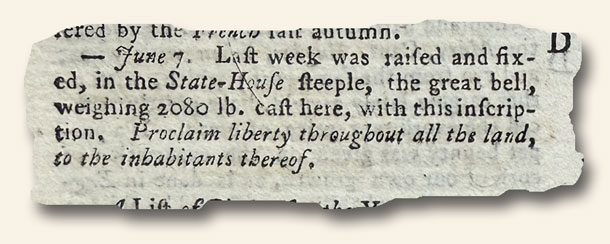
Fight for a Nation – Introduction…
October 9, 2026 by GuyHeilenman · Leave a Comment
During the lead-up to July 4, 2026 – as our country celebrated its 250th anniversary – we brought you Lead-Up to a Nation, a weekly video series using authentic, period newspapers to chronicle the fateful year heading into July 4, 1776.
Now that the Declaration has been made, the real struggle begins.
Starting this month, we’re launching our a monthly video series: Fight for a Nation. Join us over the coming years as we relive the American Revolution through the very pages, ink, and first-hand reporting of those who lived through this incredible period in American and world history.
Check out the first three installments below—we hope you enjoy journeying back in time with us!
Installment from July, 2026
The Declaration Proclaimed – Military Challenges + Growing Confidence (Fight for a Nation – E1)
Installment from August, 2026
A Nation at its Birth – Shaping the Future (Fight for a Nation – E2)
Installment from September, 2026
The Treaty of Jamestown – 1st Permanent English Settlement in America (Fight for a Nation – E3)
How a change in plans could change the course of history…
October 5, 2026 by TimHughes · Leave a Comment
One of the intriguing aspects of collecting early newspapers is the opportunity to learn–with hindsight–how some aspects of history, seeming mundane at the time, could change ever-so-slightly yet affect the course of history forever. Let me explain.
An inconspicuous report in the “Evening Bulletin” issue of Oct. 31, 1863 (shown below), from Providence, Rhode Is., is headed: “The Field of Gettysburg”. Remembering that the historic Battle of Gettysburg was fought nearly 4 months prior, it would have been no surprise that the cemetery at Gettysburg would be formally dedicated to the memory of the thousands who died in that struggle. The planning being of little consequence to anyone at the time, we are not surprised that this is the first such report we have seen in any newspaper.
The report has two points of curious interest. First, the dedication was originally planned for October 22, but it had to be postponed until November 19: “…by which time all the dead braves will be, probably, interred.” There is also mention that: “Edward Everett will deliver, probably, his finest oration…” plus more on the planned event. There was no mention of President Lincoln.
Lincoln was not formally invited to participate until November 2, just 17 days before the ceremony, and 11 days after the original date for the event. By contrast, Everett had been invited months prior. The committee did not expect Lincoln to give a major speech. David Wills’s official invitation letter specifically requested that the President provide just “a few appropriate remarks” to formally set aside the grounds after Everett’s grand oration.
Indeed, Everett gave a “grand oration”. He spoke for two hours (13,607 words), while Lincoln followed with his two-minute Gettysburg Address (272 words), which ultimately became one of the most famous speeches in human history.
What if Lincoln had not been invited at the last minute? The dedication of the Gettysburg Cemetery would still have been reported in most newspapers of the day, given Edward Everett’s speech, but over 16o years later, history would have had little memory of the event. It was Lincoln’s two-minute address that made the difference.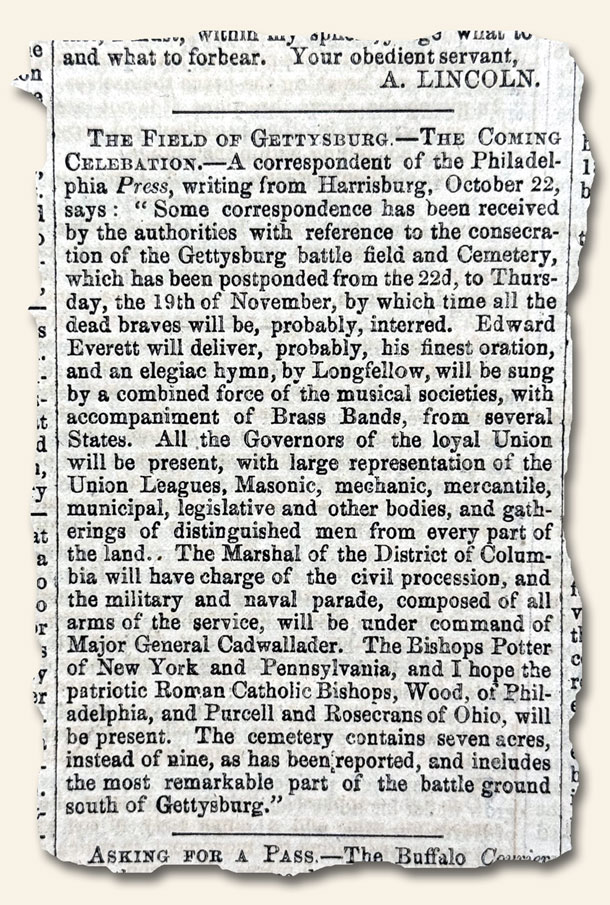
Catalog #371 (for October, 2026) – Rare & Early Newspapers…
October 2, 2026 by GuyHeilenman · Leave a Comment
|
|
As always, thanks for collecting with us! Sincerely, Guy Heilenman & The Rare & Early Newspapers Team |