

Search
The Rare & Early Newspapers Hobby

Receive the Newsletter

Buy Historic Newspapers

Do You Believe in Ghosts? The OSS and World War II’s “Ghost Foxes”…
October 19, 2026 by GuyHeilenman · Leave a Comment
If you’re a rare & early newspaper enthusiast or a history buff who loves the strange and surreal, you might think you’ve heard every bizarre military scheme concocted during World War II. But few wartime projects can rival the sheer, eerie oddity of the Office of Strategic Services’ (OSS) top-secret psychological warfare plot: Operation Fantasia.
During the height of the Pacific War, intelligence strategists were looking for unconventional ways to demoralize the enemy and spark widespread panic. They turned to anthropologists, who pointed out a deeply ingrained piece of Japanese folklore regarding the Kitsune—supernatural fox spirits. According to tradition, sighting a glowing fox spirit at night, especially one running on its hind legs, was a sure omen of impending doom and disaster.
Taking the myth literally, the OSS sprang into action. They ordered the capture of dozens of wild foxes, secured a dedicated building guarded by covert agents, and tasked chemists with developing a special radium-based paint that would make the animals glow brightly in the dark. The grand vision? Release an army of radioactively glowing “ghost foxes” into the forests of Japan to strike psychological terror into the population.
The tale was brought to our attention when we came across an intriguing post-war issue of the Springfield Sunday Republican (Mass.) dated August 18, 1946. There, featured prominently on the front page, was the newly declassified report revealing just how far the military was willing to go in the name of psychological warfare.
Of course, as compelling as the supernatural scheme sounded on paper, reality had other plans. The early tests were a comedy of errors: the paint was difficult to formulate, the disoriented foxes tried furiously to lick off the glowing chemical, and in field runs, they ended up terrifying each other just as much as anyone else. Between the logistical absurdities of deploying live glowing animals overseas and the sudden end of the war following Japan’s surrender, the “Ghost Foxes” were ultimately retired before ever setting foot on enemy soil.
Below is a photo from the front page featuring the wonderful headline: “Ghostly Foxes That Ran Upright Nearly Haunted Japan’s Forests”. It serves as a hilarious, astonishing reminder of the desperate ingenuity and bizarre tactics birthed in the shadows of wartime intelligence.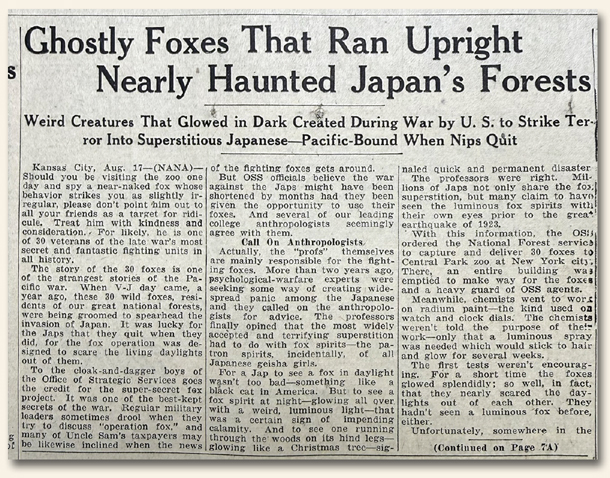
The reason I collected it: the Nuremberg trials…
November 3, 2025 by TimHughes · Leave a Comment
I have likely stated several times that part of the quest in seeking the best report of a notable event is to find it in a newspaper as close to where it happened as possible. For the death of JFK, a Dallas newspaper is best. On the bombing of Pearl Harbor, a Honolulu newspaper is great. On the Boston Massacre in 1770, a Boston paper would be wonderful.
Some events can be extremely difficult, so you do the best you can. How about when man walked on the moon? Outside of a lunar publication that did not exist, a newspaper from Neil Armstrong’s hometown is pretty good. Or perhaps one from close to Cape Canaveral.
One of the more notable events at the conclusion of World War II was the Nuremberg Trials. There were 22 defendants held for war crimes; 12 would hang, 7 served time, and 3 found not guilty.
But finding a German newspaper with this report had eluded us. And as is the case with events in foreign language countries, a report close to the event would be diminished a bit if the text is in a language other than English. Not many desire a newspaper they cannot read.
But as luck would have it, a Nuremberg suburb–Furth–had a former Nazi air base, captured by American forces in early April, 1945 & converted to a U.S. air base. And better yet, it produced a small, obviously low-circulation newspaper called “The Jet Gazette”. The October 1, 1946 issue was devoted to the results of the trials. And being an American air base, it’s in English. It was a great find that I suspected never existed!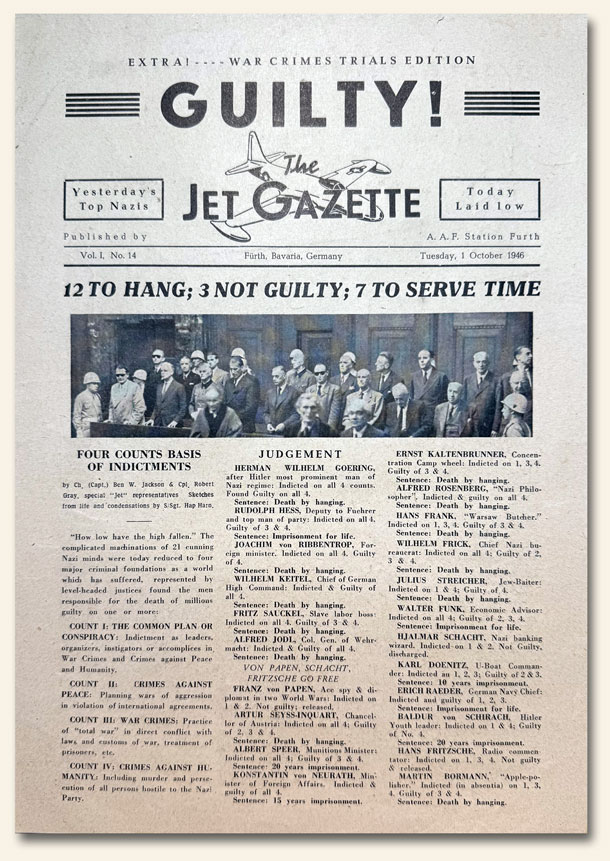
Great Headlines Speak for Themselves… The Nuremberg Trials…
August 8, 2025 by GuyHeilenman · Leave a Comment
The best headlines need no commentary. Such is the case with the October 2, 1946 issue of the Fort Worth Star-Telegram which reported the final outcome of the Nuremberg Trials:
“12 NAZIS GET DEATH, 7 PRISON; 3 FREED”

This is certainly one of the best we’ve seen.
The End of Something Bad… The Kickoff to Something Good…
March 24, 2022 by LauraH · Leave a Comment
 In the moment, we are often oblivious to the long-term impact significant newsworthy announcements will have as time goes on. “Henry Ford has made a car nearly anyone can afford” – eventually smog make city -living unbearable and the ozone takes a beating. “Computers can be made both inexpensively and small enough for daily use at home” – pornography spreads like wildfire. “A new substance called ‘plastic’ will revolutionize our lives” – our landfills overflow and our oceans are overcome with garbage which will take many lifetimes to decompose (if ever). However, not all unexpected “consequences” are bad.
The announcement on May 8, 1945 that the war with Germany was over (aka, V-E Day), wildly celebrated throughout much of the World, was such a case in point. Amidst all the exuberance, most people were probably not cognizant of the marvelous “consequences” which would arrive within a year’s time. Introducing: “The Baby Boomers – 1946 Edition!” Here, have a cigar.
The front page of this issue of THE MORNING CALL (Patterson, NJ) is one of the many reports which helped inspire the creation of an entire generation.
Snapshot 1945… America’s youth are too soft…
November 12, 2020 by GuyHeilenman · Leave a Comment
WW2 was finally over, but much was to be done. Trials, international agreements, boundaries of country’s which had been conquered by the Nazis… What to do with the millions who had lost their homes due to destruction, fleeing life-threatening circumstances, or having been carted off to concentration camps? What about the abundance of parentless children? How to rebuild? Who would pay for the rebuilding of countless areas of devastation? What about the atom bomb? What does this new power mean?
In the midst of all of these critical and time-sensitive concerns at the forefront of President Truman’s mind, one which caught my eye was found on the front page of a Wilmington Morning Star (NC) from October 24, 1945. What do we do to prepare our nation for future conflicts? While a great question, his focus was thought-provoking:
The youth of America are too soft, and something needs to be done, now!
The image below shows a portion of both Truman’s thoughts and his plan of action – initial steps which would eventually blossom into President Eisenhower’s “President’s Council on Youth Fitness” in 1956. These actions, along with similar measures taken over the 40 years to follow, led me to wonder whether it is time to take a look at this question once again. After all, raising up the next generation to be characterized by the fragile term “snowflakes” does not bode well for the future of “life, liberty, and the pursuit of happiness”. 
Snapshot 1946… The Apple Watch prototype in print…
February 18, 2019 by GuyHeilenman · Leave a Comment
The following snapshot comes from the Chicago Sunday Tribune, January 13, 1946. Does Apple pay Dick Tracy’s estate royalties?
