
Search
The Rare & Early Newspapers Hobby

Receive the Newsletter

Buy Historic Newspapers

How a change in plans could change the course of history…
October 5, 2026 by TimHughes · Leave a Comment
One of the intriguing aspects of collecting early newspapers is the opportunity to learn–with hindsight–how some aspects of history, seeming mundane at the time, could change ever-so-slightly yet affect the course of history forever. Let me explain.
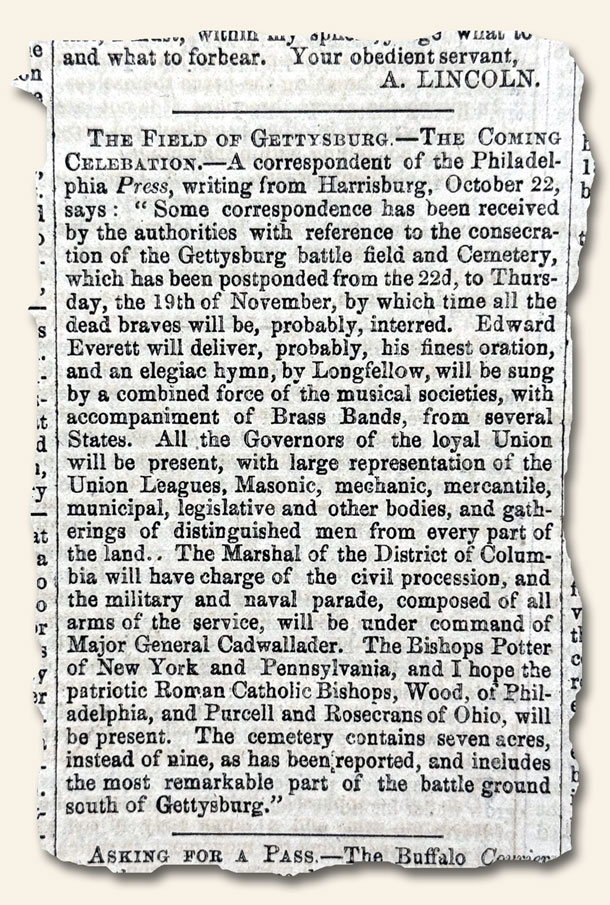
An inconspicuous report in the “Evening Bulletin” issue of Oct. 31, 1863 (shown below), from Providence, Rhode Is., is headed: “The Field of Gettysburg”. Remembering that the historic Battle of Gettysburg was fought nearly 4 months prior, it would have been no surprise that the cemetery at Gettysburg would be formally dedicated to the memory of the thousands who died in that struggle. The planning being of little consequence to anyone at the time, we are not surprised that this is the first such report we have seen in any newspaper.
The report has two points of curious interest. First, the dedication was originally planned for October 22, but it had to be postponed until November 19: “…by which time all the dead braves will be, probably, interred.” There is also mention that: “Edward Everett will deliver, probably, his finest oration…” plus more on the planned event. There was no mention of President Lincoln.
Lincoln was not formally invited to participate until November 2, just 17 days before the ceremony, and 11 days after the original date for the event. By contrast, Everett had been invited months prior. The committee did not expect Lincoln to give a major speech. David Wills’s official invitation letter specifically requested that the President provide just “a few appropriate remarks” to formally set aside the grounds after Everett’s grand oration.
Indeed, Everett gave a “grand oration”. He spoke for two hours (13,607 words), while Lincoln followed with his two-minute Gettysburg Address (272 words), which ultimately became one of the most famous speeches in human history.
What if Lincoln had not been invited at the last minute? The dedication of the Gettysburg Cemetery would still have been reported in most newspapers of the day, given Edward Everett’s speech, but over 16o years later, history would have had little memory of the event. It was Lincoln’s two-minute address that made the difference.