
Search
The Rare & Early Newspapers Hobby

Receive the Newsletter

Buy Historic Newspapers

One Thing Leads to Another… The Set Up for Patrick Henry’s Give Me Liberty Speech…
April 24, 2026 by Laura Heilenman · Leave a Comment
We usually remember big, dramatic moments however, we rarely pause to reflect on the smaller events that set the table for that seismic shift on the horizon. On March 17, 1775, THE VIRGINIA GAZETTE covered an abundance of Colonial News starting on page one’s article on treason… then moving to a page 2 article covering petitions from the American Congress to the King. Amongst the 8 pages of small print, buried on pg. 3, is a report on a meeting of freeholders from Hanover County stating: “…they proceeded to the choice of delegates to represent them in colony conventions at the town of Richmond…the 20th of next month, when Patrick Henry, jun. and John Syme, Esqrs., were unanimously chosen…”. Just a passing mention really and barely a clue to even the most loyal reader. However, this election laid the groundwork for quickly approaching fireworks that would soon come from electing Patrick Henry. The meeting these newly elected men would attend was the historic Second Virginia Convention where Patrick Henry would give his famous “give me liberty or give me death” speech. One tiny spark in the Spring of 1775 poured gasoline on the lead up to the American Revolution.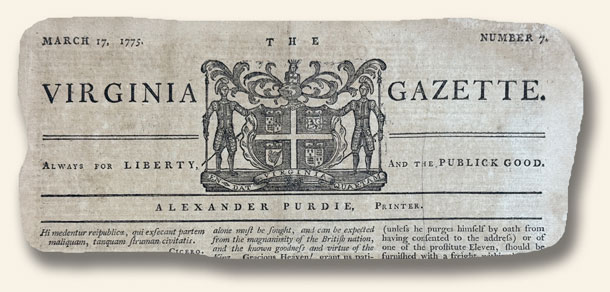
Nothing New Under the Sun… Thomas Nast Calls Out Government Fraud…
April 20, 2026 by Laura Heilenman · Leave a Comment
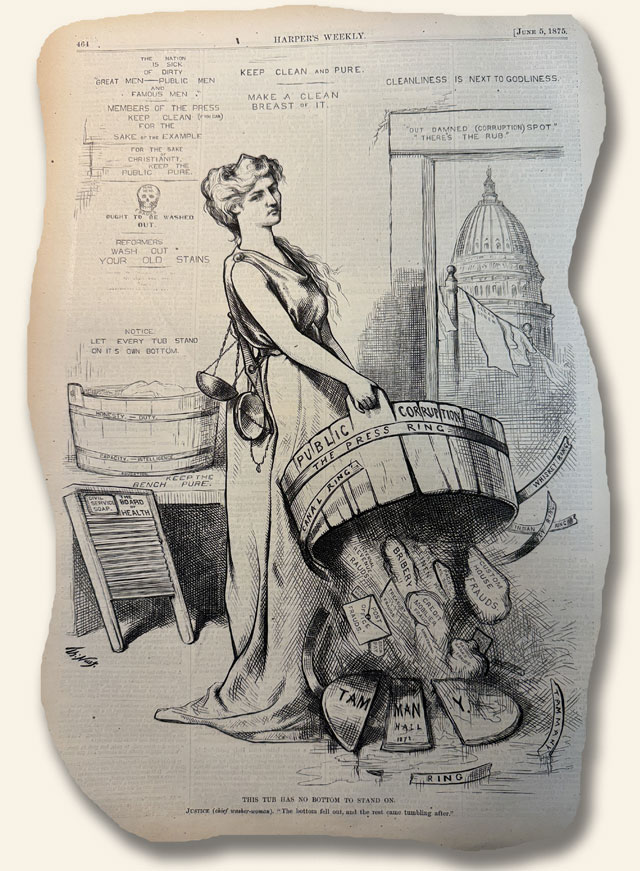 Thomas Nast’s 1875 wood engraving “This Tub Has No Bottom to Stand On,” published in Harper’s Weekly, stands as a searing indictment of Gilded Age graft. In the cartoon, blindfolded Justice hoists a washtub labeled “Public Corruption” by its handles. The metal rings binding it—each stamped with the names of notorious syndicates such as the Tammany Ring, Whiskey Ring, Canal Ring, Indian Ring, and City Ring—snap apart under the strain. The tub’s false bottom, emblazoned “Tammany Hall 1872,” plummets to the floor, spilling a cascade of documented crimes: bribery, internal-revenue frauds, Custom House swindles, Crédit Mobilier scandals, Treasury embezzlement, and Post Office graft. Nast, fresh from dismantling Boss Tweed’s machine, used the image to declare that these interlocking networks of political and corporate plunder possessed no legitimate foundation; once challenged by law or public scrutiny, the entire edifice collapsed, emptying its ill-gotten contents for all to see.
Nearly 150 years later, the United States still contends with systemic corruption that echoes those same structural weaknesses. Transparency International’s 2025 Corruption Perceptions Index gave the country a score of 64 out of 100—its lowest mark on record—ranking it 29th globally and marking a continued slide amid partisan polarization and regulatory capture.
The parallel between Nast’s era and our own is therefore not merely stylistic but substantive. Both periods feature explosive economic growth, technological upheaval, and extreme inequality that lubricate the machinery of graft; historians routinely describe the present as a “second Gilded Age” precisely because corporate-political fusion and fee-based governance have reemerged in updated forms. Yet important differences exist: today’s watchdogs, independent prosecutors, and digital transparency tools act as faster-acting surrogates for Nast’s allegorical Justice, rapidly exposing and clawing back billions that once vanished into obscurity. The enduring lesson of the cartoon therefore persists undiminished: corruption’s tub still has no bottom to stand on. When accountability is applied—whether by cartoonist’s pen or federal indictment—the contents inevitably spill, reminding every generation that vigilance and impartial justice remain the only forces capable of dismantling rings that otherwise appear impregnable.
April Newsletter (2026) – Timothy Hughes Rare & Early Newspapers…
April 17, 2026 by GuyHeilenman · Leave a Comment
|
|
Who’s Who in Newspapers? Father Thomas edition…
April 13, 2026 by Phineas Q. Wryte · 1 Comment
The 13th installment of Who’s Who in Newspapers
Many visitors to the History’s Newsstand Blog are familiar with the Damascus Affair of 1840 — one of the most consequential antisemitic episodes of the 19th century. Far fewer, however, know the name at the center of the storm: Father Thomas. It is his disappearance that lit the fuse, and it is his name that echoed through the newspapers of the day — including the remarkable report shown below, from our original issue of The Times (London), dated May 8, 1840.
Father Thomas: The Disappearance That Shook the World
Father Thomas of Tuscany (c. 1768–1840) was a Franciscan friar and physician serving in Damascus, Syria, then under the control of Egyptian ruler Mehemet Ali. On February 5, 1840, Father Thomas and his servant Ibrahim Amara vanished without a trace. What followed was not merely a criminal investigation — it was a catastrophe for the Jewish community of Damascus and, ultimately, for Jewish communities across the globe.
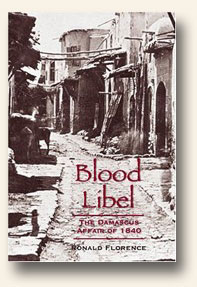
French Consul Ulysse de Ratti-Menton seized upon the disappearance to level charges against prominent local Jews, alleging that Father Thomas had been murdered as part of a ritualistic killing — the ancient and thoroughly debunked “Blood Libel” accusation, which falsely claimed that Jews used the blood of Christians in religious rites. Under torture, confessions were extracted. Several Jewish men died in captivity. Others faced execution. The affair sent shockwaves from Damascus to London, Paris, and beyond.
What makes the Damascus Affair historically significant — beyond its immediate horror — is the response it provoked. Jewish leaders in Europe, including Sir Moses Montefiore of England and Adolphe Crémieux of France, organized an international campaign on behalf of the accused, traveling to Egypt to appeal directly to Mehemet Ali. Their efforts represent one of the earliest instances of organized, international Jewish advocacy — a precursor, in many ways, to the modern human rights movement.
The report shown in full below offers a remarkable window into how the affair was unfolding in real time. Sourced from private letters arriving via Malta, the account describes how the Jews of Alexandria petitioned Mehemet Ali on April 9th, asking that those accused of Father Thomas’s murder be judged by the Viceroy himself. Seven leading men were received at the Palace, where Mehemet Ali acknowledged he had never encountered such a charge against the Jewish nation in all his years of rule. Crucially, he forbade the use of torture against the prisoners — a directive sent by dromedary to Commander-General Scheriff Pasha in Damascus. The report concludes with a notable observation: “This spirit of liberality and justice on the part of Mehemet Ali is a striking symptom of the progress of civilization in the East.”
As for Father Thomas himself — his fate was never definitively established. The accusations against the Damascus Jews were never formally dropped, though the imprisoned survivors were eventually released following the international intervention of Montefiore and Crémieux later that summer.
History has long since judged the Damascus Affair as a grotesque miscarriage of justice, fueled by antisemitism and political opportunism. The Blood Libel charge had no basis in fact — then or ever. Yet it is the name of Father Thomas that remains permanently linked to one of the 19th century’s darkest chapters: not because he caused it, but because his disappearance became the pretext for it.
This original Times of London report offers readers of today an unmediated glimpse into the unfolding events of 1840 — and is precisely what makes collecting historic newspapers so endlessly rewarding. The news, as they say, never gets old.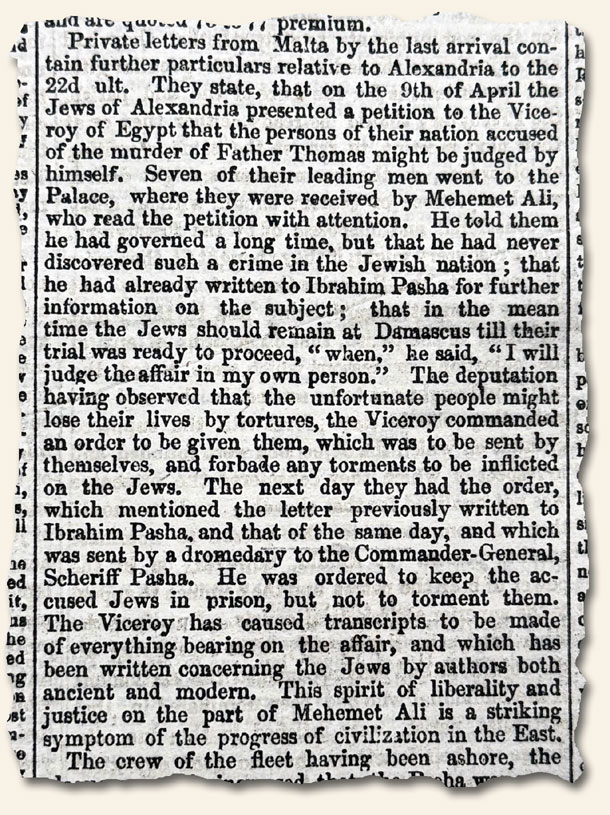
What’s in a Masthead – An 1800s Boston Investigator…
April 10, 2026 by Phineas Q. Wryte · 1 Comment
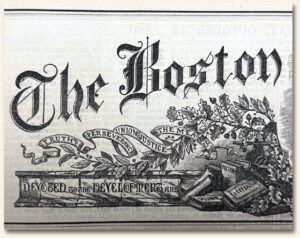 At first glance, the bold Gothic lettering of The Boston Investigator seems simply to announce a title—but linger a moment, and it reveals a creed. Founded in 1831, the paper became one of America’s longest-running freethought journals, devoted to skepticism, reform, and intellectual independence. By the 1880s, its identity was not merely stated but artistically embedded. The masthead itself functioned as a declaration of purpose, inviting readers into a publication that questioned orthodoxy and encouraged inquiry.
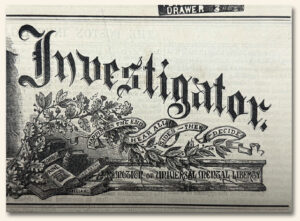
The imagery is deliberate and richly layered. Laurel and oak branches evoke endurance and strength, while flowing banners proclaim ideals such as “Truth,” “Perseverance,” and “Justice.” A cluster of books—bearing names like Paine, Voltaire, and Jefferson—anchors the paper firmly in Enlightenment tradition. And perhaps most striking is the phrase arcing confidently across the design: “Hear All Sides — Then Decide.” In an era often caricatured as rigid or dogmatic, here is a publication quite literally engraving open-minded debate into its identity. The Investigator was not merely tolerating dissent—it was institutionalizing it.
That makes the masthead feel remarkably modern—and, in some ways, quietly defiant even now. Its rebellious spirit from the 19th century champions a principle that can feel increasingly fragile today: the willingness to entertain opposing views before forming conclusions. Where much of the present climate tends to narrow discourse and reward certainty over curiosity, this 19th-century newspaper boldly carved intellectual openness into its very banner. So, what’s in a masthead? In this case, everything: a philosophy of inquiry, a commitment to dialogue, and a timeless challenge to think freely.
PS The Boston Investigator is considered to be the first American newspaper dedicated to the cause of freethought.
If you own an authentic newspaper with a “special” masthead and you would like to share it with the collectible community, please send a clear photo of the masthead and the description you would like included to me at pqwryte@rarenewspapers.com.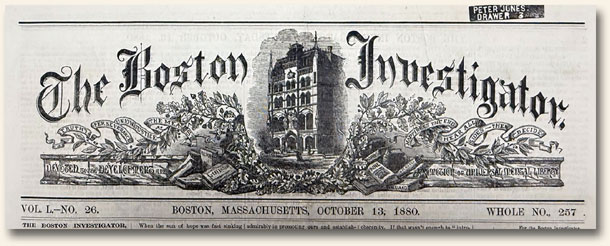
Lead-up to a Nation… as reported in the newspapers of the day (reflecting back on March, 1776)…
April 3, 2026 by GuyHeilenman · Leave a Comment

-
Colonies in Flux – The Influence of Common Sense (Lead-up to a Nation – E31)
-
General William Howe – The Pennsylvania Ledger (Lead-up to a Nation – E32)
-
The Siege of Boston – Debate at the House of Commons (Lead-up to a Nation – E33)
-
Diverse Voices – Divisions of the Era (Lead-up to a Nation – E34)
We hope you are enjoying this year-long trek to the 250th anniversary of The United States through the eyes of those who were fully engaged, first hand. As mentioned previously, all accounts are rooted in what they read in the newspapers of the day.
“History is never more fascinating than when read from the day it was first reported.” (Timothy Hughes, 1975)