
Search
The Rare & Early Newspapers Hobby

Receive the Newsletter

Buy Historic Newspapers

Announcing: Catalog 364 – Released for March, 2026 – Rare & Early Newspapers…
February 27, 2026 by GuyHeilenman · Leave a Comment
Catalog 364 (for March): This latest offering of authentic newspapers is comprised of over 300 new items, a selection which includes the following noteworthy issues: an issue re: the Olive Branch Petition, Hawaii’s first English language newspaper, “The Crisis” essay #9 by Thomas Paine, a first report of Lincoln’s assassination, a Civil War prison camp newspaper, an early newsbook from 1643, the historic “Funding Act”, and more.
The following links are designed to help you explore all available items from this latest edition of our catalog:
Abridged Catalog (EXCLUDES wholesale lots & titles sold only by year (not by a specific date)
A PDF Version of the Catalog (printable)
Entire Catalog grouped by Era:
1500-1799 (full view OR quick-scan/compact view)
1800-1899 (full view OR quick-scan/compact” view)
1900-Present (full view OR quick-scan/compact” view)
The following links focus on both this month’s and last months catalogs:
- Combined Catalogs (entirety of both)
Become a Premium Member to receive hard copy versions of our catalogs (U.S. residents only).
Displaying newspapers – Frame to see all four pages…
February 23, 2026 by TimHughes · 4 Comments
 Many newspapers lend themselves nicely to framing and display, certainly those with either graphic appeal or a very historic report on the front page. Even better if an issue has both. But display can be problematic when the significant report is on the inside or back page.
 The photos show one inventive display option for four page newspapers, which includes almost all from before the 1830’s. This “Pennsylvania Gazette” printed by Ben Franklin has his imprint at the bottom of page 4, and by opening the newspaper and matting both sides, all 4 pages are visible. The matted portion of the display is in the frame trim and hinged to the portion of which hangs on the wall, so by opening the frame all four pages are visible. A magnetic clasp keeps the frame closed while on the wall.
Give this a try for that special issue in your collection which otherwise would be difficult to display.
Perhaps the most experiential collectible?
February 20, 2026 by TimHughes · 1 Comment
My collecting gene kicked in at an early age. At some point when in elementary school I discovered that really old coins could be purchased—wow! I found owning a penny from 50 years before I was born intriguing and fascinating, even though others considered it nothing more than curious. They just didn’t get it. I pursued the coin-collecting hobby for many years; heck, I still have many I purchased 60 years ago. But I must admit, collecting old coins is certainly not very experiential. There’s a date and a dead guy’s image on the front, and some curious symbol or building on the back. That’s about it. You can “experience” an old coin in about 3.5 seconds.
Some 50 years ago I discovered an old newspaper from 1827 at a flea market priced at $3. It was an epiphanal moment for my collecting passion. Here was something very old that could be enjoyed for more than 3.5 seconds. It was just a four-page newspaper but it must have taken at least 20 minutes to “experience” from beginning to end. News reports, advertisements, curious notes about travel, legal notices, criminal reports—all of it was so different from my experience I was living.
As I relegated my coin collection to a dresser drawer, I pursued more old newspapers from wherever I could find them. Each was a different experience from a different era. Not only were the news reports from the Civil War different from the Revolutionary War, & different from the 1920’s, but the advertisements, notices, and other quaint tidbits were much different as well.
At times I found inconspicuous, benign reports of no historical consequence to be more interesting than the news report which prompted the purchase. A benign listing of the West Point admissions for 1839 which included Ulysses S. Grant can be a fascinating find. After all, who cared about the name Ulysses S. Grant in 1839? Or what about discovering a small classified ad for “Lincoln and Herndon, Attorneys & Counsellors At Law” in an 1857 Illinois newspaper. Did I really care anymore about the report of political troubles in Kansas, the reason for which I purchased the newspaper?
And the capability of discovering intriguing reports—thanks to the internet–adds so much more dimension to early newspapers. It is common to read of fugitive slave reports which include the names of the slave & its owner, neither of which might mean anything to anyone. But a quick check on the internet for “Shadrach Minkins” unveils a fascinating and notable drama on the struggles & horrors of this runaway slave in 1850, greatly enriching the innocuous report by allowing the reader to experience a piece of American history that otherwise would have been easy to pass over. This is what differentiates old newspapers from the rest of the collectible world. It is dramatically more experiential. What other collectible requires a half hour to fully experience? Stamps? Crocks? Matchbook covers? Furniture? Ink wells? Certainly not.
With an old newspaper, whether it be a $500 issue from the colonial era or an $8 newspaper from 1868, one gets far more than the report that prompted the purchase. Every early newspaper opens up an entire world of experiences just waiting to be discovered.
Arsenal of Freedom… America’s Leaders Work to Inspire…
February 16, 2026 by Laura Heilenman · Leave a Comment
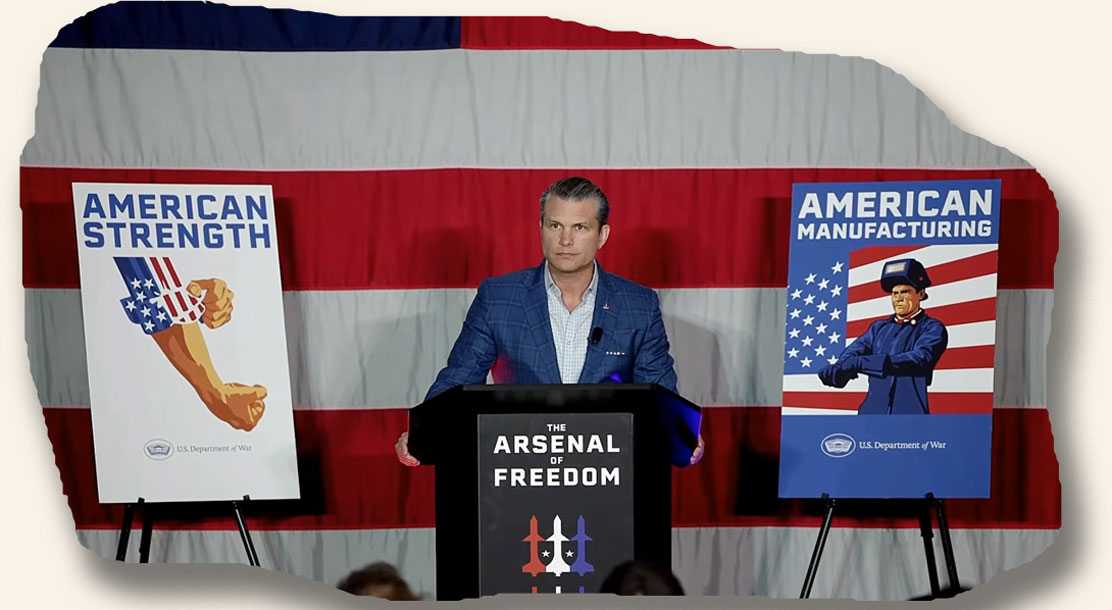
The saying, “History never repeats itself, but it does often rhyme” is popularly attributed to author and humorist Mark Twain. Two weeks ago I wrote a post covering FDR and his famous “Arsenal of Democracy” speech. which was printed in several newspapers of the day, including The New York Times dated Dec. 30, 1940. Ironically, this week, I noticed something current with a Mark Twain history rhyming vibe. On January 5, 2026, Secretary of War, Pete Hegseth began his, “Arsenal of Freedom” tour. One of the fascinating benefits of reading historic newspapers is the ability to see patterns and, in this case, to see leaders, separated by decades, using similar rhetoric to rally America to step up in an era where she is needs to be her brightest and strongest. Despite the years between them, both FDR & Sec. Hegseth work intentionally to inspire and while we have yet to see the outcome of the “Arsenal of Freedom” tour, our hope is that we will indeed stand strong and be a beacon on a hill.
February Newsletter (2026) – Timothy Hughes Rare & Early Newspapers…
February 13, 2026 by GuyHeilenman · Leave a Comment
|
|
|

|
The reason I collected it: Atlanta Journal 2nd Extra, 1963…
February 9, 2026 by TimHughes · 1 Comment
In the rush to get an ‘extra” edition to the press and on the streets, mistakes can often be made. Such is the case with the “Second Extra” of the JFK assassination issue of The Atlanta Journal. This edition has a curious–if not macabre–combination of headline and photo.
As would be expected of an “Extra” of November 22, 1963, the large & bold headline proclaims: “KENNEDY KILLED”. So far so good. But immediately beneath it is a photo of a street sweeper pushing his trash cart containing a pair of trousers & boots protruding from the top, with the caption: “Sweeper Means What He Says” as if related to the assassination report.
One might excuse the editor, for I’m sure that in rushing this edition to the streets as quickly as possible the planned headline was removed and the Kennedy death report quickly inserted with little thought as to what else was scheduled above the fold that day. Indeed, the “Third Extra” has the same headline but a photo of the Kennedy motorcade immediately after the shooting.
This issue remains one of the more unique & interesting newspapers of the 20th century, earning its right into the private collection. It is also a great example to editors everywhere to be aware of headlines & photos which appear in close proximity.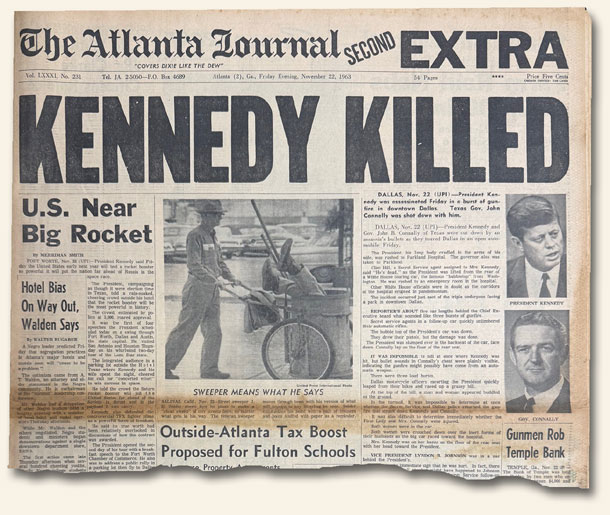
Lead-up to a Nation… as reported in the newspapers of the day (January, 1776)…
February 6, 2026 by GuyHeilenman · Leave a Comment
-
Dr. B Church Jr – American Traitor (Lead-up to a Nation – E22)
-
Field Music Corps – The Drummer Boys of the Revolution (Lead-up to a Nation – E23)
-
Battle of Quebec – “Unsuccessful but Brave Attempt” (Lead-up to a Nation – E24)
-
Thomas Paine – Battle in the Tabloids (Lead-up to a Nation – E25)
-
The Burning of Norfolk – Nearly Annihilated (Lead-up to a Nation – E26)
We hope you are enjoying this year-long trek to the 250th anniversary of The United States through the eyes of those who were fully engaged, first hand. As mentioned previously, all accounts are rooted in what they read in the newspapers of the day.
“History is never more fascinating than when read from the day it was first reported.” (Timothy Hughes, 1975)
FDR Fireside Chat… Building “The Arsenal of Democracy”…
February 2, 2026 by Laura Heilenman · 1 Comment
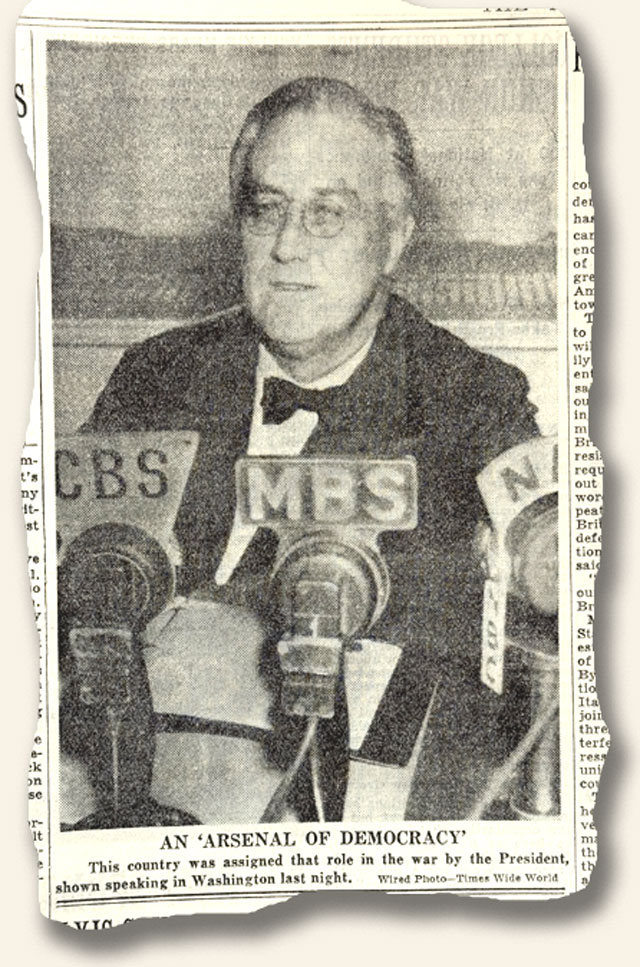 For those of you who have seen the most recent update of The Hall of Presidents located in Disney World, the following narration may sound familiar…
“FDR, paralyzed by polio, knows how to restore the faith of a people paralyzed by the great depression. He has found the inner strength his countrymen now need. He speaks to us like a friend, a neighbor. His optimism is contagious… his voice, perfect for the latest breakthrough medium, radio. He calls us to believe we have nothing to fear but fear itself… and we do believe.”
If you have seen this production, you can hear the narrator’s rich voice echo through the auditorium. Those living in 1933 could have listened to FDR deliver this powerful inaugural address live, and those who missed it, could have read it in its entirety the next day in the New York Times.
Years later, on December 29, 1940, FDR gave his, now famous, “Great Arsenal of Democracy” fireside chat, and again attempted to rally America to rise to her best and brightest. People could again read the entire speech in newspapers the following day, including the December 30, 1940, New York Times. Throughout American history, we see the importance of a president sitting and talking with their people as an important connection point for both the president and the populous… words of truth and encouragement from their leader who should put the citizenry ahead of themselves and hold what is best for the America as their highest priority. May that be the legacy of every president.