
Search
The Rare & Early Newspapers Hobby

Receive the Newsletter

Buy Historic Newspapers

The reason I collected it: an accordion fold newspaper…
January 23, 2026 by TimHughes · Leave a Comment
I’m sure I’ve commented before on the occasional need for “necessity” paper, meaning when supplies were restricted, printing conditions were stressed, or “siege” conditions prevented access to typical newsprint, publishers would be as resourceful as possible in finding something upon which to print.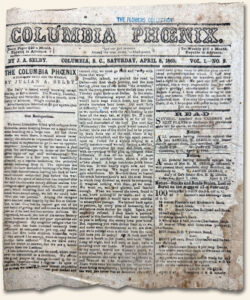 Not only was this issue (Columbia Phoenix, April 8, 1865) printed during the closing days of the Civil War, but due to the shortage of newsprint this publisher utilized short and uncommonly wide paper measuring just 8 3/4 inches high but over 24 inches long. As such it has an accordion fold which is unlike any other newspaper we have encountered.
During the Civil War, particularly in the South, securing newsprint was a common problem. During the closing days of the war, Columbia, South Carolina underwent siege conditions before it surrendered to Yankee forces on February 18, 1865. Although Columbia was occupied by Union forces on February 18 and largely destroyed by fire, this newspaper literally rose from the ashes [hence the phoenix title] and became the Confederate voice for the residents. So despite the city being in Union control, this newspaper kept its pro-Confederate leanings.
Information on the Library of Congress website provides further detail on this fascinating title and its Confederate publisher:
“The Columbia Phoenix arose out of the charred remains of Columbia, the capital city of South Carolina, in the aftermath of the Civil War to record its losses and bear witness to its gradual recovery. A triweekly newspaper, the Phoenix first appeared on Tuesday, March 21, 1865, mere weeks after fires had razed a third of the city. It struck a defiant tone, declaring, “Our city shall spring, from her ashes, and our Phoenix, we hope and trust, shall announce the glorious rising! God save the state!”
Proprietor Julian A. Selby boasted considerable experience in the newspaper business, having formerly owned the Tri-Weekly South Carolinian. In establishing the Columbia Phoenix, however, he literally started from scratch. In the weeks immediately following the city’s destruction, Selby scoured the state for paper, a press, and printing supplies. He and his assistants fashioned for themselves the things they could not find. He also secured the services of renowned Southern literary critic, novelist, and poet William Gilmore Simms as editor. Living conditions in the capital city were so desperate that, early on, the staff offered to accept food staples such as bacon, eggs, rice, and potatoes as payment in lieu of cash subscriptions. The first ten issues contained a detailed history of the burning of Columbia, which was separately published as Sack and Destruction of the City of Columbia, S.C., in October 1865 (itself edited and republished as A City Laid Waste in 2005).”
The content in this issue is great as well, being a few days after the fall of Richmond and just one day before Lee would surrender to Grant at Appomattox.
The front page has part 2 of: “Our Refugeeism” and some ads. Pages 2 and 3 are taking up with details of the: “Capture, Sack and Destruction of the City of Columbia” being chapters 30 thru 35. Half of another page is taken up with: “Evacuation of Richmond”. There is also an upbeat and obviously pro-Confederate report noting in part: “President Davis takes a right view of the results of the evacuation of Richmond. We have said elsewhere, that, in our opinion, it should have been evacuated long ago & that we should not have waited till this became a military necessity. The cheerful tones of President Davis is highly becoming…so long as the armies of Lee, Johnston and others are intact, they will speak and we trust to the purpose. God still rules in heaven.”
This issue is a fine example of the determination & resourcefulness of many early publishers.
Journalists at Their Gritty Best…
October 25, 2024 by Laura Heilenman · Leave a Comment

Fair or not, the journalists of today have taken a substantial hit in terms of credibility. However, at least for some, the cred-deficit has been well-earned. We have to look far and wide to find an “old school”, gritty, gutsy reporter who pounds the sidewalks and knocks on doors to get the scoop. Nowadays it is easier to visualize them lounging at a Starbucks with their laptop, a latte and headphones blocking out the public noise, hoping to discover an early mention of an event through the news sources which match their societal bent. Unfortunately, this taints the reputations of those who take the road less travelled. However, “back in the day”, those who went the extra mile and physically climbed up hills and down dales was more the norm. Case in point (from during the Civil War): The journalists of THE MEMPHIS DAILY APPEAL from Jackson, Mississippi.
Below Wikipedia gives an interesting look at this historic paper’s origin story.
“The Commercial Appeal traces its heritage to the 1839 publication, The Western World & Memphis Banner of the Constitution. Bought by Col. Henry Van Pelt in 1840, it was renamed The Memphis Appeal. During the American Civil War, the Appeal was one of the major newspapers serving the Southern cause. On June 6, 1862, the presses and plates were loaded into a boxcar and published from Grenada, Mississippi. The Appeal later journeyed on to Jackson, Mississippi, Meridian, Mississippi, Atlanta, Georgia, Montgomery, Alabama and finally Columbus, Georgia, where the plates were destroyed on April 16, 1865, temporarily halting publication days before the Confederate surrender. The press was hidden and saved, and publication resumed in Memphis, using it, on November 5, 1865.” ~ WIKI
Now that’s what I call gritty, gutsy journalism.
The Battle of Gettysburg… an intimate look…
November 7, 2022 by LauraH · Leave a Comment
I would imagine, as a journalist, an eyewitness is the “rare pearl”. Research is all well and good but interviewing someone who saw it with their own two eyes will most often give the very best information. So it was for the journalist who wrote for the DAILY RICHMOND EXAMINER, July 17, 1863 issue. The article…
“The Invasion of Pennsylvania–The Battle Of Gettysburg–The Retreat To Hagerstown” features an eye-witness account of the retreat and is prefaced with: “…the only connected, intelligent and intelligible account that has yet been given to the public of the movements of General Lee…after the Battle of Gettysburg.” This lengthy & detailed accounting by one of the soldiers begins with the Confederate advance from Virginia into Maryland on June 18, then continues with: “On Friday, 26th, we took up the line of march through Chambersburg on the Harrisburg road. The splendid band in the 4th Louisiana brigade…proceeded the column playing ‘Dixie” and the Marseillaise…We passed through Shippensburg to the sound of martial music again & went on to Carlisle…Harrisburg was in a panic…”.
A report from a soldier who was more than an eyewitness of the battle; rather, one who experienced it first-hand… From a journalist’s point of view, it just doesn’t get any better. 
Who’s Who in Newspapers? Joseph A. Turner edition…
February 23, 2018 by GuyHeilenman · Leave a Comment
The 4th installment of Who’s Who in Newspapers:
George Washington, Benjamin Franklin, Alexander Hamilton… Babe Ruth, Jesse Owens, Vince Lombardi… John Wayne, James Dean, Katharine Hepburn – these individuals, among many, are easily recognizable. However, there are quite a few historical figures who, while having adorned the pages of many a newspaper, are far from household names. Such is the case with Joseph A Turner. Who is he? What was he known for? When did he live?
Mr. Turner just happens to be the publisher of what is believed to be the only Confederate newspaper printed/published on a Southern Plantation: The Countryman. He was the owner of Turnwold Plantation, located about 9 miles from Eatonton, Georgia – of Chick-fil-A, J.C.H. (see below), and The Color Purple fame.
As if this distinction were not enough, he took on Joel Chandler Harris – the eventual famed author of the Uncle Remus, Br’er Rabbit, and Br’er Fox stories, as an apprentice at the age of 14 – and trained him to serve as the typesetter for the newspaper.
Whenever we post an installment of “Who’s Who in Newspapers,” we typically provide a link to a chronological listing of newspapers which have information regarding the notable person in question. In this case, however, the newspapers are extremely rare, and while we do (at the time of this post) have a handful of issues, in this instance our link simply goes to a sample issue of this title:
THE COUNTRYMAN, by Joseph A. Turner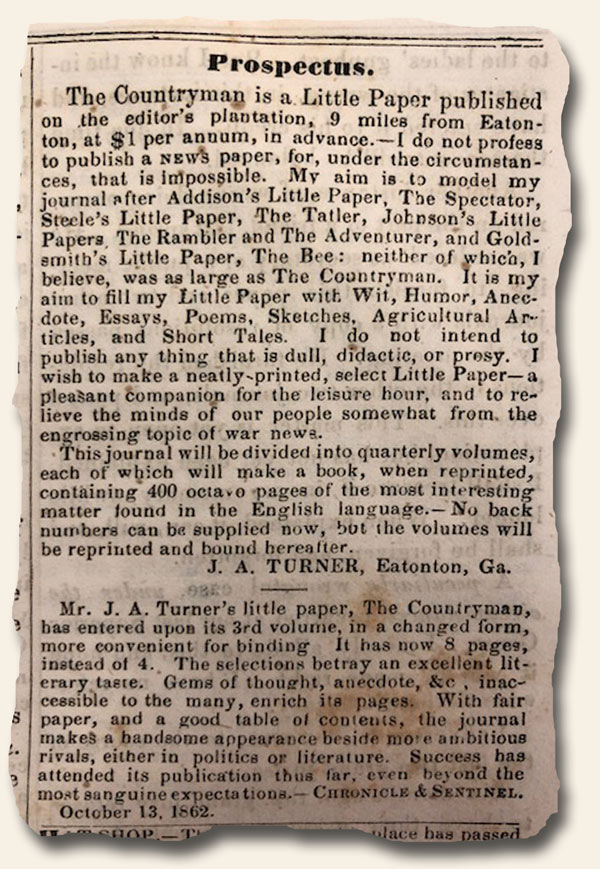
.
The (now) controversial Robert E. Lee monument unveiled in Richmond (1890)…
August 28, 2017 by GuyHeilenman · 1 Comment
 Whether or not the Robert E. Lee monument will remain in Richmond has yet to be determined, but considering the controversy, we thought it might be interesting to post the original Harper’s Weekly report from June 14, 1890 concerning the unveiling of the monument. The link provides the full text related to the image. The text reads, in part:
“The occasion of the unveiling of the Lee statue at Richmond, Virginia, on the 29th of May, possessed features that render it unique in history. It was a mighty tribute to the central figure of a lost-cause, attended by an undercurrent of satisfaction even that the cause was lost… The Confederate flag was everywhere conspicuously displayed… The military companies affectionately bore it in the line of march, but with it they bore the Stars and Stripes, and bore them loyally. The paradox is explainable only by the fact that the former no longer meant disunion… The opinion has with much reason been expressed that the occasion of such magnitude as the one described, with reference to the late Confederacy, is not likely ever to be repeated. General Lee personified what was best in a bad cause. His individual virtues gave the Southern people, who craved a demonstration commemorative of an indelible epoch in their lives, some substantial and unquestioningly credible to rally around. The honor to the hero of their vain struggle has been paid, and the full conditions for another gathering are wanting. It may therefore by surmised that in the great outpouring of the ex-Confederates at Richmond the final obsequies of the war of session have taken place, and the circumstances attending it show how completely the wounds of conflict have been healed, and a mist important chapter of American history closed. AMOS W. WRIGHT
When “white paper” was unavailable the presses kept running…
January 2, 2015 by TimHughes · Leave a Comment
We recently came across an interesting issue of “The Daily Rocky Mountain News” from Denver, dated Oct. 4, 1864. The uniqueness was not in the reporting; it was in the newspaper itself. Rather than printed on traditional newsprint stock, this issue is printed on pink-colored tissue paper. Fortunately, although very flimsy, it is not the least bit fragile.
 It was not unusual for print shops to run out of newsprint and to become inventive in finding ways to get out the day’s edition, particularly for newspapers in remote parts of the country as most paper mills were located in the Northeast. Think of the famous wallpaper issues from the Civil War. Some investigating came across the reason. One website on the history of the “Rocky Mountain News” noted that: “…When the Indian outbreak caused an embargo on traffic over the Western plains in 1864-5, he frequently ran out of white paper, and in such emergencies he printed the news on wrapping paper gathered from Denver stores…”. So this pink paper was wrapping paper. I wonder how long the need for “necessity paper” lasted. We also have two more issues with a similar date which are printed on yellow and green paper. In any case, very interesting curiosities for this fascinating hobby.
Some back-handed compliments for Abe Lincoln…
August 2, 2013 by TimHughes · Leave a Comment
The June 5, 1860 issue of the “New York Tribune” has two testimonials as to the character of Abraham Lincoln, to be the Republican nomination for President in the up-coming election. The second report is by the Honorable George Ashmun and offers some interesting comments. Also, “The Daily Delta” from New Orleans, issue of Feb. 27, 1861 has an equally back-handed “compliment” on the appearance of Lincoln (see below), noting he: “…is not handsome by a great many degrees,but he has not that hideous, ugly look which his portraits give him…”:
The editor shows his bias…
July 26, 2013 by TimHughes · Leave a Comment
Editorials from the 19th century were often quite frank and not afraid to mince words, and perhaps the most scathing comments were found in newspapers during the Civil War years. The “Daily Examiner” newspaper from Richmond, Virginia, January 20, 1865, has an editorial which begins with some very biased words about Andrew Johnson:
Gettysburg revisted… 150 years ago…
June 28, 2013 by GuyHeilenman · 2 Comments
 Since the birth of the United States, there may not be a single more formative event than The Battle of Gettysburg. Authentic newspapers containing first-hand accounts continue to be one of the most sought after within the collectible. Over the years several History’s Newsstand posts have been written about these contemporary reports. A sample of a few are:
The ultimate optimist…
Beyond the big, historic headline…
The Civil War…
The “top ten”: 19th century…
Most historic Civil War event…
The following are the currently available original newspapers with reports related to the Battle of Gettysburg. Please enjoy a brief walk into the heart of “America in crisis” (arranged in chronological order): Battle of Gettysburg
The Traveler… Conferedate president issues a proclamation… new establishments……
March 4, 2013 by The Traveler · Leave a Comment
 Today I decided to travel back to the era of the Civil War through The New York Times of March 4, 1863. In this issue I found the Southern President Jeff Davis had appointed March 27th to be a Day of Fasting and Prayer. “…Under these circumstances it is my privilege to invite you once more to meet together and prostrate yourselves in humble supplication to Him who has been our constant and never-failing support in the past, and to whose protection and guidance we trust for the future. To this end I, Jefferson Davis, President of the Confederate States of America, do issue this, my proclamation, setting apart Friday, the 27th day of March, as a day of fasting, humiliation and prayer…” This is also signed in type: JEFFERSON DAVIS.
Also under the “Important from Washington” are the new establishments of “The New Banking Law”; “Designs for Currency Notes” due to the recent passing of the National Currency Act; “A Branch Mint in Nevada”; as well as the establishing of “The Territory of Idahoe (Idaho)” from within the territory of Montano (Montana). “Slavery is forever prohibited within the limits of the new Territory”.
What an incredible time in history!
~The Traveler