

Search
The Rare & Early Newspapers Hobby

Receive the Newsletter

Buy Historic Newspapers

Announcing: Catalog #302 (for January, 2021) is now available…
January 4, 2021 by GuyHeilenman · Leave a Comment  Email This Post
|
Email This Post
|  Print This Post
- Catalog 302 (in its entirety)
- Noteworthy Catalog 302 ($250+)
- Combined Catalogs (current, w/ remnants of previous)
Don’t forget about this month’s DISCOUNTED ISSUES.
The links above will redirect to the latest catalog in approx. 30 days,
upon which time it will update to the most recent catalog.
If you liked this post, you may also enjoy...
- Announcing: Catalog #301 (for December, 2020) is now available…
- Announcing: Catalog #306 (for May, 2021) is now available…
- Announcing: Catalog #300 (for November, 2020) is now available…
- Announcing: Catalog #292 (for March, 2020) is now available…
- Announcing: Catalog #277 (for December, 2018) is now available…
As we close the door on 2020…
December 31, 2020 by GuyHeilenman · Leave a Comment Email This Post
| Print This Post
Overall, 1923 was a pretty good year. However, even a decent year has its share of troubles. A few examples from 1923 include:
The Rosewood massacre, the eruption of Mount Etna, the unexpected death of the popular President Warren G. Harding, Gustav Stresemann being named Chancellor of Germany resulting in policies which led to hyperinflation crushing the German economy (paving the way for Hitler’s rise, the Great Kanto earthquake devastates Tokyo and Yokohama killing an estimated 142,807 people, 640 structures a burned to the ground in Berkley (CA), Adolf Hitler is arrested for his leading role in the Beer Hall Putsch greatly increasing his popularity among those who want to see change, the Gleno Dam (in Italy) bursts killing hundreds, multiple competing factions in China align themselves with the Communist Party – greatly strengthening their influence – and eventual dominance, Prohibition reigns, the largest peace-time U.S. Naval disaster (to-date) occurs off the coast near Santa Barbara (the Honda Point disaster), and more. Although somewhat under the radar, a number of world events took place during 1923 which, upon looking in the rear view mirror, helped pave the way for Communism in China, Nazism in Germany, and the severely ramped up conflict in the Middle East.
Yes, even a good year can have its share of warts. AND then, there’s 2020… Was it worse than the years impacted by the Spanish Flu epidemic, WW1, WW2, any of the Great plagues, the death and destruction brought by Atilla the Hun – to name a few? This doesn’t diminish the impact of the pandemic which defined much of 2020; rather, it’s intention was to merely put it in perspective (if possible).
Speaking of perspective…
A few days ago the front page of a Rotogravure Section of a Detroit News for December 30, 1923 caught my eye. It was a great reminder that there are times when it’s simply best to look to the future with child-like faith. Happy New Year!
If you liked this post, you may also enjoy...
- Looking back at past elections…
- Snapshot 1941 – Crushing Debt’s Impact on Democracy…
- Why collect Rare & Early Newspapers? July 23rd…
- Before heading out to Your New Year’s Eve Party…
- A New Year’s Retrospective thru Historic Newspapers…
Snapshot 1977… The Original (?) Star Wars…
December 28, 2020 by GuyHeilenman · 4 Comments Email This Post
| Print This Post
As we were searching the Calendar section of a Los Angles Times, July 10, 1977 for a full-page ad for an upcoming ELP concert to be held at the Long Beach Arena, we came across another full-page ad for the newly released movie, “Star Wars”. While such ads are desirable when found in a Los Angeles Times (due to the Hollywood connection), what caught our attention was the text of the ad which, instead of just having “STAR WARS”, had “STAR WARS NOW”. Upon investigation we learned that the original STAR Wars was quickly edited soon after it was decided to convert the stand alone movie into a trilogy. Several fans of Star Wars had posted frustration in their inability to obtain the original-release version of the movie. This made me wonder if the odd title in the ad (“STAR WARS NOW”) is/was related to this change. If anyone has more information in regards to this version of the ad, we’d love to know (guy@rarenewspapers.com). Thanks.
If you liked this post, you may also enjoy...
- Summer Blockbuster Movie Ads at Their Best – “Top Gun: Maverick” Edition…
- Calendar Section of the Los Angeles Times … Mini-Time Capsules of Our Lives…
- Blockbuster Movie Ads at Their Best – Overview – Part II
- 20th century prices realized… revisted…
- What happened to this Yankee stadium?
Merry Christmas from Timothy Hughes Rare & Early Newspapers…
December 24, 2020 by GuyHeilenman · Leave a Comment Email This Post
| Print This Post
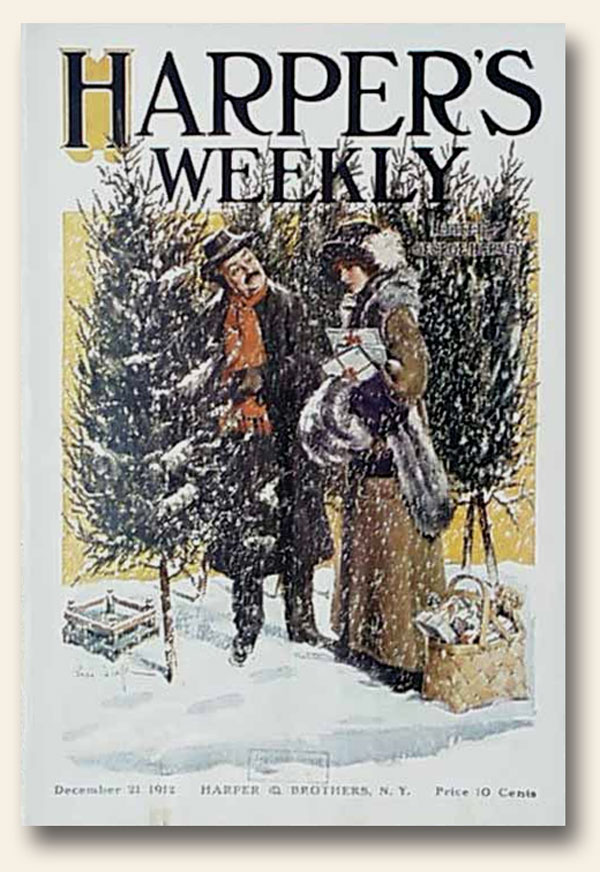
Merry Christmas. A few weeks ago I asked our staff to submit one of their favorite Christmas-themed prints from our website. Their selections were quite varied. If you have a personal favorite from RareNewspapers.com, feel free to share.
Without commentary, the staff’s selections are shown below.
Merry Christmas!


Oh, and the rest of us selected one for the staff member who did not submit their favorite:

If you liked this post, you may also enjoy...
- Merry Christmas…
- The September (2017) Newsletter from Rare & Early Newspapers…
- Meet the staff: Doreen Mileto… Office Manager Extraordinaire…
- Meet the Staff of Rare & Early Newspapers: Lyndsay Miller
- Christmas Day… Not what one might expect…
The Titanic orphans: the rest of the story…
December 21, 2020 by TimHughes · Leave a Comment Email This Post
| Print This Post
One of the advantages of reading a newspaper with fascinating reports from long ago is the ability to investigate and see how the “event” came to a conclusion.

Such is a case with a Detroit newspaper dated six days after the Titanic’s sinking which had a front page photo of the: ” ‘Orphans Of The Titanic:’ Parents Gone and Even Names Unknown“, the caption noting in part that the: “…two little orphans, who were found clasped in each others’ arms in one of the lifeboats…thought to be the children of an unknown…French couple…The little ones speak only French…all efforts to establish their identity have so far failed…”.
And there the story ends for readers of that April 21, 1912 issue of the Detroit News-Tribune. One wonders what became of the unfortunate children.
Well, they were part of an intriguing story with a good ending.
This link has the details, but in short, the children’s father absconded from France with the boys after losing custody of them in a divorce settlement. The father died on the Titanic, and photos of the boys in newspapers were identified by the mother in France, who would soon be reunited with them.
Did you ever read a news report from a century ago and wonder how it finished out? The internet makes it possible to find out!
If you liked this post, you may also enjoy...
- First newspapers in Michigan…
- Great Headlines Speak for Themselves… The Sinking of the Titanic!
- Great Headlines Speak For Themselves… Sinking of the Titanic…
- The question for freedom… the Underground Railroad…
- They put it in print… the R.M.S. Carpathia…
Niles’ Registers from 1820 – unearthing interesting content (part 1)
December 17, 2020 by GuyHeilenman · Leave a Comment Email This Post
| Print This Post
Earlier this year Timothy Hughes Rare & Early Newspapers offered free issues of 200-year-old Niles’ Registers with a request for collectors to let us know if they found interesting, historical or unusual content within the issue they received. Below is the 1st installment of their “finds”. Enjoy.
 Collector L.D. from New Jersey –
“Niles’ Weekly Register” – April 1, 1820.
Located on the front page.
Well I can’t say that I’m an expert on 1820s vernacular, I read this article from the edition I received and it seems (more than) a bit odd. “Covering the country with smiles” sounds like something that would’ve been said in today’s way of speaking, but not something that would’ve been said 200 years ago. Thoughts?
Collector J.T. from Georgia –
“Niles’ Weekly Register” – November 11, 1820.
In the “Foreign Articles” section Page 15 of 16.
Interesting find – News of the suicide of the first and last King of Haiti.
“HAYTI”
“King Henry has committed suicide by blowing out his brains. One account says that he did the deed in July, and that the event was kept secret to secure the succession of his son; and another that it happened about the 1st of October. But it seems certain that he is dead. He had been struck with a paralytic, and no longer able to command his troops, they became mutinous, and revolted at St. Marks – he ordered five regiments to march and punish the insurgents — they refused, and then his kingship made his exit. A body of 6000 troops……. etc.”
Wikipedia History reports that, “His son and heir was assassinated 10 days later.”
For historical references see: https://m.youtube.com/watch?v=q7lfSjjMNU8
and
https://www.britannica.com/biography/Henry-Christophe “… He built the famous Citadelle Laferrière, a fortress south of his capital at Cap-Haïtien. In August 1820 he suffered a paralytic stroke. When his condition was learned, revolts broke out. In despair over his failure to pacify the country, he shot himself at Sans-Souci palace (the citadel and palace were designated UNESCO World Heritage sites in 1982), and his kingdom became part of the Haitian republic in 1821. …”
Also: https://en.wikipedia.org/wiki/Henri_Christophe
If you liked this post, you may also enjoy...
- Hidden gems within Niles’ Weekly Registers…
- Niles’ Weekly Register documented the first half of the 19th century…
- Stepping back: old catalogs show amazing prices…
- I’m New Here: Week Thirty (gasp!)
- The Traveler… a presidential nomination… a bit buggy…
Earliest Lincoln letter published in a newspaper?
December 14, 2020 by TimHughes · Leave a Comment Email This Post
| Print This Post
Finding the earliest mention of notable people in period newspapers, long before they would become national figures, is a quest of many. Such nuggets–when found–can become treasured pieces for any collection.
We recently discovered what, by our research, is the earliest letter signed by Lincoln to appear in a newspaper. The “New York Weekly Tribune” of July 8, 1848 printed a letter signed A. Lincoln from when he was a representative from Illinois in the national legislature (see photos).In our 44 years of experience this is the earliest we have encountered. One would think letters may have appeared in his local Springfield, Illinois newspaper but lacking the holdings to do such research we can only speculate.
Are any collectors out there aware of an earlier published letter signed by Lincoln? Let the collecting world know!

If you liked this post, you may also enjoy...
- The Traveler… a great man laid to rest…
- They Put It In Print (1848)… “Lincoln that is, political gold, Illinois tea…”
- Lincoln’s famous letter to Lydia Bixby…
- Lincoln establishes a national Thanksgiving Day…
- John Wilkes Booth appears at Ford’s Theater, in 1863…
The United States elections – a bumpy walk through time…
December 11, 2020 by GuyHeilenman · Leave a Comment Email This Post
| Print This Post

(false report – Rutherford B Hayes won)
The first president of the United States, George Washington, was elected by a unanimous decision in 1789 [the election process started in 1788]. Since then few elections, whether for mayor, governor, president, etc., have sailed on such smooth waters – and the preponderance of elections outside the U.S. have not fared any better. While the privilege and responsibility of citizens of democracies to exercise their right to elect those whom they wish to lead them cannot be understated, the process is often fraught with civic and relational tension. However, once the election is in the rear view mirror, in most instances wounds are eventually healed and sunny skies return – even if it takes months.
We at Rare & Early Newspapers have created a link to our available election-related issues and arranged them in chronological order. There may be a few stray issues which do not belong in the list, but hopefully those who have an interest in such things will appreciate the somewhat tumultuous stroll through time.
Elections Through Time
If you liked this post, you may also enjoy...
- Looking back at past elections…
- Did you know? Elections and Inaugurations…
- Movie Prop Newspaper… Can you identify the movie (round 1)?
- The Traveler… the President takes office, again…
- Popular Categories – A Deeper Dive into the Legacies of U.S. Presidents…
Snapshot 1775… A prayer for the country and its leaders…
December 7, 2020 by GuyHeilenman · Leave a Comment Email This Post
| Print This Post
We recently sent sent out high-resolution images of a Virginia Gazette (Williamsburg, VA) dated July 20, 1775 which included coverage of the “Causes & Necessity of Taking up Arms”, the last appeal for peace, and the Battle of Bunker Hill. Within hours we were receiving an abundance of responses from those who had read the issue, and guess what was commented on most frequently? The coverage of the “Causes & Necessity of Taking up Arms”? No. The last appeal for peace? No again. Perhaps the report regarding the Battle of Bunker Hill? No, no, and again no. What captured the attention of most of those who responded was an anonymous prayer printed on the front page. Without commentary, I include this prayer below. 
Dear Lord, As America continues to wrestle with election issues, my prayer is that no matter who You enable to hold positions of leadership/authority, You will direct their steps – whether they acknowledge You or not. I pray You will give them wisdom, humility, and compassion for all whom they serve. I am also grateful for Your sovereign will, and rest in the hope beyond reason which has already revealed the end of the story. Amen!
Note: To our readers, if anyone knows who wrote the above prayer from 1775, please let us know. Thanks.
If you liked this post, you may also enjoy...
- Announcing: Catalog #268 (for March, 2018) is now available…
- Introducing: RareNewspapers.com – The Revolutionary War…
- Hearts & Minds… The Causes and Necessity of Taking Up Arms…
- Reflections on Decoration Day: Honoring the Ultimate Sacrifice…
- The Traveler… treaty ratified…
My Collecting Story… G.F. in Lexington, Virginia…
December 3, 2020 by GuyHeilenman · Leave a Comment Email This Post
| Print This Post

Continued below in the next installment in our series in which we post the “stories” graciously submitted by our collecting friends during the pandemic which began in 2020.
I love US history and as soon as I earned a permanent salary, I started visiting historical sites and eventually turned to collecting items of interest, particularly US Civil War. I collected many of my Harper’s from numerous civil war shows; my favorite is a Richmond Examiner, 23 June 1864 (long before I knew about the RareNewspapers.com website); it talked of Sherman’s campaign and how it would end like Napoleon’s in Russia! Great reading. Years went by and I am a docent at the Stonewall Jackson House in Lexington, VA (come by when this contagion is past and we’re open again). I prepared a presentation on Jackson in the Mexican War; I came across your site and ordered a “National Intelligencer,” 16 Nov 1847 and “The Union,” also dated 1847. Future Civil War luminaries their exploits abound. Finally, and not about the Civil War, my wife loves to explore Scottish roots and your site had several papers regarding the Scottish rebellion of 1746, referencing the battle of Culloden – yep, I bought it as a Christmas gift for her. Your site piques my curiosity and I’ll remain a customer!
As additional “stories” are posted they will be available at: MY COLLECTING STORY. We did this many years ago as well – and their posts are also included.
If you liked this post, you may also enjoy...