
Search
The Rare & Early Newspapers Hobby

Receive the Newsletter

Buy Historic Newspapers

The Gentleman’s Magazine & Bankruptcy…
May 8, 2021 by Stephanie Williams · Leave a Comment  Email This Post
|
Email This Post
|  Print This Post
Under the illustration of St. John’s Gate that introduces each issue of the Gentleman’s Magazine, is the month and year, followed by the table of contents (each issue via the link will show an image of this – typically the last image posted). For the first time, I noticed the calligraphy that follows “CONTAINING” and precedes the article headings and their corresponding page numbers. “More in Quantity and greater Variety than any Book of the Kind and Price.” While I have nothing to compare it to, I can attest that of the thirty-seven distinct articles listed for March of 1782, the subject matter ranges from Parliamentary debates to a Swiss underground road, and includes bull-baiting and the wool trade along the way. The regular coverage of weather, news from around the world, births and marriages and deaths, trials, and literary reviews is fit in around the special bits.
In particular, my interest was caught by “Usual Causes of Bankruptcy, Caution against — ” and turned to page 138 to read.
In all ages there have been men, who, by sudden losses, by entering into indiscreet obligations, by improvident conduct, or through fraudulent designs, have become, or pretended to become, incompetent to the discharges of their just debts; but the number of bankrupts which now appear in every Gazette is a subject of serious and alarming consideration.
Along with the obvious financial harm that can be caused by frivolous living and participation in gambling, the author addresses the lack of care and foresight that must be viewed as the social responsibility of every gentleman, in order to enable him to properly discharge his debts and contribute to the public funds by means of taxes. He recommends annual reflection for the purpose of seeing areas of weakness in funding, and to not allow debts to unknowingly pile up beyond the ability to repay. Then, he maintains, steps toward frugality can be made in enough time to avert distress. Finally, he offers as example the late Sir Stephen Theodore Janssen who he terms a “virtuous citizen.” He records the words of Sir Stephen, addressed to the Livery, as he deems them of value to the general population. The speech concludes in this way:
I do further declare that it is my determined resolution to continue living in the same frugal manner, till the last shilling is discharged; and in case any turn of fortune should happen to me, my whole just debts shall be discharged so much the sooner, as I am determined to persevere in preserving the character of an honest man.
If you liked this post, you may also enjoy...
- The Traveler… The Emancipation… the last look… and today…
- Gentleman’s Magazine & Insanity…
- When did the “Gentleman’s Magazine” print the Declaration of Independence?
- Print date for the Gentleman’s Magazine…
- The Gentleman’s Magazine & Poetry… Still learning…
Many Thanks to Give…
May 3, 2021 by LauraH · Leave a Comment Email This Post
| Print This Post
 My family often jokes with me (maybe about me ) when they say, “she can use Disney World as an example for anything.” They aren’t wrong and have accurately pegged me as a bit of a Disney fanatic. I won’t bore you with all the reasons I have for loving this place but I will tell you how it came to mind today as I was perusing an issue published by Frederick Douglass. For those of you who have visited Disney World or more specifically Epcot, I hope you have experienced Spaceship Earth. I never tire of riding this attraction and hearing Dame Judy Dench recount mankind’s history of communication to me as I gaze at the vignettes on each side of my “time machine”. At one point, she is describing how, since the invention of papyrus, knowledge is able to be kept and shared more easily and so civilization advances more rapidly until …
“Rome falls, and the great Library of Alexandria in Egypt is burned. Much of our learning is destroyed—lost forever… or so we think. It turns out there are copies of some of these books in the libraries of the Middle East, being watched over by Arab and Jewish scholars. Call it the first backup system. The books are saved, and with them our dreams of the future.”
I get shivers every time I hear those words… so much knowledge… so much history… so many pages. Just now, as I pause to admire this precious Frederick Douglass paper lying on my desk, I am overwhelmed with gratitude for all the people we, the collectors of historic newspapers, have to thank for watching over the issues that later end up in our hands. Precious treasures of knowledge and history handed off to us, if even for a moment, to guard for future generations.
If you liked this post, you may also enjoy...
- Love of History Takes Many Forms…
- The Traveler… “Who’s the leader of the club…?”
- Perhaps not a perfect system, but… Happy Memorial Day!
- The Frederick Douglass’ Paper… Solomon Northup…
- We all need a North Star… Wisdom from Frederick Douglass…
Announcing: Catalog #306 (for May, 2021) is now available…
April 30, 2021 by GuyHeilenman · Leave a Comment Email This Post
| Print This Post
- Catalog 306 (in its entirety)
- Noteworthy Catalog 306 ($250+)
- Combined Catalogs (current, w/ remnants of previous)
Don’t forget about this month’s DISCOUNTED ISSUES.
The links above will redirect to the latest catalog in approx. 30 days,
upon which time it will update to the most recent catalog.
If you liked this post, you may also enjoy...
- Announcing: Catalog #300 (for November, 2020) is now available…
- Announcing: Catalog #309 (for August, 2021) is now available…
- Announcing: Catalog #292 (for March, 2020) is now available…
- Announcing: Catalog #296 (for July, 2020) is now available…
- Announcing: Catalog #282 (for May, 2019) is now available…
I Would Love to Have Them All…
April 22, 2021 by LauraH · Leave a Comment Email This Post
| Print This Post
 As you can imagine, working here at the RareNewspapers office can be a bit like a kid working in a candy shop. Almost daily I push the thought, “Maybe I should buy this one for myself”, to the back of my mind. Sometimes it is because of the historic impact of the content I am seeing and the deep desire to personally protect it for posterity. Sometimes it is because the issue triggers a fond memory and whisks me away to another day. Last week this thought would not stay in the back of my mind but continued to crash to the forefront over and over. Finally, with my many rationalizations in hand, I pulled out my credit card and purchased the issue. Feelings of nostalgia of a simpler by gone era washed over me as I paged through my new treasure. This treasure is mine however, if you are ever drawn to that same simpler time, we here at the RareNewspapers office have other options for you to consider. There is truly something for everyone. I may have been drawn to the vintage ads, drawings, paper dolls and old stories, but there is so much more. Take a moment to step back in time. Sometimes those brief moments are all that are needed to add a bit of perspective to the “thoroughly modern” life we currently live.
If you liked this post, you may also enjoy...
- You’ve Come A Long Way Baby…
- Three cheers for Time Zones…
- One Hit Wonders Can Still Pack an Emotional Punch…
- Definition of terms…
- January 21st Thru History… An Eye Focused From Whence We Came…
The April (2021) Newsletter from Rare & Early Newspapers…
April 19, 2021 by GuyHeilenman · Leave a Comment Email This Post
| Print This Post
Monthly Newsletter ~ Rare & Early Newspapers
Welcome to the September 2020 edition of our monthly newsletter. This month we’d like to bring your attention to the following:
An Expanded Set of Discounted Newspapers – 50% Off
New Items Added to January’s Catalog
Since Catalog 302 went to print we’ve added approximately 50 additional items. Some of the topics/issues include: a mid-1700’s map of Eastern Canada, Convicts shipped off to America and Oglethorpe before the founding Georgia in the same issue, several different rare Confederate newspapers, George Washington rejects an honor and the delegates to the Constitutional Convention in the same American issue, a Philip Burke caricature of Donald Trump, and more.
Catalog 302
|
|

|
|
See what’s happening on our social sites
|


If you liked this post, you may also enjoy...
- The January (2021) Newsletter from Rare & Early Newspapers…
- The April (2021) Newsletter from Rare & Early Newspapers…
- The September (2020) Newsletter from Rare & Early Newspapers…
- The October (2019) Newsletter from Rare & Early Newspapers…
- The August (2020) Newsletter from Rare & Early Newspapers…
Snapshot July,1814… The war of 1812 ends nearly a year earlier than we thought…
April 19, 2021 by GuyHeilenman · Leave a Comment Email This Post
| Print This Post
While for years most of us were taught that The War of 1812 ended in February, 1815, we just unearthed a reliable source which makes it obvious we’ve been sold a bill of goods. How do we know? The highly respected Columbian Centinel, printed in Boston from 1790 through 1840, obtained a Proclamation from President James Madison declaring the war to be over and printed it in their July 2, 1814 newspaper. Furthermore, this announcement was signed in block type by the President himself – confirming its authenticity. Knowing this would be met with a degree of skepticism, we’ve included the evidence for all to see:
However, whenever something doesn’t pass the smell test from a few inches away, it’s often wise to pull back and take a whiff from a greater distance…
Perspective beyond the end of our own noses can change everything!
If you liked this post, you may also enjoy...
- Where did it end up? Boston
- The first newspaper in Utah…
- The Traveler… immigration issues one-hundred years ago…
- True? Muhammad’s pledge of protection for Christians…
- The Gettysburg Address… What did he actually say?
The April (2021) Newsletter from Rare & Early Newspapers…
April 16, 2021 by GuyHeilenman · Leave a Comment Email This Post
| Print This Post
Monthly Newsletter ~ Rare & Early Newspapers
Welcome to the April 2021 edition of our monthly newsletter. This month we’d like to bring your attention to the following:
An Expanded Set of Discounted Newspapers – 50% Off
New Items Added to April’s Catalog
Since Catalog 305 went to print we’ve added approximately 50 additional items. Some of the topics/issues include: a Frank Leslie’s Illustrated issue on the hanging of the “Lincoln Conspirators”, Babe Ruth as a Baltimore Oriole (quite rare), a hard-to-find 1840 campaign newspaper, the “fixed” boxing match between Jack Johnson and Jess Willard – 26 rounds, a great map of Jamaica in 1762, and more.
Catalog 305
Speaking of the catalog, some links which you may find useful include:
|
|
|
|
See what’s happening on our social sites
|
If you liked this post, you may also enjoy...
- The April (2021) Newsletter from Rare & Early Newspapers…
- The January (2021) Newsletter from Rare & Early Newspapers…
- The October (2019) Newsletter from Rare & Early Newspapers…
- The April (2023) Newsletter from Rare & Early Newspapers…
- The June (2020) Newsletter from Rare & Early Newspapers…
Master Wordsmiths Often 1st Shared Their Treasures in Newspapers…
April 12, 2021 by LauraH · Leave a Comment Email This Post
| Print This Post
What do Walt Whitman (poet extraordinaire) … Joel Chandler Harris (Uncle Remus fame) … Charles Dickens (needs no introduction) all have in common? Perhaps my title gave the answer away. These and many other authors often shared their literary master pieces in newspapers before they were printed in book form. Recently, as I was delving into some San Francisco Chronicles, I came upon another addition to this illustrious list. Warm welcomes to Dame Agatha Mary Clarissa Christie, Lady Mallowan. On September 3, 1939, the San Francisco Chronicle, This Week Magazine section began a “thrilling series of short mystery stories” by Agatha Christie. This 1st story in the series “The Labours of Hercules” was titled “Invisible Enemy”. By putting such variety of writing into a public newspaper, the everyday person was often exposed to quality literature giving them the opportunity to increase their education in a casual way. Thanks to these master story tellers for sharing with all of us.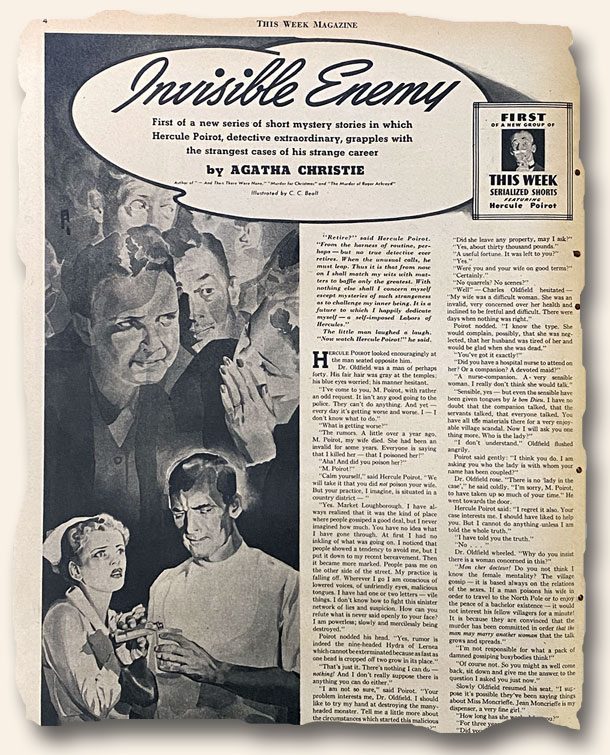
If you liked this post, you may also enjoy...
- Lincoln & Whitman … it’s all in the perspective…
- Print date for the Gentleman’s Magazine…
- The Traveler…Frigate President makes a capture… newspaper proposal…
- The Illustrated London News… Beautiful imagery…
- They Put It In Print… How to hate – 1941…
Flawed Greatness…
April 9, 2021 by LauraH · Leave a Comment Email This Post
| Print This Post
A very, very, very, very… wise Man once said, “Let any one of you who is without sin cast the 1st stone.” As was often the case, this Sage was addressing the situation at hand as well as the next 2000+ years of human history. Fast forward to today when we all feel as if we are in a constant state of ducking as stone after stone whizzes past our heads. Sometimes they are aimed at us… sometimes at the person next to us… sometimes at our favorite podcast host… sometimes at the history pages from 250 years ago. With this in mind, may I share a few inspirational words from one of those among us who was, like us all, flawed and with sin but, in moments of divine inspiration, lead with greatness as so many of our Founding Fathers did.
 On March 4, 1797, John Adams, 2nd president of the United States, took up the mantle of George Washington and penned the words below as part of his Inaugural Speech. At such a pivotal moment in our countries history, with the transition from our 1st President to our 2nd, everything was on the line … freedom, democracy and our nation’s ability to continue grow and throw off any national “sins that so easily entangle”. What began with our Constitution would make a giant leap forward 100 years later and continue to progress for the 100 years after that. Listen to John Adams as he shares the passion of his heart for this country.
“… Employed in the service of my country abroad during the whole course of these transactions, I first saw the Constitution of the United States in a foreign country. Irritated by no literary altercation, animated by no public debate, heated by no party animosity, I read it with great satisfaction, as the result of good heads prompted by good hearts, as an experiment better adapted to the genius, character, situation, and relations of this nation and country than any which had ever been proposed or suggested. In its general principles and great outlines it was conformable to such a system of government as I had ever most esteemed, and in some States, my own native State in particular, had contributed to establish.
…With this great example before me, with the sense and spirit, the faith and honor, the duty and interest, of the same American people pledged to support the Constitution of the United States, I entertain no doubt of its continuance in all its energy, and my mind is prepared without hesitation to lay myself under the most solemn obligations to support it to the utmost of my power.
And may that Being who is supreme over all, the Patron of Order, the Fountain of Justice, and the Protector in all ages of the world of virtuous liberty, continue His blessing upon this nation and its Government and give it all possible success and duration consistent with the ends of His providence.”
If you liked this post, you may also enjoy...
- Be sure you are buying what you think you are buying…
- The Traveler… Battle of Baltimore…
- President George Washington: “Et tu, John Adams?”…
- A Time of Transition… Washington’s Funeral…
- There Are Not Enough Words to Say Thank You… Veteran’s Day
Inspiration from Days Gone by…
April 5, 2021 by LauraH · Leave a Comment Email This Post
| Print This Post
I heard an interesting quote the other day: “Long after the medals go into a box and the trophies have a layer of dust on them, will your speech still be having an impact on the audience you gave it to?” (Heather Neumann) Ironically, Heather’s statement had the impact it appears she wanted. As I contemplated her statement as I wrote this post, I was curious about who had made a lasting impact on this day throughout the ages, hoping to glean a bit of inspiration for myself. Here are a few that caught my eye.
 Having been raised by a mother who took our health seriously, I was encouraged from a very young age to” take Vitamin C at the 1st sign of a cold”. Who do I have to thank for this bit of wisdom besides my mother? On 4/5/1932, the New York Times covered research done by Charles Glen King. Prof. King isolated the compound for Vitamin C for the 1st time… over 30 years before my mother began her diligent training. Charles’ work continued in the nutritional field to help any with open ears to a step into a healthier life… continuing to positively impact the bodies of mankind.
On April 5, 1990, the LA Times covered the death of legendary jazz vocalist Sarah Vaughn. The University of Central Florida’s website asserts … music impacts the brain by “reducing stress, pain and symptoms of depression as well as improving cognitive and motor skills, spatial-temporal learning and neurogenesis”. Perhaps the phrase, “music calms the savage beast” is not just an old wives saying enabling Sarah’s music to bring a sense of peace and wellbeing to the many who continue to listen to her, bringing far more lasting impact than her 4 Grammy’s and lifetime achievement award… continuing to positively impact the minds of mankind.
In April of 1985, USA Today covered Michael Jordon’s work with Special Olympics. Most of us can only imagine how hard it must be for someone famous and in the perpetual limelight to tear the focus off of themselves and place it on others. Often times we judge the motives of these people even when they are trying to do a good thing. Perhaps we should take their good deeds at face value and appreciate the fact that when we do good for others, both the giver and receiver are uplifted. In this case, Michael’s efforts to reach out to others has a lasting impact on the his life, the lives he touched and all of us watching if we can put our skepticism aside… continuing to positively impact the souls of mankind.
While I am sure I will never sing like Sarah Vaughn or discover a great scientific breakthrough, I do have daily opportunities to bless others. I am sure these will never make it into USA Today or the LA Times and that is okay however, if by chance they would, sometimes those trophies in a box can inspire the next person.
If you liked this post, you may also enjoy...