
Search
The Rare & Early Newspapers Hobby

Receive the Newsletter

Buy Historic Newspapers

Popular Categories – A Deeper Dive into the Legacies of U.S. Presidents…
May 9, 2022 by LauraH · Leave a Comment  Email This Post
|
Email This Post
|  Print This Post
Most people have their favorite President of the United States. I’m sure if we each came up with our short list of five favorites there would be considerable overlap. Washington, Lincoln, Ronald Regan or Barack Obama (depending on which side of the isle the person resides), etc. – each president, popular or otherwise, has their own fascinating history which often includes failure, success, and often a few quirky tidbits of fun facts. The wonderful thing about original newspapers is they give collectors the ability to dig into the more obscure details of the lives and legacies of each of these once-upon-a-time “leaders of the free world”. In fact, newspapers containing such mentions are so sought after, we have a dedicated link on our website to help with the exploration: Presidents (U.S.)
As I began perusing collectible issues related to this post my attention aroused by an interesting story regarding our 37th president, Richard Nixon. To counter-act the ever-growing tension which plagued the latter years of his administration – both Watergate and the “resignation” of his VP, Spiro Agnew, President Nixon nominated a replacement for Agnew whom he knew would be easily and quickly confirmed, but who also believed in his innocence in regard to Watergate – one who would likely pardon him if the need arose. President Gerald Ford, after taking the oath of office upon Nixon’s resignation, did in fact give him an unconditional pardon for any and all crimes he may have committed against the United States. Although this particular use of a Presidential pardon has only occurred once in U.S. History, now that the box has been opened, it likely won’t be the last.

If you liked this post, you may also enjoy...
- The Traveler… the President takes office, again…
- They Put It In Print – The 12th President of The United States…
- The United States elections – a bumpy walk through time…
- The Louisiana Purchase is useless to the United States…
- President George Washington: “Et tu, John Adams?”…
National Day of Prayer… Love our neighbors… Newspapers provide perspective…
May 5, 2022 by GuyHeilenman · Leave a Comment Email This Post
| Print This Post
As we reflect on the political, religious, racial, socio-economic, etc., etc., etc. diversity of the citizens of the United States on this National Day of Prayer, one cannot ignore what appears to be our ever-increasing polarization and wonder if our days are numbered. Is it possible to learn to appreciate our differences… to be kind… to play nice? When we were just sprouting, many of us were taught the Biblical mandate to love our neighbors – albeit a difficult task, at least we could wrap our minds around the concept.
 However, Jesus, in His famous Sermon on The Mount, upgraded this calling to a height eclipsing human reason:
“You have heard the law that says, ‘Love your neighbor’ and hate your enemy. But I say, love your enemies! Pray for those who persecute you! In that way, you will be acting as true children of your Father in heaven. For He gives His sunlight to both the evil and the good, and He sends rain on the just and the unjust alike.”
Is this really possible? Can we actually learn to love those who violently oppose us – who would wish us harm? God tells us that with Him, ANYTHING is possible. He also provides considerable encouragement when He states: “You often do not have because you do not ask.”
Reading news from the day it was first reported through historical first-hand accounts as found in Rare & Early Newspapers provides incredible perspective. Our shared heritage was built upon diversity. Did we make mistakes, have passionate disagreements, and even come to the brink of our demise? Absolutely! However, through it all we managed to stay together – to be a melting pot unlike any the world had ever experienced. Was this… is this a God-thing? One thread woven throughout our history has been the calls by our leaders (Presidents, Governors, etc.) to seek God through prayer – often given as Proclamations for a Day of Thanksgiving, Humiliation, and Prayer. The truth is, prayer has been woven throughout the fabric of our nation from the start.
So, on this agreed upon, country-wide, National Day of Prayer…
Dear Lord,
We, as a nation, need Your help. Please give us the ability too see others through Your eyes and to love those with whom we fervently disagree. We understand the truth in President Lincoln’s words: “A house divided against itself cannot stand.” We realize there are many from outside our borders who are actively fomenting such division, and rather than steeling ourselves against such attacks, we too often respond as mere pawns. Help us to unite against such nefarious intentions. Help us to appreciate our common Source – that we are all made in Your image, our common citizenry, and the abundance of our shared experiences – birth, death, and a ton of joys and sorrows in between. Help us to play nicely with one another – to seek common ground whenever possible, and to agree to live peacefully with our differences. While humanly absurd, please give us Your strength to love one another. We grasp this is a You-size quest and therefore come to You with child-like humility – pleading for You to do that which we cannot do ourselves. We, as a nation, need Your help. Thanks in advance.
Amen
The following is a post from the past which, in my opinion, is worth a second look:
America – pulling a nation back together…
 My Fellow Americans: Devastating hurricanes, Pearl Harbor, 9-11, the end of WWII, Lindbergh’s 1st flight across the Atlantic – while there is much that divides us, there have been times throughout our history when both triumphs and tragedies have inspired us to lay down our weapons and to unite as one. While these times of mutual good will are typically short-lived, they often act as a reset to help center us on that which binds us together. We need such a time!
It is was with the current atmosphere of angst as a backdrop that I was moved by an under-the-radar prayer found buried on page 11 of an issue reporting the assassination of President JFK. His death, airmailed via television directly into the living room of nearly every home in America, brought together Republicans, Democrats, and Independents alike and unified us around shared grief. May a day come when such unity of spirit flourishes without the inspiration of deep sorrow, tragedy, or war. As another assassinated President once said: “A house divided against itself cannot stand (Abraham Lincoln).” It is time for us to lay down our weapons. Much is at stake.
If you liked this post, you may also enjoy...
- America – pulling a nation back together…
- A Time of Transition… Washington’s Funeral…
- For United We Stand…
- 1776-2026: The Dream Still Shines at Dawn’s Early Light!
- Reflections on Decoration Day: Honoring the Ultimate Sacrifice…
From the Library of Congress: “Printing Newspapers 1400-1900: A Brief Survey…”
May 2, 2022 by GuyHeilenman · Leave a Comment Email This Post
| Print This Post
 A friend of Rare & Early Newspapers recently sent us a link to an article posted on the Library of Congress’ blog titled, “Printing Newspapers 1400-1900: A Brief Survey of the Evolution of the Newspaper Printing Press” (written by Joanna Colclough and posted by Malea Walker), which we thought was quite interesting. It begins in part:
“The printing press has always been a marvel of human invention, and the printing of newspapers occupies a unique course in the history of printing machines. As demands grew for more pages, more news, and faster delivery, newspapers had to achieve greater speeds and higher efficiency.
Newspapers started on Gutenberg presses – individual type pieces arranged backwards by hand, secured in a flat bed, inked by hand, and a great leverage force applied to create the impression. The machine did one part of the job, and newspapers were often printed once a…”
To read the entire post, go to:
Printing Newspapers 1400-1900: A Brief Survey of the Evolution of the Newspaper Printing Press
If you liked this post, you may also enjoy...
- More on printing newspapers in the 1700’s (revisited)…
- More on printing newspapers in the 1700’s…
- Giant leaps… Baby steps are nice, but every now and then…
- Historic printing press returns home…
- Celebrating 150 years since Arizona’s first newspaper…
Announcing: Catalog #318 (for May, 2022) – Rare & Early Newspapers (for purchase)
April 30, 2022 by GuyHeilenman · Leave a Comment Email This Post
| Print This Post
|
 May’s catalog (#318) is now available. Also shown below are links to a video featuring highlights from the catalog, our currently discounted newspapers, and recent posts to the History’s Newsstand Blog. Please enjoy.
|
The links above will redirect to the latest catalog in approx. 30 days,
upon which time it will update to the most recent catalog.
If you liked this post, you may also enjoy...
- Announcing: Catalog #319 (for June, 2022) – Rare & Early Newspapers (for purchase)
- Announcing: Catalog #316 (for March, 2022) – Rare & Early Newspapers (for purchase)
- Announcing: Catalog #320 (for July, 2022) – Rare & Early Newspapers (for purchase)…
- Announcing: Catalog #327 for February, 2023 – Rare & Early Newspapers for collectors…
- Announcing: Catalog #328 for March, 2023 – Rare & Early Newspapers…
Edward Gallaway – bibliophile, publisher, circus performer, cardshark – help needed…
April 25, 2022 by GuyHeilenman · Leave a Comment Email This Post
| Print This Post
A collecting friend is doing research on Edward Gallaway (1868-1930). Perhaps the collecting community can help. He sent the following note:
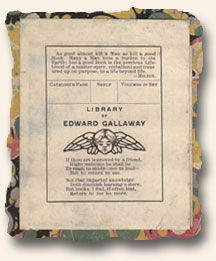
You can help a research project into a largely unknown bibliophile from Chicago, Edward Gallaway, by checking if you have any of the following in your collection:
1) Anything with the bookplate shown in the image.
2) Any issue or clipping from the Payne Weekly People, published in Fort Payne Alabama in October of 1889. This weekly newspaper, published by Edward Gallaway, discontinued roughly a year later end of 1890. This town experienced a boom during those years and many investors hailed from Massachusetts. Thus issues may have been transported back to the New England region.
3) Any issue from the Fort Payne Journal before 1891.
4) Any issue from the Fort Payne Herald.
5) Any issue from the Delphos Kleeblatt before 9th May 1891. The Delphos Kleeblatt was a German newspaper out of Delphos, Ohio, published by Carl A. Jettinger, who was a friend of Edward Gallaway.
Edward Gallaway had a fascinating life. He was born in Delphos, Ohio, in 1868. Already with 14 he became a printer’s devil at the local Delphos Weekly Herald newspaper, where he learned the printer’s art. From 18 years old to 21 he worked as a traveling typesetter. Eventually, he followed his older brother Alexander August Gallaway to Fort Payne, Alabama, where he established the short lived Payne Weekly Newspaper during the coal and iron boom years there. After the boom collapsed, Edward completely changed course and he became a circus performer working from 1892 until about 1895 at small traveling circuses such as the W.D. Ament sideshow. He performed mostly under the stage name Prof. Charles P. Wilson. His act consisted of Punch and Judy as well as magic. He would also work as barker, canvass boss man, as well as sideshow manager.
Edward Gallaway had a secret life as a cardshark. Later in 1902 he would write a manual of sleight-of-hand with cards educating readers on cheating at the card table as well as how to perform magic card tricks. This book, The Expert at the Card Table, was published under the pseudonym S.W. Erdnase, and it is to this day the most important book on sleight-of-hand with cards. It was decades ahead of its time.
Eventually, he found back to his printing profession and he started either alone or with others various job printing business, all of which were short lived. Around 1900 he is employed by the Bentley Murray printing company where he honed his skill on the Monotype typesetting machine which lead him to write the Monotype System books and other educational matter for Lanston Monotype. He started to teach estimating at the United Typothetae which brought him to the attention of Donnelley where he was later employed as estimator. There he rose up through the ranks to reach the position of director of estimating. In other words, he was the chief estimator at the largest privately owned printing company in the US. In 1925 he left and established his own School for Estimating in Chicago, the only school focusing on that particular aspect of printing. He died 1930 in Chicago.
During his life Edward Gallaway accumulated a large library with many precious books which his wife after his death sold through Chicago second-hand book dealers. This was the ‘pension’ she lived on until her death in 1943.
If anyone can be helpful in regards to this research project, please contact me (Guy) at guy@rarenewspapers.com. Thanks.
If you liked this post, you may also enjoy...
- Historic printing press returns home…
- My collecting story… B. C. in Trion, Georgia..
- Mining town of Gunnison, Colorado…
- The reason I collected it: Predicting the 21st century from a perch in 1929…
- The first newspapers in Iowa…
Exploring “This Day in History” through Rare & Early Newspapers…
April 22, 2022 by GuyHeilenman · Leave a Comment Email This Post
| Print This Post
Who among us isn’t a bit curious as to what occurred on our birthday (or today’s date) through time? The concept of exploring a specific day (month/day) through history has always been intriguing, but before the internet, such knowledge was not easy to obtain. However, in the present world of data explosion, websites which explore “This Day in History” do the job quite nicely and have become very popular. One of my favorites is HISTORY.COM maintained by The History Channel.
Of course, as a collector and reseller of old newspapers, this trek is amplified by the capability of holding authentic newspapers containing contemporary reporting of these events – to not only read the articles themselves, but to explore the context of what else was going on as the events unfolded.
Thanks to ongoing requests from collectors, we’ve created an interface on our website which enables the seeker to explore what is available at any given moment for any month/day. Even if you are not looking to add to your collection, perusing through the issues can be fascinating. If you have interest in giving this a try, the steps below are provided to help you get started.
This feature is available at: Explore: “THIS DAY IN HISTORY”
– – –
I tried own birthday and came up with the following: January 2nd Through Time
Don’t forget the “Sort” feature which will give you multiple ways to arrange your search results. Have Fun!

If you liked this post, you may also enjoy...
- Exploring “This Day in History” through Rare & Early Newspapers… Updated!
- This Month in History – October…
- This Month in History – August…
- Today’s month and day through the eyes of Rare & Early Newspapers… 9/26 edition…
- March Newsletter (2026) – Timothy Hughes Rare & Early Newspapers…
A Fly on the Wall at the Lincoln-Douglas Debates…
April 18, 2022 by GuyHeilenman · Leave a Comment Email This Post
| Print This Post
 As I sat down to write this post, I was reminded that a year ago I wrote another post titled “A Fly of the Wall …” which ironically, was also about Lincoln. This time Lincoln had an adversary who also drew me in – who made me, once again, desire to be a fly on the wall.
On August 26, 1858, THE NEW YORK TIMES reported on the now-famous Lincoln-Douglas debates. While coverage of the debates is difficult to find in newspapers because it was a senate race and Lincoln was, at this time, still a relatively unknown figure in American politics, sometimes you find a gem. Page 5 contains a report headed: “Douglas and Lincoln at Ottawa–Personal Reminiscences” which begins: “Messrs. Douglas and Lincoln had a grand tilt at Ottawa, Ill., last week. Mr. Douglas’ speech contained this amusing passage:…”, and what follows is an excerpt of a Douglas’ speech. There is something particularly engaging about two great thinkers, with many polar-opposite views, battling it out with their most useful weapons: words. Go ahead and admit it, you wish you could have been a fly right there with me.
If you liked this post, you may also enjoy...
- A Fly on the Wall at Lincoln’s Cooper Union Speech…
- They put it in print… “Liar, Liar”…
- A Fly on the Wall… Ben Franklin at the Printing Press…
- Announcing: Catalog #314 (for January, 2022) is now available…
- A Fly on the Wall … With the Founding Fathers
Take a Closer Look … The Delicate Details of Woodcut Prints…
April 14, 2022 by LauraH · 1 Comment Email This Post
| Print This Post
I have had some fascinating conversations this past year with one of our collecting friends who is an expert in woodcut prints. I won’t be a name dropper, however, if he is reading this, he will have no doubt as to who I am referencing. I greatly appreciate the time he took to share his knowledge which has motivated me to pause and look more carefully at every print I encounter in the RareNewspapers archives. My proficiency in this area is sparse and not terribly reliable but I did want to share a few takeaways.
Some artists of woodcut prints would draw on paper and send the illustration to a publisher who would cut the paper into tiny square blocks and have each one sketched onto a square block of wood. These wooden squares would be handed out to different craftsmen who would carve their block and then the blocks would be rejoined for printing. Sometimes, when time was of the essence, each craftsman would use carving tools which could create many tiny lines at once. If you look closely at many such illustrations, you can tell these prints have hundreds of parallel lines – indicating the use of these tools. Occasionally, when more time was available, each line was formed individually – a painstaking process, but one which produced an almost unimaginable degree of detail!
Some artists preferred to draw their own prints directly onto the wood and so they were sent a group of one-inch square pieces bound together with twine. When the artist had finished their drawing, the publisher would untie the pieces and distribute the blocks to the woodcarvers.
Regardless of how each print was created, the detail, craftsmanship and artistic skill needed to produce one illustration is mind blowing. So, the next time you glance through a Harper’s Weekly, Leslie’s Illustrated , Illustrated London News, or handful of other illustrated titles of the “woodcut era”, perhaps you will join me in pausing and giving a bit of deference to these creators of beauty. Thanks Bill for sharing this delightful insight with me.
If you liked this post, you may also enjoy...
- From the Vault: Creating Harper’s Weekly engravings: a fascinating process…
- A woodcut masthead is worth a thousand words… Slavery…
- Frederic Remington Prints on Pinterest…
- Related collectibles… carrier & newsie memorabilia…
- Snapshot 1871 – Yosemite Edition…
Great Headlines Speak for Themselves… The Sinking of the Titanic!
April 11, 2022 by GuyHeilenman · Leave a Comment Email This Post
| Print This Post
The best headlines need no commentary. While there are many dramatic headlines regarding the Sinking of the Titanic, the April 16, 1912, New York American is considered one of the very best: “J. J. ASTOR LOST ON TITANIC” “1500 TO 1,800 DEAD” (see below). Of course, the striking illustration certainly helps. We also have a nice Pinterest board with Titanic headlines: Titanic

If you liked this post, you may also enjoy...
- Great Headlines Speak For Themselves… Sinking of the Titanic…
- The Titanic… and newspapers…
- Great Headlines Speak For Themselves… the Hindenburg tragedy!
- Great Headlines Speak For Themselves… Salk’s Vaccine!
- Decorative newspapers on Pinterest…
Snapshot 1844 – Voter Fraud… “death by a thousand cuts…”
April 8, 2022 by GuyHeilenman · Leave a Comment Email This Post
| Print This Post
Political scientist Robert Dahl defines a free and fair election as one in which “coercion” is comparatively uncommon.
Did voter fraud occur in the 2020 U.S. Presidential election? Of course. To think otherwise would be naive. Some degree of fraud has likely occurred in most, if not all elections which involve an imperfect people. This may seem a bit jaded, but I’m actually encouraged by the degree to which most elections in America have been “free and fair”. Still, complaints regarding election fraud have been documented throughout our history. True? In some cases, yes. Enough to impact the final outcome? It’s hard to know.
One such cry came from Louisiana in 1844, and was recorded in the National Intelligencer dated Nov. 30, 1844 (originally printed in the New Orleans Bee). Truth be told, fraud cannot be stopped. However, for the sake of the confidence of the electorate (i.e., to preserve a free and fair election), every intention must be made to keep it to a minimum – while not inhibiting citizens from voting. Balancing both is no small task – but is worth our ongoing effort.
If you liked this post, you may also enjoy...