
Search
The Rare & Early Newspapers Hobby

Receive the Newsletter

Buy Historic Newspapers

Walmart sells them too…
December 12, 2009 by TimHughes · Leave a Comment  Email This Post
|
Email This Post
|  Print This Post
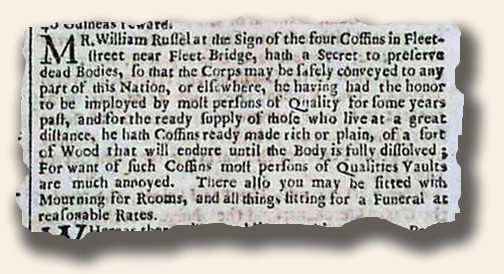
A 1685 issue of the “London Gazette” newspaper contains on the back page the following interesting advertisement, not the type typically found in newspapers–at least not in more modern times. Interesting that the coffin maker notes that he makes them: “…of a sort of wood that will endure until the body is fully dissolved…”.
I saw a piece recently where Walmart now sells coffins on-line. And just in time for Christmas:
If you liked this post, you may also enjoy...
- The Traveler… coffins… do they really have an expiration?
- What a name…
- They put it in print… Execution bar set a little too low?
- They put it in print… in two different editions…
- From a collector of rare newspapers… The Pennsylvania Railroad…
Sure it does…
December 10, 2009 by TimHughes · 1 Comment Email This Post
| Print This Post
 I have always found it amusing to discover articles–particularly those with photos or illustrations–on “flying machines” from before the Wright brothers. In hindsight most of the contraptions are comical yet provide fun reading.
Here is one headed “A New Flying Machine That Flies” which appeared in “The Illustrated American” from New York, Sept. 9, 1898. It apparently was collapsible (to fit in garages?) and could be unfolded to look much like an overgrown bat with propellers. The article notes that: “…There are a large number of details that the inventor has kept strictly to himself…”, the biggest likely that it didn’t fly.
But the article closes with a very prophetic note: “…it has a  military side. It is impossible to imagine without terror the day when these mechanical birds, these flying apparitions, will be able to rain upon armies, hostile towns & escalating parties most deadly and most destructive explosives…”.
If you liked this post, you may also enjoy...
- Beyond the historic headline…
- Beyond the big, historic headline…
- Human ingenuity… not always successful…
- The put it in print… America will become the greatest nation ever!
- The Traveler… Let the journeys begin…
Top ten: 16th and 17th centuries…
December 7, 2009 by TimHughes · 3 Comments Email This Post
| Print This Post
As Guy introduced a few days ago, we will use the Mondays of December to consider the top ten events to be found in newspapers for various periods of time. In a few cases the desired “event” is actually a specific newspaper.
 Today we consider the 16th & 17th centuries, which is a bit difficult as the mere existence of newspapers–or even their predecessors: newsbooks–is limited. And all would be European, as no American newspapers existed in this time period (only exception noted below). Nonetheless I’ve created what I consider to be the top ten historical events or newspapers collectors would love to add to their collections.
I do offer apologies to our non-American friends as this list, and those to follow, have a decidedly American bias, primarily because the vast majority of those who purchase from us are American. But there are a few European events noted.
Here we go, beginning with number ten and ending with the most desired event or newspaper:
10) Coronation of William & Mary, 1689 (after all, they were the king & queen of colonial residents as well. Almost like a very early Presidential “inauguration”)
9) King Philip’s War, 1675-6 (America’s first war)
8.) William Penn’s charter for land in the New World, & his settlement there, 1682 (an issue of the London Gazette includes: “…Mr. Penn bound for Pennsylvania with a great many Quakers to settle there…”)
7) Capture of Capt. Kidd near Boston, 1699 (who wouldn’t want a period report of this very famous pirate)
6) Defeat of the Spanish Armada, 1588 (my one entry from the 16th century; available in period newsbooks)
4) The volume 1 number 1 issue of the Oxford Gazette, Nov. 16, 1665 (great to have the first issue of the world’s oldest continually published newspaper: become the London Gazette with issue #24)
3) Salem Witchcraft trials, 1692 (famous event, but try to find period reports of it!)
2) Settlement in the “New World” from 1607-1630 (from the very earliest period of European settlements in America, predating newspapers but newsbooks did exist)
1) Public Occurrences Both Foreign and Domestick, Boston, Sept. 25, 1690 (America’s first newspaper. To this date only one issue has surfaced. Could there be another?)
If you liked this post, you may also enjoy...
- The “top ten”: 18th century…
- The “top ten”: 19th century…
- Most historic: Pre-Revolutionary War…
- The 1600’s and 1700’s on a budget…
- Most historic pre-Civil War 19th century event…
Before the days of Rogaine…
December 5, 2009 by TimHughes · 1 Comment Email This Post
| Print This Post
This one speaks for itself:

If you liked this post, you may also enjoy...
- Desperate spy tactics…
- Dramatic Headlines Speak for Themselves… Charles Lindbergh’s Solo Flight…
- Happy Passover… Happy Easter…
- The grave-site legacy of Benjamin Franklin…
- A woodcut masthead is worth a thousand words… Slavery…
Top 10 lists…
December 3, 2009 by GuyHeilenman · Leave a Comment Email This Post
| Print This Post
Top 10 lists are always fun to consider. Their strength is in their ability to generate thought, reflection, and opinion. We all acknowledge that no two top ten lists are the same, and whereas going to experts in the field may add a certain level of credibility to a list, even an amateur/novice can bring food for thought to the discussion. Everyone has an opinion, and each and every opinion has some some value. In the end, the greatest benefit may well be in the journey traveled as we formulate and consider both our own views as well as the views of others.
It is with this in mind we plan to offer 4 top ten lists over the course of the next four Mondays. The focus will be on giving thought to the top ten most historic newspapers from each of the following eras: 17th century and earlier (12/7/2009), 18th century (12/14/2009), 19th century (12/21/2009), and 20th century & beyond (12/28/2009). In some cases we may choose a specific newspaper title (any date), realizing that having any issue of the title is of note. In other instances we may focus on a specific title and date of a newspaper – these being the “holy grails” of the hobby. Yet in other cases we’ll include a more general top ten entry, focusing on the event itself, acknowledging that finding any newspaper coverage of the event is noteworthy.
As we proceed through the month, we invite both reactions to our lists and the submission of your own “top tens”.
 In an effort to help kick-start your walk into the past, we invite you to enjoy a recent post which appeared on OnLineSchool.net titled, “100 Great Moments in American History You Can Catch on YouTube”, by Amber Johnson: (http://onlineschool.net/2009/11/18/100-great-moments-in-american-history-you-can-catch-on-youtube/).
If you liked this post, you may also enjoy...
- Top ten battles of the Civil War… Just for fun…
- Top ten: 16th and 17th centuries…
- The “top ten”: 19th century…
- Q & A – Did older newspapers published on the same day vary in content?
- The “top ten”: 18th century…
When the story is as good as the newspaper…
November 30, 2009 by TimHughes · Leave a Comment Email This Post
| Print This Post
Over the last 33 years we have come across newspapers in many different ways. Typically they have been mundane: auction sales or library deaccessionings can be a bit sterile of “excitement’ or intrigue. Some obtained from private holdings often have an interesting story behind them as to how they came into the owner’s possession.
 One prized newspaper, now a part of our private collection, stands out as having a story behind it as interesting as the newspaper. It is the “Teheran Times” of November 5, 1979. Those who know their history will recall that November 4 was the day when Muslim students in Iran stormed the U.S. embassy in Teheran taking 66 American hostages.
It was on November 5 when long-time collector and friend Mort Bryer was returning from Europe and met a woman in the London airport who had just escaped from Iran. She was American but was married to an Iranian. Mort noted that she was visibly shaken as he spoke to her about what she went through. She felt she escaped death. Upon leaving she turned to Mort and said “would you like a souvenir” and gave him the newspaper. It was the “Teheran Times” with front page coverage of the embassy takeover, purchased by her in Teheran earlier that day as is typically done by travelers to pass the time on the plane.
Mort kept the newspaper since 1979 then gave it to me a dozen years later when I visited with him at his home. It remains in our private collection as a treasured piece, as much for the story of how it came to America as for the historic content in contains. It is currently on loan to the Newseum in Washington, D.C. where it is on display.
If you liked this post, you may also enjoy...
- Curiosities are fun to collect…
- My Story… C. H. in Olive Branch, MS…
- The reason I collected it: The Spy…
- Videos regarding the hobby… Private Collections…
- My Collecting Story… Robert (Bob) Cassidy…
Does the phonograph have a future?
November 28, 2009 by TimHughes · 1 Comment Email This Post
| Print This Post
 The piece shown is from “The Alaskan” newspaper of Sitka, dated March 20, 1886. It’s an interesting commentary on a problem with Thomas Edison perfecting his new photograph.
If you liked this post, you may also enjoy...
- Most Historic 19th Century post-Civil War Headline… revisited…
- Are cigarettes bad for you? Thomas Edison & Philip Morris disagree…
- The Traveler… Edison’s ears… cheaper at night…
- Amazing Stories… The Loch Ness Monster…
- They put it in print… a prophetic statement on “modern technology”…
Lincoln establishes a national Thanksgiving Day…
November 26, 2009 by TimHughes · 1 Comment Email This Post
| Print This Post
Appropriate for this day we show photos of the official Proclamation by Abraham Lincoln establishing the “…last Thursday in November…” as a day of Thanksgiving.
In the midst of the Civil War and with the troubles the nation was facing, he thought it appropriate that: “…fellow citizens in every part of the United States…to act apart & observe…a day of Thanksgiving & Prayer to our beneficent Father…due to him for such singular deliverances and blessings, they do also, with humble penitence for our national…disobedience, commend to His tender care…implore the interposition of the Almighty hand to heal the wounds of the nation & to restore it...” (see photos).
This text appeared in the New York Daily Tribune of October 5, 1863. A beautifully written piece by the President in the midst of so much national turmoil & bloodshed. Please enjoy:

If you liked this post, you may also enjoy...
- Lincoln’s “under the radar” proclamation for Thanksgiving…
- Thanksgiving… I time to be thankful…
- The Traveler… the Thanksgiving proclamation…
- Thanksgiving – only days away…
- Properly Directed Thankfulness – George Washington and the Foundations of a New Nation…
A modest resume…
November 23, 2009 by TimHughes · Leave a Comment Email This Post
| Print This Post
“The Crisis” newspaper from Columbus, Ohio, dated May 24, 1863 ran the piece on Lincoln shown in the photo. Keep in mind that this was a “copperhead” newspaper (northern paper opposed to the war, even advocating the continuance of slavery) so there was much criticism to Lincoln and his administration throughout it’s print run, so it is likely the piece was printed to emphasize the “modestness” of his resume.
From what we know of Abraham Lincoln this short piece he submitted, despite likely edits by the newspaper publisher, is largely correct and emphasizes the humble background of the man whom history arguably ranks as among the best of American Presidents. Certainly the trappings of wealth, family pedigree and the best of education which are traits common to leaders in other parts of the world are not prerequisites to success in America. This simple piece in a 146 year old newspaper is evidence that “the American dream” has been alive and well on this side of the Atlantic for many years.

If you liked this post, you may also enjoy...
- Terrific “association” item in American history…
- How often does a President admit he is wrong?
- Political bias no stranger to today’s newspapers…
- “…one of the vilest scoundrels that ever lived…”
- Value of the internet…
A sale that worked out just fine…
November 21, 2009 by TimHughes · Leave a Comment Email This Post
| Print This Post
In a day & age when sales of items between people can be fraught with troubles, here is an interesting “sale” that seemed to work out just fine. It appeared in “The London Chronicle” issue of June 4, 1767:

If you liked this post, you may also enjoy...