

Search
The Rare & Early Newspapers Hobby

Receive the Newsletter

Buy Historic Newspapers

Great Headlines Speak For Themselves… Graf Zeppelin’s flight…
December 19, 2014 by The Traveler · 1 Comment  Email This Post
|
Email This Post
|  Print This Post
The best headlines need no commentary. Such is the case with The New York Times, October 16, 1928: “ ZEPPELIN SAFE AT LAKEHURST AFTER 111-HOUR FLIGHT; SOARS OVER THE WHITE HOUSE AND THEN OVER NEW YORK; MOORED TO MAST TILL WIND DROPS AT 2 A.M.; NOW IN HANGAR”…
If you liked this post, you may also enjoy...
- Great Headlines Speak For Themselves… the Hindenburg tragedy!
- Great Headlines Speak For Themselves… O.J. Simpson not guilty…
- Dramatic Headlines Speak for Themselves… Charles Lindbergh’s Solo Flight…
- Great Headlines Speak For Themselves… Dodgers are moving!
- Great Headlines Speak For Themselves… perfect game for Don Larsen…
The Traveler… capturing Pensacola… plundering away…
December 15, 2014 by The Traveler · Leave a Comment Email This Post
| Print This Post
Today I traveled by the means of the Boston Patriot, December 17, 1814 (shown below) to Boston, Massachusetts. There I found that under the leadership of Maj. Gen. Jackson, Pensacola, West Florida, had been captured.The first portion of the report did not have details yet, however there is a “from an Office in Gen. Jackson’s army” letter. “I write you a few lines to tell you that I am alive and well. We took the town by a coup de main the 7th,… The Baranca has been blown up, and the object intended to be effected, to wit, preventing the British from entering the Bay, cannot now be obtained, so that we shall to day return to Mobile.”
Also reported is “The Brutal Enemy!”. “We learn that the enemy have descended the Rappahannock. Accounts from there state that their ascent up there was marked by a conduct every way worthy of the infamous Cockburn, plundering and burning on both shores and almost everything within their reach… They have laid in ashes the Court-house, prison, collector’s office, clerk’s office, and a large ware-house, and scarcely a building escaped plunder or damage… they broke into the family vault of Col. Richie, and ransacked the ashes of the dead…”.
~The Traveler
If you liked this post, you may also enjoy...
- The Traveler… three cheers…
- Snapshot 1918… President Wilson becomes the first U.S. President to…
- Losses of the Past… Sherman’s March to the Sea…
- The Traveler… Surrender of Detroit… New Orleans takes a blow…
- The Traveler… the defeat at Waterloo…
They sure don’t make’em like they used to…
December 12, 2014 by GuyHeilenman · Leave a Comment Email This Post
| Print This Post
How many things can you think of that are simply not made to the same quality standards as they once were? It would be fun to comprise such a list. However, when someone makes the statement, “They sure don’t make’em like they used to”, it is interesting to note the assumption that the object in question is no longer made as well. However, as the following article from a November 21, 1858 National Intelligencer reveals, thankfully, there are a few things which buck this assumption. Please enjoy… and feel free to send on your own list of things that are actually made better than they were in the past. Let’s transform this common phrase from a negative to a positive.
Note: The Hadley Falls Dam disaster (above), in what is currently Holyoke, Connecticut, drew considerable attention in the 19th century. In 1896, a Harper’s Weekly writer reflected, “The engineer took great pride in his work, and when it was finished, and the gates shut down, he is said to have irreverently exclaimed: ‘There! Those gates are shut, and God Almighty himself can not open them!’” Yet another example of man underestimating the power of God… or perhaps overestimating his own. 🙂
If you liked this post, you may also enjoy...
- 10 Most Shocking Deaths in Sports History…
- The Woman’s Rights Convention, Seneca Falls, 1848…
- “The Times They Are A-Changin'”… Martha’s Vineyard… 1867 (updated)
- Our obsession with “firsts”… History gives us plenty – including John Rock…
- An oddity from 1863 – The Battle of Gettysburg…
For United We Stand…
December 8, 2014 by GuyHeilenman · Leave a Comment Email This Post
| Print This Post
“And if a house is divided against itself, that house will not be able to stand.”
(God, as written by Mark in Mark 3:25)
“United we stand, divided we fall.”
(Aesop)
“A house divided against itself cannot stand.”
(Abraham Lincoln)
“For united we stand; Divided we fall. And if our backs should ever be against the wall. We’ll be together…”
(The Brotherhood of Man)
Bringing people together is no small task. Those who have the ability to rally factions behind a common cause are few and far between. Those who can do so for a noble cause are a true rarity.
While we all acknowledge Abraham Lincoln’s efforts to this end as exemplified in both his “House Divided” speech and yet again in his “Gettysburg Address”, it was another relatively unknown true American patriot who was instrumental in doing the same soon after the close of the American Revolutionary War: Dr. Benjamin Rush. Below please find (and enjoy) the full text of “Address to the People of the United States”, which begins:
“There is nothing more common that to confound the terms of the American revolution with those of the late American war. The American war is over; but this is far from being the case with the American revolution.”,
and concludes:
“PATRIOTS of 1774, 1775, 1778—HEROES of 1778, 1779, 1780! come forward! your country demands your services!—Philosophers and friends to mankind, com forward! your country demands your studies and speculations! Lovers of peace and order, who declined taking part in the late war, come forward! your country forgives your timidity, and demands your influence and advice! Hear her proclaiming, in sighs and groans, in her governments, in her finances, in her trade, in her manufactures, in her morals, and in her manners, ‘THE REVOLUTION IS NOT OVER!’ “, Dr. Benjamin Rush, MD.
What a tremendous rally for all Americans to unite behind a noble cause: the establishment of a nation like none other!
To read the complete text of this amazing speech, go to: American Museum, January, 1787
If you liked this post, you may also enjoy...
- The Traveler… the President takes office, again…
- Will the real Abraham Lincoln please stand up?
- National Day of Prayer… Love our neighbors… Newspapers provide perspective…
- A Fly on the Wall at Lincoln’s Cooper Union Speech…
- The Gettysburg Address… What did he actually say?
Great Headlines Speak For Themselves… death of Rudolph Valentino…
December 5, 2014 by The Traveler · Leave a Comment Email This Post
| Print This Post
The best headlines need no commentary. Such is the case with the Los Angeles Record – Second Extra, August 23, 1926: “VALENTINO DEAD“, with subhead, “Hollywood Mourns Film ‘Sheik’s’ Death“…
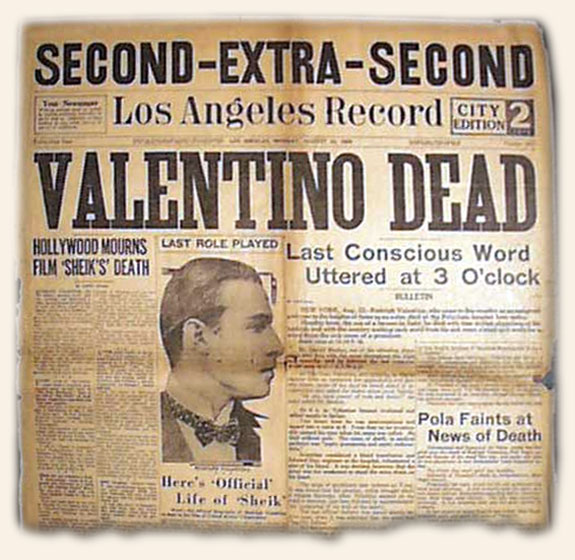
Rudolph Valentino
If you liked this post, you may also enjoy...
- Great Headlines Speak For Themselves… death of Marilyn Monroe…
- Great Headlines Speak For Themselves… Jean Harlow dies…
- Great Headlines Speak For Themselves… Gary Cooper dies…
- Great Headlines Speak For Themselves… Watts riots in Los Angeles…
- Great Headlines Speak For Themselves… death of Groucho Marx…
The Traveler… Col. Bradstreet’s peace offering… the devil’s what?…
December 1, 2014 by The Traveler · Leave a Comment Email This Post
| Print This Post
Today I traveled to London, England, by the way of The Gentleman’s Magazine of December, 1764. There I found a letter from Quebec reporting “Col. Bradstreet, on his arrival at  Detroit, sent a belt of peace to General Pontiac, but he, like a true hero, depended on his power, and greatly dared his worst, by cutting the belt in pieces at the head of his army, (the Indians) and two days ago an Indian canoe came on board us, who assured us M. Pontiak had assembled all his forces together at St. Dusky, and received Col. Bradstreet with undaunted courage… “.
Also in the issue is a “sketch of Peak’s Hole commonly called the Devil’s A—–se-A-Peak in Derbyshire”. This also is Pool’s Hole and includes a plate with two illustrations. To enter this, “the entrance is by a small arch, so very low, that such a venture into it are forced to creep upon their hands and knees, but it gradually opens into a vault more than a quarter of a mile long, and, as some have pretended, a quarter of a mile high…”. This also has a running stream and both a cold and hot spring — the springs within a hand touch from the other.
~The Traveler
If you liked this post, you may also enjoy...
- Still Learning…Website Topical Searches
- The Traveler… the largest single arrest of Rabbis in American history…
- The Traveler… the frigate Huzza… struck by lighting!
- Who’s Who in Newspapers? Stephen Crane edition (1891)…
- The Traveler… “The Birdman”, Lincoln Beachey… the irony…
I’m thankful for… Abraham Lincoln…
November 26, 2014 by GuyHeilenman · Leave a Comment Email This Post
| Print This Post
As Thanksgiving rapidly approaches, one is compelled by the overwhelming blessings so many of us experience on a daily basis to consider things for which we are thankful, but often overlook. One such gratitude-producing individual for me is Abraham Lincoln. Was he a perfect man? No. Have many of his flaws been white-washed from history? Yes (I’m counting on the same treatment). However, this does not negate the truth that in my eyes, he was a man for “such a time” as his was. I’ve always appreciated his writing (whether it be from his own pen or another’s makes no difference to me). One of my favorites is:
“I do the very best I know how – the very best I can; and I mean to keep doing so until the end. If the end brings me out all right, then what is said against me won’t matter. If the end brings me out wrong, then ten Angles swearing I was right would make no difference at all.” Abraham Lincoln
We should all have such strength of conviction in regards to our actions under fire.
A short time ago I came across a letter from him which was printed in a National Intelligencer dated January 27, 1865 that may rival the above. It is his response to a letter received from him from Eliza Gurney, the wife of a recently departed friend. The full text is viewable via the image shown below, with the transcribed text to follow.
Executive Mansion,
Washington, September 4, 1864.
Eliza P. Gurney.
My esteemed friend.
I have not forgotten–probably never shall forget–the very impressive occasion when yourself and friends visited me on a Sabbath forenoon two years ago. Nor has your kind letter, written nearly a year later, ever been forgotten. In all, it has been your purpose to strengthen my reliance on God. I am much indebted to the good Christian people of the country for their constant prayers and consolations; and to no one of them, more than to yourself. The purposes of the Almighty are perfect, and must prevail, though we erring mortals may fail to accurately perceive them in advance. We hoped for a happy termination of this terrible war long before this; but God knows best, and has ruled otherwise. We shall yet acknowledge His wisdom and our own error therein. Meanwhile we must work earnestly in the best light He gives us, trusting that so working still conduces to the great ends He ordains. Surely He intends some great good to follow this mighty convulsion, which no mortal could make, and no mortal could stay.
Your people–the Friends–have had, and are having, a very great trial. On principle, and faith, opposed to both war and oppression, they can only practically oppose oppression by war. In this hard dilemma, some have chosen one horn, and some the other. For those appealing to me on conscientious grounds, I have done, and shall do, the best I could and can, in my own conscience, under my oath to the law. That you believe this I doubt not; and believing it, I shall still receive, for our country and myself, your earnest prayers to our Father in heaven.
Your sincere friend,
A. Lincoln.
So, what are you thankful for?
If you liked this post, you may also enjoy...
- History’s Hidden Gems… President Lincoln, July 4th, 1861…
- The best of the best from the mouth and/or hand of Abraham Lincoln…
- Will the real Abraham Lincoln please stand up?
- A Thankful Heart from the Mouth of Babes…
- Mystery Solved … The Ancestry of Abraham Lincoln Clarified…
Thanksgiving – only days away…
November 24, 2014 by GuyHeilenman · Leave a Comment Email This Post
| Print This Post
As Thanksgiving (U.S.) rapidly approaches, we thought we’d bring everyone’s attention to various Thanksgiving-themed posts from the past. Please enjoy:
Civil War era reflections on Thanksgiving…
Reflecting on a Day of Thanksgiving & Prayer from 1776…
Thanksgiving Proclamations… a survey through American History…
The Traveler… Thanksgiving proclamation… schooling that maybe should be revisited…
Lincoln establishes a national Thanksgiving Day…
Thanksgiving… I time for expressing gratitude…
If you liked this post, you may also enjoy...
- Thanksgiving Proclamations… a survey through American History…
- Lincoln establishes a national Thanksgiving Day…
- The Traveler… Thanksgiving proclamation… schooling that maybe should be revisited…
- Macy’s Thanksgiving Day Parades through time…
- The Traveler… the Thanksgiving proclamation…
Great Headlines Speak For Themselves… Gary Cooper dies…
November 21, 2014 by The Traveler · 1 Comment Email This Post
| Print This Post
The best headlines need no commentary. Such is the case with the HERALD EXPRESS–EXTRA, Los Angeles, May 13, 1961: “GARY COOPER DIES“…
If you liked this post, you may also enjoy...
- Great Headlines Speak For Themselves… Jean Harlow dies…
- Great Headlines Speak For Themselves… Clark Gable’s death report…
- Great Headlines Speak For Themselves… death of Walt Disney…
- Great Headlines Speak For Themselves… Doolittle raid…
- Great Headlines Speak For Themselves… “Bugsy” Siegel assassinated…
The Traveler… the coronation… out of the mouths of babes…
November 17, 2014 by The Traveler · Leave a Comment Email This Post
| Print This Post
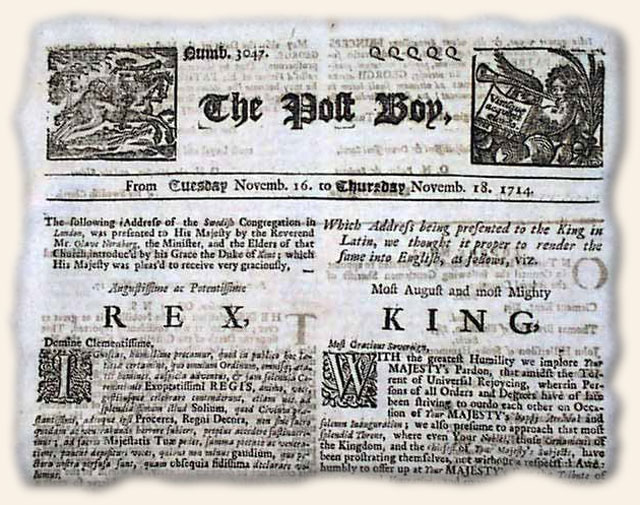 Today I traveled back to London, England by the way of The Post Boy dated November 18, 1714. There I found that in Swansea, Wales, they had celebrated the coronation of King George I very early in the morning. “…at Three in the Morning the Bells began to ring, the musick play’d round the Town, and at the Dawning the Drums followed, each saluting the Inhabitants with Good-morrow, and long live King George: At Eight the Marker was hung round with Scarlet; intermixt with Springs and Flowers of Gold; and at the North-End a large Crown with Garlands and Streamers:…”. Much more information on the parade is in the issue.
I also found an intriguing article about a very young abbot in Paris, being just 9 1/2 years old, preaches. “…he made a very fine Discourse, and was admired by all that heard him. He is a Prodigy of Wit, having now preach’d these 4 years, and even several times before the King…The King gives him a Salary of 200 Livres a Year, and Father le Tellier has promis’d to take Care of him…”.
~The Traveler
If you liked this post, you may also enjoy...