

Search
The Rare & Early Newspapers Hobby

Receive the Newsletter

Buy Historic Newspapers

“New Series” of a newspaper…
September 7, 2009 by TimHughes · Leave a Comment
 A recent inquiry by a concerned customer about the words “fifth series” printed in the dateline of his “Niles’ National Register” prompted me to share my comments with our blog readers should you have similar concerns of such notes atop this and other titles held in your collection.
Through the life of any newspaper which lasted beyond ten years it would not be uncommon for the title to change, either slightly or dramatically. This could happen for a number of reasons, such as the merging with another newspaper, the purchase of the paper by a new publisher, new city of publication, an altering in the size, theme, or format of the newspaper, etc. While some titles made no note of such changes in their volume and issue numbering, some chose to create a “new series” and start anew with the volume & issue numbering.
 “The Weekly Register“, which began in Baltimore, chose the latter. The photos show five of the title or location changes in a 38 year time spread, not to mention size and type font changes as well. Note that its location moved from Baltimore to “Washington City” to Philadelphia.
Fortunately Niles chose to also retain the original volume numbering as well (right side of the dateline) as well as the “whole number”, or the number since the very first issue was published. Other titles did not choose to do so, making it more difficult to determine the newspaper’s age.
The “Carrier’s Address”…
August 27, 2009 by TimHughes · Leave a Comment
Credit for portions of the following must be given to Clarence Brigham & his work “Journals & Journeymen”, as well as to the Bentley Historical Library at the University of Michigan.
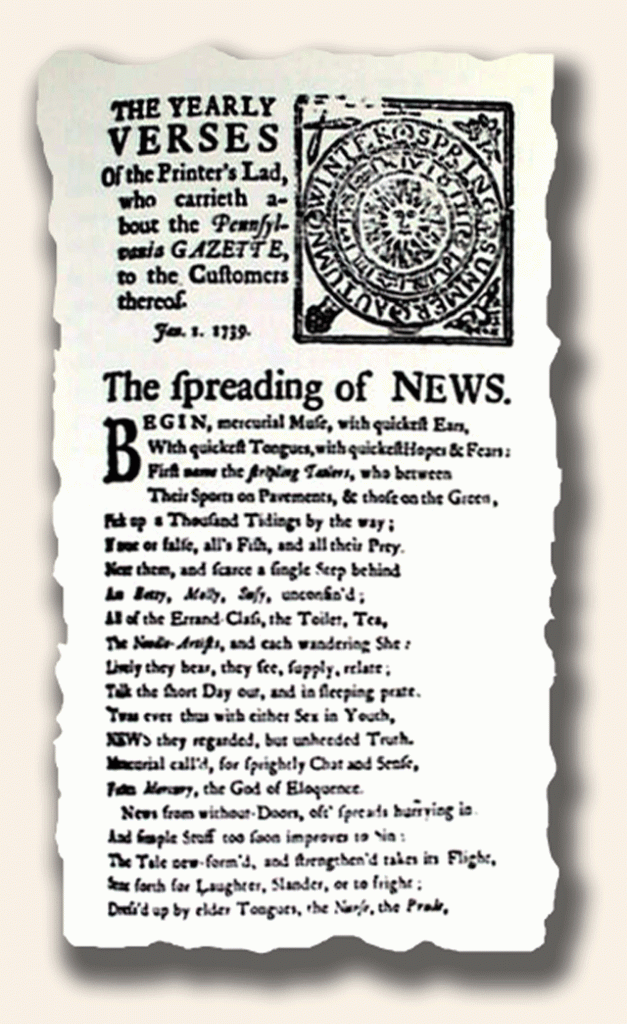 During the nineteenth century, newspaper carriers were often not paid by the publishers of the papers. They typically depended upon donations from patrons at the end of the year. To remind the public that the carriers depended on their donations, newspaper publishers issued poetic broadsides or booklets for New Years Day. These poems often recounted the major news stories of the previous year, but always closed with a plea to pay the carrier.
They were rarely saved since they contained no news reports and as a result are rather rare today. Although many Carriers’ Addresses were contained within the body of the first newspaper issue in the new year, the most sought after are the broadside editions, printed on one side of a sheet of paper typically with ornate lettering, decorative borders, etc. The more decorative the Address the more collectible. The “New York Weekly Museum” address for 1790 had an engraving of a boy delivering a paper at a doorway, one of just a few with such an illustration.
The earliest known examples were done for the “American Weekly Mercury” of Philadelphia in 1720, 1721 and 1723 although none have been found. The earliest located for the American Antiquarian Society is that of January 1, 1735. Benjamin Franklin included them in his “Pennsylvania Gazette” as early as 1739 (see photo).
The amount of the donation expected by the carrier was generally left to the customer. Many of the verses concluded with such a sentiment as “Remember the poor printer’s Devil” or “Be bounteous to the Printer’s boy”. Sometimes the sentiment was more definite, such as “I won’t Refuse a six pence” and “Please keep the cents and–give the silver”.
By the 1870’s the custom began to fall off, likely due to the beginning of more commercial & larger influential newspapers which considered such a custom undignified, also falling away in favor of the distribution of Christmas or New Year’s cards by the end of the 19th century. The latest located for the American Antiquarian Society is dated 1904.
What’s the best newspaper to have?
August 27, 2009 by TimHughes · 2 Comments
Most collectors of historic newspapers would agree that the best newspaper to have for an historic event is the city where it happened. Among the more notable would be the Boston Gazette reporting the Boston Massacre, the Honolulu issue on the bombing of Pearl Harbor, the Dallas newspapers on JFK’s assassination, and a Chicago newspaper covering the St. Valentine’s Day massacre. Stock market or finance related events are best in the Wall Street Journal, and when events happened in small towns which had no newspapers, the closest major city might be the next best thing.
But some events can’t be had—or can very rarely be had—from the city where “it” happened. What are the best issue in those situations? What’s the best issue for man landing on the moon? Or the atomic bomb dropping on Hiroshima & Nagasaki? Or the first manned flight around the earth? Or the discovery of the North Pole? Or Edison’s invention of the phonograph? What would be the best newspaper for the sinking of the Titanic?
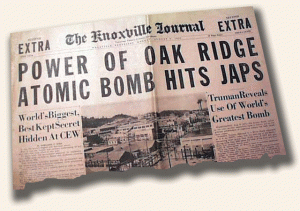 There are many answers; perhaps as many as there are collectors. But I’ll offer a few thoughts. Actually what brought all of this to mind was an issue I recently wrote up for a future catalog. It announced the dropping of the atomic bomb on Hiroshima and was from Knoxville, Tennessee. The headline reads: “Power Of Oak Ridge Atomic Bomb Hits Japs”. Keeping in mind that Oak Ridge, Tenn., the home of the Manhattan Project which developed the bomb, is less than 20 miles from Knoxville, it is not surprising that they localized the headline with mention of the role Oak Ridge played. I suspect no other newspaper in the country mentioned Oak Ridge in their headline on the atomic bomb drop. Outside of finding a Japanese newspaper from the day after, I suspect this Knoxville newspaper could be the best issue on this event.
Any space flight issue might best be from the Cape Canaveral area. Or perhaps the hometown of one of the astronauts involved. We offer a Wapakoneta, Ohio, newspaper on man walking on the moon as it’s Neil Armstrong’s hometown, and their headline is localized by: “NEIL STEPS ON THE MOON” while most newspapers reported “MAN WALKS ON THE MOON”.
The graphic appeal of the front page is a major factor as well and in the eye of many is always the deciding factor in determining the “best” for that event. We price Titanic issues almost entirely on the “wow” effect of the front page, as the larger the headline and more dramatic the look the better, regardless of where the newspaper was printed. This holds true for many 20th century events, such as D-Day, V-E Day, V-J Day and and any other military event. Some might argue that the “Stars And Stripes” would be the best paper for a military event, or perhaps newspaper from Washington D.C., home of the Pentagon.
We’d like to hear what you think on the best issues for historic events which can’t be found from the city involved. I’m sure your thoughts will spark other collectors to refine their holdings with better or more appropriate newspapers for notable events. Let us here from you!
Beware of the pony…
August 22, 2009 by TimHughes · Leave a Comment
 I suspect this little item printed in “The Sag Harbor Express” newspaper from Long Island, New York on February 23, 1871 is fictitious, but it gives a sense of 19th century humor nonetheless.
Number of titles, and where held…
August 17, 2009 by TimHughes · Leave a Comment
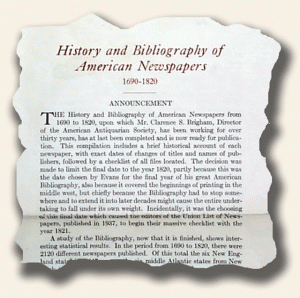 A four page promotional piece announcing the completion of a 30 year project titled: “History and Bibliography of American Newspapers 1690 – 1820”, now commonly referred to simply as “Brigham”, its creator, includes some statistical information which might be of interest.
Brigham notes that from 1690 to 1820, there were 2120 different newspapers published. Of this totals the six New England states had 447; the six middle Atlantic states from New York to Maryland had 1023; the ten Southern states from Virginia to Louisiana had 425; and the seven Western states had 225. The city which from the beginning to 1820 had the most newspaper was New York with 138, followed by Philadelphia with 107, and Boston with 73.
Also, the six largest collections of newspapers before 1820 are:
1)American Antiquarian Society with 1492 titles
2) Library of Congress with 936 titles
3) Harvard with 732 titles
4) New York Historical Society with 634 titles
5) New York Public Library with 480 titles
6) Wisconsin Historical Society with 415 titles
How to be a cowboy: The protocol in 1882…
August 13, 2009 by TimHughes · Leave a Comment
 It’s interesting how the stereotype of the cowboy as created by Western movies and the lore generated by Western writers can hold true to reality. This was my thought when I can across an interesting tidbit from a Yuma, Arizona, newspaper of January 7, 1882—from a truly Western town at the high point of the Wild West era:
“He Wanted to be a Cowboy”
A youth recently went all the way from Chicago to New Mexico to become a cowboy. When there he explained his desire to a typical mountaineer whom he met and asked for instructions in the role he had wished to assume. Grasping him by the hand the mountaineer said: “You want to get a buckskin suit with plenty of fringe, a pair of high boots and a pair of high spurs. Then you want to get a broad-rimmed hat–the broader the better; two fort-fives, a knife, a Winchester rifle and a horse; then you want to get drunk and get on your horse; then take the reins in your teeth, a revolver in each hand, and go down the street at a full run, shooting at every jump. then come back and yell as loud as you can: ‘My name is ______ and I’m stinking for a fight; I’m a sone-of-a-gun from the plains.’ After that you will be a cowboy.” The picture is duly referred to the cowboy’s prototype in Western Missouri.”
More on the time lag in news reporting…
August 10, 2009 by TimHughes · 2 Comments
 Some weeks ago I commented on the time lag between a news event and its appearance in newspapers of the day, focusing on the publication dates of the Declaration of Independence in various newspapers.
Because time lag is a major factor in looking for news reports prior to the use of the telegraph in the mid-19th century, I thought more discussion should be given to the issue. Again I turn to Brigham’s “Journals and Journeymen” for much valuable information.
Obviously the delay in receiving news of world events was beyond the control of newspaper publishers. The news of the death of Queen Anne on August 1, 1714 arrived in America on September 15. George I died June 14, 1727 but his subjects in America did not learn of it until August 13. George II died October 25, 1760 and it was two months later before the news arrived at Boston. Even the significance of the Treaty of Versailles at Paris which ended the Revolutionary War was first heard of at Boston on October 22 and not published in a newspaper until October 30 despite the event happening on September 3.
Ocean travel was dangerous & speed was dependent on the weather. Foreign wars & privateering also made voyages quite hazardous. The first issue of the “Boston News-Letter” of April 24, 1704 carried London reports of December 20, 1703. It was common for ships to load their passengers & their London newspapers and then wait around in the Channel for up to 3 weeks or more before sailing. During the first two years of newspaper publication there were exceptional voyages of five weeks, but the average was about two months.
After the Revolution & before 1820 merchants began building larger vessels which meant improved speed. In 1820 there were frequent sailings of 28 to 30 days, but there was no dependable time schedule.
Noting the diaries of some famous travelers we gain some insight. In 1722 Samuel Johnson traveled from Boston to England in 39 days. Benjamin Franklin in returning from England to Philadelphia in 1726 did so in 67 days. William Beverley sailed from Virginia to Liverpool in 37 days. Abigail Adams, whose story of a voyage is one of the most detailed on record, sailed from America to England in 30 days in 1784.
Postriders took a week to travel from New York to Boston, and at least two days from Philadelphia to New York. When stagecoaches came into use around 1785, the delivery of letters & newspapers was quicker & more consistent.
But by the establishment of the magnetic telegraph in 1844 and the laying of the Atlantic cable in 1858 (but not perfected until 1866) news was transmitteed from country to country instantaneously.
A legal conundrum…
August 1, 2009 by TimHughes · 4 Comments
 “The Olympia Transcript” newspaper of Washington Territory, Nov. 30, 1867, poses an interesting question:
“Suppose a man owns a skiff; he fastens the skiff to the shore with a rope made of straw; along comes a cow; cow gets into the boat; turns around & eats the rope; the skiff thus let loose with the cow on board, starts down stream and on its passage is upset; the cow is drowned. Now, has the man that owns the cow got to pay for the boat or the man that owns the boat got to pay for the cow?”
Any thoughts from our readers?
Rare newspaper prices from 60 years ago…
July 30, 2009 by TimHughes · 2 Comments
 While cleaning out some files at home I came across a little catalog of “American Newspapers 1732 – 1890” offered for sale by Stephen Nagy of Philadelphia. The back page has various items noting the date of the catalog as 1948.
 The photos show some interesting prices. Some may not be shown in the photos but I noticed a Confederate issue of the “Norfolk Bulletin” of 1864 for $1.25; the “Daily Hawaiian Herald” of 1866 for $3; a colonial issue of the “Pennsylvania Chronicle” of Phila., 1768 for $7.50; a ‘Phila. Inquirer” with a first report of Lincoln’s assassination for $3; the very desirable “Inquirer” of April 25, 1865 with the full pg. illustration of Lincoln’s remains in Independence Hall for $4; and a wide selection of “Dunlap’s American Daily Advertiser“, Phila., from 1796 and 1797 for $1 each.
We’ve never promoted the investment potential of rare newspapers but rather encourage the collecting of historic issues for enjoyment & personal pleasure, but this catalog from the past does give evidence of the considerable variance in prices from 61 years ago. Additional images of this early newspapers catalog may be found at: American Newspapers (1732-1890) Catalog – 1948.

Competition isn’t always friendly…
July 25, 2009 by TimHughes · Leave a Comment
 The “Amador Dispatch” newspaper from Jackson, California—small mining town in the northern part of the state—has two related items in its April 8, 1882 issue. The first is a report from the neighboring “Plymouth Reporter” newspaper concerning a pen knife which was found noting the owner could have it by proving ownership & by paying for the newspaper notice. The other is an editorial note from the competing “Dispatch” which includes: “…why in thunder don’t you give it up to her without putting her to the trouble of proving property, and charging her for such a small notice. We hate to see such petty avariciousness on the part of a high toned editor.”
I guess competing newspapers were not always friendly towards one another.